

NSA Classified Network Outage Enters Third Day as FAA Ground Stop Investigation Raises Alarming Questions About America’s Critical Infrastructure
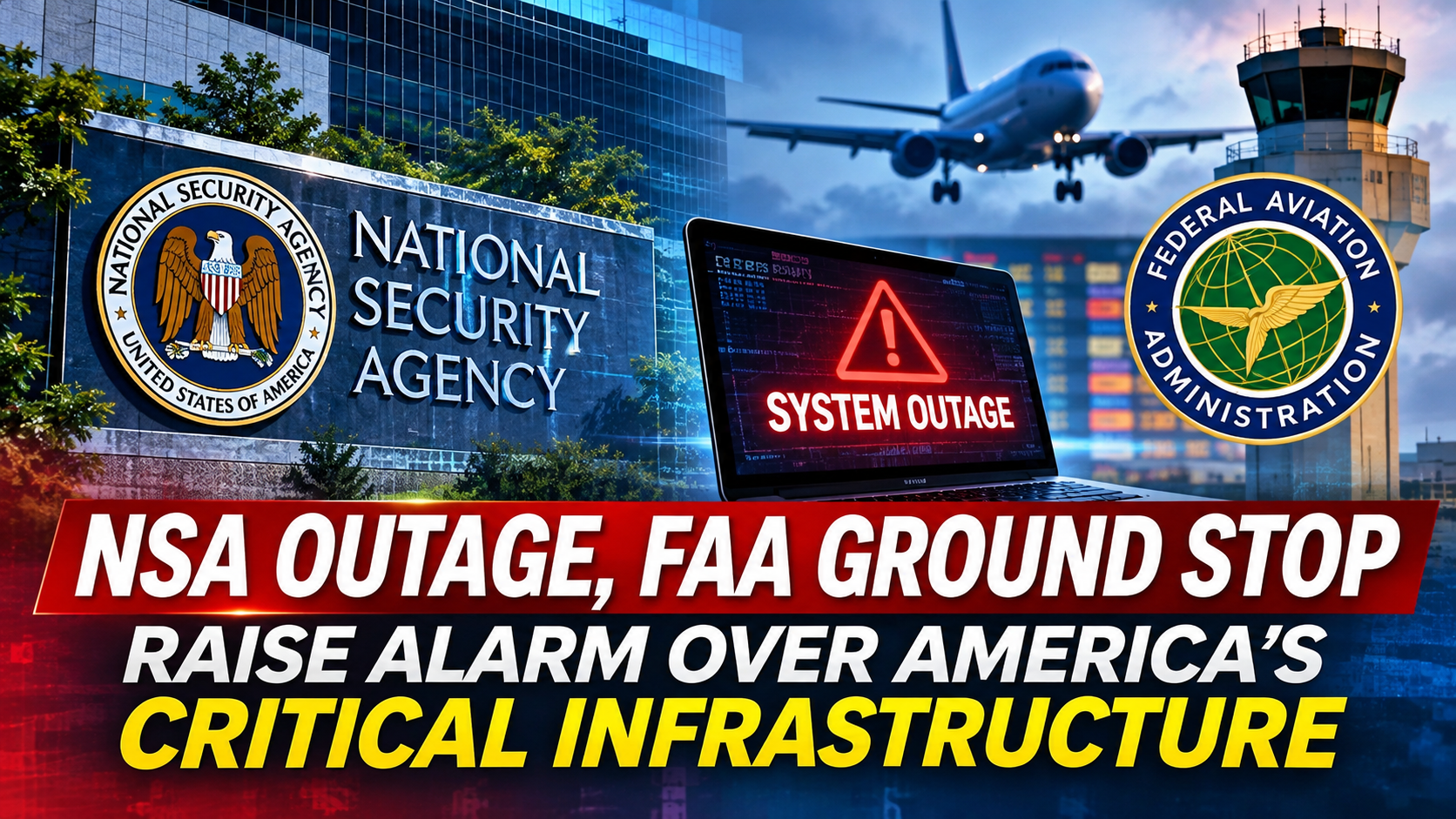
A classified communications failure affecting U.S. intelligence operations in the Middle East, disputed oversight surrounding a nationwide FAA ground stop, and technology disruptions across major American institutions are exposing troubling vulnerabilities in the nation’s digital infrastructure.
The United States is confronting a series of significant technology failures affecting national security operations, commercial aviation, financial services, and some of the country’s largest corporations. At the center of the latest developments is a classified communications disruption at the National Security Agency (NSA) that reportedly interfered with intelligence operations supporting American military personnel in the Middle East, raising concerns about the reliability of systems responsible for some of the nation’s most sensitive security missions.
According to reporting by CNN, the NSA disruption entered its third day after a classified internal network serving an intelligence facility in Georgia experienced technical problems that prevented personnel from communicating through normal secure channels with counterparts deployed overseas. The outage reportedly forced intelligence officials to rely on alternative procedures while technicians worked to restore access, creating delays and operational complications at a facility responsible for signals intelligence collection and cyber operations involving the Middle East.
The incident comes as the Federal Aviation Administration faces growing scrutiny over a nationwide aviation ground stop that disrupted thousands of flights, with conflicting accounts emerging about contractor supervision, equipment upgrades, and whether appropriate safety assessments were conducted before work began at an Arkansas facility. Meanwhile, separate technology problems involving Microsoft, United Airlines, and JPMorgan Chase have intensified concerns about the resilience of America’s increasingly interconnected digital infrastructure.
Although federal officials have maintained that the incidents are not part of a coordinated cyberattack, the concentration of failures across critical government and commercial systems has raised a broader question: Are America’s most important institutions becoming dangerously dependent on technology infrastructure that is increasingly difficult to maintain, supervise, and protect?
Classified NSA Network Failure Disrupts Communications Supporting Middle East Operations
The NSA disruption is particularly concerning because of the sensitive nature of the operations reportedly affected. The agency’s Georgia facility plays an important role in signals intelligence collection and cyber activities involving the Middle East, including intelligence support for American military personnel deployed throughout the region. According to CNN, the outage interrupted a classified communications network used by intelligence officials to coordinate with counterparts overseas, preventing personnel from exchanging information through established secure channels and requiring alternative methods of communication.
Although contingency procedures reportedly allowed some operations to continue, those workarounds consumed additional time and resources. In intelligence operations, where information can be time-sensitive and directly relevant to military planning, threat detection, and the protection of deployed personnel, even temporary communications failures can create operational challenges. By the third day of the incident, CNN reported that personnel at NSA headquarters in Fort Meade, Maryland, and the affected Georgia facility had been told not to report to work or were otherwise largely absent while technical teams attempted to repair the systems.
The NSA has attributed the disruption to routine maintenance and indicated that mission critical capabilities remained operational. However, the agency’s assurances do not fully resolve questions about the extent of the communications problems, how long affected personnel were unable to use their normal classified network, and whether existing backup procedures were sufficient to support time sensitive intelligence operations.
There is currently no publicly established evidence that the outage resulted from a foreign cyberattack or that classified information was compromised. A secure government network can fail because of hardware malfunctions, software defects, configuration errors, or maintenance problems without an adversary gaining access. Nevertheless, a multiday disruption involving communications infrastructure supporting military intelligence operations represents a significant reliability concern, regardless of whether the underlying cause was accidental or malicious.
FAA Ground Stop Investigation Reveals Conflicting Accounts of Contractor Oversight
While the NSA works to restore its classified communications systems, the FAA is confronting a separate controversy involving the circumstances surrounding a nationwide aviation ground stop on November 13, 2026. The disruption lasted approximately four hours and 45 minutes, contributing to widespread uncertainty across the nation’s aviation system during a day when thousands of flights were canceled, although not every cancellation can be attributed directly to the ground stop.
FAA Administrator Bryan Bedford told reporters that investigators were close to identifying the root cause of the incident, with Transportation Secretary Sean Duffy expected to publicly announce the findings. However, CNN’s investigation has raised questions about whether the agency’s description of the work performed before the disruption accurately reflected the level of federal oversight taking place at the affected facility.
The controversy centers on an engineer employed by defense and communications contractor L3Harris who was performing equipment replacement or a router upgrade at an FAA facility in Arkansas. Bedford previously told lawmakers that an FAA technician monitored the contractor’s work and that a risk assessment had been conducted before the equipment changes began. According to CNN, however, two sources familiar with the circumstances and representatives of the technicians’ union disputed important elements of that account, maintaining that the FAA employee’s involvement was largely limited to providing access to the building rather than supervising the technical work.
Those sources also questioned whether the pre-work risk assessment described by Bedford had actually occurred. The distinction is significant because changes to communications equipment supporting air traffic operations can have consequences far beyond the individual facility where maintenance is performed. A configuration error, equipment malfunction, or improperly coordinated network change can potentially affect interconnected systems used by air traffic controllers and airlines throughout the country.
Following CNN’s reporting, the FAA issued an updated statement acknowledging that an escort’s responsibility was to provide building access for L3 equipment rather than directly oversee the contractor’s technical activities. The agency nevertheless maintained that appropriate oversight remained in place and disputed suggestions that established safety procedures had been eliminated.
The conflicting accounts leave investigators with several important questions, including exactly what work was authorized, which technical safeguards were required, whether a documented risk assessment was completed, and how the equipment changes related to the nationwide aviation disruption. Until those questions are answered through the investigation, the precise responsibility of the contractor, supervising personnel, and FAA management remains unresolved.
A 2025 FAA Policy Memo Raises Questions About Speed Versus Safety
Another important element of CNN’s investigation involves a 2025 FAA policy memorandum associated with efforts to accelerate the federal government’s $12.5 billion air traffic control modernization initiative. The modernization effort is intended to replace aging technology, improve operational reliability, and address longstanding infrastructure problems within the nation’s aviation system, but the controversy surrounding the Arkansas facility has raised questions about whether efforts to move projects forward more quickly could undermine established safety procedures.
According to sources cited by CNN, the memorandum allowed certain contractors to notify the FAA before proceeding with equipment work without waiting through approval processes that had previously delayed some technical projects. The reported objective was to reduce administrative obstacles and accelerate modernization, but critics argue that allowing contractors greater flexibility without sufficiently rigorous supervision could introduce unnecessary risks into systems responsible for coordinating American air traffic.
The FAA has disputed the characterization that the memorandum eliminated meaningful oversight, maintaining that the policy addressed work prioritization rather than removing established safety requirements. At this stage, the memorandum’s precise relationship to the ground stop has not been conclusively established, and the existence of a streamlined contractor process does not independently demonstrate that the policy caused the disruption.
Nevertheless, the controversy illustrates a fundamental challenge confronting federal agencies responsible for critical infrastructure. Modernization is necessary, particularly when aging systems create their own reliability and security risks, but moving faster cannot come at the expense of technical testing, documented risk assessments, clear lines of responsibility, and independent verification. In aviation, where interconnected systems support thousands of commercial flights and millions of passengers, even relatively routine maintenance decisions can have nationwide consequences.
Microsoft, United Airlines, and Chase Add to Growing Concerns About Technology Reliability
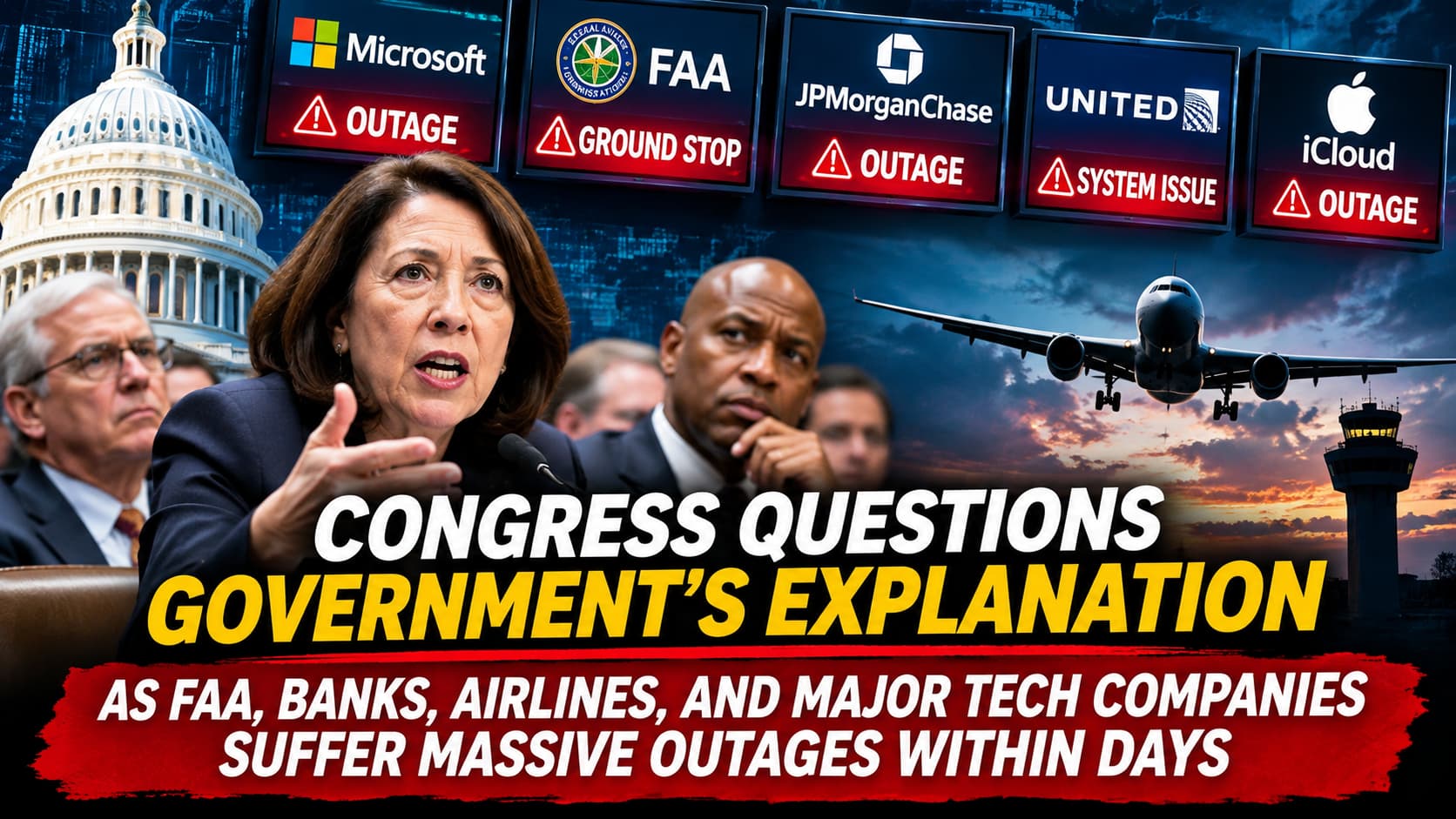
The NSA and FAA incidents are unfolding against a broader backdrop of technology disruptions affecting major American businesses and institutions. CNN highlighted recent problems involving Microsoft cloud and server infrastructure, including interruptions affecting workplace applications such as Outlook and Teams, which have become essential communication platforms for businesses, government agencies, and organizations that depend on continuous access to cloud based services.
United Airlines has also experienced technology problems, including disruptions involving software associated with aircraft weight management. These systems help flight crews and ground personnel calculate aircraft loading and balance, ensuring that planes operate within approved performance and safety limits. When such systems become unavailable, airlines may need to delay departures or use approved alternative procedures, illustrating how specialized software can directly influence the operation of commercial aviation.
JPMorgan Chase was also identified among the major financial institutions experiencing separate technology problems, adding another example of the dependence of modern banking on reliable digital infrastructure. Financial institutions rely on interconnected networks to process transactions, maintain customer accounts, support payment systems, and deliver online banking services, making technology reliability an essential component of everyday economic activity.
Although these incidents involve different organizations, vendors, and technical systems, they demonstrate how heavily modern society depends on software, networking equipment, cloud infrastructure, and specialized technology providers. A malfunction affecting a single critical component can create widespread operational problems when that service is shared across multiple departments, businesses, or government agencies.
Importantly, there is no verified evidence that the disruptions involving the NSA, FAA, Microsoft, United Airlines, and Chase share a common technical cause or were coordinated by a malicious actor. Their proximity in time is newsworthy, particularly given the importance of the institutions involved, but it should not be confused with evidence of an organized cyberattack or a broader conspiracy.
Artificial Intelligence, Cybersecurity Threats, and Government Staffing Cuts Complicate the Picture
Technology executive and artificial intelligence specialist Chris Mattmann told CNN that the recent incidents appear to involve different technical circumstances, ranging from hardware and networking changes to cloud infrastructure and software problems. Nevertheless, he raised concerns about the growing complexity of the digital systems that government agencies and major corporations must defend, particularly as organizations adopt more automation, cloud services, artificial intelligence, and interconnected technology platforms.
Every additional application, network connection, vendor integration, and software dependency can create another potential point of failure or security vulnerability. While modern technology can improve efficiency and provide powerful new capabilities, it can also make troubleshooting more difficult when a problem affects multiple interconnected systems. Organizations that once relied on relatively isolated infrastructure increasingly depend on extensive networks of outside providers, cloud platforms, and specialized contractors whose operations may be difficult to supervise directly.
Artificial intelligence introduces additional cybersecurity challenges because malicious actors can use AI-assisted tools to accelerate phishing campaigns, produce convincing fraudulent communications, and support certain aspects of vulnerability research and cyberattacks. These developments do not suggest that artificial intelligence caused any of the outages discussed in CNN’s reporting, but they illustrate the expanding range of threats facing organizations responsible for critical infrastructure.
Mattmann also expressed concern about staffing reductions affecting federal cybersecurity capabilities, including the Cybersecurity and Infrastructure Security Agency (CISA). The agency plays an important role in coordinating federal cybersecurity efforts, identifying threats, and helping public and private organizations defend essential infrastructure. Reductions in experienced technical personnel or operational resources could weaken the government’s ability to monitor vulnerabilities, coordinate incident responses, and assist organizations confronting increasingly sophisticated attacks.
The larger concern extends beyond whether Washington can purchase newer computers, software, and networking equipment. Critical infrastructure also depends on experienced engineers, cybersecurity specialists, maintenance personnel, and oversight officials who understand how complex systems interact and how to prevent routine technical work from triggering larger failures. Without adequate staffing, training, and accountability, even expensive modernization programs can leave institutions vulnerable to preventable disruptions.
No Evidence of a Coordinated Cyberattack, but Serious Questions Remain
Despite the unusual concentration of technology failures, federal officials have maintained that the United States is not experiencing a coordinated cyberattack involving these incidents. That assessment is important because accidental equipment failures, software malfunctions, and malicious cyber intrusions require different investigative approaches and carry very different implications for national security.
An equipment replacement that inadvertently interrupts communications is not equivalent to a foreign intelligence service penetrating a classified network, just as a cloud-service malfunction does not automatically mean customer information has been stolen or a provider’s systems have been compromised. Establishing the cause of each incident requires technical evidence, including equipment records, system logs, maintenance documentation, and investigative findings, rather than assumptions based on the timing of unrelated events.
However, the absence of a confirmed cyberattack does not eliminate the need for accountability. The NSA must determine why a classified communications system reportedly remained disrupted for multiple days and whether its contingency procedures adequately supported personnel responsible for sensitive intelligence operations. The FAA must establish precisely what caused the nationwide ground stop, reconcile conflicting accounts of contractor oversight, and determine whether existing safety requirements were followed before equipment work began.
Federal officials must also confront broader questions about infrastructure maintenance, contractor accountability, cybersecurity staffing, and the operational risks associated with increasingly complex technology systems. These are not simply administrative concerns; they involve the reliability of institutions responsible for national defense, public transportation, financial stability, and essential communications.
America’s Infrastructure Problem Is Bigger Than Any Single Outage
The most significant warning emerging from these incidents may not be the possibility of a coordinated attack, but the vulnerability created when essential public services depend on systems that can be disrupted by relatively ordinary technical failures. The United States relies on complex digital networks to support military intelligence, coordinate commercial aviation, process financial transactions, and maintain everyday communications, yet those networks often depend on specialized equipment, outside contractors, and highly trained personnel whose work remains largely invisible until something goes wrong.
Modernization can improve security, efficiency, and reliability, but new technology alone cannot replace rigorous testing, independent oversight, experienced technical staff, and effective contingency planning. The FAA controversy demonstrates why those safeguards matter, particularly if investigators ultimately determine that inadequate supervision or an improperly managed equipment change contributed to the nationwide disruption. Similarly, the NSA outage raises legitimate questions about redundancy and operational resilience within systems supporting sensitive national security missions.
The immediate investigations will determine what went wrong in each incident, but the larger policy question is whether Washington is investing enough in the people, procedures, and infrastructure necessary to prevent the next failure. As federal agencies push to modernize aging systems while facing pressure to reduce costs, accelerate projects, and operate with fewer personnel, the consequences of inadequate safeguards could become increasingly serious.
The central warning is not that America is necessarily under attack. It is that some of the nation’s most important systems can become vulnerable even when nobody is attacking them. When those systems support military intelligence, commercial aviation, and the country’s financial infrastructure, preventing avoidable failures should be treated as a national priority rather than an afterthought.

Sources & Further Reading
-
CNN — NSA Network Outage, FAA Oversight Investigation and Nationwide Technology Disruptions (Video)
-
CNN — NSA Outage Disrupts Critical Middle East Intelligence Operations
-
CNN Investigation — Sources Dispute FAA Oversight of L3Harris Contractor
-
CNN — FAA Pauses Router Installations as Investigators Examine Ground Stop
-
Federal Aviation Administration — Official Ground Stop Findings and Flight Cancellation Figures
-
Reuters — FAA Prepares to Announce Root Cause of Nationwide Aviation Shutdown
-
Congressional Research Service — Nationwide Ground Stop and Aviation Modernization Oversight
-
Associated Press — Technology Outages, Artificial Intelligence and Infrastructure Reliability
















Loading comments…