

Florida Prepares to Execute Thomas Overton for Brutal 1991 Murders of Pregnant Teacher and Her Husband in the Florida Keys
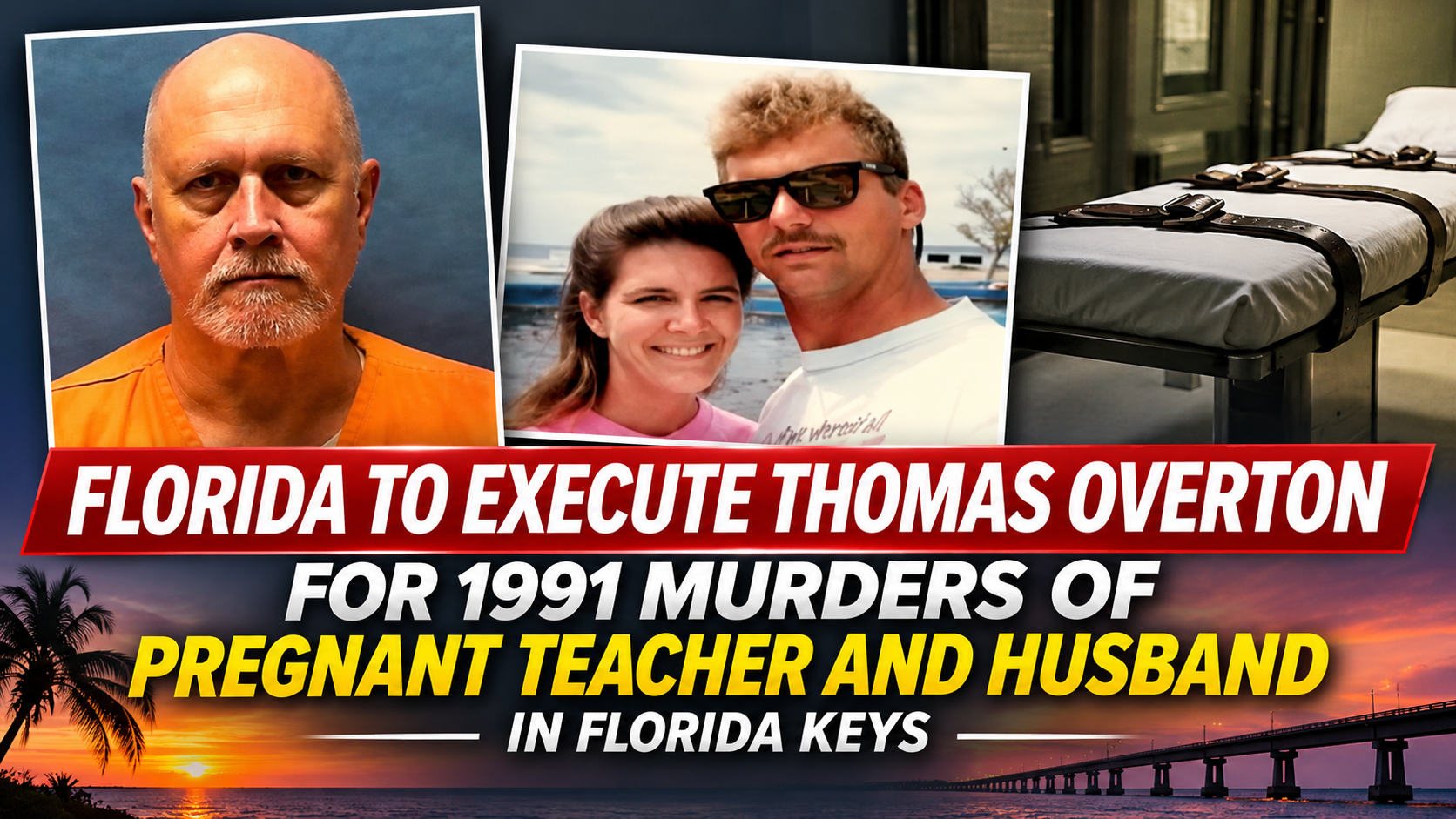
Thirty five years after Michael and Susan “Missy” MacIvor were murdered inside their Tavernier home while expecting their first child, Florida is preparing to carry out a record breaking 20th execution of 2026, bringing renewed attention to a horrific crime, a decades long legal battle, and the state’s aggressive use of capital punishment.
More than 35 years after a young married couple was brutally murdered inside their home in the Florida Keys, the state of Florida is preparing to execute Thomas Mitchell Overton, 71, the man convicted of killing Michael and Susan “Missy” MacIvor in an attack that devastated a close knit community and claimed the life of their unborn child.
Overton is scheduled to receive a three drug lethal injection at 6 p.m. Thursday, November 19, 2026, at Florida State Prison in Raiford. If carried out, his execution will be Florida’s 20th of the year, surpassing the previous state record of 19 executions established in 2025 under Republican Gov. Ron DeSantis. The governor signed Overton’s death warrant in October, setting the final legal proceedings in motion nearly three decades after his conviction.
The case dates back to August 22, 1991, when Michael MacIvor, a 30 year old pilot, and his 29 year old wife, Missy, a schoolteacher who was eight months pregnant, were discovered dead inside their Tavernier residence. Both had been strangled, and investigators determined that Missy had been sexually assaulted. Their unborn son also died, with a medical examiner concluding that the child may have survived for approximately 30 minutes after his mother’s death.
According to court records and reporting by WPLG Local 10 and the Associated Press, the murders remained unsolved for years until DNA evidence collected from the crime scene was linked to Overton following an unrelated burglary arrest in 1996. A jury convicted him of two counts of first-degree murder in 1999, and he received two death sentences. Overton has maintained his innocence, while his attorneys have challenged the reliability and handling of the forensic evidence used to convict him.
The U.S. Supreme Court denied Overton’s final request for a stay of execution and his petition for review on November 19, clearing a major legal obstacle to the scheduled execution. As of this report, the execution had not yet been confirmed as completed.
A Young Couple Building Their Future in the Florida Keys
Michael and Missy MacIvor had established a life together in Tavernier, a quiet Upper Florida Keys community where longtime residents often knew one another personally. Michael worked as a pilot, while Missy taught at Key Largo School, where she was remembered as a dedicated educator and a valued member of the community. The couple lived in a modest home near a private landing strip and were preparing to welcome their first child, a boy they reportedly planned to name Kyle Patrick.
Friends and relatives described the MacIvors as warm, hardworking people who were excited about becoming parents. Their home reflected the future they were building together, including a nursery they had prepared for their son. According to court records discussed in subsequent reporting, the room had been painted light blue in anticipation of the baby’s arrival.
Their lives ended in the early morning hours of August 22, 1991, when an intruder entered their residence and attacked them. Investigators determined that the assailant gained access through an upstairs window, overpowering the couple before binding and killing them. The circumstances of the attack suggested that the victims had been deliberately targeted rather than killed during a chance encounter.
The murders shocked residents of Tavernier and neighboring Key Largo, where the couple’s connections to the local school and aviation community made the tragedy particularly personal. For those who knew them, the crime represented not only the loss of two young adults but also the destruction of a family that was just beginning.
Investigators Uncovered a Brutal Attack Inside the Couple’s Home
According to court records, investigators determined that the attacker entered the MacIvors’ home through a second floor window after using a ladder to reach the upper level. Prosecutors later described a carefully planned intrusion in which the assailant allegedly cut the home’s telephone lines and concealed himself inside the residence before confronting the couple.
The prosecution’s account described Michael being struck and incapacitated before the attacker restrained Missy and sexually assaulted her. Both victims were subsequently strangled, and their bodies were discovered bound inside an upstairs bedroom. Investigators recovered physical and biological evidence that would eventually become central to the criminal case.
The medical findings revealed an especially devastating detail involving the couple’s unborn son. Missy was approximately eight months pregnant, and the medical examiner concluded that the baby may have survived for a short period after his mother’s death. The finding underscored the extraordinary violence of the attack and the loss of three members of the same family.
The crime scene presented Monroe County investigators with a difficult homicide investigation. Detectives needed to determine how the intruder entered the residence, whether the victims had been selected in advance, and whether evidence recovered from the home could identify the killer. Although biological material was collected, investigators initially could not match it to a suspect, leaving the case unresolved for several years.
A Gas Station Encounter Became a Disturbing Clue in the Investigation
One of the most unsettling details to emerge from the investigation involved a gas station where Missy MacIvor regularly purchased fuel. According to WPLG Local 10, she had previously told a relative that a man working at the station made her uncomfortable, describing his behavior as giving her “the creeps.”
Investigators subsequently examined whether the encounter could have provided the killer with information about where the couple lived. Missy had reportedly paid for gasoline using a personal check that displayed her home address, creating a possible connection between an otherwise routine transaction and the attack that followed.
Prosecutors alleged that Overton, who had worked at a gas station near the MacIvors’ home, became fixated on Missy after encountering her there. Court records and subsequent reporting described allegations that he learned where she lived and surveilled the residence before the murders. Those allegations formed part of the prosecution’s account of how the crime developed, although the precise sequence of events was not independently witnessed.
The possibility that an everyday transaction helped an attacker locate the couple added a particularly disturbing dimension to the case. What began as an ordinary stop for gasoline became an important element in investigators’ efforts to reconstruct the events leading to the murders.
DNA Evidence Linked Thomas Overton to the Killings Five Years Later
For approximately five years, the MacIvor murders remained unsolved as investigators pursued leads and attempted to identify the person responsible. The breakthrough came after Overton was arrested in 1996 on an unrelated burglary charge, allowing authorities to compare a DNA sample associated with him against biological evidence recovered from the 1991 crime scene.
Investigators reported that the samples matched, providing the forensic connection that had been missing during the initial investigation. The discovery transformed the case, allowing prosecutors to bring murder charges against Overton and present DNA evidence as a central component of their prosecution.
In 1999, a jury convicted Overton of two counts of first-degree murder for the deaths of Michael and Susan MacIvor, and he received a death sentence for each conviction. The deaths of Missy and her unborn son were central to the case, although the murder convictions involved the two adult victims.
Overton has consistently maintained his innocence, and his defense attorneys have argued that investigators planted or improperly handled the DNA evidence used to secure his conviction. Those allegations have been rejected through the judicial process, but they remained part of his legal challenges as the execution date approached.
The case illustrates both the importance and the controversy surrounding forensic evidence in capital prosecutions. DNA testing can provide powerful evidence connecting a suspect to a crime scene, particularly when an investigation has remained unresolved for years, but the collection, preservation, testing, and interpretation of that evidence remain subject to legal scrutiny.
Florida Supreme Court Rejects Final Challenges as U.S. Supreme Court Denies Stay
Overton’s execution date triggered another round of litigation as his attorneys sought to prevent the state from carrying out the sentence. The Florida Supreme Court rejected his latest challenges in a November 13 decision, allowing the execution process to continue.
His defense raised concerns involving the handling of evidence, the circumstances of his death sentence, and the fairness of Florida’s capital punishment procedures. Attorneys also questioned aspects of the state’s clemency process and the governor’s discretion in determining which death warrants to sign.
On November 19, the U.S. Supreme Court denied Overton’s application for a stay of execution and rejected his petition for a writ of certiorari. The order did not provide a detailed explanation of the justices’ reasoning, but it removed a significant remaining legal barrier to the scheduled execution.
The final proceedings came after decades of appeals and post conviction litigation, reflecting the lengthy judicial process that frequently follows death sentences in the United States. Although Overton’s conviction and sentences remained intact, his case continued to attract attention from death penalty opponents who questioned the fairness of his sentencing and the handling of his legal claims.
Florida’s 20th Execution Would Set a New State Record
Overton’s scheduled execution comes during an extraordinary period in Florida’s administration of capital punishment. Under Gov. Ron DeSantis, the state carried out 19 executions in 2025, establishing a modern annual record following the reinstatement of the death penalty in 1976. The execution scheduled for November 19 would raise the 2026 total to 20, breaking that record with more than a month remaining in the year.
Florida has accounted for more than half of the 37 executions carried out nationwide so far in 2026, according to Associated Press reporting. Two additional executions are scheduled in the state for December, potentially pushing the annual total even higher before DeSantis leaves office in January.
The governor has defended his administration’s aggressive use of capital punishment, arguing that executions provide long-delayed justice for victims’ families whose cases have remained in the legal system for decades. Supporters of the death penalty maintain that the punishment is appropriate for particularly brutal murders and represents the enforcement of sentences imposed by juries and judges.
Opponents argue that the death penalty raises serious questions about fairness, the risk of wrongful convictions, the adequacy of legal representation, and whether executions can be administered consistently across different cases. Critics have also questioned the pace of Florida’s executions and the extent to which defendants receive meaningful opportunities to present mitigating evidence.
The Death Penalty Information Center has highlighted additional concerns surrounding Overton’s case, including his military service, his childhood experiences at Florida’s notorious Dozier School for Boys, and the fact that his death sentence followed a non-unanimous jury recommendation. The organization has argued that those circumstances raise broader questions about how Florida evaluates mitigating evidence and applies capital punishment.
Overton’s case therefore occupies two distinct places in Florida’s criminal justice history: as the prosecution of a man convicted of a horrific double murder and as part of a record-setting execution schedule that has intensified scrutiny of the state’s death penalty system.
The Dozier School, Military Service, and Questions About Mitigating Evidence
Overton’s personal history has become an important component of the debate surrounding his execution. According to the Death Penalty Information Center, he served in the U.S. Army and was previously confined at the Arthur G. Dozier School for Boys, a Florida reform institution that became notorious for allegations and documented findings of severe physical abuse and mistreatment of children.
The institution’s history has received extensive public attention following investigations into the treatment of boys sent there over several decades. Former residents have described beatings and other abuse, while researchers and investigators have examined deaths and burial sites associated with the facility.
Death penalty advocates and legal experts have long debated the importance of presenting evidence involving childhood trauma, mental health, military service, and other mitigating circumstances during capital sentencing proceedings. Such evidence does not excuse violent crimes or negate criminal responsibility, but it can be relevant when jurors and judges determine whether a defendant should receive a death sentence.
The Death Penalty Information Center has argued that Overton’s sentencing jury did not hear significant mitigating information about his background. The organization has also raised concerns about the non-unanimous recommendation that preceded his death sentences and the legal limitations affecting older Florida capital cases.
Those arguments did not overturn Overton’s convictions or prevent the courts from allowing the scheduled execution to proceed. They nevertheless illustrate the broader legal and ethical disputes that continue to surround capital punishment, particularly when death sentences imposed decades earlier are carried out under evolving constitutional standards.
A Florida Keys Community Still Remembers Michael and Missy MacIvor
For the people who knew Michael and Missy MacIvor, the passage of more than three decades has not erased the memory of what happened. WPLG Local 10 interviewed Larry Herald, a friend who had worked on the couple’s home and recalled the shock that spread throughout Tavernier after their bodies were discovered.
Herald remembered the MacIvors as exceptionally kind people whose deaths left a lasting emotional impact on their friends and neighbors. His recollections reflected the personal nature of the tragedy in a small community where residents often shared longstanding relationships and the victims were known for their work, friendships, and involvement in local life.
The property where the murders occurred has changed over the years, and a different house now stands at the location of the couple’s former residence. Although the physical setting has been transformed, reminders of the victims remain within the community, particularly at the school where Missy taught.
A memorial bench at Key Largo School honors Missy and her connection to the students and families she served. The tribute preserves her memory as an educator, wife, expectant mother, and valued member of the Florida Keys community rather than allowing her identity to be defined solely by the violence that ended her life.
For those who knew the couple, the case has never been simply a criminal investigation, a forensic breakthrough, or a death penalty proceeding. It has remained the story of a young family whose future was destroyed before their first child could be born.
Thirty Five Years Later, Florida’s Search for Justice Reaches Its Final Stage
The scheduled execution of Thomas Mitchell Overton brings one of the Florida Keys’ most disturbing murder cases to the brink of its final legal chapter. Michael and Missy MacIvor were newlyweds preparing for parenthood when they were killed inside their Tavernier home, leaving behind grieving relatives, friends, students, and a community that has continued to remember them for more than three decades.
Their murders prompted an investigation that remained unresolved until forensic evidence linked Overton to the crime years later. His 1999 convictions brought legal accountability, but the subsequent decades of appeals demonstrated the complexity of capital punishment cases, particularly when defendants challenge the evidence and procedures used to impose a death sentence.
As Florida prepares to carry out its 20th execution of 2026, the case also underscores the state’s increasingly prominent role in the national debate over capital punishment. Questions about deterrence, fairness, accountability, mitigating circumstances, and the finality of executions remain deeply contested, even in cases involving exceptionally brutal crimes.
For Tavernier and Key Largo, however, the most enduring legacy of the case is not the execution chamber or the lengthy court proceedings that followed. It is the memory of Michael and Missy MacIvor, their unborn son, and a family whose future ended in a violent attack that forever changed the lives of those who knew them.
Thirty-five years later, Florida may be approaching the final chapter of Thomas Overton’s case, but for the people who loved Michael and Missy MacIvor, the loss remains permanent.

Sources & Further Reading
-
WPLG Local 10 — Thomas Overton Execution and the 1991 Tavernier Murders
-
Associated Press — Florida Set to Carry Out Record-Breaking 20th Execution
-
CBS Miami / Associated Press — Overton’s Execution and DNA Evidence in the MacIvor Murders
-
U.S. Supreme Court — November 19, 2026 Order Denying Overton’s Stay and Petition
-
Death Penalty Information Center — Overton’s Background and Florida’s Execution Record
-
The Independent — The 1991 MacIvor Murders and Overton’s Final Legal Challenges












Loading comments…