

Congress Questions Government’s Explanation for Nationwide Tech Outages as FAA, Banks, Airlines, and Cloud Systems Fail Within Days
A wave of major technology failures involving federal aviation systems, Microsoft, JPMorgan Chase, United Airlines, and Apple has raised questions about America’s digital infrastructure. Congressional lawmakers are demanding answers about the FAA shutdown, challenging whether federal officials have adequately explained the failures threatening the nation’s most critical systems.
America’s digital infrastructure has become so essential to everyday life that when major systems fail, the consequences can spread across the country in minutes. Airlines can be grounded, banking customers can lose access to financial services, businesses can become disconnected from cloud platforms, and critical government operations can grind to a halt. Now, a reported cluster of major technology disruptions involving Microsoft, the Federal Aviation Administration, JPMorgan Chase, United Airlines, and Apple’s iCloud services is drawing attention to a troubling possibility: The systems supporting modern American life may be far more interconnected, fragile, and vulnerable than the public realizes.
The central question is not necessarily whether a foreign government launched a coordinated cyberattack or whether a malicious actor deliberately shut down multiple systems. It is whether federal agencies and major corporations have adequately explained the failures, disclosed their shared technological dependencies, and demonstrated that similar disruptions will not happen again. A series of failures occurring close together does not establish a conspiracy, but neither does the absence of publicly disclosed evidence of an attack prove that every underlying cause has been identified.
Congressional oversight is particularly important when failures involve critical infrastructure, national transportation networks, and financial institutions. The more troubling possibility is that America’s technology systems have become so tightly connected that a relatively ordinary software error, configuration change, or equipment malfunction can produce extraordinary consequences.
Congress Demands Answers After FAA’s Explanation Raises More Questions
The strongest evidence that lawmakers are dissatisfied with the government’s initial explanation emerged on November 17, when Democratic members of the Senate Commerce, Science and Transportation Committee issued a letter demanding a detailed accounting of the November 13 nationwide FAA ground stop. Led by Sen. Maria Cantwell of Washington, the lawmakers questioned the Department of Transportation and FAA over their explanation that the disruption involved a router malfunction in Arkansas during a telecommunications modernization project involving contractor L3Harris.
Their central objection was that identifying malfunctioning equipment is not the same as determining the underlying cause of a failure. The senators warned that discrepancies between explanations provided by the contractor and federal transportation officials suggested investigators had not yet established exactly why the system broke down. Their concerns went beyond the immediate disruption, raising questions about the testing, implementation, and oversight of equipment being installed across the national air traffic control network.
The letter also revealed the enormous scale of the modernization project. According to information provided to congressional offices by L3Harris, the transition from older copper-based infrastructure to fiber optic technology involves replacing or converting 3,648 routers to Juniper devices. At the time of the letter, senators understood that approximately 400 devices had been installed, with just 69 operational. That leaves thousands of additional equipment changes ahead, potentially exposing the aviation network to further problems if the underlying vulnerability is not understood and corrected.
The senators requested a joint technical briefing involving the FAA, L3Harris, and Juniper, along with assessments of network redundancy, shared infrastructure dependencies, backup communications pathways, and recovery procedures. They established a November 23 deadline for the requested information, making clear that Congress expects more than general assurances that the problem has been resolved.
The Government Says It Was a Router. The Manufacturer Says the Device Worked as Configured.
The dispute becomes more significant when examining what investigators have established about the FAA disruption. The November 13 ground stop reportedly lasted approximately four and a half hours, disrupting flights nationwide and triggering delays and cancellations that continued after the immediate telecommunications problem was addressed. Transportation officials linked the incident to a newly installed router involved in the transition to fiber-optic infrastructure, while subsequent reporting indicated that communications and radar systems at multiple air traffic control centers became overloaded.
The FAA paused additional Juniper router installations and reverted to older Cisco equipment as investigators continued examining the incident. Although officials reportedly reproduced the failure, the root cause remained unresolved, and the router manufacturer’s position was that the equipment had operated as configured. That distinction is important because a device can function according to its configuration while still triggering a catastrophic failure through an integration problem, unexpected network traffic, inadequate testing, or insufficient redundancy elsewhere in the system.
For Congress, the question is no longer simply which router was involved. Lawmakers want to know why a localized telecommunications problem could produce a nationwide aviation emergency, whether backup systems were capable of handling the disruption, and why safeguards intended to prevent a cascading failure did not contain the damage. Until those questions are answered, identifying a piece of equipment does not amount to a complete explanation of what happened.
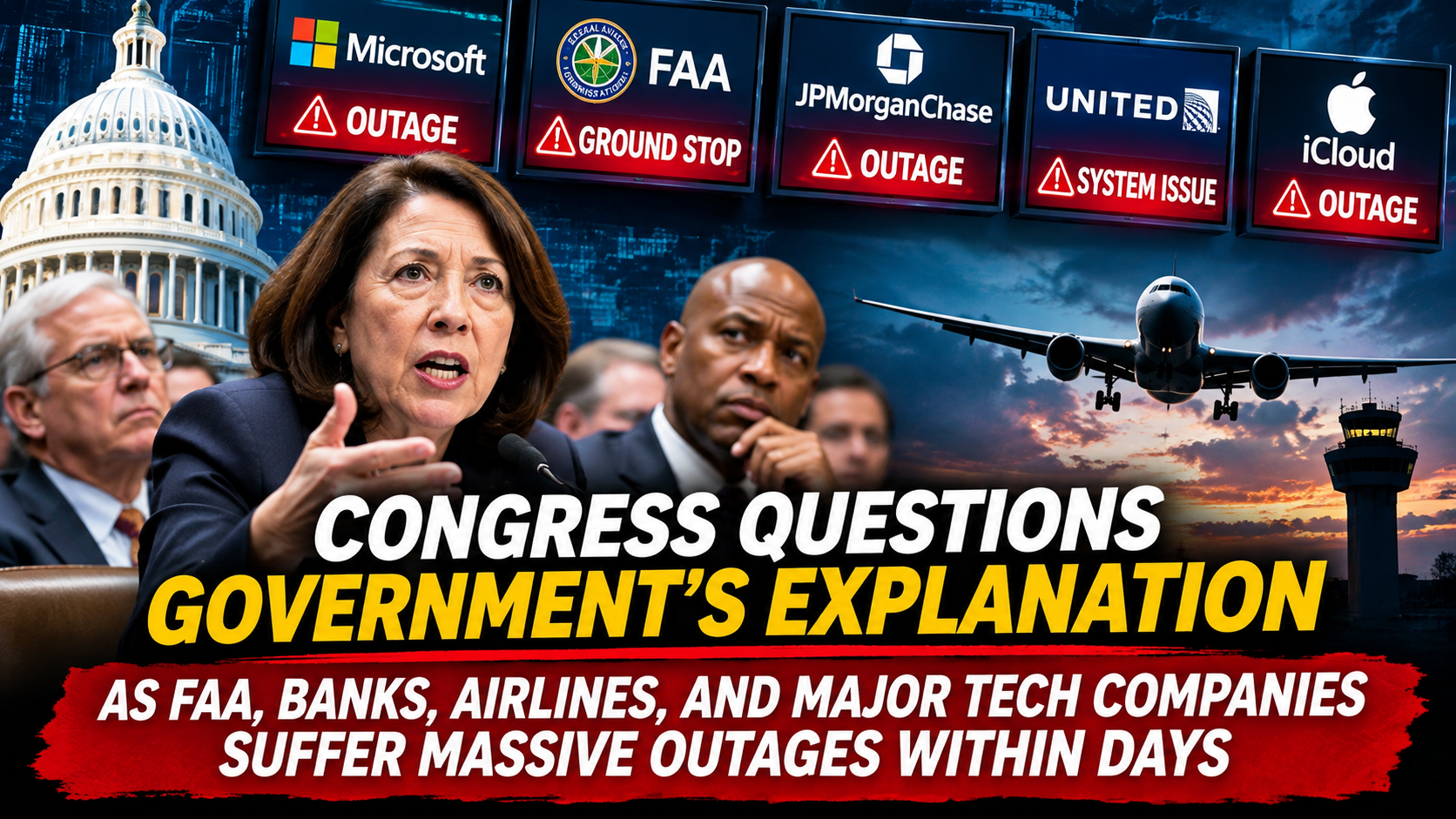
Microsoft, Chase, United Airlines, and Apple: A Week of Technology Failures
The FAA disruption did not occur in isolation. Beginning November 12, a series of reported high-profile technology failures affected major corporations and services Americans depend on daily. Microsoft experienced a widespread disruption involving workplace services, including Outlook and Teams, while the FAA shutdown followed on November 13. On November 16, JPMorgan Chase reported a software problem involving its on-premises hardware systems, delaying some transactions and affecting customers interacting with other financial institutions. United Airlines experienced a separate technology failure the same day, delaying departures while flights already airborne continued operating.
Apple services, including portions of its iCloud ecosystem, also reportedly experienced disruptions on November 17, adding to the perception that critical digital systems were failing in unusually rapid succession. Although the incidents involved different organizations and technical environments, their proximity raised questions about the resilience of the infrastructure connecting government agencies, financial institutions, airlines, and major technology providers.
Each organization described its own operational problems, and the available evidence has not established that the incidents shared a common technical cause or resulted from coordinated malicious activity. Nevertheless, the disruptions demonstrated how quickly failures in different parts of the digital economy can affect transportation, financial transactions, workplace communications, and other services that millions of Americans take for granted.
Even the Administration Would Not Initially Rule Out a Cyberattack
The administration’s early response illustrates why public confidence has been difficult to restore. During a November 13 White House press briefing, Homeland Security Secretary Markwayne Mullin was asked whether the Microsoft outage and FAA shutdown were connected. He said he saw no reason to connect the two incidents, but when pressed on whether officials could definitively rule out a cyberattack, he declined to do so while investigators were still examining the situation.
That position was not proof of a cyberattack. It was an acknowledgment that investigators had not yet completed their work. Subsequent statements from officials and affected companies emphasized the lack of evidence of malicious activity, but that is a narrower conclusion than claiming every root cause has been definitively established.
A responsible investigation must distinguish between identifying a likely equipment or software failure, determining why safeguards failed, and excluding the possibility of malicious interference. Those are separate questions requiring different forms of technical evidence. Until investigators have completed their analysis, the public should be cautious about accepting either claims of a coordinated attack or categorical assurances that every aspect of the disruptions has been explained.
Are the Odds of So Many Failures in Five Days Really Astronomical?
One of the most provocative questions surrounding the outages is whether so many major technology failures could realistically occur within such a short period by coincidence. At first glance, the timing appears extraordinary. Microsoft, federal aviation infrastructure, banking systems, and major airline operations all experienced reported disruptions within days of one another. If each system were completely independent and catastrophic failures occurred randomly at extremely low rates, the probability of several disruptions falling within a predetermined five day period could indeed be small.
However, claims that the odds were one in billions, or effectively zero, cannot be supported without reliable failure-rate data, a clearly defined list of systems, and an appropriate statistical model. For example, a hypothetical system experiencing one major outage every ten years would have approximately a 0.137% chance of such an event occurring during a particular five-day period, assuming a constant random failure rate. Five independent systems with identical failure rates would have an extremely small probability of all failing during that same predetermined window, but that calculation does not describe what actually happened.
The systems involved have different architectures, maintenance schedules, failure histories, and operational dependencies. The five day period was also identified after the incidents occurred, making the statistical problem fundamentally different from predicting the failures in advance. Another common mistake involves confusing service availability targets with the frequency of major outages. A 99.999% uptime objective allows approximately 5.26 minutes of downtime annually, but it does not establish that a multihour outage is a once in a decade event.
The appropriate conclusion is that the timing warrants investigation, not that mathematics has demonstrated coordination. Without a reliable statistical baseline, the probability of this particular cluster cannot be responsibly quantified, and any precise numerical claim would risk misleading the public.
America’s Technology Infrastructure Is More Connected Than Most People Realize
The larger concern is that modern technology systems are not necessarily independent, even when they belong to different organizations. Banks, airlines, cloud providers, telecommunications companies, and government agencies frequently depend on overlapping hardware manufacturers, software vendors, network protocols, identity services, and third party infrastructure. These relationships can create common points of failure that are not immediately obvious to the public, particularly when organizations rely on complex networks of subcontractors and external service providers.
A faulty software update, unexpected network behavior, or configuration problem can affect multiple services when those services share a dependency. Automated retry mechanisms can make matters worse, as applications repeatedly attempt to reconnect to unavailable systems, creating additional traffic and potentially overwhelming infrastructure already struggling to recover. In particularly severe cases, an otherwise manageable problem can spread across dependent systems faster than engineers can isolate the original malfunction.
Scheduled maintenance also introduces patterns into the timing of failures. Software deployments, security patches, infrastructure migrations, and certificate changes often follow recurring operational schedules rather than occurring randomly. This means technology failures can cluster even without a coordinated attack, particularly when organizations operate similar infrastructure or implement changes during overlapping maintenance windows.
These mechanisms provide plausible explanations for why technology failures sometimes occur close together, but they should not be confused with evidence that the November incidents shared a particular software component or vendor defect. Establishing such a connection would require technical records, incident reports, and forensic analysis that have not been publicly presented. The distinction matters because interconnected infrastructure creates genuine systemic risks without requiring an organized conspiracy to explain them.
Trump Downplays the Outages While His Administration Seeks $50 Billion
The political controversy has intensified because the FAA disruption occurred while the Trump administration was seeking billions of dollars to modernize America’s aging air traffic control infrastructure. Transportation Secretary Sean Duffy has requested approximately $50 billion for aviation infrastructure improvements, arguing that existing systems require major investment. The request has attracted scrutiny from lawmakers concerned about the administration’s spending priorities, the management of existing modernization projects, and the adequacy of contractor oversight.
According to Reuters, President Donald Trump downplayed the series of outages, telling reporters that such failures happen. When questioned about responsibility for the nationwide FAA ground stop, he said he did not accept responsibility. Congressional Democrats have taken a more confrontational approach, questioning why the administration increased its modernization funding request while significant questions remained about the router transition and the government’s ability to prevent additional failures.
The funding debate is not simply about whether the FAA needs newer equipment. Modernization is widely recognized as necessary, particularly as aging communications technology struggles to support increasingly complex aviation operations. The question is whether federal officials can demonstrate that billions of dollars in additional spending will address the vulnerabilities responsible for the latest disruption rather than introduce new ones through poorly tested equipment, inadequate redundancy, or insufficient contractor oversight.
What Congress Still Needs to Investigate
The Senate Commerce Committee’s demands point toward a broader issue that extends beyond aviation. If a single equipment change can disrupt a nationwide transportation network, the public deserves to understand whether similar weaknesses exist in other essential systems. Investigators should establish whether the affected organizations shared critical software or infrastructure dependencies, whether maintenance changes were adequately tested before deployment, and whether backup systems were capable of operating independently when primary services failed.
The FAA investigation also needs to determine why a localized failure was able to propagate across multiple air traffic control centers. In banking and commercial aviation, the corresponding questions involve transaction-processing resilience, operational redundancy, and the ability to maintain essential services during software disruptions. These inquiries do not require assuming that a coordinated attack occurred. They require recognizing that complex technological failures can have national consequences even without a malicious actor.
For lawmakers, the most important test will be whether agencies and corporations provide detailed technical findings rather than general assurances that the incidents were unrelated or not cybersecurity events. A credible investigation should produce a documented sequence of events, identify contributing factors, explain why existing safeguards failed, and establish measurable corrective actions. Anything less leaves the public dependent on the same institutions whose systems failed to determine whether those failures have been adequately addressed.
The Real National Security Threat May Be a Digital Infrastructure Too Fragile to Trust
The United States has spent decades expanding its dependence on digital infrastructure, connecting everything from commercial aviation and financial transactions to emergency communications and government operations. That interconnectedness has delivered enormous economic benefits, but it has also created a dangerous concentration of operational risk. When critical systems fail, the consequences are no longer limited to a single company or service. They can affect transportation, commerce, public safety, and confidence in institutions responsible for keeping the country functioning.
The recent disruptions do not establish that America was targeted by a coordinated cyberattack, nor do they prove that the federal government is concealing a common cause. What they demonstrate is that significant technology failures can occur across multiple essential sectors in rapid succession, while investigators and policymakers struggle to provide complete explanations. Congressional skepticism about the FAA’s initial findings is therefore justified as an oversight concern, even though it does not establish that the government’s account is false.
The public should not have to choose between accepting incomplete explanations and embracing unsupported conspiracy theories. There is a third option: demand the technical evidence, investigate shared vulnerabilities, identify failures in oversight, and require meaningful corrective action. Congress has the authority to press federal agencies and contractors for those answers, and the November FAA shutdown provides a compelling reason to exercise that authority.
Because whether America’s technology systems were disrupted by unrelated errors, common infrastructure weaknesses, or some combination of the two, the central national security question remains the same: If this much of the country can be disrupted by ordinary technological failures, what happens when someone deliberately tries to bring those systems down?

Sources & Further Reading
- U.S. Senate Commerce, Science and Transportation Committee — Democrats Demand Answers on the November 13 FAA Ground Stop (November 17, 2026)
https://www.commerce.senate.gov/press/dem/release/commerce-committee-democrats-demand-clear-fact-based-answers-from-dot-faa-on-root-cause-of-nov-13th-nationwide-ground-stop/ - Associated Press — Congressional Questions Surround Aviation Modernization and Infrastructure Spending
https://apnews.com/article/a638c9651f1fabe8f95d20353779ee5b - Reuters — Trump Shrugs Off Series of U.S. Technology Outages
https://www.investing.com/news/world-news/trump-shrugs-off-spate-of-usoutages-says-things-like-that-happen-5032857 - Roll Call — White House Press Briefing Transcript, November 13, 2026
https://rollcall.com/factbase/trump/transcript/donald-trump-press-briefing-markwayne-mullin-the-white-house-november-13-2026/ - Los Angeles Times — Democrats Demand Answers on FAA Outage and Aging Air Traffic Control Infrastructure
https://www.latimes.com/politics/story/2026-11-13/democrats-demand-answers-on-faa-outage-question-aging-air-traffic-control - Audacy — Technical Glitches Disrupt Microsoft, FAA, Banks, and United Airlines
https://www.audacy.com/krld/news/local/technical-glitches-disrupt-microsoft-faa-banks-and-united-in-one-week - ConsumerAffairs — Bank and United Airlines Outages Extend String of Infrastructure Disruptions
https://www.consumeraffairs.com/news/bank-and-united-airlines-outages-extend-a-string-of-infrastructure-disruptions-111726.html - SFL Media — South Florida News, Politics, Technology, and National Coverage
https://sfl.media/











Loading comments…