
Elon Musk Wants Starlink to Become America’s Fourth Major Phone Carrier, but Its Biggest Advantage Isn’t Speed. It’s Global Coverage.
SpaceX’s $8 billion wireless spectrum agreement has rattled Verizon, AT&T, and T-Mobile as Elon Musk moves toward a new kind of mobile network combining satellites and ground-based infrastructure. But while Starlink could eventually transform connectivity around the world, conventional cellular networks remain faster, more responsive, and better equipped to serve millions of customers in densely populated areas.
Elon Musk is moving SpaceX into direct competition with America’s largest telecommunications companies, pursuing an ambitious expansion of Starlink that could eventually challenge Verizon, AT&T, and T-Mobile with a mobile network capable of reaching far beyond conventional cellular coverage. The company’s latest agreement to acquire approximately $8 billion in wireless spectrum has intensified speculation that Starlink could become the nation’s fourth major mobile carrier, raising questions about whether satellite technology can fundamentally change the economics of an industry built around cell towers, fiber optic networks, and billions of dollars in terrestrial infrastructure.
The announcement sent shock waves through the telecommunications sector, with shares of major wireless carriers falling sharply as investors considered the possibility of a new competitor backed by SpaceX’s enormous satellite constellation, launch capabilities, and growing portfolio of licensed radio frequencies. The market reaction reflects a potentially significant shift in the competitive landscape, but it also risks obscuring the technological realities of satellite communications. Starlink’s direct-to-phone service is not currently superior to established 5G networks in everyday performance, and the company still faces substantial challenges before it can operate as a comprehensive nationwide wireless carrier.
The more important development is that SpaceX may eventually offer something traditional carriers have struggled to deliver economically: connectivity across vast geographic areas where cellular towers are impractical, prohibitively expensive, or simply nonexistent. If the company succeeds in combining its satellite infrastructure with terrestrial wireless networks, Starlink could introduce a new model of mobile service that prioritizes geographic reach while relying on ground based infrastructure for the speed and capacity consumers expect in cities.
SpaceX’s $8 Billion Spectrum Agreement Signals a Major Shift Into Mobile Communications
On October 8, 2026, investment firm Grain Management announced an agreement to sell its nationwide portfolio of 800 MHz wireless spectrum to SpaceX. Reuters subsequently reported that the transaction, valued at approximately $8 billion, involves up to 14 MHz of paired low-band spectrum and remains subject to Federal Communications Commission approval. The frequencies are particularly valuable because lower frequency radio signals can travel relatively long distances and generally penetrate buildings more effectively than higher-frequency transmissions, making them an important foundation for wide-area mobile coverage.
The transaction is significant because it represents an expansion beyond Starlink’s existing satellite broadband business and direct to device partnerships. Unlike satellite spectrum intended primarily for communication with orbiting spacecraft, the 800 MHz licenses could support a terrestrial mobile network that complements Starlink’s satellites. SpaceX has indicated that combining ground based and orbital connectivity is central to its broader mobile strategy, potentially allowing the company to deliver service through whichever infrastructure is best suited to a customer’s location.
The latest agreement follows SpaceX’s earlier spectrum transactions with EchoStar, including a September 2025 agreement initially valued at $17 billion and subsequently expanded to approximately $20 billion. EchoStar’s regulatory filings describe the acquisition of AWS-4, H-Block, and additional AWS-3 spectrum intended to support SpaceX’s next generation direct to cell satellite system. Together, these investments demonstrate that SpaceX is pursuing a much larger telecommunications strategy than simply providing occasional satellite messages to smartphones.
However, the spectrum acquisitions do not mean SpaceX already possesses a fully functioning nationwide mobile network. The company must still secure applicable regulatory approvals, develop or obtain terrestrial infrastructure, expand satellite capacity, and establish the operational systems necessary to support millions of wireless customers. Those requirements include emergency communications, network interconnection, customer support, device compatibility, and reliable service in locations where satellite signals are obstructed.
Why Verizon, AT&T, and T-Mobile Are Taking the Threat Seriously
America’s three largest wireless carriers have spent decades constructing networks designed to handle enormous volumes of voice and data traffic. Their infrastructure includes cellular towers, fiber optic connections, licensed spectrum, switching facilities, and dense networks of antennas positioned to serve residential neighborhoods, commercial districts, highways, and major metropolitan areas. Replicating those systems would ordinarily require tens of billions of dollars and years of construction, presenting an extraordinary barrier to any new competitor.
SpaceX is approaching that challenge with assets few companies possess. Its Starlink constellation already provides satellite broadband services across numerous countries, while its Falcon launch operations allow it to deploy additional spacecraft at a scale unavailable to most telecommunications businesses. The company’s vertically integrated manufacturing and launch capabilities could also reduce some of the costs associated with expanding its orbital infrastructure.
Nevertheless, operating satellites and operating a conventional mobile carrier are different businesses. Satellites can extend service across enormous geographic regions, but densely populated areas require substantial network capacity, reliable indoor reception, and the ability to support thousands of devices simultaneously within relatively small areas. Traditional carriers have spent decades optimizing their networks for those conditions, and their existing infrastructure remains a formidable competitive advantage.
Wall Street’s response illustrates how seriously investors are considering the long term threat. Following the latest spectrum announcement, shares of AT&T, Verizon, and T-Mobile experienced substantial declines as analysts reassessed the possibility of future competition. The selloff, however, was a reaction to SpaceX’s ambitions rather than evidence that Starlink had already displaced established carriers or demonstrated comparable nationwide mobile performance.
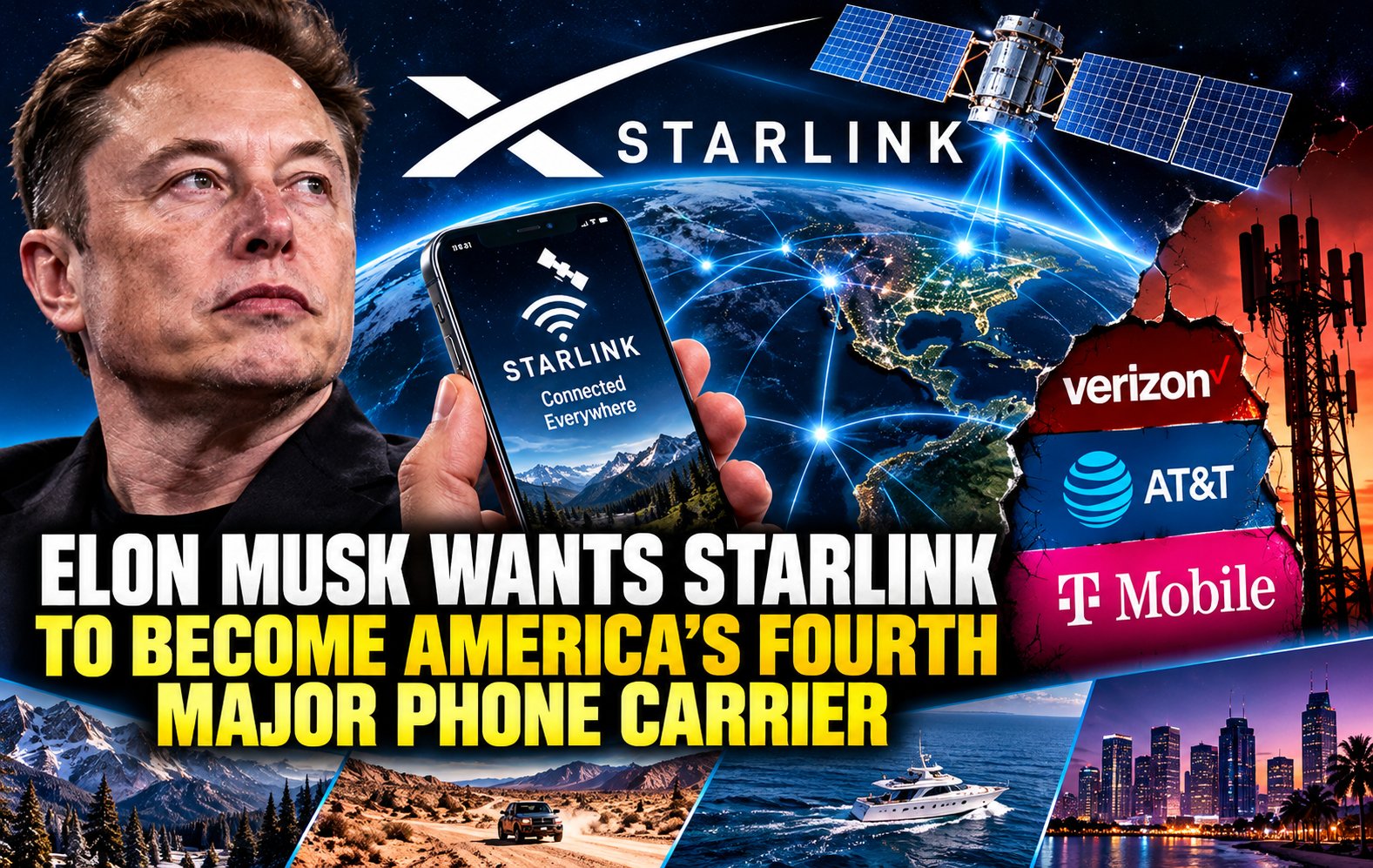
Starlink’s Biggest Advantage Could Be Coverage Almost Anywhere on Earth
The central attraction of Starlink’s mobile ambitions is the possibility of dramatically reducing the geographic limitations that have defined cellular communications for decades. Conventional wireless networks depend on towers positioned within radio range of customers, which makes service relatively practical in populated communities but increasingly difficult in isolated regions where the cost of construction cannot be justified by the number of potential subscribers.
Mountains, deserts, forests, remote highways, offshore waters, and sparsely populated regions remain challenging environments for terrestrial telecommunications companies. Even in technologically advanced countries, substantial geographic areas lack reliable mobile coverage because installing towers requires electrical power, backhaul connectivity, physical access, maintenance, and a viable commercial return.
Satellite networks approach the problem differently. Rather than relying exclusively on nearby towers, compatible devices communicate with spacecraft moving overhead, allowing a sufficiently developed constellation to serve locations where conventional infrastructure is absent. For international travelers, maritime operators, emergency responders, rural residents, and people working in remote environments, the ability to maintain basic connectivity without depending on a local tower could be transformative.
That possibility also has enormous implications for international travel. A future satellite enabled mobile service could reduce the need to rely entirely on local carriers and roaming arrangements when traveling between countries, particularly in remote regions where coverage is inconsistent. Someone moving between the United States, Colombia, Panama, and other international destinations could potentially benefit from a communications system designed around broad geographic reach rather than the boundaries of individual terrestrial networks.
However, global coverage remains an objective rather than a guarantee of service everywhere. SpaceX must obtain regulatory authorization in the countries where it intends to operate, and governments retain authority over telecommunications services and spectrum usage within their jurisdictions. Physical obstructions, device compatibility, network capacity, and satellite availability also affect performance. A network may have satellites passing overhead without being authorized or technically able to provide uninterrupted service to every smartphone below.
Starlink Is Not Faster Than Conventional 5G, and That Distinction Matters
Despite the excitement surrounding SpaceX’s expansion, conventional terrestrial cellular networks generally remain superior for high speed mobile internet in populated areas. Modern 5G systems are engineered to provide substantial data capacity, low latency, and consistent connectivity to large numbers of users through networks of nearby antennas connected to high capacity terrestrial infrastructure.
Starlink’s direct to phone technology operates under considerably different physical constraints. A conventional smartphone has a relatively small antenna and limited transmission power, yet must communicate with a spacecraft hundreds of kilometers above Earth. The available radio spectrum must also be shared among users across potentially large geographic areas, creating capacity limitations that are especially important for applications requiring substantial bandwidth.
The distinction between Starlink’s conventional broadband service and its direct to phone offering is essential. Starlink broadband terminals use dedicated antennas and equipment designed specifically for satellite internet, allowing considerably greater performance than can currently be expected from an ordinary smartphone communicating directly with a satellite. Broadband performance figures therefore should not be used to suggest that Starlink’s mobile service already rivals terrestrial 5G.
For consumers in major cities, established wireless carriers remain better positioned to support high-definition video streaming, large downloads, demanding applications, and simultaneous connections from thousands of nearby devices. Satellite to phone technology is currently more useful as a way to extend basic connectivity into locations where conventional service is unavailable than as a substitute for the full capabilities of a modern cellular network.
The Latency Problem Gives Traditional Cell Towers Another Advantage
Latency, the delay involved in transmitting information between a device and its destination, is another important difference between satellite and terrestrial communications. Lower latency improves the responsiveness of video calls, online gaming, remote computing, and other applications that depend on rapid exchanges of information.
Conventional cellular networks generally benefit from relatively short radio distances between smartphones and nearby towers, followed by high-capacity terrestrial connections. Starlink’s low Earth orbit satellites operate much closer to the planet than traditional geostationary communications satellites, substantially reducing the delays historically associated with satellite internet. Nevertheless, direct to phone connections must still account for the distance to orbiting spacecraft, satellite movement, network routing, available capacity, and other operational factors.
Not every satellite connection will necessarily have higher latency than every terrestrial connection, since congestion and network design can affect both technologies. But established cellular systems retain meaningful advantages in delivering consistently responsive service under favorable coverage conditions, particularly in densely populated areas where extensive infrastructure already exists.
For someone using a smartphone in downtown Miami, Fort Lauderdale, New York, or Los Angeles, a reliable 5G connection will generally provide a better experience for demanding internet applications. For someone stranded on a remote highway without cellular reception, however, a slower satellite connection could be far more valuable than a faster terrestrial network that cannot be reached.
Can Starlink Deliver Reliable Service Inside Buildings?
Indoor coverage presents one of the most difficult engineering challenges for satellite to phone communications. Radio signals traveling from space must pass through or around roofs, walls, windows, and other obstructions before reaching a smartphone, often with far less favorable signal conditions than those encountered outdoors. The problem becomes particularly difficult inside concrete buildings, underground parking garages, large commercial facilities, and structures containing substantial amounts of steel or energy efficient glass. Conventional carriers can address many of these limitations by deploying nearby towers, indoor antenna systems, and small cellular installations that bring network signals closer to customers.
SpaceX’s acquisition of low band spectrum could help address this problem by supporting terrestrial service in areas where direct satellite connections struggle. Lower frequency signals generally provide better propagation characteristics than many higher frequency bands, although they do not eliminate the challenges of indoor reception or guarantee coverage through every structure.
The emerging strategy therefore appears to involve a combination of satellites and terrestrial equipment rather than satellites alone. That hybrid approach could make Starlink more competitive, but it also means SpaceX will face some of the same infrastructure requirements and operating costs that established carriers already manage.
Starlink Could Become a Hybrid Network Rather Than a Pure Satellite Phone Company
One of the most consequential developments in SpaceX’s strategy is the growing emphasis on integrating ground based wireless infrastructure with its orbital constellation. The company could eventually use satellites to extend coverage across remote areas while relying on terrestrial equipment to deliver stronger service in populated locations and inside buildings.
This would represent a significant departure from the popular image of Starlink as a phone company that operates entirely from space. Instead, the company could develop a network that automatically shifts between satellite and terrestrial connectivity, using different technologies to address the strengths and limitations of each environment.
The concept is commercially attractive because satellite coverage could reduce the need to construct towers in sparsely populated regions, while terrestrial installations could supply the capacity required in cities and suburbs. But the economics remain uncertain. SpaceX would still need suitable locations, equipment, power, backhaul connectivity, maintenance, and regulatory compliance for any substantial ground-based network.
Established telecommunications companies have questioned whether SpaceX can deploy such infrastructure more cheaply than existing operators. Their skepticism reflects the considerable complexity of building reliable wireless networks, although SpaceX’s satellite capabilities and manufacturing scale could provide advantages that traditional carriers do not possess.
How Much Will Starlink Phone Service Cost?
One of the biggest unanswered questions is whether SpaceX can offer a competitively priced standalone mobile plan. The company has not established a confirmed nationwide consumer price for a future full-service Starlink Mobile subscription comparable to an unlimited Verizon, AT&T, or T-Mobile plan.
Consumers can already access a more limited form of satellite to phone connectivity through T-Mobile’s T-Satellite service, which uses Starlink technology. The service is included with certain qualifying T-Mobile plans and is also available as a $10 per month add on for eligible customers. It supports messaging and selected satellite compatible applications on supported devices, with service generally intended for outdoor locations where a clear view of the sky is available.
T-Mobile cautions that satellite data speeds are limited, some applications may not function as they would over conventional cellular networks, and connections can experience interruptions or timeouts. These restrictions are important because they demonstrate the difference between today’s commercially available satellite-to-phone capabilities and the broader mobile network SpaceX hopes to build.
The $10 satellite add-on should not be mistaken for the price of a complete standalone Starlink wireless plan. It supplements existing mobile service rather than providing all the capabilities of a traditional nationwide cellular subscription. SpaceX’s eventual pricing will depend on network capacity, infrastructure investment, partnerships, competitive conditions, and the features included in its consumer offerings.
SpaceX’s Expansion Could Reshape the Industry, but Not Overnight
SpaceX’s ambitions have become more credible as the company acquires spectrum and secures authorization to expand its satellite network. The FCC has approved the deployment of additional next-generation Starlink satellites designed to improve direct to device communications, providing a potential foundation for more capable mobile services as the constellation grows.
Those developments do not establish a definitive date when Starlink will offer nationwide mobile performance comparable to existing carriers. Regulatory approvals, satellite deployment schedules, terrestrial network construction, equipment compatibility, and commercial arrangements will all influence the pace of expansion.
Some industry analysts believe a more substantial competitive threat could emerge toward the end of the decade, while others remain skeptical that SpaceX can match the capacity and reliability of established wireless networks without making enormous investments in ground infrastructure. The difference between providing occasional satellite connectivity and supporting millions of subscribers with comprehensive mobile service remains substantial.
The most plausible near term outcome is a continued expansion of hybrid connectivity, with traditional cellular networks handling most high capacity communications and satellite systems filling coverage gaps. Over time, improvements in satellite technology, spectrum efficiency, and device compatibility could allow those services to support increasingly demanding applications.
Starlink Doesn’t Have to Be Faster Than Verizon to Change the Wireless Industry
The larger significance of SpaceX’s mobile expansion is not that Starlink has suddenly developed a faster or more reliable network than Verizon, AT&T, or T-Mobile. It has not demonstrated that capability across the full range of conventional mobile services, and existing carriers retain major advantages in speed, latency, capacity, and indoor reception.
The potential disruption is that Starlink could eventually change the meaning of nationwide and international wireless coverage. For decades, consumers have accepted that cellular service depends on the availability of nearby infrastructure, with coverage disappearing in remote regions and international connectivity often requiring separate roaming arrangements. Satellite to phone technology could gradually reduce those limitations, particularly as SpaceX expands its constellation and integrates additional spectrum.
If the company succeeds in combining broad satellite reach with competitive terrestrial service, it could become a significant new force in telecommunications and place additional pressure on established carriers to improve coverage, pricing, and service quality. If the technical and economic obstacles prove too difficult, Starlink may instead develop into an increasingly valuable supplemental network that works alongside traditional carriers rather than replacing them.
Either outcome could benefit consumers by extending connectivity and encouraging competition. The distinction is that Starlink’s strongest selling point is not currently superior everyday performance, but the possibility of providing service across geographic areas that conventional networks have struggled to reach.
Verizon, AT&T, and T-Mobile remain the stronger choices for most high-performance mobile applications today. Starlink’s emerging opportunity is to make the places without cellular coverage increasingly difficult to find.

Sources & Further Reading
- Reuters — October 9, 2026: What Is the Low-Band Spectrum That SpaceX Acquired for Starlink Mobile?
- Grain Management — October 8, 2026: Definitive Agreement to Sell Nationwide 800 MHz Spectrum Portfolio to SpaceX
- Ars Technica — October 9, 2026: Starlink Spectrum Deal Boosts Musk Plan to Beat AT&T, T-Mobile, and Verizon
- Axios — October 9, 2026: SpaceX Pens $8 Billion Spectrum Deal
- MarketWatch — October 9, 2026: Wall Street Assesses the Growing SpaceX Threat
- EchoStar / SEC — 2026: Quarterly Filing Detailing SpaceX Spectrum Transactions
- T-Mobile: T-Satellite With Starlink — Official Coverage, Pricing, and Service Limitations
- Fox Business: Elon Musk Positions Starlink to Become Fourth Major U.S. Phone Company



















































Want to join the conversation?
Create an account or sign in to share your thoughts, vote,
and reply to other readers.
Showing 0 of 0 comments
Don't have an account?
Already have an account?