
Putin Meets Witkoff and Kushner in Moscow as Trump Launches New Push to End Ukraine War
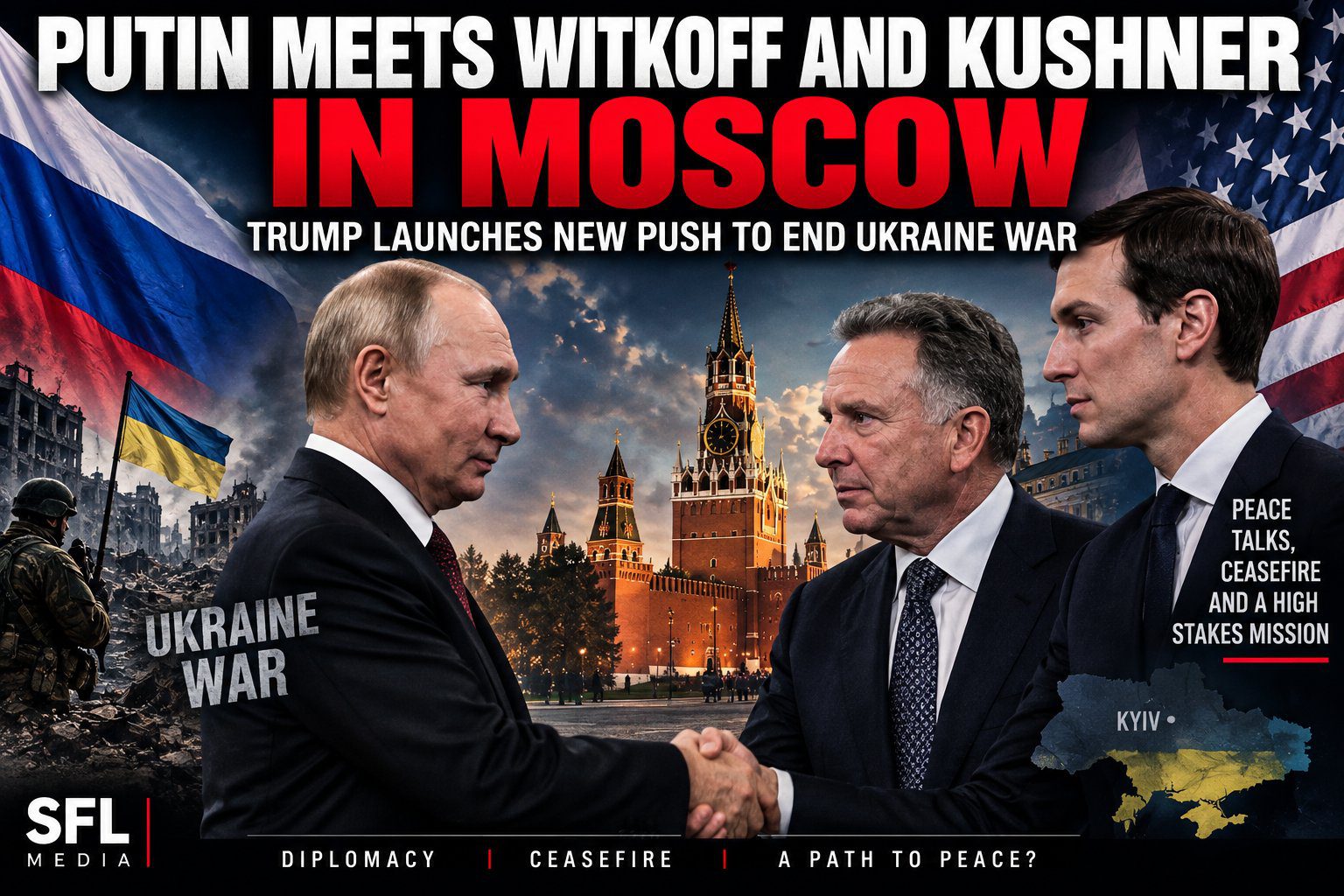
A renewed American effort to end the war in Ukraine moved directly into the Kremlin on Saturday as Russian President Vladimir Putin held more than three hours of talks with U.S. special envoy Steve Witkoff and Jared Kushner, President Donald Trump’s son in law and diplomatic adviser. The meeting marked another high level attempt by the Trump administration to revive negotiations after previous diplomatic efforts failed to produce a settlement and the conflict continued through increasingly destructive missile and drone attacks.
Witkoff and Kushner arrived in Moscow carrying what Trump described as a specific American proposal for ending the war, although neither the White House nor the Kremlin publicly released its terms. After meeting Putin, the American delegation was expected to continue to Kyiv for talks with Ukrainian President Volodymyr Zelenskyy, putting the two envoys in the unusual position of carrying proposals directly between the Russian and Ukrainian leadership.
The diplomacy unfolded against an unusually fragile military backdrop. Russia announced a 72-hour suspension of strikes on Kyiv connected to the envoys’ planned travel to the Ukrainian capital, while Zelenskyy said Ukraine would refrain from attacking Moscow through Monday and expected reciprocal restraint from Russia. The limited arrangement is not a general ceasefire and does not stop fighting elsewhere along the front, but it creates a temporary diplomatic window as Washington tests whether the enormous remaining differences between Moscow and Kyiv can be narrowed.
Witkoff and Kushner Carry Trump’s Peace Proposal to Moscow
Trump announced Friday that Witkoff and Kushner were traveling to Russia and Ukraine with a concrete proposal intended to restart the peace process. The president did not disclose the proposal’s provisions, leaving unanswered some of the most consequential questions surrounding territory, security guarantees, sanctions, NATO aspirations and the future status of Russian-occupied Ukrainian land. Reuters reported after the Moscow meeting that the American envoys presented several settlement ideas but that no breakthrough was announced.
The assignment places considerable responsibility on Witkoff and Kushner, both of whom have participated in previous Trump administration diplomatic initiatives. The two men met Putin for approximately five hours in December 2025 during another round of negotiations that Russian officials characterized as constructive but that ultimately failed to produce a settlement. Their latest mission therefore represents a continuation of a diplomatic channel already tested with the Kremlin rather than an entirely new negotiation.
Their arrival also illustrates Trump’s preference for using trusted personal envoys in negotiations rather than relying exclusively on conventional State Department diplomacy. That approach can potentially create direct communication between national leaders, but it does not eliminate the underlying disputes that have repeatedly prevented Russia and Ukraine from reaching an agreement. The Moscow meeting therefore represented an important diplomatic event without yet providing evidence that either side has accepted the compromises necessary for a durable peace.
Putin Orders 72 Hour Pause in Strikes on Kyiv
Shortly before the negotiations, Kremlin spokesperson Dmitry Peskov announced that Putin had ordered Russian forces to suspend strikes on Kyiv for three days beginning at midnight. The Kremlin connected the decision to preparations for Witkoff and Kushner’s visit to the Ukrainian capital after their Moscow negotiations, creating a temporary security arrangement around the American diplomatic mission.
Ukraine offered reciprocal restraint toward Moscow. Zelenskyy said Ukrainian forces would refrain from striking the Russian capital through the end of Monday and called on Russia to observe the same limitation against Kyiv. The agreement is significant because both countries have increasingly relied on long-range drones and missiles to strike targets far beyond the front lines, making the air war an important component of the broader conflict.
The arrangement should not, however, be confused with a comprehensive 72 hour ceasefire. The publicly announced restrictions concern strikes on Kyiv and Moscow rather than a complete halt to military operations across Ukraine and Russia, and fighting elsewhere has continued. Describing the development as a temporary pause in attacks on the two capitals is therefore more accurate than suggesting Russia and Ukraine agreed to stop fighting nationwide.
Russian Strikes Immediately Before the Talks Underscore the Fragility
The diplomatic pause followed another period of intense Russian attacks. Zelenskyy said Russian forces struck Ukrainian targets, including airports in Kyiv and Boryspil, shortly before the American delegation’s arrival in Moscow. He publicly linked the timing of those attacks to the diplomatic mission, although that interpretation represents Ukraine’s assessment rather than an independently established Russian motive.
The attacks highlighted the contradiction surrounding the latest negotiations. Washington is attempting to create enough diplomatic space for direct bargaining while Russia and Ukraine continue trying to strengthen their positions militarily. That dynamic has complicated previous peace efforts because neither government wants to make concessions while believing battlefield developments could improve its eventual negotiating position.
Russia has continued launching large drone and missile attacks against Ukraine, while Ukraine has demonstrated an increasing ability to strike targets deep inside Russian territory. The temporary restrictions surrounding Witkoff and Kushner’s visit may reduce immediate risks to the diplomatic mission, but they do not resolve the larger strategic calculation driving either military. Until negotiations begin changing those calculations, even productive meetings can coexist with continued warfare.
Putin Calls the Situation Difficult but Praises Trump’s Efforts
Putin acknowledged the difficulty of the negotiations as he received the American delegation at the Kremlin. At the beginning of the meeting, the Russian leader asked Witkoff and Kushner to convey his warm wishes and gratitude to Trump while emphasizing the complexity of reaching an agreement over Ukraine.
Following the closed-door talks, Kremlin foreign policy adviser Yuri Ushakov described the discussions as frank, constructive and useful. Reuters reported that the meeting lasted more than three hours and included both potential settlement proposals and possible future economic cooperation between Russia and the United States. Despite the positive diplomatic language, Russian officials announced no breakthrough, and substantial differences between Moscow and Kyiv remain unresolved.
Putin also emphasized Russia’s battlefield position and again raised what Moscow describes as the “root causes” of the conflict. That language has repeatedly accompanied Russian demands involving Ukraine’s security alignment, NATO ambitions and territorial questions, issues Kyiv considers fundamental to its sovereignty. The continued use of those positions helps explain why a diplomatic opening does not necessarily mean the two sides are approaching an agreement.
Territory Remains One of the Most Difficult Obstacles
Any serious settlement eventually has to confront the territory Russia currently occupies inside Ukraine. Moscow annexed Crimea in 2014 and, following its full-scale invasion in February 2022, seized additional Ukrainian territory while claiming annexation of four more Ukrainian regions. Those annexations are not broadly recognized internationally, and Kyiv has consistently rejected Russian claims to sovereign Ukrainian territory.
Reuters reported after Saturday’s Moscow talks that a substantial gap remains between the Russian and Ukrainian positions, particularly over territory and Ukraine’s future security alignment. Putin continues to project confidence that Russian forces can improve Moscow’s position militarily, while Ukraine has rejected demands requiring it to formally surrender territory. Those competing positions create one of the central problems confronting Witkoff and Kushner as they move from Moscow to Kyiv.
A ceasefire can theoretically stop combat without resolving every territorial dispute, but a permanent peace agreement requires considerably more. Negotiators would have to address control of occupied areas, future borders, security guarantees, sanctions, reconstruction, prisoners, displaced populations and the possibility of renewed Russian military action. The difficulty is therefore not merely getting Putin and Zelenskyy to stop shooting; it is creating an arrangement both governments believe is safer than continuing the war.
The Envoys Head From Putin to Zelenskyy
The next stage of the mission is expected to take Witkoff and Kushner directly to Ukraine for discussions with Zelenskyy. The sequence is important because the American delegation can hear Putin’s position in Moscow and then present the Russian response directly to the Ukrainian government, potentially shortening the diplomatic distance between two countries that remain at war.
For Kyiv, the central concern will be whether the American proposal protects Ukrainian sovereignty and provides credible security arrangements capable of preventing another Russian invasion. Ukraine has repeatedly resisted proposals it believes would reward Russian military aggression by forcing Kyiv to permanently surrender occupied territory without sufficient guarantees. Russia, meanwhile, continues demanding broader changes to Ukraine’s strategic orientation and security relationship with the West.
That leaves the United States attempting to mediate between positions that remain fundamentally different. The importance of the Moscow meeting therefore lies less in any immediate agreement than in whether Witkoff and Kushner can identify areas where both governments are willing to negotiate. The absence of an announced breakthrough after more than three hours with Putin indicates that the diplomatic process remains difficult even as communication continues.
The Trump Administration Is Reopening a Stalled Diplomatic Track
The Moscow visit comes after months in which negotiations struggled to produce meaningful progress. Trump has repeatedly said he wants to end the conflict, but earlier diplomatic initiatives failed to overcome disputes over territory, security guarantees and the conditions for a ceasefire. The broader peace effort also lost momentum as American foreign-policy attention shifted toward the prolonged conflict involving Iran.
The administration has nevertheless continued high level contacts with Moscow. CIA Director John Ratcliffe reportedly traveled to the Russian capital in August and pressed Russian officials to return to negotiations, while Witkoff has participated in repeated contacts with Russian officials. Saturday’s Kremlin meeting therefore represents the latest stage of a broader effort to determine whether direct American engagement can produce movement where earlier negotiations stalled.
Russia’s participation in recent international diplomatic events has also generated political controversy in the United States and among some American allies. At the recent G20 gathering in North Carolina, Treasury Secretary Scott Bessent defended engagement with Russian representatives as necessary for attempting to resolve the war, while some Canadian and European participants expressed discomfort with Russia’s presence. The disagreement reflects the larger strategic debate surrounding diplomacy with Moscow: whether sustained engagement creates opportunities for peace or risks normalizing relations before the underlying conflict has been resolved.
Three Hours at the Kremlin Produced Talks, Not Yet a Breakthrough
The immediate result of Saturday’s meeting is renewed diplomacy rather than a peace agreement. Putin met directly with two of Trump’s most trusted envoys for more than three hours, the Kremlin temporarily restricted attacks on Kyiv, Ukraine agreed to refrain from striking Moscow during the diplomatic mission, and the American delegation prepared to carry the process forward to Kyiv. Those are meaningful developments after months of stalled negotiations, but none demonstrates that Russia and Ukraine have resolved the disputes that have prolonged the war.
The next test will come when Witkoff and Kushner present the results of their Moscow discussions to Zelenskyy. If the American proposal contains terms Ukraine considers unacceptable, the diplomatic opening could close quickly. If both governments identify areas where negotiations can continue, however, the temporary pause surrounding the envoys’ visit could become the beginning of a more substantial process.
For now, the distinction between diplomacy and resolution remains critical. Trump has put two of his closest negotiators directly between Putin and Zelenskyy with a proposal intended to end a war now deep into its fifth year. The Kremlin meeting reopened the negotiating channel, but the absence of a breakthrough makes clear that the most difficult part of the process remains ahead.

Sources & Further Reading
Moscow Talks and Latest Diplomatic Developments
Reuters — Kremlin Says Putin Talks With U.S. Envoys Were Useful, but No Breakthrough Announced
Associated Press — Putin Meets U.S. Envoys at Kremlin for Renewed Ukraine Peace Talks
CBS News — Witkoff and Kushner Visit Moscow in Latest Push to End Ukraine War
Trump’s Peace Proposal and U.S. Mission
Reuters — Trump Sends Witkoff and Kushner to Russia and Ukraine With Peace Proposal
Washington Post — U.S. Envoys Meet Putin as Washington Attempts to Revive Peace Talks
Temporary Pause in Strikes
PBS NewsHour — Putin Orders 72-Hour Pause in Kyiv Strikes During U.S. Envoys’ Visit
Deutsche Welle — Russia Announces Temporary Pause in Strikes Against Kyiv
Ukraine’s Position and Continuing Russian Attacks
The Guardian — Zelenskyy Links Russian Airport Strikes to U.S. Envoys’ Visit
G20 and Wider Diplomatic Context
Associated Press — Bessent Defends Russian Participation at G20 Meeting in North Carolina



















































Want to join the conversation?
Create an account or sign in to share your thoughts, vote,
and reply to other readers.
Showing 0 of 0 comments
Don't have an account?
Already have an account?