
Putin Rattles the Nuclear Saber Again as Kaliningrad Becomes a Dangerous NATO Russia Flashpoint
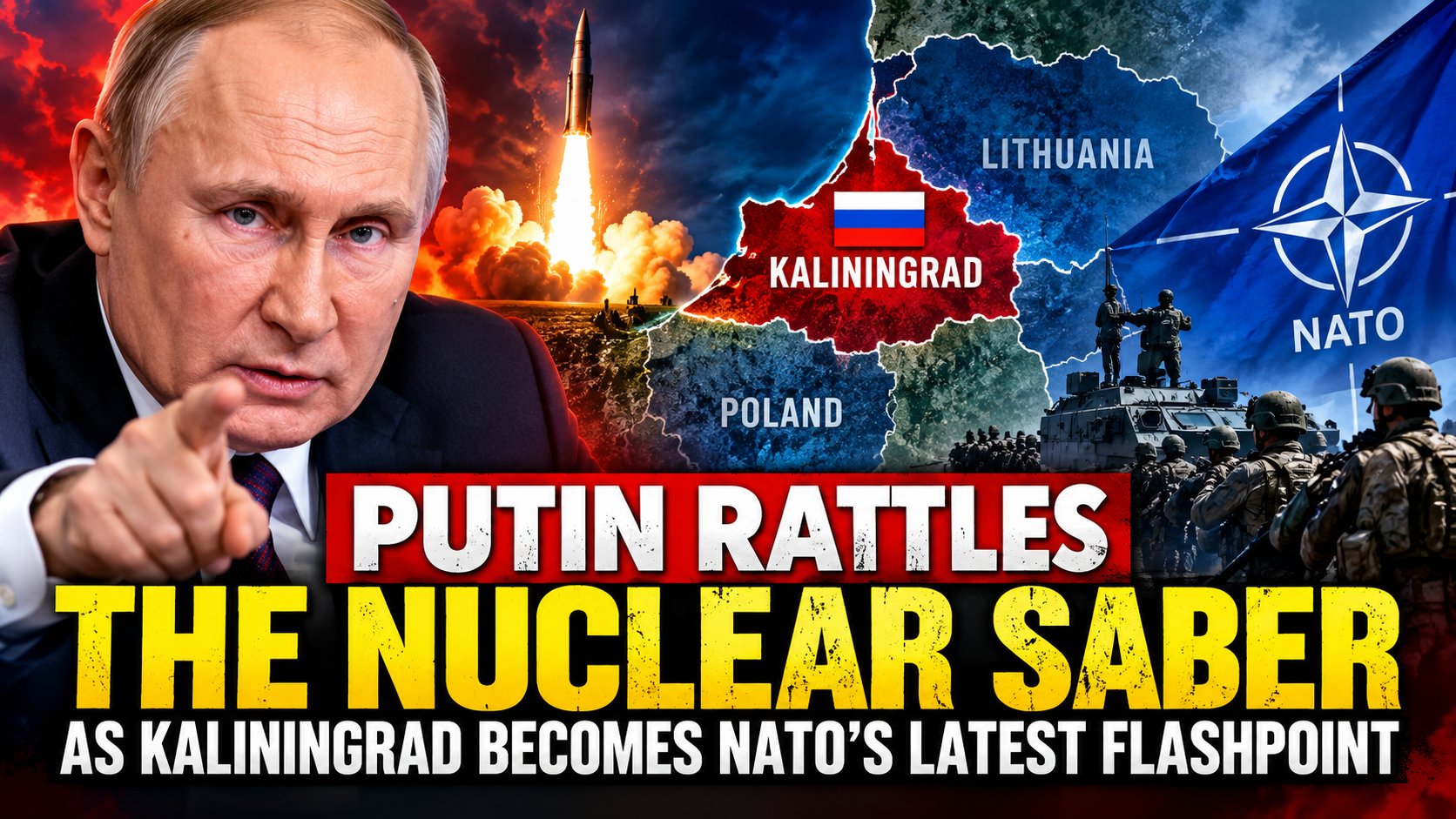
Russian President Vladimir Putin is once again invoking the possibility of nuclear war, warning that Moscow could put “all weapons” in its arsenal on the table if Russia’s heavily militarized Baltic exclave of Kaliningrad comes under direct attack. The warning, delivered Thursday at the Valdai Discussion Club, represents the latest escalation in a familiar Kremlin strategy: repeatedly reminding NATO that a direct military confrontation with Russia could carry the risk of nuclear escalation.
This time, however, the warning is centered on one of the most geographically vulnerable and strategically important pieces of Russian territory in Europe. Kaliningrad is a Russian exclave of roughly one million people wedged between Poland and Lithuania, both NATO members, with no land connection to mainland Russia. The territory hosts Russia’s Baltic Fleet and significant military infrastructure, making Kaliningrad simultaneously an important Russian military asset and a potential vulnerability in any direct confrontation with NATO.
“If it comes to a direct attack on the Russian Federation, in this case, we are referring to Kaliningrad, and perhaps other territories as well, the question of the Russian Federation deploying all the weapons at our country’s disposal will, of course, inevitably and immediately be on the agenda,” Putin said at the Valdai forum. While Putin did not explicitly say Russia would automatically launch nuclear weapons, his remarks followed a formal Russian warning to NATO that specifically referenced nuclear weapons in connection with Kaliningrad.
Putin simultaneously insisted that Russia has no intention of attacking European countries. NATO, for its part, says it has no intention of attacking Russia or blockading Kaliningrad and has condemned Moscow’s nuclear rhetoric as unnecessary and irresponsible. The result is an increasingly dangerous security environment in which both sides publicly insist they do not want a direct war while preparing militarily for the possibility that deterrence could fail.
Why Kaliningrad Matters So Much
Kaliningrad occupies one of the most sensitive geographic positions in Europe. The Russian territory borders Poland to the south and Lithuania to the north and east, while its western coastline opens onto the Baltic Sea. Nearby is the strategically important Suwałki corridor, the narrow land connection between Poland and Lithuania that links the Baltic states with the rest of NATO territory.
That geography makes Kaliningrad extraordinarily valuable to Moscow. Russian forces based there could potentially threaten NATO aircraft, ships and ground forces operating throughout portions of the Baltic region. But the same geography that makes Kaliningrad useful also leaves it isolated from the rest of Russia and surrounded by NATO territory and the Baltic Sea.
Paul van Hooft, head of the RAND Europe Deterrence Initiative, told CNN that this makes Kaliningrad both a strategic asset and a serious vulnerability for Russia. In a hypothetical NATO, Russia conflict, Moscow would want to preserve its ability to operate from the exclave, while NATO could have strong military incentives to neutralize Russian forces there if they were being used against allied territory or reinforcements. Van Hooft described that potential dynamic as particularly destabilizing because both sides could perceive an advantage in acting quickly if a larger conflict began.
That does not mean NATO is currently preparing to invade or blockade Kaliningrad. NATO says explicitly that it is not targeting the territory and that its regional exercises are defensive. Russia, however, has accused the alliance of creating the conditions for a possible blockade and has cited NATO military exercises and activity in the Baltic region as evidence of what Moscow considers an escalating threat.
Moscow Had Already Sent NATO a Nuclear Warning
Putin’s remarks did not emerge from nowhere. Russia had already delivered a diplomatic warning to NATO saying it could resort to nuclear weapons if the alliance attempted to cut Kaliningrad off from the rest of Russia. Reuters reported that Moscow warned NATO it was prepared to use nuclear weapons if the Western alliance attempted to isolate the exclave, while Russian embassies in Europe publicly circulated similar warnings.
NATO Secretary General Mark Rutte confirmed that the alliance received a Russian communication and responded to it, although he declined to disclose the letter itself. Rutte said NATO’s response emphasized that it is a defensive alliance, called on Moscow to stop issuing nuclear threats and again urged Russia to end its war against Ukraine. He also said there was no imminent threat to NATO territory and that the alliance was prepared to defend its members if necessary.
Putin then personally amplified the warning at Valdai, arguing that a direct attack on Russian territory would fundamentally change the nature of the confrontation and bring Russia’s entire arsenal into consideration.
Nuclear Warnings Have Become a Recurring Feature of the Ukraine War
The rhetoric fits a broader pattern that has persisted throughout Russia’s war against Ukraine. Moscow has repeatedly invoked its nuclear arsenal while warning Western governments against deeper involvement in the conflict, particularly as NATO countries have debated supplying Ukraine with increasingly sophisticated weapons and loosening restrictions on how Western supplied systems can be used.
Van Hooft described the latest warning as another attempt to invoke what he called the “nuclear shadow” over Western decision-making. His assessment is that repeatedly reminding European governments of the possibility of catastrophic escalation can serve a strategic purpose by making them more cautious about expanding military support for Ukraine. At the same time, he cautioned that Kaliningrad presents a genuine military vulnerability for Russia and could become a serious flashpoint if relations deteriorated into direct conflict.
A nuclear warning is not evidence that Russia has decided to use nuclear weapons, and Putin’s latest comments were explicitly conditional on an attack against Russian territory. But repeated nuclear signaling still carries risks because deterrence depends on adversaries accurately interpreting one another’s intentions, thresholds and red lines. The danger becomes greater when conventional forces belonging to nuclear armed adversaries operate close to one another, and Kaliningrad is precisely such a place.
NATO and Russia Are Already Operating in an Environment of Hybrid Conflict
The confrontation is also no longer confined to conventional military deployments. NATO governments have accused Russia of conducting a broader campaign of hybrid warfare across Europe involving cyberattacks, sabotage, espionage and other destabilizing operations intended in part to weaken Western support for Ukraine. Moscow denies many of those allegations and has rejected Western claims that it is preparing for a future attack against NATO territory.
The gray zone between conventional war and peacetime competition creates another potential escalation problem. Cyberattacks, sabotage, drone incursions and attacks on critical infrastructure can be deliberately calibrated to remain below the threshold of open warfare, but a sufficiently destructive incident could force NATO governments to determine when a hybrid operation constitutes an armed attack requiring a broader response.
Those boundaries become particularly dangerous when one side is simultaneously warning that attacks against its territory could bring nuclear weapons into consideration. Van Hooft cautioned that the possibility of an accidental or unintended confrontation is a legitimate concern, even while noting that Moscow can also use fears of accidental escalation as a way to discourage NATO governments from responding forcefully to Russian actions.
Russia Is Also Preparing to Pressure Ukraine Through Another Winter
The nuclear rhetoric comes as Russia continues attacking Ukraine with missiles and drones, including strikes affecting civilian and energy infrastructure. Ukrainian officials reported another large wave of Russian drone attacks as the country prepares for another winter in which its electrical system is expected to remain a major target.
Russia has repeatedly targeted electricity generation, substations, transmission infrastructure and other energy facilities throughout the conflict, while Ukraine has worked to repair damaged infrastructure, decentralize generation and strengthen air defenses around critical facilities. The consequences extend far beyond the electrical grid itself. Sustained damage to power infrastructure can affect heating, water distribution, hospitals, communications, transportation and basic civilian life, giving attacks on the energy system both military and humanitarian consequences.
The New York Times has also reported on concerns surrounding a Russian strategy aimed at placing further pressure on Ukraine’s nuclear powered electricity system. Ukraine continues to depend heavily on nuclear generation, making the protection of the electrical infrastructure surrounding its operating reactors particularly important even when the reactors themselves are not directly targeted.
Air Defense Remains One of Ukraine’s Critical Bottlenecks
Ukraine’s ability to protect its cities and infrastructure increasingly depends on maintaining sufficient stocks of sophisticated air-defense interceptors. Patriot systems equipped with PAC-3 interceptors are particularly important against some ballistic missile threats, but those missiles are technically complex, expensive and available in limited quantities.
The problem is not simply whether Ukraine possesses Patriot launchers. An air defense system without sufficient interceptor missiles eventually loses much of its defensive value, while Russia can combine ballistic missiles, cruise missiles and large numbers of attack drones to force Ukrainian commanders to make difficult decisions about which incoming threats justify the expenditure of scarce high end ammunition.
Former U.S. Deputy National Security Adviser Meghan O’Sullivan told CNN that Russia has significantly expanded its stockpile of ballistic missiles and long range strike drones, increasing the pressure on Ukraine’s defenses heading into winter. She identified the availability of PAC-3 interceptors as one of the most important constraints facing Ukraine and its Western supporters.
The challenge extends beyond Ukraine because Patriot interceptors are sought by multiple U.S. allies and partners, while production cannot instantly expand to meet wartime demand. For Ukraine, surviving another winter therefore depends not simply on possessing advanced Western air-defense systems but on maintaining enough ammunition to keep those systems operational during sustained Russian attacks.
Putin Says Russia Does Not Want War With NATO While Warning About Nuclear War
The contradiction at the center of Putin’s latest remarks is also the central contradiction of the broader Russia NATO confrontation. Putin says Russia does not intend to attack Europe. NATO says it does not intend to attack Russia. Both sides describe their military preparations as defensive, yet both are strengthening military capabilities, conducting exercises and preparing for scenarios in which deterrence fails.
Putin warned that cycles of increasingly harsh retaliation could eventually reach what he described as a “fatal point of no return.” He simultaneously argued that Russia would respond to aggression and again reminded Western governments that Moscow possesses an enormous nuclear arsenal. NATO’s position is similarly explicit but from the opposite direction. Rutte has said there is no imminent threat to NATO territory, stressed that the alliance remains defensive and said NATO is prepared to protect its members if attacked. He has also argued that Russia’s nuclear warnings should not distract allied governments from continuing their support for Ukraine. That mutual deterrence is supposed to prevent war. The danger is what happens if either side miscalculates.
The Nuclear Saber Is Still Dangerous No Matter How Many Times Putin Rattles It
After years of nuclear warnings from Moscow, another threat from Putin can begin to sound almost routine. That familiarity may itself be dangerous. Nuclear deterrence depends partly on nuclear weapons remaining an extraordinary threshold, and repeatedly introducing them into conventional political and military disputes risks normalizing rhetoric surrounding weapons capable of catastrophic destruction.
There is an important distinction between taking Putin’s rhetoric seriously and assuming every nuclear warning means an attack is imminent. Nothing in his latest remarks establishes that Russia has made a decision to use nuclear weapons. His comments were conditional on a direct attack against Russian territory, and NATO officials have said they do not view the latest warning as evidence of an imminent nuclear strike. But Kaliningrad is not an abstract hypothetical. It is a heavily militarized Russian territory positioned between NATO countries in one of Europe’s most strategically sensitive regions. Russia considers it critical to its national security, while NATO is treaty bound to defend Poland, Lithuania and its other member states.
That is why the latest nuclear saber-rattling matters even if the world has heard variations of it many times before. The danger is not simply that Putin continues talking about nuclear weapons. It is that he is doing so while Russia and NATO operate increasingly close to one another in exactly the part of Europe where a military incident, miscalculation or uncontrolled escalation could turn rhetoric into something much harder to contain.

Sources & Further Reading
Reuters — Putin Warns West Against Escalation and Raises Nuclear Defense of Kaliningrad
Reuters — Russia Sends NATO Nuclear Warning Over Kaliningrad
Associated Press — Putin Says Russia Could Use “All Weapons” if Its Territory Is Attacked
NATO — Secretary-General Mark Rutte Responds to Russia’s Nuclear Warning
CNN — Kaliningrad, Nuclear Deterrence and RAND Europe Analysis
CNN — Putin’s “All Weapons” Warning and Latest Ukraine Attacks



















































Want to join the conversation?
Create an account or sign in to share your thoughts, vote,
and reply to other readers.
Showing 0 of 0 comments
Don't have an account?
Already have an account?