
Trump Abruptly Cancels Kansas and Iowa Rallies Before Midterms, Lashes Out at Reporter Who Questions His Health
President Donald Trump’s decision to cancel two campaign appearances during the final weekend before the midterm elections has raised questions about his campaign strategy and demanding travel schedule. The White House says he is shifting to telephone rallies, while the president insists he feels healthy.
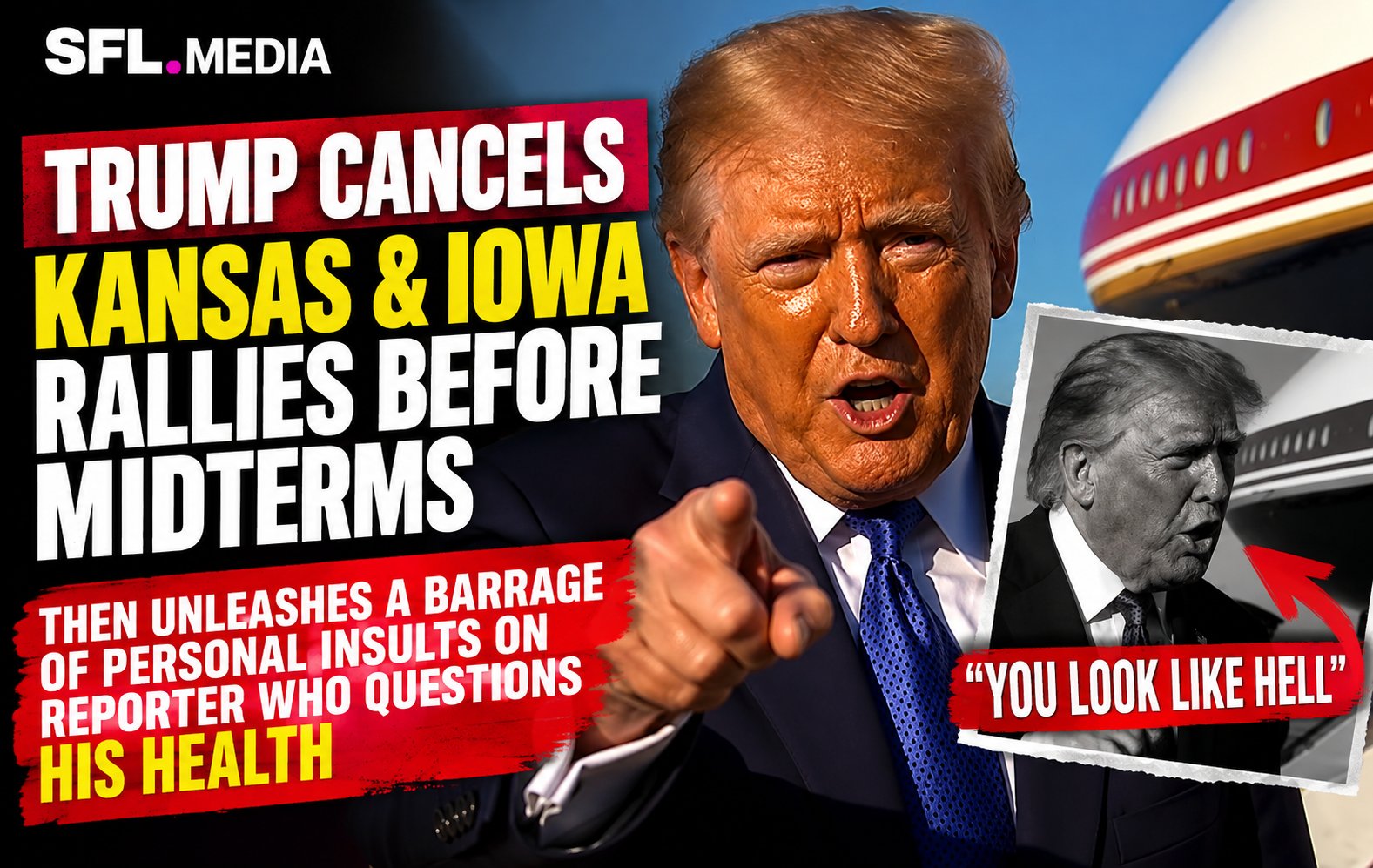
President Donald Trump has canceled planned campaign appearances in Kansas and Iowa just days before the November 3 midterm elections, replacing the in-person events with a series of telephone rallies as Republicans enter the final stretch of a closely watched election season. The abrupt scheduling changes have attracted scrutiny not only because of their timing but also because of the president’s combative response when a reporter questioned whether fatigue or health concerns played a role.
According to reporting attributed to CNN, Reuters, and the Associated Press, Trump had been expected to appear in Salina, Kansas, on Saturday and at a separate event in Iowa on Sunday. Both appearances were subsequently removed from his travel schedule, with administration and Republican officials describing the changes as part of a broader effort to reach voters in multiple states without requiring the president to travel to each location.
The White House has presented the decision as a matter of campaign efficiency rather than a sign of any medical concern. Trump has insisted that he feels healthy and suggested that his confidence in Republican candidates influenced the decision to cancel the events. The controversy intensified when questions about his physical condition prompted an angry exchange with a reporter, shifting attention from the election strategy to the president’s response to scrutiny.
Trump Attacks Reporter After Questions About His Health
The most contentious moment came during an exchange with a reporter who questioned whether the canceled campaign appearances were connected to Trump’s health or the physical demands of an intensive month of travel. Trump rejected the suggestion that he was too tired to continue campaigning and defended the changes to his schedule, insisting that he felt well and that the decision reflected political considerations.
The exchange reportedly escalated when the president turned his attention toward the journalist personally, criticizing his appearance and physical condition rather than limiting his response to the campaign schedule. The confrontation attracted attention because the reporter’s question concerned an unexplained change in presidential travel plans, while Trump’s response shifted toward personal insults and criticism of the news media.
Trump’s reaction transformed what began as a routine question about campaign logistics into another confrontation between the president and the White House press corps. Although Trump has frequently criticized journalists and news organizations throughout his political career, personal attacks against reporters raise broader questions about the relationship between the presidency and the news media, particularly when journalists are seeking explanations for decisions involving the president’s public responsibilities.
The exchange does not establish that Trump is experiencing a medical problem. It does, however, underscore the difficulty the White House faces when questions about the president’s health intersect with changes to his public schedule. At 80, Trump is subject to legitimate scrutiny over presidential fitness, just as other older presidents have faced questions about their ability to meet the physical and mental demands of the office.
The White House Says Trump Will Reach More Voters Through Telephone Rallies
Republican officials insist that the cancellations reflect a deliberate adjustment to campaign strategy. Rather than spending hours traveling to individual locations, Trump is expected to participate in as many as 20 telephone rallies before Election Day, allowing him to address voters in multiple states over a relatively short period.
The Republican National Committee and organizations aligned with the president have promoted telephone events as a way to maximize Trump’s reach during the final days of the campaign. The approach would allow the president to communicate with voters across several states while reducing the travel, security arrangements, and scheduling demands associated with traditional campaign rallies.
The difference in time commitment could be substantial. Trump’s in-person campaign speeches frequently last more than an hour, while telephone appearances can be considerably shorter. This would allow him to participate in numerous events without the extensive preparation required for presidential travel, although telephone rallies lack the television imagery, crowd energy, and local media attention generated by a large public gathering.
The administration’s explanation is plausible from a logistical standpoint. Presidential travel requires significant preparation, and a single campaign stop can consume much of a day even when the public appearance itself lasts only a few hours. Telephone rallies provide a way to distribute a candidate’s message more broadly, but whether they produce the same enthusiasm or turnout benefits as in-person events is a separate political question.
Kansas Republicans Face an Unexpected Campaign Disruption
The cancellation in Kansas is politically significant because the state has historically been a reliable Republican stronghold, yet Democrats have increasingly sought opportunities to compete in areas where the GOP traditionally enjoys substantial advantages. Trump’s planned appearance in Salina was expected to provide additional attention for Republican candidates during the final weekend of campaigning.
Trump suggested that his confidence in the Republican candidate influenced his decision to skip the event, presenting the cancellation as evidence that the race did not require an additional presidential appearance. That explanation, however, does not resolve whether local Republican officials would have preferred the president to appear in person or whether his absence could affect voter enthusiasm.
A presidential rally can provide several advantages to a campaign, including local media coverage, volunteer mobilization, fundraising opportunities, and the ability to attract voters who might not otherwise participate in political events. At the same time, the presence of a polarizing national figure can reinforce opposition messaging among voters dissatisfied with the administration, creating competing considerations for candidates in potentially competitive races.
Kansas has a long history of voting Republican in federal elections, but individual races can still be influenced by candidate quality, local economic concerns, voter turnout, and national political conditions. Without reliable evidence demonstrating the effect of a particular rally, the political consequences of Trump’s cancellation cannot be determined in advance.
Iowa Republicans Lose a Presidential Visit During the Final Campaign Weekend
The cancellation in Iowa carries its own political implications. Trump had been expected to appear in the state on Sunday, offering Republican candidates an opportunity to benefit from the visibility and enthusiasm generated by a presidential visit immediately before voters head to the polls.
Iowa has moved decisively toward Republicans in recent presidential elections, but congressional and statewide contests can still depend on local political conditions and turnout among different groups of voters. A presidential appearance can help energize party activists, attract media attention, and remind occasional voters of the importance of participating in the election.
Although telephone rallies may still reach substantial numbers of supporters, they do not provide the same local visibility as a public event attended by campaign volunteers, elected officials, journalists, and thousands of voters. The cancellation therefore represents a change in the way the Republican Party intends to deploy its most prominent political figure during the final days of the campaign.
CNN also reported that some Republican officials expressed relief at the canceled appearances, with one anonymous party source suggesting that Trump’s rallies had not significantly changed the political landscape. That assessment represents the opinion of an unnamed Republican official rather than an independently established measurement of the president’s electoral influence, but it illustrates the complicated calculations surrounding his role in competitive races.
Questions About Fatigue Follow an Intensive Month of Campaigning
The questions about Trump’s health and stamina did not emerge in isolation. His October schedule has reportedly included numerous campaign appearances across the country, many involving extended speeches and substantial travel. The demands of such a schedule can be significant for any political figure, particularly a sitting president who must also manage the responsibilities of the White House.
The president has acknowledged the demands of frequent speaking engagements, and questions about fatigue naturally arise when major public appearances are canceled without an immediately detailed explanation. However, vocal strain, schedule adjustments, and the physical demands of travel do not independently establish the presence of a medical condition.
The White House has not identified a medical problem as the reason for the canceled appearances, and Trump has denied feeling unwell. His planned appearance in Daytona Beach, Florida, remained on the schedule as of the reporting available for this article, suggesting that the administration was not announcing a complete suspension of in-person campaign activity.
That distinction is essential. A change in presidential scheduling can legitimately raise questions about health, particularly when the president is 80 years old, but the available information does not establish that illness caused the cancellations. Any suggestion that Trump is concealing a particular medical condition would require evidence beyond the rally changes and his reaction to journalists.
What is established by the reported accounts is that the president canceled two in-person appearances, Republican officials announced a substantial expansion of telephone events, and Trump responded angrily when questioned about whether his physical condition influenced the decision.
Trump’s Florida Appearance Remains on the Schedule
Despite the cancellations in Kansas and Iowa, Trump was still expected to appear in Daytona Beach, Florida, on Friday, where he planned to campaign for Republican candidates. The decision to retain that appearance while abandoning other stops has added another dimension to questions about how the White House is allocating the president’s time during the final days before Election Day.
From a campaign perspective, presidential travel involves calculations that extend beyond the competitiveness of individual races. Scheduling decisions may reflect fundraising commitments, security arrangements, regional political priorities, and the availability of candidates and campaign organizations. A rally in a reliably Republican area may be intended to energize voters across a broader region, while an appearance in a competitive state can carry the risk of motivating opponents as well as supporters.
The administration has not publicly provided a comprehensive explanation for every change to Trump’s final campaign itinerary. Until additional scheduling details are available, it remains unclear whether the cancellations represent a broader reduction in presidential travel or a limited effort to concentrate the president’s remaining time on selected appearances while expanding his participation in telephone events.
Republicans Face a High Stakes Midterm Election With Control of Congress at Risk
The controversy comes as Republicans prepare for an election that could significantly reshape the balance of power in Washington. Control of the House of Representatives and Senate is at stake, and the outcome will determine whether Trump continues governing with Republican congressional majorities or faces a Congress in which Democrats control one or both chambers.
Maintaining congressional support would be important to the administration’s ability to advance legislation, confirm nominees, approve spending priorities, and defend its policies against congressional challenges. Democratic victories, particularly in the House, could result in expanded investigations, more aggressive oversight, and additional obstacles to the president’s legislative agenda during the remaining years of his term.
Those stakes explain why Republican officials are closely examining the potential value of every presidential appearance. In competitive states, rallies can energize loyal supporters, generate favorable local coverage, and encourage participation among voters who might otherwise remain at home. Yet presidential visits can also nationalize races that candidates would prefer to frame around local concerns, particularly when the president’s positions or personal conduct are controversial among independent voters.
The shift toward telephone rallies may therefore reflect several considerations at once, including the practical demands of presidential travel, the desire to communicate with more voters, and political calculations about where Trump’s physical presence would provide the greatest benefit. The publicly reported information does not establish any single explanation as the exclusive reason for the changes.
Trump’s Confrontation With the Press Becomes a Story of Its Own
Beyond the immediate campaign implications, the dispute has revived questions about how Trump responds to scrutiny from journalists. The president has long used confrontations with the news media as part of his political identity, portraying critical questions as evidence of hostility toward his administration and frequently attacking individual reporters or their employers.
In this instance, the underlying question was straightforward: whether an abrupt change to the president’s travel schedule was connected to fatigue or a health concern. Such questions fall within the ordinary responsibilities of journalists covering a sitting president, particularly when the changes occur during a demanding campaign schedule and involve a president who is 80 years old.
Trump’s reported decision to respond with personal insults rather than confine his answer to the scheduling issue created a separate controversy. His supporters may interpret the exchange as another example of his confrontational political style, while critics may view it as an attempt to discourage legitimate questioning. Neither interpretation changes the central factual distinction: the reporter’s inquiry does not prove that Trump is ill, and the president’s angry response does not independently establish why the rallies were canceled.
The episode also demonstrates how quickly the administration’s intended political message can be overtaken by controversy. Instead of focusing exclusively on Republican candidates and the approaching election, coverage of the cancellations has increasingly centered on Trump’s health denials, his treatment of journalists, and conflicting assessments of his value on the campaign trail.
The Final Days Before Election Day Will Test Trump’s Campaign Strategy
The coming days will provide an immediate test of the White House’s revised approach. If Trump participates in the planned telephone rallies, Republican officials will be able to reach voters across numerous states without the time and logistical commitments associated with traditional campaign stops. Whether those appearances produce meaningful electoral benefits, however, will be difficult to separate from other factors affecting turnout.
Campaign organizations routinely use telephone events, prerecorded messages, text messages, and digital advertising to reach voters who may never attend an in-person rally. These methods can be effective at distributing information and reminding supporters to vote, but they do not necessarily reproduce the excitement or news coverage generated by a major presidential appearance.
The canceled Kansas and Iowa events also leave unanswered questions about the role Trump will play in the Republican Party’s closing argument to voters. His political influence remains substantial among the party’s core supporters, but individual candidates must balance that advantage against the need to appeal to independents and voters who may be dissatisfied with the administration.
Ultimately, the results of the November 3 election will provide a broader measure of Republican performance, although they will not conclusively establish whether any particular rally cancellation helped or hurt an individual candidate. Electoral outcomes are shaped by numerous factors, including economic conditions, candidate strength, campaign spending, turnout operations, and voters’ assessments of the party in power.
The Bottom Line: Trump Cancels Two Rallies, Denies Health Concerns, and Attacks a Reporter
President Donald Trump’s decision to cancel campaign rallies in Kansas and Iowa has created an unexpected controversy during the final days before the 2026 midterm elections. His administration describes the changes as a strategic pivot toward telephone events, and the president maintains that he is healthy and confident in Republican candidates. The abrupt cancellations have nevertheless prompted questions about the demands of his travel schedule, the effectiveness of his campaign appearances, and the political calculations facing Republicans in the closing days of the election.
Trump’s reported confrontation with a journalist added a separate controversy to the scheduling changes. Rather than simply addressing questions about fatigue and travel, the president turned the exchange into a personal dispute, shifting attention away from the Republican candidates he was expected to support and toward his own conduct under scrutiny.
There is no verified evidence in the reporting reviewed for this draft that illness caused the cancellations. The more immediate political question is whether replacing major in-person rallies with shorter telephone appearances will help Republicans reach more voters or deprive candidates of the visibility and enthusiasm that a presidential visit can generate. With Election Day approaching on November 3, the consequences of that decision will unfold alongside a much larger contest over control of Congress and the direction of Trump’s presidency.
Sources & Further Reading

National reporting and election coverage
SFL Media Related Coverage





































Want to join the conversation?
Create an account or sign in to share your thoughts, vote,
and reply to other readers.
Showing 0 of 0 comments
Don't have an account?
Already have an account?