
Somewhere, Elon Musk of SpaceX is smiling. You would think that a huge explosion is nothing to laugh about. Well, then you don’t know how serious the great space race really is. There is a competition between Elon’s SpaceX and Jeff Bezos’ Blue Origin. So this explosion has, without a doubt, set Blue Origin back. How much so? Well, that is to be determined. One thing is for certain, though, Elon Musk is enjoying seeing this unfold.
So What Happened?
A Blue Origin New Glenn rocket exploded during a static fire test Thursday night at Launch Complex 36 in Cape Canaveral, sending a massive fireball into the sky and shaking homes along Florida’s Space Coast.
No injuries were reported, but the incident marks another setback for the heavy-lift rocket program that is expected to support future commercial satellite launches and NASA lunar missions.
The explosion occurred during a static fire test of Blue Origin’s New Glenn rocket ahead of a planned launch next week carrying Amazon Kuiper internet satellites.
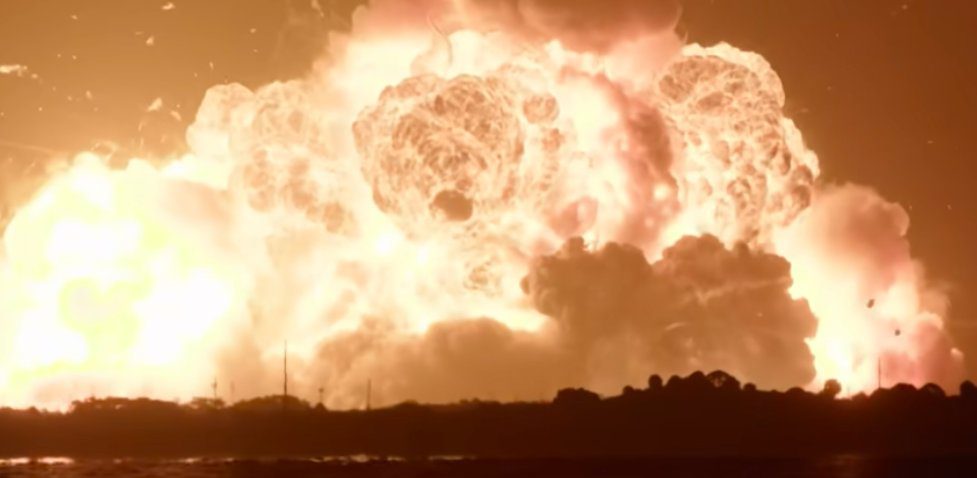
Blue Origin confirmed that an “anomaly” occurred during the test and said all personnel were accounted for and safe. Emergency crews responded to the launch complex, but officials said there was no danger to the surrounding community from fire, fumes or other hazards.
Residents in Cape Canaveral and Cocoa Beach reported hearing and feeling the blast around 9 p.m. Local social media channels quickly filled with photos and videos showing a large orange fireball rising from the launch site.
NASA Administrator Jared Isaacman said the agency is coordinating with Blue Origin and other partners to investigate the incident and determine whether it could affect future missions. Investigators have not identified the cause of the explosion.
It remains unclear how much damage was done to the launch pad, support infrastructure or the rocket itself. Officials have not said whether the planned launch of Amazon’s Kuiper satellites will be delayed or canceled.
So What Now?
Blue Origin has not released a timeline for completing its investigation or returning the rocket to flight status.
New Glenn is Blue Origin’s flagship orbital rocket and represents the company’s effort to compete directly with SpaceX and other launch providers in the commercial and government spaceflight markets.
Standing 321 feet (98 meters) tall, the rocket is named after astronaut John Glenn, the first American to orbit Earth. The vehicle first flew in 2025 and is designed to carry large satellites, national security payloads and lunar mission hardware.
The rocket already faced challenges earlier this year. In April, a New Glenn mission suffered an engine-related problem that left a satellite in an incorrect orbit, grounding the vehicle while engineers worked to address the issue.
Blue Origin plans to use New Glenn for future NASA-related missions, including launches connected to lunar exploration efforts.
The explosion was immediately felt across portions of Brevard County, where rocket launches are a regular part of daily life.
Residents reported homes rattling from the blast, while beachgoers and nearby communities watched the fireball from across the Space Coast. Launch Complex 36 is visible from portions of Cape Canaveral and Cocoa Beach, making the incident highly visible to the public.
Despite the dramatic scene, local emergency management officials emphasized there was no threat to public safety and no reported injuries.
“We experienced an anomaly during today’s hot-fire test. We will provide updates as we learn more,” the company said and later emphasized that all workers were safe.
Blue Origin’s owner, Jeff Bezos, said it is too early to determine the cause of the incident but that an investigation is already underway.
“All personnel are accounted for and safe,” Bezos posted on X. “It’s too early to know the root cause, but we’re already working to find it.”
The company acknowledged the setback but said it remains committed to the program.















































Want to join the conversation?
Create an account or sign in to share your thoughts, vote,
and reply to other readers.
Showing 2 of 2 comments
Don't have an account?
Already have an account?