
Rep. Lauren Boebert Raises Questions About Alien Hybrids, Portals, and Stargates as UFO Debate Takes a Strange Turn
The debate over unidentified anomalous phenomena (UAPs) has taken Congress into some unusual territory over the past several years. What began as discussions about military encounters with unexplained objects has increasingly expanded into conversations involving secret government programs, interdimensional theories, ancient religious texts, and even allegations of alien human hybridization.
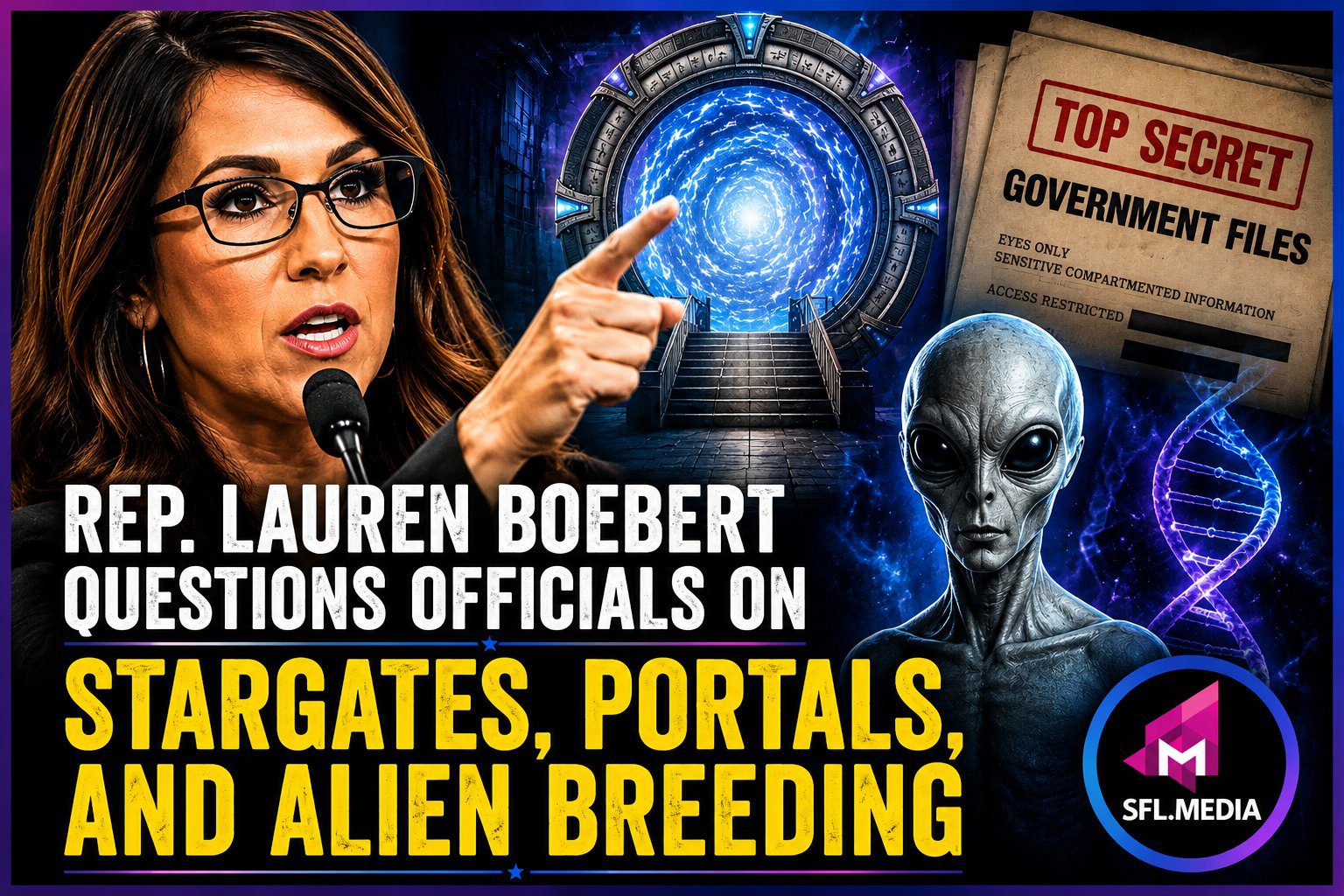
Now, one of the most outspoken voices in Congress on the subject is drawing attention for publicly discussing claims involving alien breeding programs, underwater non-human bases, portals, and so called stargates. Rep. Lauren Boebert has become one of several lawmakers willing to push beyond traditional national security questions and into some of the more controversial theories circulating within the modern UFO disclosure movement.
While critics argue these claims lack evidence and risk distracting from legitimate investigations into unexplained aerial phenomena, supporters believe lawmakers have a responsibility to ask difficult questions, even when the answers seem extraordinary.
The Congressional Hearing That Raised Eyebrows
The controversy traces back to a November 2024 House Oversight Committee hearing titled “Unidentified Anomalous Phenomena: Exposing the Truth.” During the hearing, Boebert directly questioned a panel of UFO researchers and former government insiders about rumors she said were circulating on Capitol Hill. Her most controversial question centered on allegations of a secret Department of Defense program involving genetic experimentation.
In a formal exchange entered into the congressional record, Boebert asked whether any of the witnesses were familiar with reports of government efforts involving the manipulation of human genetics using what she described as “non-human genetic material” to create enhanced human capabilities or hybrid beings. The response was immediate and unanimous.
None of the witnesses testified that they had knowledge of such a program. The exchange nevertheless generated significant attention online because it represented one of the first times a sitting member of Congress publicly referenced rumors involving alleged human-alien hybridization during an official government hearing. The topic has long existed on the fringes of UFO lore but has historically been absent from serious congressional discussions.
Questions About Underwater UFO Bases
Boebert’s questioning did not stop with genetic experimentation. She also pressed witnesses regarding reports of unidentified objects entering and exiting oceans without visible signs of propulsion. The inquiry reflected a growing interest among some UAP researchers in what are known as USOs, or Unidentified Submerged Objects.
Over the past several years, military personnel and civilian researchers have documented reports of unidentified craft allegedly moving between air and water with capabilities that appear to exceed known technology. Some researchers have speculated that such sightings could suggest the existence of hidden underwater facilities or bases.
No evidence supporting the existence of non-human underwater installations was presented during the hearing, but the discussion reflected the increasingly expansive scope of congressional UAP inquiries.
From Government Secrecy to Spiritual Warfare
While the congressional hearing focused primarily on government programs and unexplained technology, Boebert’s comments took a dramatically different direction during a May 2026 appearance on Sean Feucht’s podcast, Breakthrough Hour. Rather than discussing spacecraft or advanced technology, the conversation shifted into religion, spirituality, and biblical interpretations of the UFO phenomenon.
During the interview, Boebert explored theories suggesting that unidentified aerial phenomena may not originate from distant planets at all. Instead, she discussed the possibility that these entities could be interdimensional beings connected to what some religious scholars describe as spiritual warfare.
The conversation echoed ideas that have gained traction among certain religious and political figures who view UFO encounters through a biblical lens rather than a scientific one. Under this framework, the entities commonly referred to as aliens are not extraterrestrials but supernatural beings capable of moving between dimensions.
Portals, Stargates, and the Interdimensional Theory
One of the most controversial aspects of the podcast centered on discussions of portals and stargates. The terms have become increasingly common within some segments of the UFO community, where proponents argue that advanced entities may access Earth through dimensional gateways rather than traditional interstellar travel.
Boebert discussed these concepts in connection with theories that unidentified phenomena may be linked to ancient religious accounts and supernatural events described in scripture. The discussion touched on interpretations of the Nephilim, mysterious beings referenced in the Book of Genesis that have become a focal point for some religious UFO researchers.
Advocates of the interdimensional theory argue that many reported UFO encounters appear more consistent with paranormal activity than conventional space travel. Critics, however, note that such theories remain speculative and unsupported by empirical evidence.
A Growing Divide Within the Disclosure Movement
Boebert’s comments highlight a growing divide within the broader UFO disclosure movement. One camp views UAPs primarily as a national security issue involving advanced technology, unknown aircraft, or potentially non-human intelligence operating in Earth’s airspace.
Another increasingly influential faction believes the phenomenon is fundamentally spiritual in nature. These competing interpretations have created unusual alliances between former intelligence officials, religious leaders, lawmakers, and paranormal researchers.
Some advocates argue that limiting the discussion solely to extraterrestrial hypotheses ignores historical reports of supernatural encounters that predate modern aviation by centuries. Others warn that mixing religion and government investigations risks undermining the credibility of legitimate efforts to study unexplained phenomena.
The Political Risks of Asking Extraordinary Questions
Whether one views Boebert’s comments as responsible inquiry or political theater largely depends on perspective. Supporters argue that congressional oversight requires lawmakers to investigate claims regardless of how unusual they may seem. After all, many aspects of the UAP discussion that were once dismissed, including military pilot encounters and Pentagon investigations, have since been officially acknowledged. Skeptics counter that extraordinary claims require extraordinary evidence and that discussions involving alien hybrids, portals, and stargates currently lack the factual foundation necessary for serious policy debate.
At present, no publicly available evidence confirms the existence of alien-human breeding programs, interdimensional portals, stargates, or non-human underwater civilizations. Nevertheless, the fact that such topics are now being openly discussed by elected officials demonstrates how dramatically the UAP conversation has evolved. Just a decade ago, such subjects were largely confined to fringe conferences and late night radio shows.
Today, they are appearing in congressional hearings, political podcasts, and national news coverage. Whether that represents progress toward greater disclosure or a drift into speculation remains one of the central questions facing the modern UFO movement.


















































Want to join the conversation?
Create an account or sign in to share your thoughts, vote,
and reply to other readers.
Showing 0 of 0 comments
Don't have an account?
Already have an account?