
The Kars4Kids Jingle Is Catchy. The Money Trail Is Far More Complicated
For years, Americans have heard the relentlessly memorable Kars4Kids pitch: donate your car and help kids. The jingle became one of the most recognizable charity advertisements in the country, and the message appeared straightforward. Give up an unwanted vehicle, and the proceeds will benefit children in need. But behind that simple advertising campaign is a far more complicated nonprofit structure that has attracted scrutiny from state regulators, courts and independent charity watchdogs over where the money goes, how much is consumed by fundraising and whether donors are adequately informed about the organization’s actual religious mission.
Kars4Kids is a legally registered nonprofit organization, but it is not a general children’s welfare charity in the way many Americans might reasonably assume from its advertising. Its charitable activities primarily support Jewish educational and religious programs, with substantial funding flowing through Oorah, an affiliated Orthodox Jewish nonprofit based in New Jersey. Oorah operates programs involving religious education, mentorship, summer camps, tuition assistance and other services for Jewish children and families. That mission is itself entirely legitimate. The controversy is whether Kars4Kids historically made that specific mission sufficiently clear to the millions of Americans hearing advertisements that broadly promised to help “kids.”
A Large Share of the Money Is Consumed Before Reaching Charitable Programs
One of the biggest concerns surrounding Kars4Kids is financial efficiency. Independent watchdog CharityWatch has given the organization poor marks and calculated that a substantial portion of its expenditures goes toward fundraising rather than charitable programs. Its analysis has estimated that Kars4Kids spends roughly $48 to raise every $100 in contributions, while approximately 41% of total expenditures were devoted to programs under CharityWatch’s methodology. Those figures reveal just how expensive the organization’s fundraising operation has become.
Some of those costs are understandable. Donated vehicles have to be collected, processed, sold and administered, and Kars4Kids operates an enormous national advertising operation. But the numbers still mean that someone donating a valuable vehicle should not assume that anything close to the full value generated from that vehicle ultimately reaches children. A significant portion supports the machinery necessary to acquire, process and advertise for additional donations.
The Oorah Connection Explains Where Much of the Charitable Money Goes
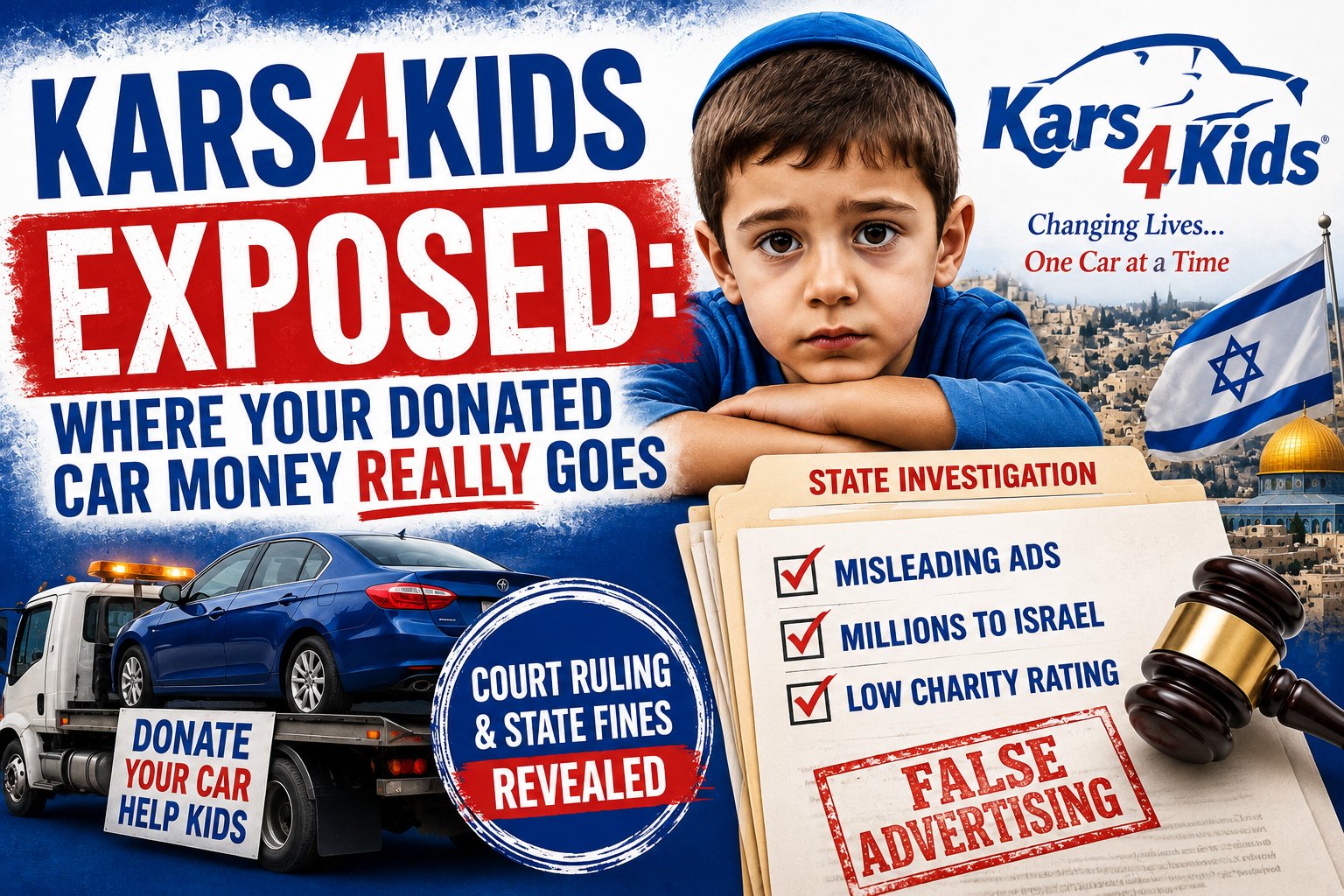
Understanding Kars4Kids requires understanding Oorah. Kars4Kids functions largely as a fundraising engine, while Oorah operates many of the programs ultimately supported by those funds. A very large share of Kars4Kids’ charitable distributions has historically gone to Oorah, which concentrates its mission on Orthodox Jewish education and outreach.
Oorah’s programs include summer camps, mentorship, religious education, tuition assistance and other services aimed at strengthening Jewish religious participation among children and families. This is considerably more specific than the generalized image of children’s assistance presented by the famous Kars4Kids advertising campaign. Again, there is nothing inherently improper about raising money for Orthodox Jewish education. The legitimate transparency question is whether donors understood that this was substantially what their donations were financing.
Yes, Significant Money Has Gone to Israel, But the Viral 80% Claim Is Wrong
Claims circulating online that 80% of Kars4Kids donations are spent sending people to Israel are not supported by the available financial evidence. The organization’s finances are significantly more complicated, and enormous amounts are consumed by fundraising, vehicle processing and other expenses before charitable program distributions are even considered.
However, dismissing the 80% claim does not mean the Israel connection is fictional. Financial records and court proceedings have documented significant spending connected to Israel, including religious education programs, gap year programs and major real estate activity. Millions of dollars have been associated with programs and assets in Israel, including a reported $16.5 million real estate acquisition. Oorah’s financial disclosures have also reported substantial grants associated with religious education in the Middle East.
The accurate version is therefore considerably more nuanced than the viral accusation. Kars4Kids is not sending 80% of every donated dollar to Israel for religious trips. But the charitable network it supports has directed significant money toward Orthodox Jewish religious activities, including programs and investments connected to Israel.
California Put the Advertising Itself on Trial
The controversy reached a major turning point in California, where a Superior Court judge found that aspects of Kars4Kids’ advertising violated the state’s false-advertising and unfair-competition laws. The case focused heavily on what the advertisements failed to tell potential donors about the organization’s religious mission, its beneficiaries and where charitable money was ultimately being directed.
That is an important distinction. The case was not based on the argument that supporting Orthodox Jewish programs is improper. Instead, the issue was whether consumers were receiving enough information to make an informed charitable decision. An advertisement presenting itself broadly as helping children can create a very different impression than an advertisement explicitly stating that donations principally support Jewish religious education and outreach.
The California ruling imposed significant restrictions on how Kars4Kids could continue advertising without additional disclosures. Kars4Kids disputed the decision and defended its transparency, pointing to information about its Jewish mission available through its own materials. Nevertheless, the ruling represented a serious legal rebuke of the way the organization’s enormously successful advertising campaign communicated its purpose to potential donors.
Other States Raised Similar Concerns Years Earlier
California was not the first government to question the organization’s advertising practices. Pennsylvania and Oregon previously scrutinized Kars4Kids over disclosures surrounding its charitable mission and promotional practices. Minnesota later conducted an extensive examination of the organization and its financial relationship with Oorah.
The Minnesota investigation was particularly revealing because it examined the difference between where money was raised and where charitable benefits were actually delivered. Kars4Kids collected donations from residents across the country, but much of the resulting charitable spending was concentrated elsewhere. The investigation found remarkably limited direct benefits reaching children in Minnesota compared with the amount raised from donors there.
That geographical disconnect matters because national advertising naturally encourages people to believe they are supporting a broadly operating national charity. If a nonprofit raises substantial amounts of money nationwide while concentrating its services within a much narrower geographic and religious community, transparency about that structure becomes especially important.
The Famous Jingle Became Part of the Problem
The brilliance of the Kars4Kids campaign is also what made it vulnerable to criticism. The advertisement is extraordinarily simple. Donate a vehicle. Help children. Remember the phone number.
But charitable organizations have responsibilities beyond producing memorable advertising. Donors should have enough information to understand the essential nature of the organization they are supporting. Someone who wants to support Orthodox Jewish religious education may enthusiastically donate to Kars4Kids after understanding its mission. Someone intending to support impoverished children regardless of religion or geographic location might choose a completely different organization.
Neither donor is wrong. The critical issue is whether both donors understand what they are buying into before transferring an asset potentially worth thousands of dollars.
This Is Ultimately a Story About Donor Consent
The religious component of the controversy requires precision. The problem is not that Kars4Kids supports Jewish organizations. Religious charities are an important part of American civil society, and organizations representing every major faith raise money to support religious education, schools, camps, humanitarian programs and community services.
The standard should be straightforward and universal: tell people what they are funding.
If a Christian charity raises money primarily for Christian missionary programs, donors should know that. If a Muslim charity principally supports Islamic education, donors should know that. If an Orthodox Jewish organization raises money primarily for Jewish religious education and outreach, donors should know that too. Transparency allows donors to make their own decisions. Concealing or minimizing material information about a charity’s actual mission undermines that choice.
Kars4Kids Is a Real Charity, but That Does Not End the Discussion
It would also be inaccurate to describe Kars4Kids simply as a fake charity or scam. It is a legally recognized nonprofit organization that funds actual charitable programs. Children and families participate in programs financed through its network. The organization has also consistently defended its mission and financial practices.
But being legally registered does not automatically make a charity efficient, transparent or appropriate for every donor. Those are separate questions. A nonprofit can legally operate while still spending an unusually large percentage of its resources on fundraising. It can conduct legitimate charitable programs while still facing criticism about how those programs are presented to donors.
That distinction is important because sensational claims can actually obscure the strongest criticism of Kars4Kids. There is no need to exaggerate the organization’s finances when its documented structure already raises legitimate questions.
The 80% Israel Claim Distracts From the Stronger Story
The claim that 80% of Kars4Kids donations finance Israel trips is precisely the kind of internet shorthand that can undermine legitimate scrutiny. Available financial information does not support it. Kars4Kids spends heavily on advertising and fundraising, and much of its charitable funding supports programs operating domestically through Oorah.
The stronger story is that a charity with one of America’s most recognizable generic children’s advertising campaigns principally finances a specific religious outreach network, while significant funds have also supported activities and assets connected to Israel. That reality is complicated enough without turning it into an unsupported numerical claim.
For journalists and donors alike, accuracy matters here. If criticism depends on an exaggerated statistic, the organization can attack the statistic instead of answering the broader transparency questions raised by regulators, watchdogs and financial disclosures.
Americans Should Look Beyond the Advertisement Before Donating
The Kars4Kids controversy offers a larger lesson about charitable giving. Donors should not assume that the organization described in a 30 second commercial accurately represents the complete financial structure behind the charity. Before donating a vehicle, real estate, securities or substantial amounts of money, consumers should examine nonprofit tax filings, independent charity evaluations and detailed program descriptions.
They should look at how much money reaches programs, how much goes toward fundraising, whether money is transferred to affiliated organizations and what those affiliated organizations actually do. Those questions become particularly important when a charity accepts valuable assets such as automobiles that may be worth thousands or tens of thousands of dollars.
The Jingle Was Simple. The Money Trail Was Not.
Kars4Kids built one of America’s most recognizable nonprofit brands around an extraordinarily simple promise: donate your car and help kids. But behind that promise sits a complicated network of vehicle processing, enormous advertising expenditures, affiliated organizations, Orthodox Jewish educational programs and significant financial activity connected to Israel.
The organization is real. Its charitable programs are real. The claim that 80% of its money simply finances trips to Israel is not supported by the evidence. But the controversy surrounding Kars4Kids is real too. Multiple government investigations, court proceedings and independent watchdog reviews have raised serious questions about transparency, advertising and financial efficiency. And ultimately, those questions come down to something remarkably basic. People have a right to know what their donations are actually paying for. A charity should not need donors to investigate thousands of pages of financial records to understand its fundamental mission. The advertisement that asks for the money should make that mission clear in the first place.















































Want to join the conversation?
Create an account or sign in to share your thoughts, vote,
and reply to other readers.
Showing 0 of 0 comments
Don't have an account?
Already have an account?