
America Is Getting High: Marijuana Use Is Surging and Fox News Is Freaking Out
America’s relationship with marijuana has changed so dramatically that statistics once unimaginable during the height of the War on Drugs are becoming ordinary. Cannabis has moved from illicit counterculture to dispensary storefronts, medical programs, gummies, vape cartridges and increasingly normalized adult recreational use. That cultural transformation recently collided with the decidedly more skeptical worldview of Fox News, where co-host Ainsley Earhardt and senior medical analyst Dr. Marc Siegel discussed statistics showing just how deeply cannabis has penetrated American life.
The basic takeaway from the segment was difficult to miss: Americans are using a tremendous amount of weed. But underneath the television alarm bells is a genuinely important public health story. Marijuana is neither the civilization destroying menace portrayed by generations of drug war propaganda nor the completely harmless plant sometimes presented by cannabis enthusiasts. As legalization spreads and millions of Americans consume cannabis regularly, the country is essentially conducting a massive real world experiment in what happens when a previously prohibited intoxicant becomes mainstream.
America Has Gone From Reefer Madness to Reefer Normalcy
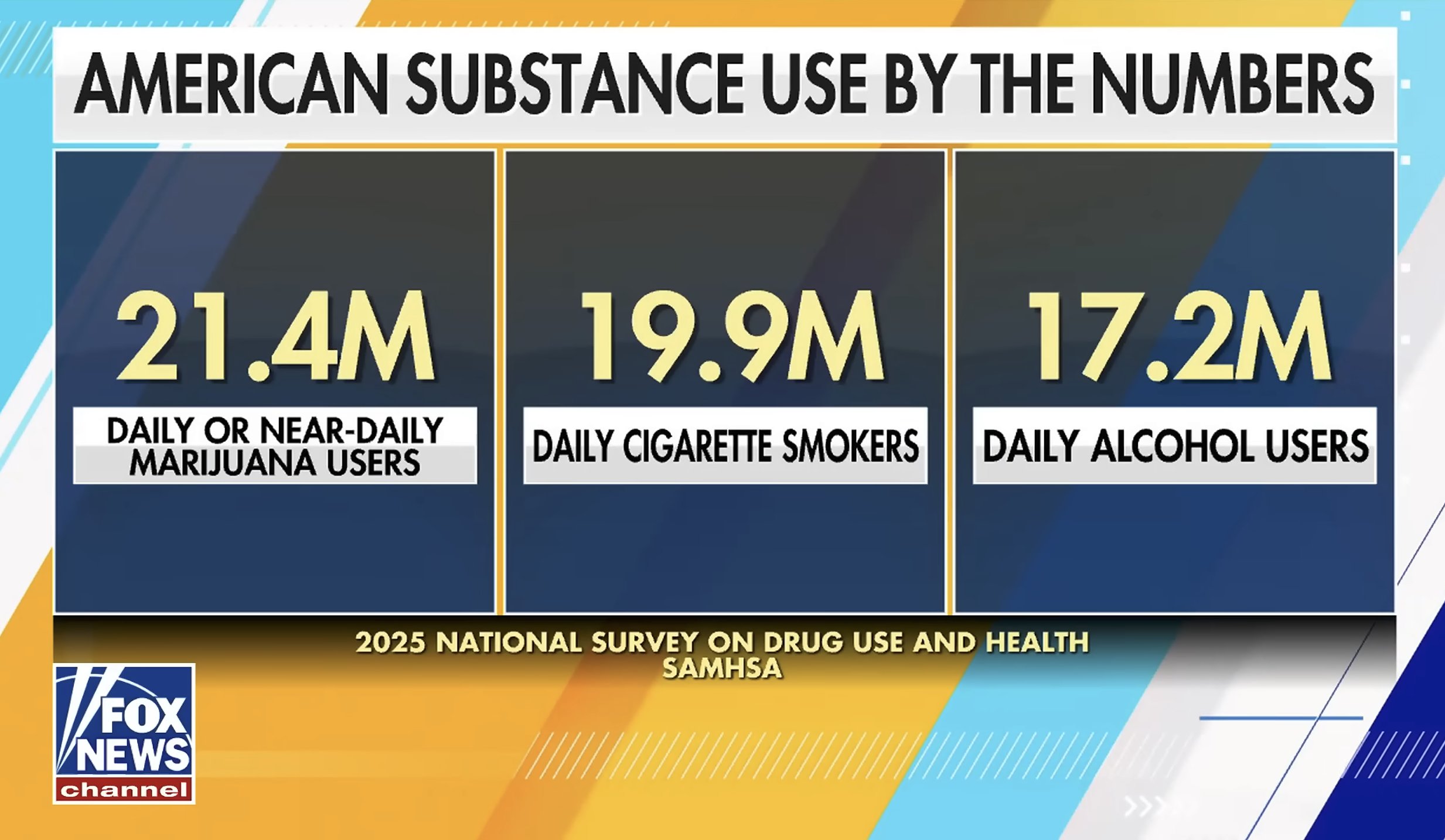
Fox cited figures suggesting approximately 24 million Americans now consume marijuana daily or nearly every day, comparing that figure with 19.9 million daily cigarette smokers and 7.2 million daily alcohol users. Those particular figures should be treated carefully because definitions and survey years matter enormously when comparing different substances. The best known peer reviewed analysis of the trend, published in the journal Addiction using National Survey on Drug Use and Health data, estimated that 17.7 million Americans reported daily or near daily cannabis consumption in 2022, compared with approximately 14.7 million people reporting alcohol consumption at the same frequency.
The historical trajectory is extraordinary. In 1992, fewer than one million Americans reported daily or near daily marijuana consumption. By 2022, the per-capita rate had increased approximately fifteenfold. For the first time in the survey’s history, daily or near-daily cannabis users outnumbered people drinking alcohol with comparable frequency. Alcohol remains more widely consumed overall, but when researchers look specifically at habitual consumption, marijuana has crossed a remarkable cultural threshold. Weed isn’t hiding in America’s basement anymore. It’s sitting on the patio.
Fox News Discovers America Likes Weed
The Fox segment approached the numbers primarily as a health warning, with Siegel arguing that Americans increasingly underestimate marijuana’s risks while simultaneously becoming better educated about cigarettes and excessive alcohol consumption. There is a legitimate argument buried beneath the television theatrics. America spent decades aggressively educating the public about cigarettes. Smoking went from something physicians appeared to endorse in advertisements to one of the country’s most heavily stigmatized consumer behaviors. Alcohol has undergone a slower but noticeable cultural reassessment as research continues documenting its relationship with cancer, liver disease, cardiovascular problems, accidents and addiction.
Cannabis traveled in almost the opposite direction. For decades, marijuana was burdened by absurd propaganda, racially discriminatory enforcement and criminal penalties wildly disproportionate to the behavior being punished. As Americans recognized those injustices, marijuana’s reputation understandably improved. But correcting one exaggeration can create another. Marijuana was never the demonic substance portrayed by Reefer Madness. That doesn’t make it broccoli.
Weed Is Not Harmless
Siegel warned that modern cannabis products can contain considerably more THC than marijuana consumed by previous generations and argued that frequent use can contribute to anxiety, sleep problems and psychiatric complications in susceptible individuals. Those concerns should not simply be dismissed because they appeared on Fox News. High-frequency cannabis consumption carries legitimate risks, including cannabis use disorder, impaired driving, cognitive effects and increased risks of psychiatric complications among some vulnerable users.
The cardiovascular evidence has also become increasingly difficult to ignore. A large study analyzing information from more than 430,000 American adults found an association between cannabis consumption and cardiovascular problems even after researchers accounted for tobacco and other cardiovascular risk factors. Daily cannabis users had 25% higher odds of heart attack and 42% higher odds of stroke compared with nonusers in the observational analysis. Importantly, that does not establish that marijuana directly caused those events, the study identified an association, but it is substantial enough that regular users shouldn’t pretend the cardiovascular question doesn’t exist.
Smoking anything presents another obvious problem. Cannabis smoke contains many of the same toxic and cancer-causing chemicals found in tobacco smoke, according to the CDC. Your lungs do not care whether the smoke came from Marlboro or Maui Wowie. Combustion is combustion.
Where Fox Has a Point: Modern Weed Is Different
There is another complication frequently lost in the political argument over marijuana: today’s cannabis market is not simply your grandfather’s joint. Legal and gray market cannabis industries sell concentrated oils, extremely potent flower, vape cartridges, edibles, dabs and extracts capable of delivering THC doses far beyond what many occasional consumers expect. That matters because public attitudes toward marijuana were largely formed around older versions of the drug.
A person taking a small dose of a regulated edible before watching Netflix is not engaging in precisely the same behavior as someone repeatedly consuming high potency concentrates throughout the day. Treating every form of marijuana consumption as medically identical makes about as much sense as treating one beer and half a bottle of vodka as the same alcohol exposure. Dose matters. Frequency matters. Potency matters. Age matters. Method of consumption matters. Individual vulnerability matters.
Cannabis During Pregnancy Is a Different Conversation
Siegel also raised concerns about cannabis use during pregnancy, including women using marijuana products to manage nausea or morning sickness. Here, the medical warnings deserve considerably more attention than the broader culture war framing. The CDC recommends that pregnant women avoid cannabis because THC can reach the developing fetus and because research has associated prenatal cannabis exposure with adverse outcomes, including lower birth weight and potential neurological and developmental problems. Researchers are still determining the magnitude and mechanisms of those risks.
That scientific uncertainty is not evidence that cannabis is safe during pregnancy. When fetal development is involved, “we haven’t completely quantified the risk” is a terrible reason to assume there isn’t one.
But None of This Vindicates the War on Drugs
This is where marijuana coverage frequently goes off the rails. Acknowledging cannabis risks does not retroactively justify arresting millions of people for possessing it. Those are completely different policy questions. A substance can carry genuine health risks without requiring criminal prohibition. Alcohol kills people. Tobacco kills people. Prescription medications can kill people. Nobody seriously proposes sending armed police officers into someone’s home because they possess a bottle of bourbon.
The rational public policy response to cannabis is therefore neither Reefer Madness nor pretending marijuana is magical green medicine incapable of causing harm. It is regulation: test products, accurately label THC concentrations, keep cannabis away from children, punish businesses selling contaminated products, fund addiction treatment, educate consumers about high potency concentrates, research long term cardiovascular and psychiatric effects, crack down aggressively on impaired driving and stop destroying people’s lives over possession of a plant millions of otherwise law abiding Americans openly consume. Those positions are perfectly compatible.
Legalization Changed More Than the Law
The enormous increase in cannabis use didn’t happen in a vacuum. Most Americans now live in states permitting marijuana in some form, whether through medical programs, recreational legalization or both. Cannabis businesses operate openly in communities where possessing the same product could once result in arrest. Legalization also changed the psychological cost of consuming marijuana. People no longer necessarily have to locate an illegal dealer. They can walk into brightly lit dispensaries where cannabis products are displayed like consumer electronics.
Products are branded. Potency is measured. Strains have marketing campaigns. Edibles look like premium candy. In legal markets, adults increasingly treat buying cannabis less like purchasing an illegal drug and more like stopping at a liquor store. Once marijuana entered ordinary commerce, ordinary consumption followed.
The Real Story Is Generational
Fox can warn its audience about America’s cannabis consumption, but the larger political reality is that marijuana prohibition has lost much of its cultural legitimacy. Millions of Americans have personally used cannabis without experiencing the catastrophic outcomes they were warned about as children. Many watched friends get arrested for possessing marijuana while other people legally purchased substances capable of causing considerably greater immediate harm. That contradiction helped destroy public confidence in prohibition, and once that happened, marijuana legalization stopped being a fringe political cause. It became mainstream.
That doesn’t mean every consequence of legalization has been positive. It means the debate has moved. The question is increasingly not whether Americans will consume marijuana. They clearly will. The question is how a society with tens of millions of cannabis consumers manages the consequences intelligently.
America Doesn’t Need Another Marijuana Panic
Fox News is right about one important thing: normalization should not become denial. People who consume cannabis deserve accurate information about cardiovascular risk, pregnancy, psychiatric vulnerability, dependency, impaired driving and the consequences of heavy long-term consumption. But America has already tried the opposite extreme. For decades, politicians portrayed marijuana as an existential social threat, spent billions enforcing prohibition and incarcerated enormous numbers of people while cannabis remained readily available across the country. That strategy did not eliminate marijuana.
Now America has an opportunity to do something more mature. Legalize it where voters support legalization. Regulate it seriously. Study it aggressively. Tax it reasonably. Keep it away from children. Tell adults the truth about the risks. Then allow adults to make adult decisions.
Because whatever cable news hosts think about it, one fact has become impossible to smoke screen away: America likes weed. A lot.





































Want to join the conversation?
Create an account or sign in to share your thoughts, vote,
and reply to other readers.
Showing 0 of 0 comments
Don't have an account?
Already have an account?