
Some Good Ideas Just Come to an End
The dream of autonomous police patrols has hit a roadblock in central Ohio. After less than a year in service, the City of Dublin, a suburb of Columbus, has officially ended its police robot pilot program, retiring the autonomous security robot known as “DubBot.” City officials determined that while the robot generated public curiosity and demonstrated the potential of emerging technology, it ultimately failed to meet the operational expectations needed for law enforcement.
The decision highlights the growing debate over whether artificial intelligence and robotics are ready to take on meaningful roles in public safety or whether the technology still has significant hurdles to overcome before becoming a practical policing tool.
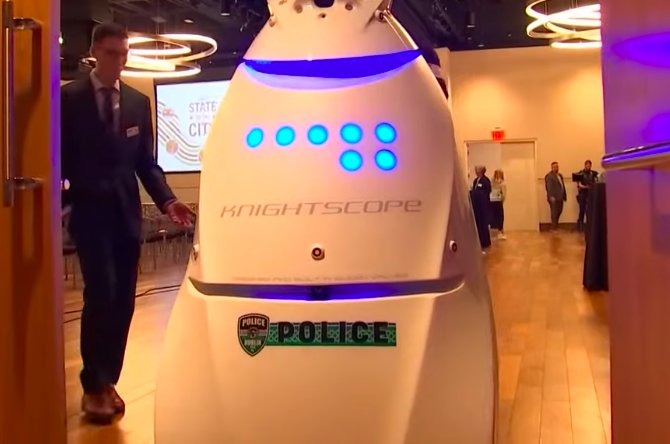
DubBot was introduced in July, 2025 as part of an ambitious pilot program between the City of Dublin Police Department and California-based security robotics company Knightscope. The robot was designed to patrol public areas, particularly parking garages and municipal facilities, acting as an extra set of electronic eyes for officers. Standing several feet tall and equipped with a 360-degree camera system, microphones, speakers, thermal sensors, and autonomous navigation capabilities, the robot could monitor its surroundings continuously while communicating with the department in real time.
Unlike science fiction’s image of robotic police officers making arrests, DubBot’s intended purpose was much simpler. It was never designed to replace officers but instead to provide constant surveillance, deter crime through its visible presence, and alert human officers if suspicious activity was detected.
The City Makes a Deal
The city entered into a contract worth just over $128,000 that included two autonomous robots. However, only one of the robots was ever deployed, while the second never entered service. City officials later announced they expected reimbursement for roughly $60,000 related to the unused unit after deciding to terminate the program. The pilot represented part of a larger nationwide trend in which municipalities have experimented with robotics and artificial intelligence to supplement traditional policing.
Cities across the United States have increasingly explored technologies ranging from drones and automated license plate readers to robotic patrol systems in hopes of improving efficiency while addressing staffing shortages and expanding surveillance capabilities.
Despite its futuristic appearance, DubBot struggled to demonstrate measurable value. According to city officials, the robot did not identify any criminal incidents, contribute to any arrests, or issue any citations during its time in operation. While supporters argued that crime prevention is difficult to quantify because a visible security presence can discourage illegal activity before it occurs, city leaders ultimately concluded the robot did not satisfy the department’s operational needs. Rather than continue investing in a technology that failed to produce tangible results, Dublin chose to end the experiment and return the robot to Knightscope.
Even Though This Program Came to an End, More are On the Way
The decision serves as another reminder that while robotics and artificial intelligence continue advancing rapidly, successful implementation in public safety requires more than impressive hardware. Police departments need technologies that integrate seamlessly with existing operations, provide actionable intelligence, and demonstrate measurable improvements in crime prevention or officer safety. Autonomous patrol robots still face challenges, including limited decision-making abilities, difficulties navigating complex public environments, and public concerns surrounding privacy, surveillance, and accountability.
Although DubBot’s retirement marks the end of Dublin’s experiment, it likely will not be the last attempt to integrate robotics into policing. Companies like Knightscope continue developing increasingly sophisticated autonomous security platforms, and many municipalities remain interested in technologies that can serve as force multipliers without replacing sworn officers. As artificial intelligence becomes more capable, future generations of robotic patrol systems may overcome many of the limitations exposed during Dublin’s pilot program.
For now, however, Dublin’s experience illustrates an important lesson in government innovation. New technology can generate excitement and headlines, but public agencies ultimately judge success by practical results. In this case, the promise of autonomous police patrols proved greater than their real-world performance, leading the city to conclude that human officers remain far more effective than their robotic counterparts. The end of the DubBot program is less a rejection of robotics than a recognition that today’s technology still has considerable ground to cover before becoming an indispensable part of everyday policing.
*****Editor’s Note*****
At the end of the day, this was a pilot program in a small town. Yes, it failed. But don’t you worry. The robot police will be coming. It’s just a matter of time and logistics.



















































Want to join the conversation?
Create an account or sign in to share your thoughts, vote,
and reply to other readers.
Showing 0 of 0 comments
Don't have an account?
Already have an account?