
Universal Denies It Is Backing Away From Alex Gibney’s Scathing Four Hour Elon Musk Documentary
Reports of Studio “Cold Feet” Ignite a Hollywood Controversy as the Film Examines Musk’s Extraordinary Reach Across Technology, Government and Politics
LOS ANGELES — Universal Pictures is pushing back against reports that it is reconsidering the international release of “Musk,” Oscar winning filmmaker Alex Gibney’s sprawling, nearly four-hour documentary examining Elon Musk’s rise from Silicon Valley entrepreneur to one of the world’s most powerful technology executives and an increasingly influential figure in American politics.
The controversy erupted after The Hollywood Reporter reported that Universal, which controls theatrical distribution rights outside North America, appeared to be getting “cold feet” about releasing the film internationally. According to the report, Universal had not established overseas release dates, communication between the studio and the filmmakers had reportedly diminished, and people associated with the production had begun questioning whether the Comcast owned studio still intended to distribute the documentary. The report also raised the possibility that Universal could surrender its rights back to the filmmakers, potentially triggering financial obligations under its distribution agreement.
Universal has publicly disputed the central premise that it is abandoning the documentary. A studio representative said the company remains committed to releasing “Musk” and that its plans have not changed, explaining that Universal is still developing its international release strategy. Subsequent reporting also cited sources familiar with the project who maintained that Universal remains committed to an overseas release and argued that the absence of finalized international dates is not necessarily unusual for a documentary of this type.
The competing accounts have transformed what ordinarily would have been an industry distribution story into a larger controversy involving Hollywood, corporate power and the challenges surrounding the release of a highly critical documentary about a billionaire who controls major technology companies, owns an influential social-media platform and has developed significant political relationships.
Universal’s International Release Becomes Part of the Story
Universal became involved with “Musk” years before the documentary was completed, acquiring international distribution rights while the project was still evolving. Bleecker Street later joined as the North American theatrical distributor alongside HBO Documentary Films, Universal Pictures Content Group, Gibney’s Jigsaw Productions and other production partners.
The documentary itself changed considerably during production as Musk’s public and political role expanded. Gibney began working on the project before Musk’s political involvement reached its later scale, but the billionaire subsequently endorsed Donald Trump, became heavily involved in the 2024 presidential campaign and emerged as a prominent Trump administration adviser associated with the Department of Government Efficiency, or DOGE. Gibney has said what initially began as a roughly two-hour documentary ultimately expanded into a nearly four-hour examination as Musk’s influence increasingly extended beyond technology and business into politics and government.
That evolution is central to the controversy surrounding Universal. The Hollywood Reporter characterized the completed documentary as substantially more politically sensitive than the project Universal originally agreed to distribute, while other reporting has described concerns among members of the filmmaking team about whether political considerations were affecting the international rollout. Those concerns have not been established as Universal’s motive, however, and the studio has explicitly denied that its commitment to releasing the documentary has changed.
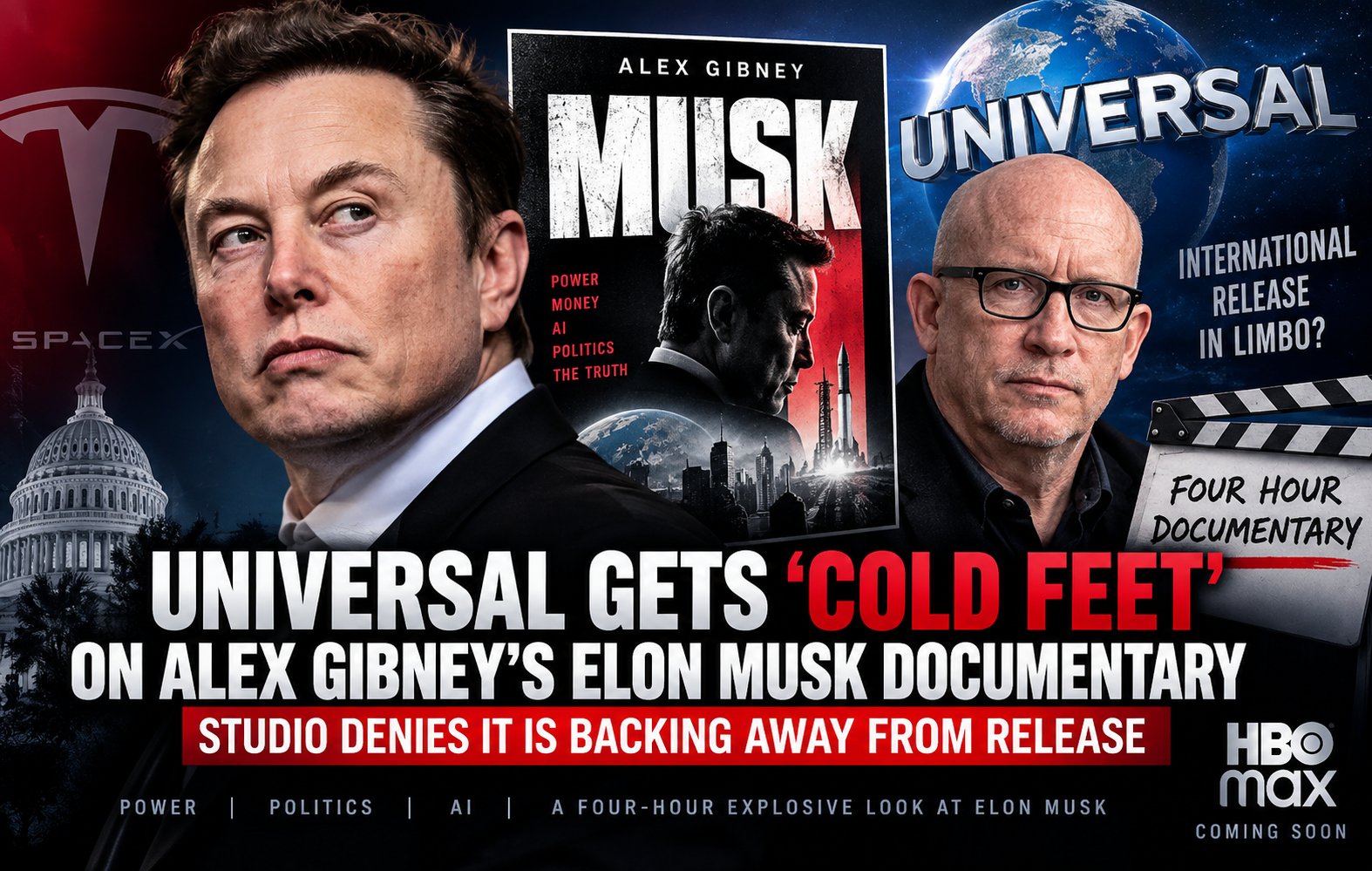
‘Musk’ Is Not a Conventional Celebrity Documentary
Running approximately 235 minutes and including an intermission, “Musk” is an unusually long theatrical documentary and an expansive examination of the billionaire’s life, businesses, political transformation and accumulation of influence. Gibney has spent decades building a reputation for aggressive investigative documentaries examining powerful institutions and personalities, with previous films including “Enron: The Smartest Guys in the Room,” “Going Clear: Scientology and the Prison of Belief,” “The Inventor: Out for Blood in Silicon Valley” and the Academy Award winning “Taxi to the Dark Side.”
“Musk” examines its subject’s trajectory through the technology industry, Tesla, SpaceX, Twitter and X while increasingly focusing on broader questions surrounding the concentration of technological, financial, informational and political power. The documentary features interviews with people who have known, worked with or closely studied Musk, including his father Errol Musk, ex-wife Justine Musk, Tesla co-founder Martin Eberhard, journalist Kara Swisher, author and podcaster Sam Harris, artificial intelligence pioneer Geoffrey Hinton and Ashley St. Clair, who shares a child with Musk.
Gibney has framed the project as an examination not simply of Musk as an individual but of the larger systems that allow technology executives to accumulate extraordinary economic, informational and political influence. Those conclusions represent the filmmaker’s analysis and arguments rather than independently established findings about Musk’s motives.
Musk Declined to Participate, So Gibney Created an AI Musk
Musk did not participate in an interview with Gibney, and the circumstances surrounding attempts to secure his involvement have themselves become disputed. Gibney has said his team repeatedly reached out to Musk without receiving a response, while Musk’s attorney, Alex Spiro, has challenged aspects of the filmmakers’ account and accused the production of bias and misrepresentation. Musk has also publicly attacked the documentary, characterizing it as a “hit piece.”
Rather than leave Musk entirely absent from portions of the documentary, Gibney employed an unusual filmmaking device involving an AI-assisted digital simulation of Musk constructed from his public statements and a computer-generated representation. The filmmakers reportedly consulted attorneys before incorporating the technique, which Gibney has described as a way of examining the public narrative surrounding Musk against the documentary’s broader investigation of his record and influence.
The use of an artificial Musk is particularly notable because the documentary itself explores artificial intelligence, information systems and the growing power of technology companies to influence public discourse. It also places Gibney directly inside one of the debates his documentary examines: how AI-generated representations of real people should be used, understood and disclosed.
Ashley St. Clair Says She Rejected a $40 Million Agreement
One of the documentary’s most closely watched interviews comes from Ashley St. Clair, the conservative influencer who shares a child with Musk. St. Clair has said she was presented with an arrangement potentially worth $40 million that would have required significant restrictions on her ability to speak publicly.
Some accounts have characterized the allegation as Musk offering St. Clair $40 million specifically to stay out of Gibney’s documentary, but the available reporting does not establish that claim that narrowly. Reporting on St. Clair’s account describes the proposed arrangement as involving paternity support and restrictions on public statements rather than a documented $40 million payment offered specifically in exchange for refusing to participate in “Musk.” Musk has disputed that such an offer existed.
St. Clair ultimately participated in Gibney’s documentary and appeared publicly with the filmmaker during the film’s festival rollout, ensuring that her account became part of a project Musk had already criticized before its commercial release.
Musk Threatens Legal Action Over the Documentary
Musk’s opposition to the film has extended beyond criticism on X. His attorney sent a letter to Gibney’s Jigsaw Productions before the documentary’s release threatening potential legal action and challenging claims addressed in the film. The dispute includes the documentary’s treatment of Musk’s political activities and other allegations surrounding his influence and technology.
Musk subsequently attacked both the documentary and people who participated in it, describing the project as a “boring hit piece” and criticizing Gibney personally. Published reporting has noted that it was unclear whether Musk had watched the completed documentary when he began publicly attacking it.
The filmmakers have defended their reporting and say the documentary underwent legal and journalistic review. That confrontation places “Musk” within a familiar territory for Gibney, whose previous documentaries have generated aggressive responses from some of the powerful institutions and individuals they investigated.
Strong Festival Reception Raises the Stakes
Whatever uncertainty surrounds its international distribution, “Musk” has already generated substantial attention on the international festival circuit. The documentary premiered at the Venice Film Festival, where it reportedly received approximately five minutes of applause, and subsequently screened at the Toronto International Film Festival as Gibney continued discussing the film’s central concerns about concentrated technological and political power.
The festival response also affected the American release strategy. Bleecker Street moved the documentary’s U.S. opening forward following its festival run, increasing the contrast between a clearly developing North American rollout and Universal’s still unannounced international calendar.
The lack of overseas dates does not establish that Universal intends to bury the documentary, particularly because international distribution strategies can differ substantially by market. But the combination of the original “cold feet” reporting, reported frustration from people associated with the production and Universal’s subsequent public denial has made the studio’s handling of the documentary part of the story surrounding the film itself.
U.S. Release Remains on Track
Unlike the international situation, there is currently little ambiguity surrounding the documentary’s North American theatrical release. Bleecker Street is scheduled to begin the U.S. rollout on October 9, 2026, initially opening the film in New York and Los Angeles before expanding nationally. Universal’s involvement concerns international theatrical distribution rather than the Bleecker Street release in North America.
HBO is also attached to the project, with the documentary expected to reach HBO and its streaming platforms following the theatrical window. Reporting has also indicated that an extended version of the documentary is planned for HBO, potentially giving Gibney additional space to present material beyond the already substantial theatrical cut.
For now, the most dramatic interpretation of the controversy, that Universal has definitively shelved or canceled Alex Gibney’s Elon Musk documentary, is not supported by the studio’s public position. What is established is narrower but still significant: Universal has yet to announce its international release dates, The Hollywood Reporter reported hesitation surrounding the project, people associated with the filmmakers have reportedly questioned the delay, and Universal has responded by publicly insisting that it remains committed to distributing the movie.
The next concrete test will be whether that commitment produces an international release schedule. Until then, the controversy surrounding “Musk” illustrates an unusual dynamic: a documentary investigating one of the world’s most powerful technology figures has generated a corporate and political dispute significant enough that the battle over releasing the movie has become part of the story the movie itself is attempting to tell.
Sources & Further Reading
- The Hollywood Reporter — Universal Is Getting Cold Feet on Releasing the Elon Musk Documentary — The original report that Universal had not dated the film internationally and that people familiar with the situation believed the studio might return the rights. (JCSA Live)
- TheWrap — Universal Remains Committed to Releasing ‘Musk’ Documentary: ‘Plans Have Not Changed’ — Universal’s response stating that it remains committed to an international release and is working through its release strategy. (TheWrap)
- Variety — Universal Still Plans Overseas Release for Alex Gibney’s ‘Musk’ Documentary — Reports that Universal is moving forward with international distribution despite the controversy and Musk’s legal threats. (Variety Australia)
- Reuters — ‘Musk’ Director Wants Viewers to Reclaim Power From ‘Tech Oligarchs’ — Interview with Gibney covering the documentary’s expansion, Musk’s political role, the simulated Musk character and the filmmaker’s central thesis. (Reuters)
- Associated Press — Ashley St. Clair and Alex Gibney on AI and the Dangers of Elon Musk — Covers the AI/CGI Musk simulation, St. Clair’s participation and her claim that she was offered $40 million in connection with an NDA and paternity-support arrangement. (AP News)
- TheWrap — ‘Musk’ Documentary Moves Release Date Up a Week Amid Rave Reviews and Legal Threats — Details the October 9 New York/Los Angeles opening, subsequent expansion and legal pressure surrounding the documentary. (TheWrap)
- TheWrap — Elon Musk Threatens Legal Action Over Alex Gibney Documentary, Calls It a ‘Hit Piece’ — Covers Musk’s response and attorney Alex Spiro’s letter threatening potential legal action. (TheWrap)
































Want to join the conversation?
Create an account or sign in to share your thoughts, vote,
and reply to other readers.
Showing 0 of 0 comments
Don't have an account?
Already have an account?