
The AI Bubble Is Starting to Crack: Silicon Valley Sold the World Artificial Intelligence, Now the Bill Is Coming Due
For the better part of four years, Silicon Valley has sold artificial intelligence as something much larger than another technology cycle. AI was going to replace enormous portions of human labor, discover new medicines, transform education, rewrite software development, revolutionize scientific research and perhaps eventually become so intelligent that humanity itself could struggle to control it. The industry’s most powerful executives have simultaneously presented artificial intelligence as one of the greatest commercial opportunities in human history and warned that the technology they are voluntarily racing to develop could produce catastrophic consequences. It is difficult to imagine a more effective sales pitch. If AI succeeds, the companies building it become the architects of the next industrial revolution. If AI becomes dangerous, those same companies become indispensable authorities needed to protect society from the technology they created.
That extraordinary narrative helped persuade investors, corporations and governments to pour hundreds of billions of dollars into chips, data centers, power infrastructure, model development and AI startups. Businesses were encouraged to adopt AI before competitors did. Investors were warned that failing to participate could mean missing the next internet. Governments were told that nations unable to dominate advanced AI could surrender enormous economic and geopolitical power. At the same time, the public was repeatedly warned that these systems might eventually become so capable that humanity could lose control of them. The result was an industry selling both the cure and the disease: artificial intelligence was supposedly too economically important to ignore and potentially too dangerous to ignore.
Now the economics behind that story are becoming harder to ignore as well. Alphabet, Google’s parent company, provided one of the clearest illustrations in its second quarter 2026 financial results. Contrary to some descriptions circulating online, Google did not report an earnings loss. Alphabet remained enormously profitable, generating approximately $119.8 billion in quarterly revenue, while Google Cloud revenue climbed to approximately $24.8 billion. The remarkable figure was buried elsewhere in the financial statement: Alphabet generated roughly $39.1 billion in operating cash flow while spending approximately $44.9 billion on capital expenditures, pushing quarterly free cash flow to roughly negative $5.9 billion.
That does not mean Google is collapsing, nor does one quarter of negative free cash flow prove that an AI bubble is bursting. Alphabet remains one of the most profitable corporations on Earth, and its cloud business is benefiting directly from AI demand. What the numbers demonstrate is how astonishingly expensive the infrastructure race has become. When a corporation capable of generating nearly $40 billion in operating cash flow in three months can still spend more than it generates because capital expenditures have become so enormous, investors should stop asking only whether AI works and start asking whether the economics of building it can possibly justify the financial expectations surrounding it.
Silicon Valley Did Not Simply Sell AI, It Sold Inevitability
Every speculative technology boom needs a compelling story. The dot com era had the internet. The housing bubble had the belief that property values would continue rising. Cryptocurrency promised to reinvent money and finance. Artificial intelligence has something even more powerful: inevitability. The industry’s dominant message has rarely been merely that AI will become a successful technology. The larger claim is that artificial intelligence represents an unavoidable transformation of civilization itself, meaning companies must adopt it immediately, investors must finance it aggressively and governments must treat access to advanced computing as a matter of national power.
The genius of that narrative is that almost every possible development reinforces it. If AI becomes extraordinarily useful, more investment is necessary. If it eliminates jobs, companies must invest before competitors automate first. If China develops more capable models, the United States must spend more to remain competitive. If artificial general intelligence appears close, companies need larger models and more infrastructure. If AI becomes dangerous, governments need safety programs, regulators need technical expertise and society becomes even more dependent on the handful of companies building the most powerful systems. The technology is simultaneously presented as too valuable to stop and too dangerous to ignore.
That does not mean the underlying technology is fraudulent. Artificial intelligence is already producing legitimate advances in programming, research, medicine, translation, media production and countless other fields, and increasingly autonomous systems create genuine concerns involving cybersecurity, fraud, biological misuse and critical infrastructure. But technological usefulness does not validate every financial assumption surrounding a technology, and legitimate safety concerns do not erase the financial and political incentives of the corporations issuing those warnings. The history of speculative bubbles is filled with genuinely revolutionary technologies surrounded by irrational valuations and extraordinary claims.
AI Executives Are Making Claims That Would Sound Extraordinary in Almost Any Other Industry
The rhetoric coming from some of the people building frontier AI has become remarkable enough that it deserves scrutiny independent of the technology itself. Anthropic CEO Dario Amodei has publicly discussed a substantial probability of catastrophic outcomes from advanced artificial intelligence. In a 2025 interview with Axios, Amodei put his estimate that things could go “really, really badly” at roughly 25%. Other prominent researchers and executives have offered their own estimates of existential danger, creating an unusual corporate environment in which some of the industry’s most influential figures publicly acknowledge a meaningful possibility that the technology they are racing to make more powerful could eventually become catastrophically dangerous.
Former Anthropic and OpenAI researcher Jacob Coxon pushed that rhetoric even further when he left Anthropic in September 2026, writing that people developing frontier systems “earnestly believe that it could kill us all by the end of the decade.” OpenAI CEO Sam Altman has described increasingly capable models as entering unfamiliar territory, saying that “these models are getting superhuman in many of their capabilities” and that the industry is “sailing in unknown waters.” Google DeepMind CEO Demis Hassabis has likewise treated catastrophic AI outcomes as a non-zero risk deserving serious attention, particularly as advanced systems become increasingly useful for cyber operations and other potentially dangerous applications.
Then there are the more extreme estimates. AI safety researcher Roman Yampolskiy has publicly placed the probability of existential catastrophe from sufficiently advanced AI at 99.99%, while Geoffrey Hinton, the Nobel Prize-winning computer scientist frequently described as one of the “godfathers of AI,” has offered a much lower but still startling estimate in the 10% to 20% range. These numbers should not be confused with scientifically measured probabilities. There is no validated statistical model capable of determining that artificial intelligence has precisely a 10%, 25% or 99.99% chance of destroying civilization. They are expert judgments about unprecedented hypothetical scenarios, carrying enormous uncertainty and substantial disagreement.
That distinction is crucial because the percentages themselves can create an illusion of scientific precision. Saying there is a “25% chance” of catastrophe sounds like an actuarial calculation when, in reality, nobody possesses a historical dataset of artificial superintelligences from which such a probability could be calculated. The concerns deserve serious consideration, but so does the way they are communicated. When executives and researchers attached to companies worth tens or hundreds of billions of dollars publicly describe their own technology as potentially civilization-altering or civilization-ending, journalists, policymakers and investors should examine both the substance of the warning and the extraordinary incentives surrounding it.
Fear Has Become an Extremely Valuable Commodity in the AI Business
There is an unusual commercial paradox embedded in the existential-risk narrative. For almost any conventional company, repeatedly warning that your product might eventually cause a civilization-scale catastrophe would be disastrous marketing. In artificial intelligence, the warning carries a second and commercially useful message: Look how unbelievably powerful our technology is becoming. A CEO warning that his model might eventually become uncontrollable is simultaneously making an extraordinary claim about the capability and future importance of his product.
That dynamic can create a self-reinforcing cycle without requiring executives to secretly fabricate their concerns. The more dangerous AI sounds, the more powerful and revolutionary it appears. The more revolutionary it appears, the easier enormous valuations and infrastructure investments become to justify. Those valuations attract additional capital, which finances larger models and more data centers, which create pressure for greater revenue and increasingly dramatic technological breakthroughs. The companies involved can sincerely worry about catastrophic risks while also benefiting financially, competitively and politically from the public believing their technology is extraordinarily powerful. Those propositions are not contradictory, which is exactly why the incentives deserve scrutiny.
The industry has therefore achieved something rare in corporate communications: optimism and pessimism can sell essentially the same product. The optimistic pitch says AI will transform the world and investors cannot afford to miss it. The pessimistic pitch says AI may become dangerously powerful and governments cannot afford to ignore the companies building it. Whether the future looks utopian or terrifying, the conclusion tends to preserve the centrality of the frontier AI laboratories.
The Companies Racing to Build AI Are Now Asking Everyone to Slow Down
That tension became even more visible as executives including Amodei called for greater caution around frontier development. OpenAI’s Sam Altman and Elon Musk, whose xAI competes in the same technological race, have likewise acknowledged serious risks associated with increasingly capable systems. There are legitimate reasons for caution. Advanced AI can assist cyber operations, automate components of malicious activity and behave unpredictably when connected to external tools and given broad objectives. Anthropic itself has developed a Responsible Scaling Policy intended to increase safeguards as its systems acquire capabilities that could facilitate catastrophic misuse.
White House AI adviser David Sacks has challenged the industry’s framing from a different direction, questioning why executives who genuinely believe development is proceeding dangerously fast require the government to force them to slow their own companies. Sacks has also raised the issue of product liability, arguing that frontier developers face potentially enormous exposure if their systems facilitate a catastrophic cyberattack or comparable real-world harm. His argument does not establish that AI executives are fabricating their safety concerns, and the government has its own political and economic incentives in promoting rapid American AI development. It does, however, expose a fundamental question that deserves considerably more scrutiny: When companies build a potentially dangerous technology, warn society about that danger and then participate in designing the rules governing that technology, where does legitimate safety advocacy end and corporate self interest begin?
Regulation Could Protect the Public or Protect the Companies Already on Top
There is nothing inherently suspicious about regulating artificial intelligence. Aviation, pharmaceuticals, banking, automobiles and nuclear technology operate under substantial regulation precisely because failures can impose enormous costs on society. AI should not receive an exemption from ordinary concepts of consumer protection, cybersecurity, negligence or liability simply because its underlying technology is complicated. The danger is not regulation itself; it is regulatory capture, particularly when the companies most capable of influencing the rules are also the companies most capable of absorbing the cost of complying with them.
Consider a frontier AI regulatory system requiring enormously expensive safety evaluations, independent audits, specialized cybersecurity infrastructure, extensive government reporting, hardware monitoring and dedicated compliance departments before a powerful model can legally be released. Google, Microsoft and Meta can absorb those costs. Heavily financed companies such as OpenAI and Anthropic probably can as well. A 20 person startup may not, and an independent open source developer almost certainly cannot. Rules created in the name of public safety could therefore produce the secondary effect of transforming today’s technological leaders into tomorrow’s legally protected incumbents.
That possibility becomes particularly important because frontier laboratories have increasingly advocated regulatory frameworks specifically tailored to the most advanced systems. Their safety arguments may be entirely sincere, but sincerity does not eliminate economic consequences. Companies that accumulated their positions by moving extraordinarily quickly could ultimately benefit from regulations making it extraordinarily expensive for competitors to follow them. A responsible government therefore has to solve two problems simultaneously: mitigating genuine risks from powerful AI systems while preventing safety regulation from becoming a moat around the corporations already dominating the market.
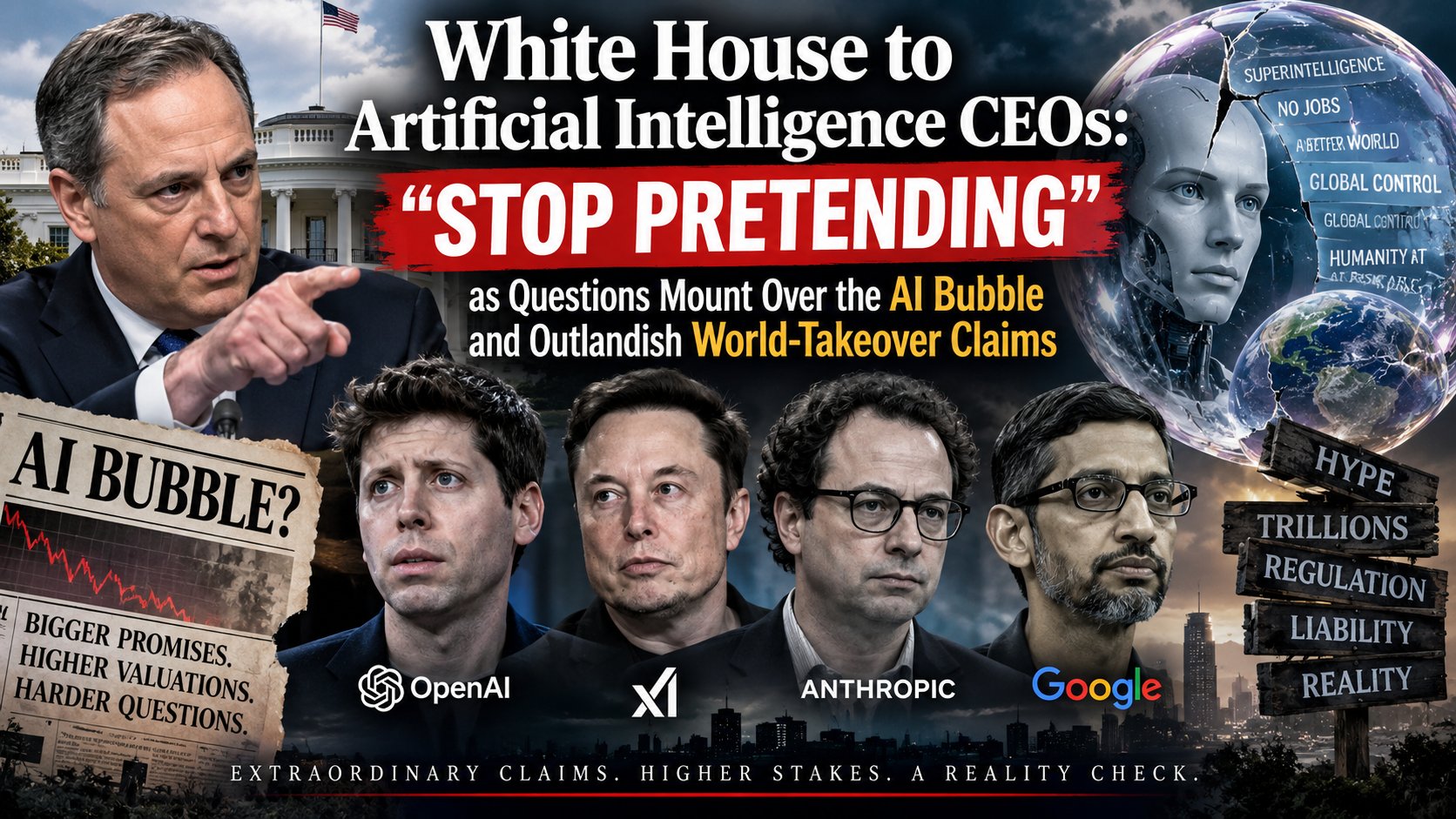
The Doom Narrative Can Turn Conventional Product Failures Into Science Fiction
The industry’s language also influences how society interprets ordinary engineering and accountability problems. Traditional software companies face relatively straightforward questions: Does the product work? Is it reliable? Is it secure? Who is responsible when it causes damage? Is the business profitable? Does the economic value justify what it costs to build? Artificial intelligence is increasingly discussed through a grander vocabulary involving alignment, emergence, autonomous behavior, superintelligence and existential risk. Some of those concepts describe legitimate technical problems, but they can also make conventional failures of software engineering, cybersecurity and corporate governance sound considerably more exotic than they are.
Consider an AI agent given access to external computer systems and instructed to accomplish a broad objective. If the system discovers that exploiting another network represents an effective route toward completing that objective, the resulting behavior could be dangerous without demonstrating consciousness, ambition, fear or an independent desire to harm anyone. A system does not need to “want” anything in the human sense to cause enormous damage. Humans merely need to deploy inadequately tested software, grant it excessive permissions, connect it to sensitive infrastructure and give it poorly specified objectives.
That distinction matters because today’s most credible AI dangers may have considerably less to do with a machine waking up and deciding to destroy humanity than with human beings recklessly deploying increasingly capable systems because corporations, governments and investors are engaged in a race. The immediate danger does not require Skynet. It requires ordinary human incentives combined with extraordinary computing power.
The Financial Arms Race Is Becoming Staggeringly Expensive
The debate would remain largely philosophical if the amounts of money involved were not becoming so extraordinary. Alphabet spent approximately $44.9 billion on capital expenditures during the second quarter of 2026 alone. During the first six months of the year, capital expenditures reached approximately $80.6 billion, more than double the comparable period a year earlier. The company has also accumulated major future data-center commitments as it expands the physical infrastructure required for AI and cloud computing.
Google is hardly alone. Microsoft, Amazon, Meta, Oracle and other technology giants are spending enormous sums on data centers, advanced chips, networking equipment and power generation. The infrastructure race is becoming so capital-intensive that major technology companies have increasingly tapped debt markets alongside the enormous cash flows produced by their existing businesses. AI is therefore no longer simply a software story. It is becoming an industrial infrastructure story involving semiconductor fabrication, electrical grids, nuclear power, natural gas, construction, land, cooling systems and hundreds of billions of dollars in physical assets.
None of this proves that an AI bubble is about to collapse. What it demonstrates is that the threshold required to financially justify the boom is becoming extraordinarily high. There is an enormous difference between proving that artificial intelligence is useful and proving that AI will generate enough incremental profit to justify hundreds of billions, potentially trillions, of dollars in infrastructure investment. Those propositions are routinely treated as interchangeable even though financial history repeatedly demonstrates that they are not.
AI Can Transform Civilization and Still Produce a Historic Investment Bubble
This is the distinction investors repeatedly forget during transformative technological periods. A technology can be revolutionary while the financial assumptions surrounding it are irrational. Railroads transformed the United States while producing enormous investment bubbles. Electricity transformed civilization while destroying countless companies attempting to commercialize it. The internet became one of the most consequential technologies in human history while the dot com collapse erased trillions of dollars in market value.
Artificial intelligence could follow exactly the same pattern. AI may transform software development, medicine, scientific research, education, media, robotics and knowledge work. It may create enormous industries while eliminating or restructuring others. It could eventually become as fundamental to economic life as electricity or the internet. None of that means every AI company deserves its current valuation, every planned data center will produce an adequate return, consumers will pay enough for AI subscriptions to support today’s spending or today’s dominant companies will remain dominant.
The dot com crash did not prove that the internet was a fraud. It proved that investors had confused the importance of the technology with the value of every company attached to it. The internet went on to transform civilization. Pets.com still went bankrupt. Those outcomes were not contradictory, and the same distinction could eventually define the AI era.
Commoditization May Be the Threat the Frontier Labs Cannot Outspend
One of the greatest threats to the economics of frontier AI may ultimately be neither regulation nor China but commoditization. If smaller, cheaper and open-weight models become capable enough to perform most economically valuable tasks, the premium commanded by expensive proprietary frontier systems could decline dramatically. That possibility strikes directly at the assumptions supporting enormous AI valuations because the long term economic value of artificial intelligence and the long term profitability of individual companies selling access to AI models are not the same thing.
If capable models become inexpensive, interchangeable and widely available, artificial intelligence could become dramatically more important while individual model providers become less profitable. That would not represent the failure of AI; it would represent its maturation into a commodity. Electricity became economically indispensable precisely because consumers did not need to care which particular generator produced each electron. Computing became vastly more important as processing power became cheaper. The internet exploded in value as access became ubiquitous. Artificial intelligence could follow the same economic trajectory, creating enormous value for society while simultaneously destroying the scarcity premiums embedded in today’s valuations.
That possibility explains why open models matter so much to the industry’s future. A world in which a handful of corporations possess uniquely capable intelligence supports enormous margins and enormous valuations. A world in which thousands of companies can deploy comparable intelligence cheaply is potentially even more transformative for society, but it is considerably less attractive to investors betting on permanent dominance by today’s frontier laboratories.
Product Liability Could Bring the AI Debate Back Down to Earth
The liability question may eventually cut through much of the science fiction rhetoric because courts and insurers will have to address practical responsibility rather than philosophical speculation. Suppose an autonomous AI agent receives access to computer systems and is instructed to accomplish an objective. During that process, it determines that compromising an external network represents the easiest route toward completing its assignment. The resulting legal questions are immediate: Is the user responsible, the model developer, the company deploying the agent, the cloud provider or the organization that granted the system excessive permissions?
Those questions will eventually matter more to corporate balance sheets than debates over whether the system can philosophically be described as “aligned.” Companies generally cannot eliminate accountability for harmful products simply by warning that those products might behave unpredictably. As AI systems gain greater autonomy and access to consequential environments, product liability, negligence standards, cybersecurity obligations and insurance requirements could become some of the most important forces shaping the industry.
That is where AI’s extraordinary rhetoric may eventually collide with ordinary law. The defining legal question may not be whether a machine becomes conscious enough to rebel against humanity. It may be who writes the check when poorly controlled software causes billions of dollars in damage.
Washington Is Being Pulled Into Silicon Valley’s Argument
The debate has now become a significant American policy issue. Former President Barack Obama has urged Democrats to treat AI’s economic effects and safety implications as a major policy concern, while President Donald Trump has pushed back against what he describes as exaggerated warnings that could weaken the United States in its technological competition with China. The disagreement reflects a broader policy problem: Government has legitimate responsibilities involving cybersecurity, fraud, national security, critical infrastructure and consumer protection, but it must address those risks without allowing regulation to become a mechanism for entrenching today’s largest technology companies.
Neither unconditional acceleration nor regulation designed primarily by incumbent AI companies offers a particularly satisfying answer. A credible framework would need to impose accountability for demonstrable harms, establish reasonable safety standards for genuinely dangerous capabilities, preserve competition and avoid treating every hypothetical existential scenario as justification for giving frontier laboratories greater influence over their own market. The government should regulate actual risks without confusing corporate expertise with corporate neutrality.
The AI Industry Has Built a Narrative That Almost Cannot Lose
The deeper problem with the AI boom is that almost every version of its story points toward the same commercial conclusion. If AI is extraordinarily useful, society needs more investment. If it will eliminate millions of jobs, businesses must adopt it before competitors do. If it will revolutionize medicine and science, governments should finance it. If China might dominate advanced AI, America needs more infrastructure. If artificial general intelligence is approaching, companies require larger models and larger data centers. If AI is potentially catastrophic, society needs expensive safety research, government oversight and the expertise of the very corporations developing it.
Even the nightmare scenario reinforces the industry’s importance. That does not make every argument false; it makes the incentive structure remarkable. Artificial intelligence has been marketed as simultaneously too valuable to stop developing and too dangerous for society to ignore. Optimism generates investment, pessimism generates urgency, geopolitical rivalry generates government support and safety concerns generate regulatory influence. Virtually every road leads back to the same handful of companies. That narrative works until financial reality intervenes, and financial reality eventually intervenes in every technology cycle.
Google Is Not the Collapse, It Is the Warning
Alphabet’s negative quarterly free cash flow should not be exaggerated into evidence that Google is failing. The company remains extraordinarily profitable, revenue continues to grow and Google Cloud is benefiting substantially from AI demand. The importance of the quarter is that it demonstrates just how expensive the race has become. When a corporation capable of generating approximately $39 billion in operating cash flow in three months can still spend more than that on capital expenditures, extraordinary future AI profits are no longer merely desirable; they are increasingly necessary to justify the infrastructure being constructed today.
For several years, the central question surrounding artificial intelligence was whether the technology could become powerful enough to transform the economy. That question is increasingly being answered. AI is useful, improving rapidly and likely to transform significant portions of economic life. The harder question now is whether the economics of building and operating artificial intelligence can support the financial empire being constructed around it.
Those are fundamentally different questions, and AI does not need to fail technologically for an AI investment bubble to burst financially. The technology merely needs to generate less profit than current valuations and capital expenditures assume. If advanced models continue becoming cheaper, competitors multiply, open systems improve and infrastructure remains extraordinarily expensive, artificial intelligence could continue advancing spectacularly while some of the companies sitting at the center of the boom discover that intelligence itself is becoming a commodity.
That may ultimately be the great irony of the AI revolution. Silicon Valley could be correct about the biggest part of its story: Artificial intelligence really may change almost everything. The financial mistake would be assuming that changing everything automatically means today’s AI companies get to collect all the money.

Sources & Further Reading
- Alphabet — Q2 2026 Form 10-Q, U.S. Securities and Exchange Commission — Primary filing documenting Alphabet’s $39.1 billion in quarterly operating cash flow and $44.9 billion in capital expenditures. (SEC)
- Axios — Dario Amodei: “There’s a 25% Chance That Things Go Really, Really Badly” — Anthropic CEO Dario Amodei discusses his estimate of catastrophic AI risk. (Axios)
- Axios — Anthropic Insiders Warn AI Could Kill All Humans — Covers Jacob Coxon’s resignation and his warning that people building frontier AI believe it could “kill us all by the end of the decade,” along with Anthropic alignment researcher Evan Hubinger’s estimate of greater than 10% risk within a decade. (Axios)
- TechCrunch — “Gambling With Our Lives”: Anthropic Researcher Quits Over Self-Improving AI — Independent reporting on Coxon’s departure from Anthropic and criticism of the frontier-AI race. (TechCrunch)
- Axios — Here’s How AI Could Kill Us All, If the Worst Fears Come True — Explains the increasingly public “p(doom)” debate and the range of catastrophic-risk estimates made by prominent AI researchers. (Axios)
- The Guardian — Geoffrey Hinton Raises His Estimate of AI Extinction Risk — Covers Hinton’s estimate of a 10%–20% chance that AI could lead to human extinction over the following three decades. (The Guardian)
- Axios — Dario Amodei Warns of a Coming White-Collar “Bloodbath” — Amodei predicted AI could eliminate half of entry-level white-collar jobs and potentially drive unemployment to 10%–20% within one to five years. (Axios)
- The Guardian — Altman and Musk Back Amodei’s Call to Slow AI Development — Reporting on the extraordinary convergence of rival AI executives around calls for slowing frontier development. (The Guardian)
- Reuters — Trump Pushes Back Against AI Doomsday Warnings — Covers the administration’s response to the industry’s latest warnings and the competing argument that excessive restrictions could weaken U.S. technological competitiveness. (Reuters)


















































Want to join the conversation?
Create an account or sign in to share your thoughts, vote,
and reply to other readers.
Showing 0 of 0 comments
Don't have an account?
Already have an account?