
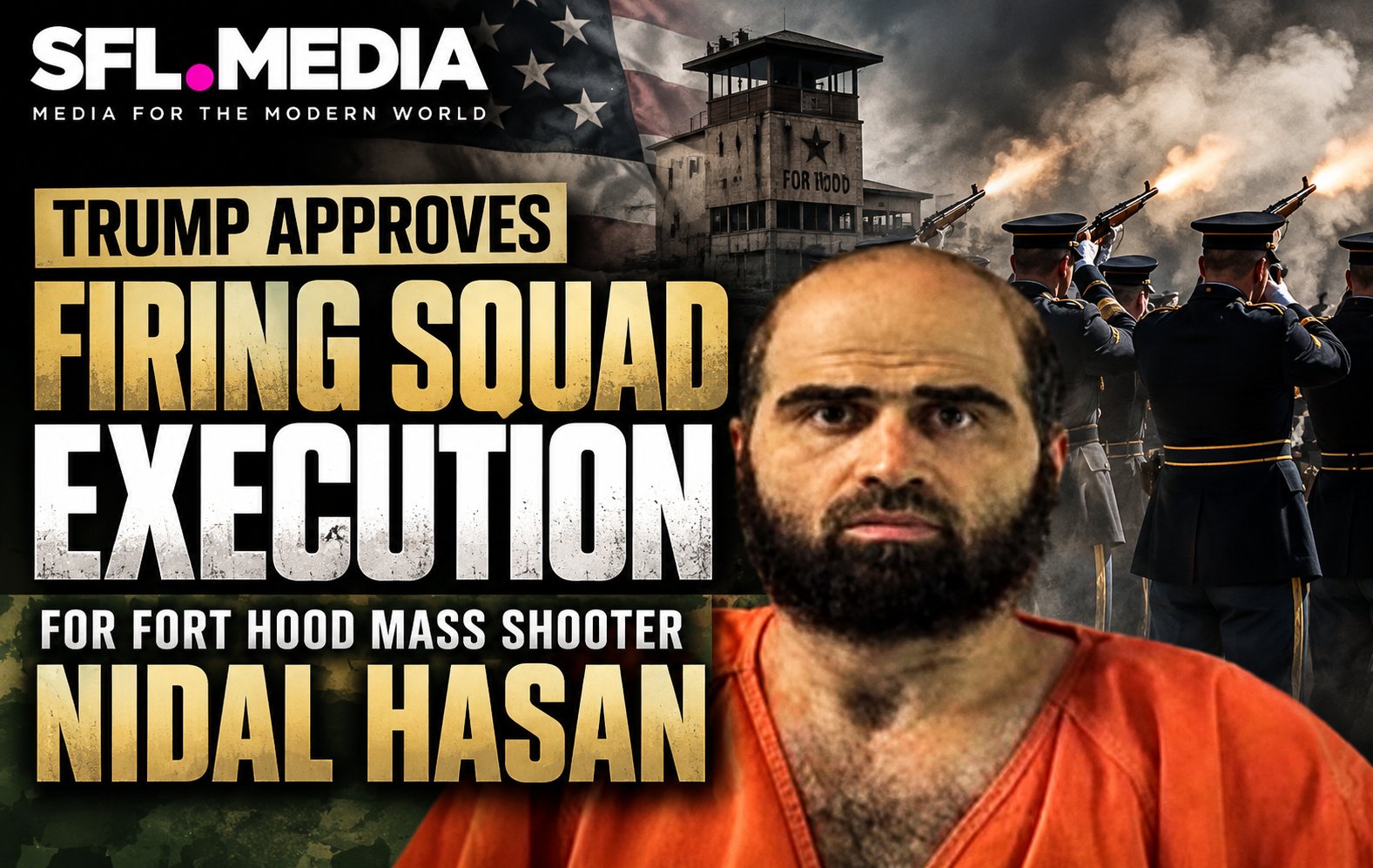
Trump Approves Firing Squad Execution for Fort Hood Mass Shooter Nidal Hasan, Setting Up First U.S. Military Execution in 65 Years
President Donald Trump has approved the execution by firing squad of former U.S. Army Maj. Nidal Malik Hasan, the former Army psychiatrist convicted of murdering 13 people and attempting to murder 32 others during the 2009 mass shooting at Fort Hood, Texas. The extraordinary decision moves one of the most notorious cases in modern military history significantly closer to an execution that, if ultimately carried out, would be the first by the U.S. military since 1961 and the first Army firing squad execution since World War II.
Defense Secretary Pete Hegseth recommended that Hasan be executed by a U.S. Army firing squad, and Trump approved that recommendation, according to Pentagon spokesperson Sean Parnell. The secretary of the Army will now determine the time and location of the execution. “Judgement day for Hasan has finally come,” Parnell said in announcing the decision.
Despite the Pentagon’s unequivocal language, however, Trump’s authorization does not necessarily mean Hasan will be executed immediately. His military appellate process has run its course, and the U.S. Supreme Court declined to hear his case in March 2025, but military legal experts have noted that condemned service members can still seek habeas corpus relief in the civilian federal court system. Those proceedings could potentially delay an execution even after presidential approval.
The 2009 Fort Hood Massacre
Hasan was an Army major and psychiatrist stationed at Fort Hood, now known as Fort Cavazos, when he entered the Soldier Readiness Processing Center on Nov. 5, 2009, armed with a semiautomatic handgun. The facility was filled with military personnel completing medical and administrative processing, including soldiers preparing for overseas deployments, when Hasan opened fire.
The attack killed 13 people, 12 active duty soldiers, and retired Chief Warrant Officer Michael Cahill, who was working as a civilian employee, and Hasan was ultimately convicted of attempting to murder another 32 people. Responding officers shot Hasan, leaving him partially paralyzed, and he was taken into custody.
Hasan was preparing for deployment to Afghanistan at the time of the attack. During his subsequent court martial, he represented himself and acknowledged that the evidence would show he was the shooter. He attempted to argue that his actions were intended to protect Taliban fighters and other Muslims from U.S. military operations in Afghanistan, a proposed defense the military judge rejected. Hasan also described himself during the proceedings as a soldier who had “switched sides.”
A military jury convicted Hasan in August 2013 of 13 counts of premeditated murder and 32 counts of attempted premeditated murder. The panel unanimously sentenced him to death, along with forfeiture of his pay and allowances and dismissal from the Army. He has since been held on military death row at the U.S. Disciplinary Barracks at Fort Leavenworth, Kansas.
More Than a Decade of Appeals Followed
Hasan’s death sentence triggered the extensive mandatory appellate review required in military capital cases. The conviction and sentence were reviewed through the military justice system, including the Army Court of Criminal Appeals and the U.S. Court of Appeals for the Armed Forces. Hasan subsequently petitioned the U.S. Supreme Court, which declined to hear his case on March 31, 2025.
The military death penalty system is deliberately difficult to navigate, in part because of the finality of the punishment. A death sentence imposed by a court martial cannot simply move from the courtroom to an execution chamber once ordinary appeals are exhausted. Under the Uniform Code of Military Justice, the sentence cannot be carried out until it has been approved by the president. Trump has now provided that approval, crossing one of the most significant remaining procedural thresholds in Hasan’s case. Even so, presidential authorization does not necessarily represent the end of the litigation. A detailed 2026 review published by The Army Lawyer specifically examined the modern military death penalty process and Hasan’s case, explaining that a condemned military prisoner can still pursue habeas corpus relief in federal court after presidential approval.
That distinction matters. The Trump administration has moved Hasan substantially closer to execution, but there remains a legal difference between authorizing a military execution and actually carrying one out.
The U.S. Military Hasn’t Executed Anyone Since 1961
The historical significance of Trump’s decision extends far beyond Hasan. The U.S. military has not carried out an execution in 65 years. The last service member executed by the military was Army Pvt. John A. Bennett, who was hanged at Fort Leavenworth on April 13, 1961, after being convicted of raping and attempting to murder an 11 year old girl. Military death sentences have continued to exist since Bennett’s execution, but actually carrying them out has become extraordinarily rare. A 2026 Army legal review identified only four prisoners on military death row: Hasan, Ronald Gray, Hasan Akbar and Timothy Hennis.
President George W. Bush came close to ending the military’s decades-long absence of executions when he approved the execution of Army Pvt. Ronald Gray in 2008. Gray had been convicted of multiple murders and rapes committed while stationed at Fort Bragg, North Carolina, and was scheduled to die by lethal injection. A federal judge halted the execution, however, and Gray remains on military death row. Gray’s case illustrates why Trump’s approval of Hasan’s execution is enormously consequential without necessarily being the final word. Federal courts can still become involved after the president signs off on a military death sentence, potentially stopping or delaying an execution that the executive branch has already authorized.
A Firing Squad Would Make the Execution Even More Historic
The method selected for Hasan adds another extraordinary dimension to the case. If the execution is ultimately carried out by firing squad, it would be the first such execution by the U.S. Army since World War II.
The best known Army firing squad execution from that era was Pvt. Eddie Slovik, who was executed in France on Jan. 31, 1945, after being convicted of desertion. Slovik was the only American service member executed for desertion during World War II. Historical records cited in current reporting indicate that the last known U.S. military execution by firing squad or “musketry” occurred later in 1945. Either way, the American military has not carried out a firing squad execution in more than eight decades. Hasan’s case therefore could revive a method of military execution associated largely with another era of American history.
Trump Administration Has Expanded Execution Methods
The decision also comes as the Trump administration has moved to broaden the methods available for carrying out federal death sentences. Earlier in 2026, the administration announced plans to add firing squads, electrocution and gas asphyxiation as alternatives to lethal injection for federal executions.
Part of that shift has been driven by practical problems surrounding lethal injection, including difficulty obtaining execution drugs and repeated complications in establishing intravenous lines or administering lethal chemicals. Those problems have fueled renewed debate over whether methods such as firing squads should be considered viable alternatives when lethal injection cannot be carried out.
Trump has long been an aggressive supporter of capital punishment. During the final months of his first administration, the federal government resumed executions after a lengthy hiatus and executed 13 federal prisoners between July 2020 and January 2021. His second administration has now moved to expand the government’s execution options, while the Hasan decision brings that broader capital-punishment policy into one of the most consequential military death penalty cases in decades.
A Rare Exercise of Presidential Power
Capital punishment occupies an unusual place inside the American military justice system. The Uniform Code of Military Justice permits the death penalty for certain offenses, but military executions have virtually disappeared from the modern armed forces, and capital cases are subjected to multiple levels of mandatory review.
The president’s role is one of the most significant differences between civilian and military capital punishment. A military death sentence cannot be carried out simply because a court martial imposed it and the appellate courts upheld it. Presidential approval is required before the military can proceed with an execution.
Trump’s decision therefore represents more than an endorsement of the sentence imposed on Hasan in 2013. A sitting president has affirmatively exercised the executive authority required to move a military death sentence toward execution something that has not resulted in an actual military execution since John F. Kennedy was president.
What Happens Next
The next administrative steps fall largely to the secretary of the Army, who will establish the time and place of Hasan’s execution. Army legal guidance states that an execution date generally must be set between 60 and 150 days after presidential approval, although litigation can interrupt that timetable. Hasan can still seek habeas corpus review in federal court, where his attorneys could challenge aspects of his conviction, sentence or execution procedures and seek a stay. Whether such litigation will succeed is another question, but the possibility means no execution should be treated as inevitable until those remaining legal avenues have been resolved.
The case of Ronald Gray provides the clearest warning against assuming presidential approval guarantees an execution. President George W. Bush authorized Gray’s execution, only for a federal judge to intervene and stop it. Hasan’s case could face its own round of post-approval litigation before the government is permitted to carry out Trump’s order.
A Case That Could End a 65 Year Era
There is little factual dispute over who carried out the Fort Hood massacre. Hasan acknowledged during his court-martial that the evidence would establish he was the shooter, a military jury convicted him of 13 premeditated murders and 32 attempted premeditated murders, the military appellate courts upheld his case, and the Supreme Court declined to intervene. He has now spent more than a decade under a military death sentence.
The unresolved question is whether the United States will actually carry that sentence out. If federal courts decline to intervene and the Army proceeds with Trump’s authorization, the government will cross two remarkable historical thresholds simultaneously: the U.S. military will conduct its first execution since 1961, and the Army will carry out its first execution by firing squad since World War II.
That would make Hasan’s death more than the conclusion of one of the darkest criminal cases in modern Army history. It would mark the return of a form of military punishment the United States has not actually used in generations and the end of a 65 year period in which the American military maintained the death penalty but never carried out an execution.

Sources & Further Reading
NBC News — U.S. Military to Conduct First Firing Squad Execution Since World War II
Associated Press — Trump Approves Firing Squad Execution for Fort Hood Shooter Nidal Hasan
Reuters — Trump Orders Firing Squad for Gunman Who Killed 13 at Fort Hood
U.S. Army — Army Lawyer: Modern Military Death-Sentence Procedure and the Hasan Case
Stars and Stripes — Death by Firing Squad Authorized for Former Fort Hood Soldier
Death Penalty Information Center — Historic U.S. Military Executions
CBS News — Fort Hood Shooter Nidal Hasan to Be Executed by Firing Squad
















































Want to join the conversation?
Create an account or sign in to share your thoughts, vote,
and reply to other readers.
Showing 0 of 0 comments
Don't have an account?
Already have an account?