
Christa Pike Survives Tennessee Execution Attempt, Corrections Chief Resigns as State Investigates What Went Wrong
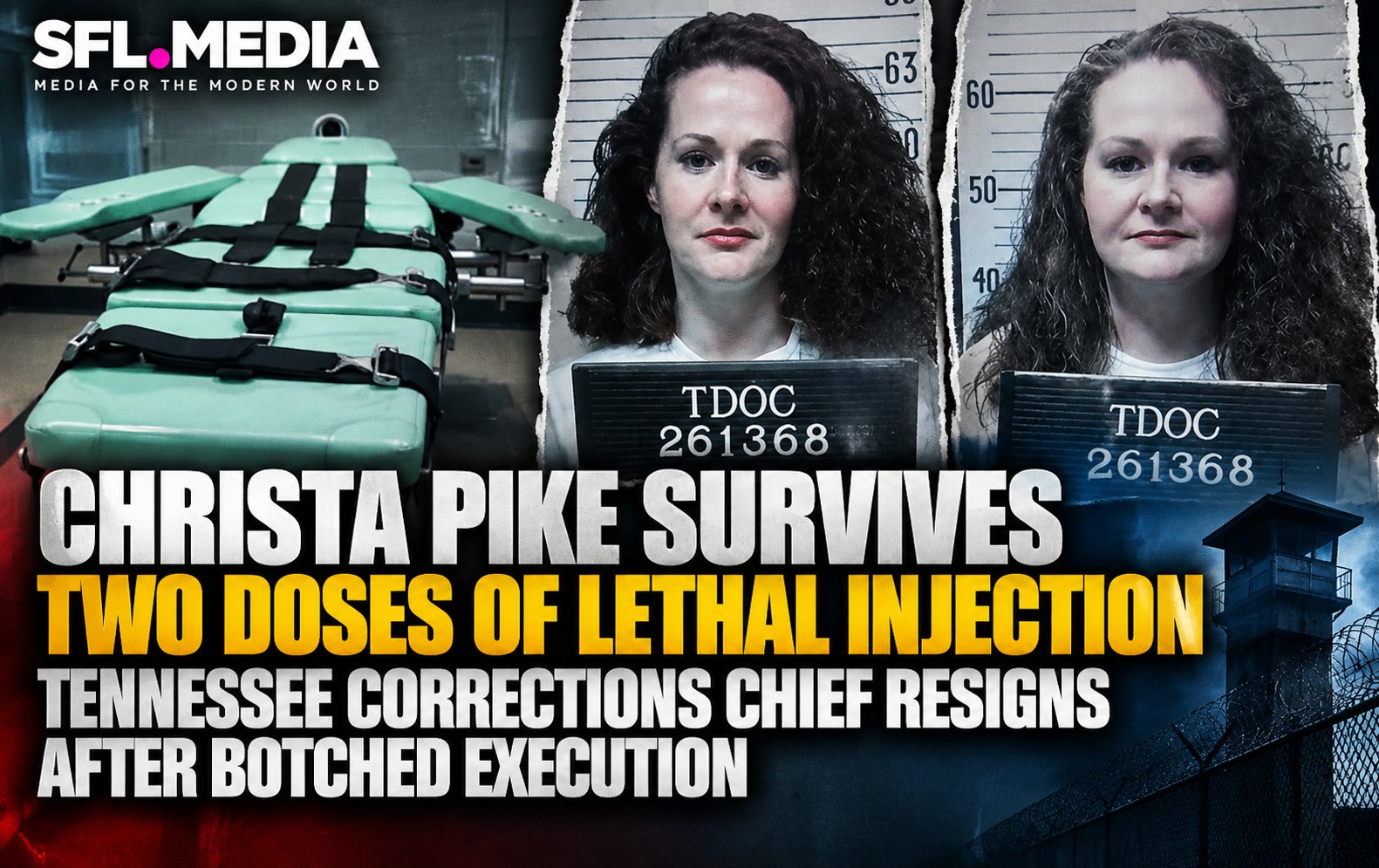
Tennessee’s attempt to execute death row inmate Christa Pike has become an extraordinary crisis for the state’s corrections system after officials administered two doses of pentobarbital but failed to kill her, leaving the 50 year old unconscious, intubated and on a mechanical ventilator as doctors worked to save her life.
Three days later, Tennessee Department of Correction Commissioner Frank Strada announced he would resign. Gov. Bill Lee accepted the resignation, halted executions for the remainder of 2026 and appointed former U.S. Attorney Ed Stanton to lead an independent investigation into what happened inside the execution chamber at Riverbend Maximum Security Institution in Nashville.
The failed execution has triggered scrutiny of Tennessee’s lethal injection procedures, medical warnings raised by Pike’s attorneys before the execution and Strada’s previous leadership role in Arizona during a period when that state experienced its own serious problems establishing IV access during executions. It was also Tennessee’s second failed execution attempt in less than five months, intensifying questions about a system the state had already overhauled following an earlier investigation.
Pike Received Two Doses of Pentobarbital and Remained Alive
Pike was scheduled to die by lethal injection on Sept. 30 for the 1995 torture and murder of 19 year old Colleen Slemmer, a fellow participant in the Knoxville Job Corps program. Had the execution succeeded, Pike would have been the first woman executed by Tennessee in more than 200 years.
Instead, the execution became a medical emergency. After prison officials administered two doses of pentobarbital, Pike lost consciousness but continued breathing, at times making loud snoring like sounds. Her attorneys said she remained alive after the state exhausted the procedures authorized by its execution protocol, and an ambulance eventually transported her from the prison to a hospital.
Pike’s attorneys said in a subsequent court filing that she was unconscious, intubated and dependent on a mechanical ventilator while hospital personnel worked to clear the pentobarbital from her system. They also reported significant injuries to both arms following repeated attempts to establish intravenous access.
Exactly where the execution drugs went is now one of the central questions facing investigators. Pike’s attorneys believe problems with the IV lines caused pentobarbital to enter surrounding tissue rather than properly flowing into her bloodstream. Tennessee officials have not yet publicly determined what caused the execution to fail.
The Death Penalty Information Center described the case as “singular and unparalleled,” saying Pike appears to be the only known person to remain alive after lethal-injection drugs were administered during an execution.
Pike Complained That Her Arm Was Burning
Accounts from inside the execution chamber describe a procedure that became increasingly alarming. Pike initially spoke with her spiritual adviser and told witnesses she was ready to die, but after the process began she complained that her arm was hurting or burning and questioned whether that sensation was normal.
Her attorneys later said Pike complained that her arm felt as though it was going to burst. Attorney Randy Spivey said he counted at least seven locations where needles had been inserted into her left arm and observed what appeared to be a bent needle following one unsuccessful attempt.
Pike nevertheless remained cooperative with the execution team. Her attorneys said she attempted to help personnel locate usable veins, suggesting places where they might try inserting a needle. After the second administration of pentobarbital, Pike appeared to lose consciousness but continued breathing. The viewing curtain was eventually closed, and witnesses were later told to leave as an ambulance was summoned.
What happened behind the closed curtain, including precisely when an execution attempt became an effort to preserve Pike’s life, is among the questions the independent investigation will now have to answer.
Tennessee Says It Followed Its Execution Protocol
The Tennessee Department of Correction has maintained that its execution team followed the state’s approved procedure. In its initial statement, the department said it had followed “every step” of Tennessee’s established execution protocol and that the lethal injection chemical had previously proved effective. Officials also said the protocol did not permit additional execution procedures beyond those already attempted.
That defense creates one of the most significant questions facing the investigation: If Tennessee personnel followed the protocol correctly, why did the protocol fail to produce the intended result?
Lee called what happened “deeply disturbing” and ordered a comprehensive third party review. Former U.S. Attorney Ed Stanton, who previously conducted an independent examination of Tennessee’s execution system following problems uncovered in 2022, has been selected to lead the new investigation. Strada has similarly maintained that corrections personnel followed the established protocol while saying an independent investigation is appropriate and necessary.
Pike’s Lawyers Say They Warned Tennessee About Her Medical Problems
Pike’s attorneys say the difficulties establishing IV access were foreseeable.
Before the execution, they warned courts and Tennessee officials that Pike had small veins and thrombocytosis, a condition involving elevated platelet levels. Her attorneys argued those medical issues could complicate intravenous access and increase the risk that lethal injection would become prolonged and painful.
Those concerns became particularly significant once execution personnel began attempting to establish IV lines. Spivey said Pike’s greatest fear was not dying but experiencing a prolonged and traumatic death. Her attorneys now argue that the state subjected her to precisely the ordeal they had warned could occur, except that the execution ended without her death. They have renewed their request that Lee commute Pike’s death sentence to life imprisonment rather than subject her to another execution attempt.
Frank Strada Resigns as Tennessee Corrections Commissioner
On Oct. 3, Lee announced that Strada would resign as commissioner of the Tennessee Department of Correction and leave the position during the month. Strada said stepping aside was “in the best interest of Tennesseans” while the independent review proceeds and pledged to assist investigators in determining exactly what happened. Lee thanked Strada for his service and said an interim commissioner would be announced. The governor did not accuse Strada personally of causing the failed execution, and no investigation has yet assigned individual responsibility.
Pike’s attorneys welcomed the leadership change but argued that replacing one official would not resolve what they view as broader institutional failures within Tennessee’s death penalty system.
Strada Previously Oversaw Executions in Arizona
Strada’s previous work in Arizona has added another layer of scrutiny. Before becoming Tennessee’s corrections commissioner in January 2023, he served as deputy director of the Arizona Department of Corrections, Rehabilitation and Reentry, where court filings show his responsibilities included overseeing executions after Arizona resumed capital punishment in 2022 following an eight-year hiatus.
Arizona encountered repeated problems establishing IV access during those executions. When Clarence Dixon was executed in May 2022, the medical team struggled for approximately 25 minutes to establish a usable line before making an incision in his groin area. The following month, execution personnel initially struggled to locate a vein while preparing Frank Atwood for execution. A media witness later reported that the IV was ultimately placed in Atwood’s hand after Atwood himself suggested using it. Arizona experienced another problem during the November 2022 execution of Murray Hooper, when an attempt to establish an IV in his right arm failed and another line was inserted into his femoral artery.
Arizona Gov. Katie Hobbs subsequently paused executions after taking office in 2023 and ordered a review of the state’s death penalty procedures. Those incidents do not establish that Strada caused Pike’s failed execution or the earlier complications in Arizona. They do, however, make his previous experience with troubled lethal-injection procedures relevant as Tennessee investigates how another execution system under his leadership produced a major failure.
Tennessee Had Already Overhauled Its Execution System
The Pike case is particularly consequential because Tennessee had already suspended and rebuilt its lethal injection system. Lee halted executions in 2022 after discovering that the state had failed to properly test lethal injection drugs and had not complied with its own procedures. Stanton conducted an independent review that identified significant problems with the system, and Tennessee subsequently revised its execution protocol.
In December 2024, the Department of Correction announced that it had completed that overhaul and would replace its previous multi-drug procedure with a single-drug protocol using pentobarbital. At the time, Strada said he was confident Tennessee could resume executions in compliance with departmental policy and state law.
Executions resumed in May 2025, and Tennessee successfully executed four people under the revised protocol before Pike’s failed execution. But Pike was not Tennessee’s first execution failure of 2026.
Tennessee Had Another Failed Execution in May
In May, Tennessee halted the execution of Tony Carruthers after medical personnel successfully established one IV line in his right arm but could not establish the required secondary line despite attempts involving his other arm, left hand and left foot. Personnel also failed to establish a central line. The execution was abandoned before lethal drugs were administered, and Lee ordered officials to wait at least a year before attempting to execute Carruthers again.
The Carruthers and Pike cases are medically different. Carruthers’ execution was stopped because personnel could not establish the necessary IV access before administering the lethal drug. In Pike’s case, Tennessee proceeded and administered two doses of pentobarbital, but she remained alive.
Together, however, the incidents mean Tennessee has now failed to complete two scheduled executions in less than five months.
Pike’s Execution Was Delayed for Hours by the Courts
Pike’s execution was originally scheduled to begin at 10 a.m. on Sept. 30, but the U.S. Court of Appeals for the Sixth Circuit issued a stay roughly an hour before it was scheduled to begin while considering a last minute legal challenge. Tennessee appealed to the U.S. Supreme Court, which later vacated the stay and allowed the execution to proceed. Approximately eight hours after the original execution time, Tennessee was cleared to carry out Pike’s sentence.
The dispute centered in part on Pike’s arguments concerning evidence of severe childhood sexual abuse and whether that history had been adequately considered in earlier proceedings. Her attorneys have argued that jurors who sentenced her to death were not given a complete picture of the abuse and trauma she experienced before committing the murder at age 18.
Once the Supreme Court cleared the way, Tennessee proceeded with the execution that evening. Hours later, Pike was transported from the prison alive.
At the Center of the Case Is the Murder of Colleen Slemmer
The extraordinary circumstances surrounding Pike’s failed execution do not change the brutal crime that placed her on Tennessee’s death row. Pike was 18 in January 1995 when she participated in the torture and murder of 19 year old Colleen Slemmer, a fellow student at Knoxville Job Corps. Prosecutors said Pike believed Slemmer was a romantic rival and lured her to an isolated wooded area near the University of Tennessee agricultural campus.
Slemmer was beaten, slashed with a box cutter and killed with the participation of Pike and her then boyfriend, Tadaryl Shipp. A pentagram was carved into Slemmer’s body, an element of the case that attracted national attention amid the “satanic panic” of the era. Shipp, who was 17 at the time, later acknowledged carving the symbol. Pike was convicted of first degree murder and sentenced to death. Shipp received life imprisonment with the possibility of parole because he was a juvenile at the time of the crime.
Slemmer’s mother, May Martinez, traveled to Tennessee to witness Pike’s execution and expressed anger and anguish after watching the state fail to carry out the sentence. She said her daughter had again been denied justice and argued that Tennessee owed her family an apology. The failed execution has therefore created trauma on both sides of a case that began more than three decades ago. Pike’s attorneys describe a medically catastrophic execution attempt that left their client critically ill, while Slemmer’s family was forced to endure another painful chapter after waiting decades to see the sentence carried out.
Tennessee Now Faces a Question Bigger Than One Failed Execution
Stanton’s investigation will have to reconstruct what physically happened inside Riverbend: how the IV lines were placed, whether they remained functional, where the pentobarbital went after it was administered, why Pike remained alive and whether execution personnel were adequately prepared for the medical complications her attorneys had warned about.
The investigation also confronts a broader institutional problem. Tennessee halted executions in 2022, investigated its procedures, replaced its lethal injection protocol and resumed capital punishment under a system state officials said would be lawful and effective. Four executions were successfully completed, but in 2026 Tennessee has now failed twice to carry out scheduled executions.
The latest failure is fundamentally different from an execution stopped before lethal drugs were administered. Tennessee injected Pike with the drug intended to kill her, twice, yet she remained alive and ultimately required emergency medical treatment.
The corrections commissioner is resigning. Executions have been halted for the remainder of the year. The same former federal prosecutor who investigated Tennessee’s earlier execution failures has been brought back to determine what went wrong. Pike’s lawyers are demanding that her sentence be commuted, while Slemmer’s family is again waiting for a punishment the state promised it could carry out. Tennessee entered the execution chamber on Sept. 30 intending to exercise the most irreversible power a government possesses.
Instead, it emerged with a question it will have to answer before the state can credibly attempt another execution: How did a lethal injection system that Tennessee had already investigated, rebuilt and declared ready fail again?

Sources & Further Reading
Tennessee Department of Correction — Official Statement on the Christa Pike Execution Attempt
Associated Press — Tennessee Prison Chief Resigns After Failed Execution of Christa Pike
Associated Press — What to Know About Christa Pike and Her Failed Lethal Injection
Associated Press — Tennessee Halts Execution After Pike Survives Lethal Injection Attempt
Reuters — Tennessee Prison Chief Resigns After Failed Execution
Reuters — Christa Pike Receives Life-Saving Medical Care After Failed Execution
ABC News — Pike Unconscious and on Ventilator Following Execution Attempt
Tennessee Department of Correction — 2024 Lethal Injection Protocol Review




















































Want to join the conversation?
Create an account or sign in to share your thoughts, vote,
and reply to other readers.
Showing 0 of 0 comments
Don't have an account?
Already have an account?