
Republicans Begin Putting Distance Between Themselves and Trump as Midterm Pressure Builds
With the 2026 midterm elections approaching, a striking change is emerging inside the Republican Party: some GOP candidates who once benefited from Donald Trump’s political brand are increasingly willing to criticize his policies, minimize his presence in campaign advertising or emphasize their independence from the White House.
The shift does not amount to a wholesale Republican break with Trump, who remains the dominant figure in the party and continues to command strong support among Republican voters. But with control of Congress at stake, the growing number of public disagreements and strategic omissions suggests that candidates in competitive races are making increasingly local calculations about when association with the president helps and when it may hurt.
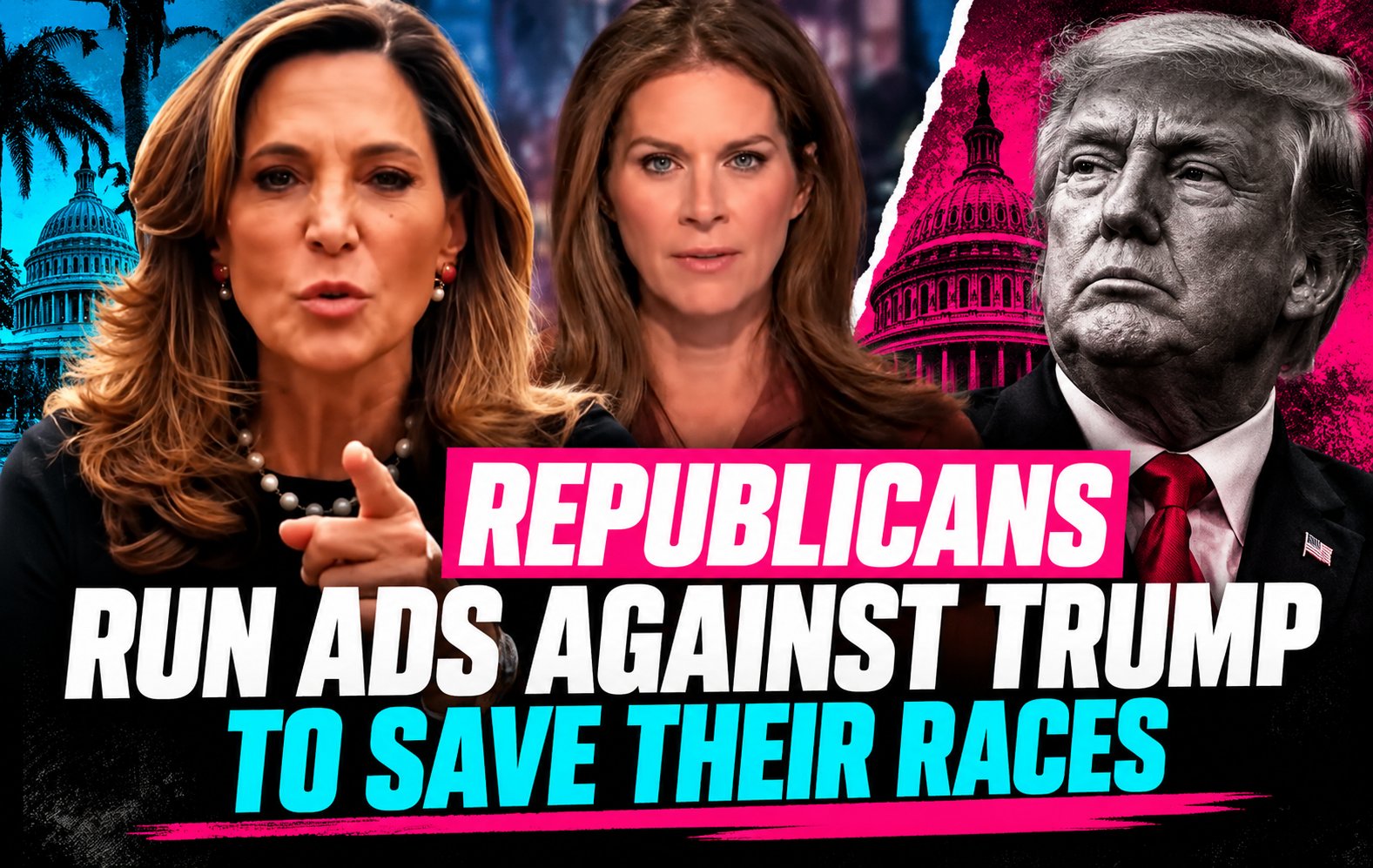
Perhaps nowhere is that tension more visible than South Florida, where Republican Rep. María Elvira Salazar released a campaign advertisement directly challenging Trump over immigration enforcement. “Mr. President, some of your immigration enforcement efforts have gone too far,” Salazar said, warning that some Hispanic voters who supported Trump’s return to the White House in 2024 now “feel betrayed.”
Salazar’s decision to confront a Republican president from her own party was notable on its own. But taken alongside campaign advertising data, criticism from longtime Republican establishment figures and signs of unease among some conservative voters, it points to a broader midterm reality: Republicans are no longer universally running toward Trump as Election Day approaches.
María Elvira Salazar Tells Trump His Immigration Crackdown Has “Gone Too Far”
Salazar’s break with Trump is particularly significant because immigration was one of the defining issues of Trump’s 2024 campaign and remains central to his second administration. Representing Florida’s 27th Congressional District in heavily Hispanic Miami-Dade County, Salazar has long attempted to balance conservative border enforcement with support for legal status and immigration reform for certain undocumented residents.
In her September campaign advertisement, Salazar addressed Trump directly rather than attacking Democrats or speaking generally about immigration policy. “Mr. President, some of your immigration enforcement efforts have gone too far,” she said. Salazar cited detention figures showing that many people taken into immigration custody did not have criminal records and warned Trump to be careful about the advice he was receiving on immigration.
Then came the politically explosive line: “The same Hispanics who helped you get to the White House in 2024 feel betrayed today.”
The criticism represented a significant departure from the posture many Republican candidates maintained during Trump’s return to power. It also reflected the unique political pressure facing Salazar in South Florida, where immigration policy is not an abstract national debate but an issue directly affecting families from Cuba, Venezuela, Nicaragua, Haiti and throughout Latin America.
Trump quickly pushed back, arguing that Salazar was weaker on border security than he was and taking credit for helping her politically. Salazar nevertheless maintained her criticism, illustrating the competing pressures confronting Republicans in districts where Trump’s immigration agenda may be more controversial than it is with the national GOP base.
Recent polling also suggests the political debate over immigration has become more complicated. An AP-KFF survey of rural voters found substantial support for Trump’s crackdown but also meaningful concern about deportations involving immigrants without criminal records. National polling cited in reporting on Salazar’s advertisement has likewise shown significant public concern that enforcement has gone too far.
For Republicans such as Salazar, the challenge is increasingly clear: defend border enforcement without becoming politically responsible for every aspect of the administration’s deportation campaign.
Republicans Are Barely Using Trump in Their Own Television Ads
The clearest evidence of the changing Republican strategy may not be what candidates are saying about Trump, but how rarely they are saying his name at all. A CNN analysis of AdImpact data found that between Sept. 1 and Sept. 15, Republican advertisers aired more than 500 television advertisements representing more than $160 million in spending. Only 12 of those advertisements mentioned Trump, accounting for approximately $1 million. That means less than 1% of the Republican television advertising spending analyzed by CNN was devoted to advertisements specifically mentioning the president.
The contrast with Trump’s own political message is difficult to miss. Trump has repeatedly urged supporters to approach the midterms as though he personally were on the ballot, understanding that presidential parties historically face difficult midterm environments. Yet Republican campaigns in many of the races that will determine control of Congress appear far more interested in emphasizing taxes, crime, immigration, local economic issues and their Democratic opponents than making Trump the centerpiece of their advertisements.
Democrats, meanwhile, are doing the opposite. Democratic campaigns and outside groups have been considerably more aggressive about putting Trump into their advertising, attempting to connect Republican congressional candidates directly to the president and his administration’s policies.
The result is an unusual asymmetry: Trump wants the election nationalized around himself, Democrats often want the election nationalized around Trump, but some Republican candidates appear to prefer an election centered on almost anything else.
Some Republican Candidates Are Also Scrubbing Trump From Their Websites
The advertising strategy mirrors another trend unfolding online. Reporting by The Washington Post found that several Republican candidates in competitive House races toned down Trump related language on their campaign websites after the primary season, removing or deemphasizing references to Trump, MAGA and “America First” messaging as they transitioned toward general election voters.
Such changes do not necessarily mean those candidates have abandoned Trump or his policies. Many continue to list his endorsement elsewhere, support major portions of his agenda or identify themselves with the broader Republican coalition he leads. Campaigns also routinely change websites between primary and general elections.
But taken together with the advertising data, the changes demonstrate a broader recalibration. During Republican primaries, association with Trump can be an enormous political asset. During a general election in a closely divided district, candidates must also appeal to independents, moderates and voters who may support Republican policies without approving of Trump personally. That political distinction becomes particularly important in a midterm election, when the president himself is not on the ballot.
Former Republican Gov. Bill Graves Crosses Party Lines in Kansas
The signs of Republican dissent are not limited to campaign messaging. In Kansas, former Republican Gov. Bill Graves endorsed Democratic Senate candidate Adam Hamilton over Republican incumbent Sen. Roger Marshall, an extraordinary cross-party intervention in a state that has not elected a Democratic U.S. senator since the 1930s.
Graves framed his decision as an institutional argument rather than a conventional partisan conversion, accusing Republicans in Congress of failing to provide an adequate check on executive power. He argued that members of his party had “walked away from their responsibility” to serve as a constitutional counterweight to the executive branch.
In a CNN interview discussing the endorsement, Graves encouraged Republicans and unaffiliated voters in Kansas to consider crossing party lines, arguing that voters should feel free to support a Democrat in a particular race without abandoning their broader political identity. The fact that such an argument is being made in Kansas illustrates the unusual environment surrounding the 2026 midterms. A Senate contest in a state Trump won comfortably in 2024 has attracted enough attention that national Republicans have increased their involvement, including appearances by Vice President JD Vance on behalf of Marshall.
Graves’ endorsement does not establish that Republican voters broadly share his concerns, but it demonstrates that resistance to the Trump administration is no longer coming exclusively from Democrats. Some longtime Republicans are increasingly framing their opposition around institutional checks and balances rather than traditional left-versus-right policy disagreements.
Karl Rove Says He Will Vote Democratic in a Texas Race
Another remarkable break came from Karl Rove, the veteran Republican strategist who helped engineer George W. Bush’s presidential campaigns and served as a senior White House adviser. Rove said he planned to vote for a Democrat for the first time in 32 years, not in a presidential race, but in the contest for the Texas Railroad Commission, because of his objections to Republican candidate Bo French.
The break followed controversial social media posts by French, including a post involving an image of nonwhite students at a University of Texas football game. Rove publicly described the material as bigoted and argued that Republicans should reject that kind of politics rather than excuse it simply because the candidate carries the party label. Rove’s decision is distinct from Salazar’s immigration criticism or the decisions of congressional candidates to minimize Trump in advertisements. It is nevertheless another example of prominent Republicans publicly signaling that party loyalty has limits, particularly when they believe individual candidates or rhetoric have crossed those limits.
The Midterms Are Becoming a Test of Trump Without Trump on the Ballot
The broader political problem for Republicans is that Trump dominates the party while simultaneously presenting candidates with a complicated general-election environment.
He remains capable of driving turnout among Republican voters and continues to exert extraordinary influence over GOP primaries, endorsements and party messaging. His political operation also possesses substantial financial resources, and Republican candidates cannot simply assume distancing themselves from Trump carries no cost. Alienating his most committed supporters could create turnout problems of its own.
At the same time, the political environment surrounding the administration has become more difficult. Energy costs have emerged as a major issue in competitive House and Senate races, particularly as the conflict with Iran affects fuel prices. Immigration enforcement has generated backlash among portions of the Latino electorate and even some rural voters. Trump’s overall approval ratings have weakened, while Democrats are attempting to turn congressional races into referendums on his presidency.
Republicans therefore face a strategic dilemma. They need Trump’s voters, but candidates in competitive districts may not want every race to become a referendum on Trump. That helps explain why campaign advertising can look so different from Republican rhetoric in Washington. Candidates do not necessarily need to denounce the president to create distance. They can simply stop putting him in their commercials.
Even the Republican Message Is Beginning to Shift
Republicans are simultaneously searching for issues that allow them to campaign on familiar conservative terrain without requiring Trump to dominate every conversation. Public safety has returned to the forefront, with GOP candidates reviving tough on crime messaging and attacking Democrats over policing and criminal justice. Border security remains important, but candidates such as Salazar are drawing distinctions between securing the border and supporting every enforcement tactic used inside the country.
Economic issues are even more difficult to avoid. Gasoline, diesel and electricity prices are becoming significant campaign issues in competitive states and districts, giving Democrats an opportunity to challenge Republicans on affordability even as the GOP attempts to shift the debate toward crime, immigration and taxes.
The war with Iran has further complicated the political landscape by linking foreign policy to household costs. Voters who might otherwise view an overseas conflict primarily through national security considerations are also encountering it at gasoline pumps and through broader inflationary pressures.
Those pressures have also produced criticism from populist voices on the Republican right, including figures who have questioned whether the administration has drifted from promises to focus more narrowly on domestic priorities. Such criticism differs substantially from establishment Republican opposition to Trump, but it underscores the same underlying problem: dissatisfaction with the administration is emerging from multiple corners of the broader Republican coalition, even when those critics disagree with one another about what Trump should be doing differently.
This Is Not a Republican Revolt, But It Is a Warning Sign
It would be premature to describe the current environment as a wholesale Republican revolt against Trump. The president remains the central figure in Republican politics, commands considerable loyalty among GOP voters and continues to shape the party’s policy agenda. Most Republican candidates are not running against him, and many continue to support major elements of his administration. What has changed is the willingness of some Republicans to publicly establish distance.
Salazar is telling Trump his immigration enforcement has gone too far. Bill Graves is asking Kansas Republicans to vote for a Democrat because he believes Congress has failed to check executive power. Karl Rove is crossing party lines in Texas over a Republican candidate he has condemned as bigoted. Competitive House candidates have toned down Trump language on campaign websites, while Republican television advertising has frequently left the president out altogether. None of those developments alone defines the Republican Party. Together, however, they reveal candidates and longtime party figures making political calculations that would have been far more difficult during the height of Trump’s 2024 campaign.
The question heading into November is not whether Republicans have abandoned Donald Trump. They clearly have not. The more consequential question is whether enough Republican candidates now believe they need some distance from him to survive.

Sources & Further Reading
CNN — One Place You Won’t Find President Trump? Starring in Republican Ads
https://kvia.com/politics/cnn-us-politics/2026/09/17/one-place-you-wont-find-president-trump-starring-in-republican-ads/
CNN — Erin Burnett OutFront: Republican Divisions Ahead of the Midterms
https://transcripts.cnn.com/show/ebo/date/2026-09-17/segment/01
CBS News — Maria Elvira Salazar Says Trump’s Immigration Enforcement Has “Gone Too Far”
https://www.cbsnews.com/news/maria-elvira-salazar-trump-immigration-ad-gone-too-far/
Reuters — Republican Maria Elvira Salazar Warns Trump His Immigration Agenda Has Gone Too Far
https://www.investing.com/news/politics-news/republican-candidate-in-florida-warns-trump-his-immigration-agenda-has-gone-too-far-4906167
The Washington Post — Salazar Warns Trump on Immigration Enforcement
https://www.washingtonpost.com/elections/2026/09/17/new-ad-republican-warns-trump-he-went-too-far-immigration-enforcement/
The Washington Post — Republican House Candidates Tone Down Trump on Campaign Websites
https://www.washingtonpost.com/elections/2026/09/05/republican-house-candidates-tone-down-trump-their-campaign-websites/
AP — Trump’s Immigration Crackdown Divides Rural Voters as Midterms Approach
https://apnews.com/article/b03eea8538b024fd02f5fb52e811738b
AP — Republicans Return to Tough-on-Crime Message Before Difficult Midterm Elections
https://apnews.com/article/4a181df89b301d65406a0f2235166be4
Axios — Energy Prices Loom Large in Key Senate and House Races
https://www.axios.com/2026/10/06/midterm-election-energy-costs











































Want to join the conversation?
Create an account or sign in to share your thoughts, vote,
and reply to other readers.
Showing 0 of 0 comments
Don't have an account?
Already have an account?