
Tesla Is Selling the Optimus Dream, But Even Elon Musk Admits the Robot Revolution Is Still Unsolved…
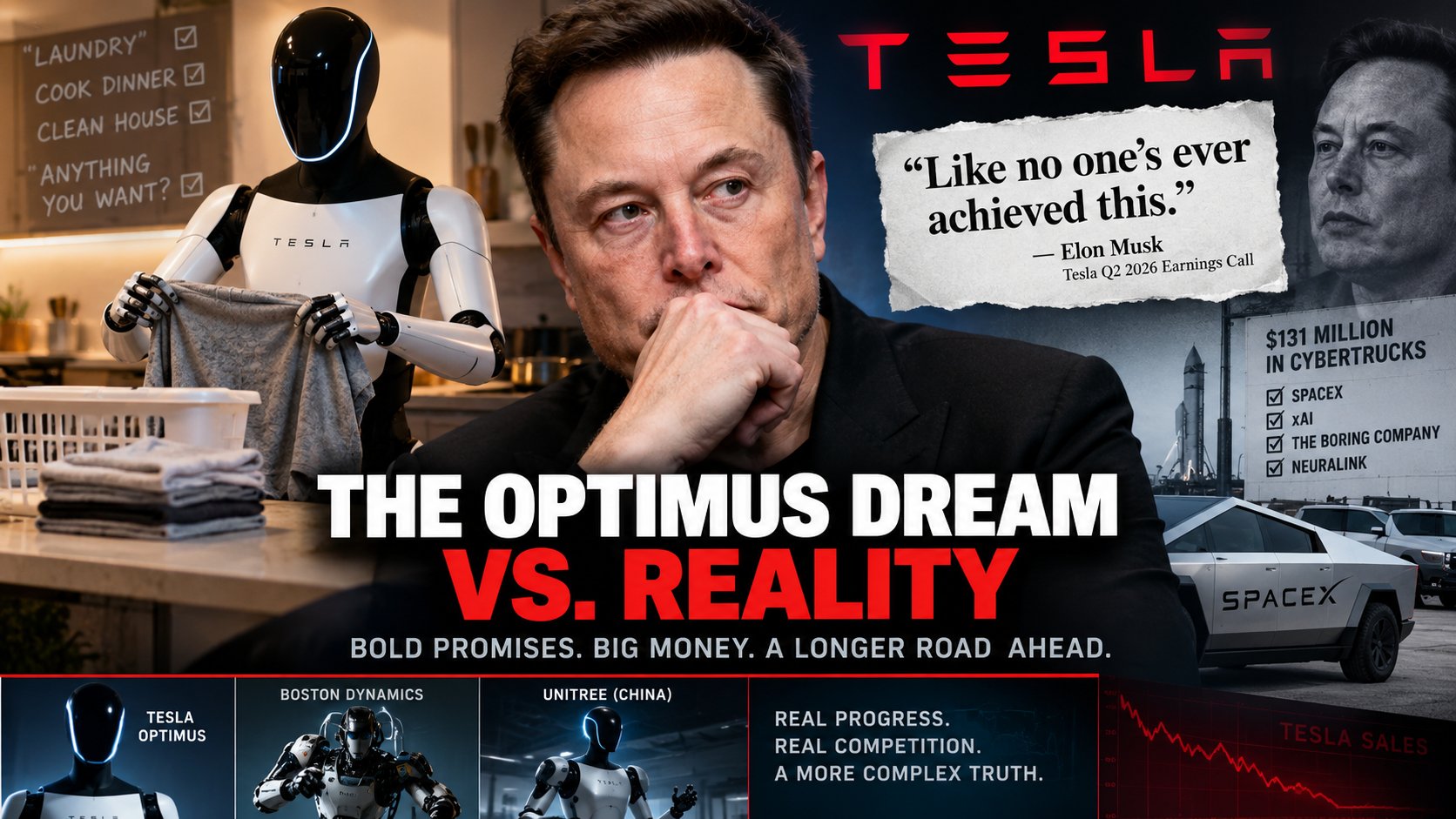
Tesla is increasingly asking investors and consumers to imagine a future in which its humanoid Optimus robot folds laundry, handles groceries, prepares food, cleans homes, works in factories and eventually becomes an almost universal replacement for human physical labor. The imagery is powerful. Tesla videos, company events, Elon Musk’s social media posts and an expanding universe of viral Optimus content have repeatedly depicted the humanoid operating in environments that look increasingly like everyday life. Musk has gone considerably further, describing a future in which Optimus could babysit children, walk dogs, mow lawns, retrieve groceries, serve drinks and perform essentially any physical task its owner requests.
“What can it do? It’ll be able to do anything you want,” Musk told the audience during Tesla’s October 2024 “We, Robot” event, ultimately summarizing the promise this way: “Whatever you can think of, it will do.”
Nearly two years later, however, Musk is publicly acknowledging something considerably less futuristic. Nobody has actually solved the central technological problem required to make that vision work. During Tesla’s second quarter 2026 earnings call in August, Musk described a genuinely autonomous general purpose humanoid as one of the hardest engineering problems Tesla has attempted. A robot that could simply be told what to do, shown an unfamiliar task and then independently perform it without special programming, Musk conceded, remains unprecedented.
“Like no one’s ever achieved this,” Musk told investors.
That admission exposes one of the most important distinctions surrounding Tesla’s increasingly aggressive Optimus narrative. Tesla may be developing a legitimate and potentially transformative humanoid robotics platform, but the general-purpose household robot envisioned by Musk remains substantially different from the capabilities Tesla has publicly demonstrated under conditions that establish autonomous real-world performance.
Tesla Is Marketing the Destination Before It Has Proven the Journey
There is nothing inherently deceptive about a technology company showing what it hopes a future product will eventually accomplish. Automakers routinely display concept vehicles, technology companies demonstrate prototypes and robotics companies publish research videos showing experimental capabilities. The problem emerges when the boundary between demonstrated capability and future aspiration becomes difficult for ordinary viewers to identify.
Tesla has repeatedly shown Optimus manipulating objects, walking through controlled environments, interacting with people and performing chore like movements. Viral videos surrounding Optimus now depict everything from laundry and household cleaning to cooking and restaurant work, although an important distinction must be made: not every Optimus video or advertisement circulating online is an official Tesla production. Some are third-party creations and should not be attributed directly to Tesla.
Tesla and Musk themselves, however, have unquestionably encouraged the broader narrative that Optimus is intended to become a general purpose domestic and industrial worker. At the 2024 “We, Robot” event, Musk described a future in which Optimus could become a teacher, babysitter, dog walker, lawn mower, grocery runner, companion and bartender. That sounds remarkably close to a commercially useful household robot. The technical reality Musk described to investors in August 2026 remains considerably further away.
Musk Now Says General Purpose Humanoid Robotics Has Never Been Solved
During Tesla’s Q2 2026 earnings call, Musk offered one of his most candid assessments yet of Optimus, calling it an extraordinarily complex problem and explaining that Tesla wants to create an autonomous humanoid capable of performing a task after simply being asked to do it or shown an example video, without conventional programming.
“Like no one’s ever achieved this,” Musk said.
The difficulty is not limited to artificial intelligence. Musk cited electromechanical design, dexterity, reliability, mechanical durability and manufacturing as major challenges. He even described the practical problem of a roughly 70 kilogram robot failing in the field and becoming a heavy machine that humans would have to physically carry away.
Tesla nevertheless plans for enormous eventual scale. In its January 2026 investor update, the company described Optimus Gen 3 as its first design intended for mass production and said preparations were underway for its first production line, with production planned to begin before the end of 2026 and eventual planned capacity of one million robots per year. The wording matters. Tesla is describing planned manufacturing capacity, not one million robots currently being produced or one million robots already capable of performing generalized autonomous work.
Tesla’s Most Famous Optimus Event Required Human Assistance
Skepticism about Tesla’s demonstrations is not hypothetical because the company has already shown Optimus performing impressive interactions that were subsequently revealed to involve human assistance. At Tesla’s October 2024 “We, Robot” showcase, Optimus robots walked around the event, danced, served drinks and held remarkably natural conversations with guests. The effect was dramatic, and some attendees initially believed the robots’ conversational abilities were being generated autonomously through artificial intelligence.
Reporting after the event established that humans were remotely assisting many of those interactions. Morgan Stanley analyst Adam Jonas reported that the robots relied on teleoperation, while Tesla Optimus engineering lead Milan Kovac subsequently acknowledged that the robots were “human assisted to some extent.”
That does not mean Optimus was fake. The machines themselves were real, and reporting indicated that some locomotion was autonomous. But a humanoid robot autonomously walking across a floor and a humanoid robot independently understanding an unfamiliar request, planning how to accomplish it, manipulating the physical world and recovering from unexpected problems are profoundly different technological achievements. It is the second capability that would transform Optimus from an impressive robotics platform into the general-purpose worker Musk describes.
Even the Famous Laundry Video Came With an Important Disclaimer
Tesla encountered the same issue when Musk published a video in January 2024 showing Optimus folding a shirt. At first glance, the demonstration appeared to show exactly the kind of domestic capability that could eventually make humanoid robots useful inside ordinary homes. Musk subsequently added a crucial clarification.
“Important note: Optimus cannot yet do this autonomously,” Musk wrote, adding that he believed the robot would eventually perform the task “fully autonomously and in an arbitrary environment.”
That distinction was enormous. Manipulating clothing is particularly difficult for robots because fabric constantly changes shape. Unlike a rigid factory component that appears at a predictable location and orientation, a shirt can wrinkle, fold over itself, twist, slide, stretch and obscure its own geometry.
Doing laundry in an actual home compounds the difficulty dramatically. A genuinely useful household robot would need to locate clothing, distinguish objects, grasp unpredictable piles of fabric, identify machines, manipulate doors and controls, transfer clothing, recognize errors, recover dropped objects, fold garments with different geometries and determine where those items belong. Folding one carefully positioned shirt in a controlled setup demonstrates useful progress in manipulation. Doing the household laundry is an entirely different technological problem.
Cooking Dinner Raises the Bar Even Higher
The same principle applies to imagery depicting humanoids cooking or finishing partially prepared meals. Cooking combines nearly every difficult problem facing general purpose robotics: perception, manipulation, planning, memory, safety, dexterity, force control and error recovery. A robot would need to identify ingredients and utensils, determine what stage of preparation a meal has reached, manipulate objects with radically different physical properties, apply varying amounts of force, avoid contamination, interact safely with heat and appliances, recognize whether food has been prepared correctly and respond intelligently when something unexpected happens. A dropped spoon cannot simply cause the program to stop. Neither can an ingredient sitting in the wrong cabinet, a pan being several inches away from its expected location or a dog walking into the kitchen.
Humans handle thousands of these tiny deviations almost subconsciously. A genuinely useful domestic humanoid must perceive them, understand them and safely recover from them. Tesla has not publicly established that Optimus can independently enter an unfamiliar household and autonomously complete that class of multi-stage domestic work from beginning to end without human assistance.
Musk Is Warning About the Same Problem Tesla’s Demonstrations Have Raised
Musk has also warned that spectacular humanoid demonstrations can create misleading impressions when viewers do not know what is happening behind the scenes. That warning is legitimate. Robotics videos can make systems appear substantially more generalized than they actually are when viewers are not told how much human intervention, environmental preparation, repeated training, editing or task-specific programming occurred outside the frame.
The same standard should apply to Tesla.
When Tesla demonstrates Optimus performing a sophisticated task, the meaningful questions are whether the robot was fully autonomous, whether a human controlled or assisted its movements, whether the environment was mapped or prepared in advance, whether the robot was specifically trained for the objects being used and whether it could repeat the same task in a substantially different environment. Most importantly, a general purpose robot must recover when something goes wrong. Those details determine whether viewers are watching artificial intelligence independently solving a physical problem or sophisticated machinery reproducing a carefully prepared routine.
Boston Dynamics Shows How Competitive This Race Has Become
Tesla is operating in a humanoid robotics industry that is moving remarkably quickly, and it is not the only company with enormous resources pursuing the problem. Boston Dynamics, which has spent decades developing advanced mobile robots, unveiled the production version of its fully electric Atlas humanoid in January 2026. The company says manufacturing began immediately and that its entire 2026 deployment capacity was already committed, with fleets scheduled for Hyundai and Google DeepMind.
Atlas has a dramatically different development history from Optimus. Boston Dynamics has repeatedly demonstrated sophisticated locomotion, balance, recovery and whole body manipulation through generations of experimental robots, giving the company one of the deepest pedigrees in dynamic humanoid robotics. That does not mean Atlas can walk into a South Florida home tomorrow and make dinner. It cannot.
Hyundai’s own roadmap illustrates how deliberately even advanced competitors are approaching deployment. The automaker says Atlas robots trained through its manufacturing ecosystem are expected to begin sequencing work at its Georgia Metaplant by 2028, with more complicated assembly operations targeted for 2030. That timeline is revealing. One of the most sophisticated robotics companies in the world is planning a multiyear progression toward increasingly complicated tasks inside structured factories, not promising an immediate leap into completely autonomous household labor.
Different companies currently lead different portions of an extraordinarily difficult problem. Tesla’s potential advantage lies less in possessing the most athletic humanoid today than in its ability to combine artificial intelligence, computer vision, custom computing hardware, batteries, manufacturing expertise and potentially enormous amounts of training data. That is a formidable strategy. It is not the same thing as having already solved household robotics.
Chinese Humanoid Robots Are Creating Another Challenge for Tesla
China’s rapidly developing robotics industry creates additional competitive pressure. Companies such as Unitree have demonstrated increasingly dynamic humanoids while aggressively lowering the cost of robotics hardware. Unitree’s G1, for example, has been marketed at a starting price dramatically below the historical cost of advanced humanoid research platforms. Chinese robotics manufacturers have also demonstrated impressive locomotion, balance and increasingly sophisticated manipulation.
Those demonstrations do not establish general household intelligence either.
A robot can run, dance, recover from a push or perform an impressive choreographed movement while remaining incapable of independently entering an unfamiliar kitchen and preparing dinner. Physical agility and generalized intelligence are related but fundamentally different technological problems. That distinction applies equally to Tesla, Boston Dynamics, Unitree and every other company competing in humanoid robotics.
Tesla Has a Powerful Financial Incentive to Make Optimus the Future
The Optimus debate matters for considerably more than robotics because Tesla is increasingly positioning itself not simply as an electric car manufacturer but as an artificial intelligence, autonomous-transportation, energy and robotics company. Musk has repeatedly predicted that Optimus could become Tesla’s largest product. During the August 2026 earnings call, he again said he believed Optimus would become “the biggest product ever.” That future matters enormously to the investment thesis surrounding Tesla. It also arrives after Tesla’s traditional automotive business faced increasing competition and an extraordinary political complication created by Musk himself.
A National Bureau of Economic Research working paper by Yale economists attempted to quantify what its authors called the “Musk partisan effect.” Using county level monthly vehicle registration data, the researchers estimated that Tesla sales between October 2022 and April 2025 would have been approximately 67% to 83% higher without the measured effect associated with Musk’s increasingly polarizing partisan political activity.
The researchers estimated that difference was equivalent to approximately 1 million to 1.26 million additional Tesla sales. They also estimated that other manufacturers’ electric and hybrid sales increased by approximately 17% to 22% as consumers substituted away from Tesla. Those numbers require context. The study constructed a counterfactual economic estimate; researchers did not literally identify one million individual customers and ask each whether Musk personally caused them to reject a Tesla.
But the research provides serious empirical evidence supporting something that had previously been discussed largely through surveys, brand research and anecdotal accounts: Musk’s political activity appears to have imposed a substantial commercial cost on Tesla.
Musk Controlled Companies Also Became Major Tesla Customers
Against that backdrop, Musk controlled companies became significant purchasers of Tesla products, creating one of the more unusual related party stories surrounding the automaker. SpaceX’s own 2026 SEC filing provides the clearest evidence. The company disclosed that during 2025 it purchased $506 million of Tesla Megapack products and $131 million of Cybertrucks at manufacturer’s suggested retail price. Tesla separately disclosed approximately $143.3 million in 2025 revenue from SpaceX, primarily from vehicle sales.
Registration data reported by Bloomberg and subsequently cited by other publications showed that SpaceX registered 1,279 Cybertrucks during the fourth quarter of 2025. Electrek, citing the S&P Global Mobility data, reported that those vehicles represented roughly 18% of all U.S. Cybertruck registrations during the quarter. Including approximately 60 additional Cybertrucks registered to xAI, The Boring Company and Neuralink brought the Musk-affiliated total to approximately 1,339 vehicles, or roughly 19% of U.S. Cybertruck registrations for the quarter.
Calling those purchases fraudulent or an illegal bailout would go beyond the evidence. SpaceX received real vehicles, disclosed the purchases to investors and says it paid MSRP. Tesla says related party transactions are governed by its related-person transaction policies. But the transactions remain extraordinary from a corporate-governance and demand analysis perspective. Companies controlled or led by the same executive who runs Tesla purchased more than $100 million worth of Cybertrucks during a period of weak Cybertruck demand. Whatever terminology is used to describe the arrangement, those purchases materially contributed to Tesla vehicle revenue and Cybertruck registrations.
The Financial Web Extends Far Beyond Cybertrucks
The relationships among Musk’s companies extend considerably further than vehicles. Tesla disclosed $430 million in 2025 revenue from xAI for Megapack purchases. Tesla subsequently agreed to invest approximately $2 billion in xAI, an investment that was converted into the right to acquire SpaceX shares following the merger of SpaceX and xAI Holdings. Tesla completed the approximately $2 billion SpaceX investment in March 2026.
The relationship has continued growing. Tesla reported that during the first six months of 2026 it recognized $405 million in revenue from SpaceX for Megapack purchases, including $318 million during the second quarter alone. Reuters, analyzing SpaceX disclosures, reported in May that SpaceX and xAI spent approximately $650 million on Tesla products and services during 2025, including $506 million in Megapacks and $131 million in Cybertrucks. None of those transactions is inherently improper. Companies under common leadership can legally conduct business with one another, and the transactions are subject to disclosure and related party governance requirements.
But the scale of the financial relationships makes scrutiny important because Musk’s companies have increasingly become customers, suppliers, strategic partners and investment targets of one another. That context matters when Tesla simultaneously asks investors to reconsider what kind of company Tesla ultimately intends to become.
Optimus May Still Become Enormously Important
None of this establishes that Optimus will fail.
Tesla possesses several legitimate advantages that could eventually make it one of the dominant humanoid robotics companies in the world. The company knows how to manufacture sophisticated electromechanical products at enormous scale, designs custom computing hardware, develops computer vision systems, possesses extensive battery and power electronics expertise and operates factories that could become both testing grounds and training environments for robots.
Tesla is also attempting to apply lessons from autonomous driving to embodied artificial intelligence. Instead of conventionally programming Optimus separately for every movement, the long term objective is to build systems capable of learning from demonstrations, video, real world experience and eventually large fleets of deployed robots. If successful, that approach could move Optimus beyond carefully programmed industrial automation toward genuinely general-purpose physical intelligence. That would be revolutionary. It has not happened yet.
Factory Robots Could Arrive Long Before Robot Butlers
Humanoid robots do not need to cook dinner to become economically transformative. A robot capable of reliably moving components between workstations, loading machines, sorting products, carrying materials or performing repetitive factory operations could be enormously valuable even if that same robot would be hopeless inside an unpredictable household. That is why industrial environments are likely to become the first major proving grounds for humanoids. Factories and warehouses can be engineered around robots. Floors are predictable, lighting can be controlled, objects can be standardized and workflows can be simplified. Potential hazards can also be isolated and humans can be trained to work around the machines.
Homes are the opposite. Every house is different, furniture moves, objects disappear, children leave things on floors, pets behave unpredictably, clothing changes shape, humans interrupt tasks, kitchens contain heat and liquids, doors stick and objects are rarely positioned exactly where a robot expects them to be. Humans handle these problems because people possess extraordinarily flexible perception, reasoning, dexterity and common sense. Replicating those abilities in a roughly human-sized autonomous machine while maintaining acceptable reliability and safety remains one of the defining engineering challenges of modern robotics.
Is the Tesla Household Robot Really Ten Years Away?
Nobody can responsibly place an exact date on solving general purpose household robotics. It could happen faster than skeptics expect. Artificial intelligence has already produced advances that arrived significantly faster than many researchers and industry observers anticipated. Tesla could also achieve meaningful industrial Optimus deployments within the next several years without coming close to producing the fully autonomous household assistant Musk describes. Those statements are not contradictory.
A humanoid robot successfully performing several highly structured factory operations is not the same product as a relatively affordable machine capable of safely entering millions of unpredictable homes and doing “whatever you can think of.” The latter remains an unsolved engineering problem. Musk now openly acknowledges that fundamental reality.
The Real Optimus Story Is the Gap Between What Tesla Shows and What Tesla Has Proved
Tesla deserves credit for attempting something exceptionally difficult. Humanoid robotics could become one of the most important technologies of the century, and Tesla possesses the capital, engineering workforce, AI expertise and manufacturing experience to become a major competitor. But technological ambition does not eliminate the need to distinguish between autonomous demonstrations, teleoperation, task specific training, carefully controlled environments and genuine general purpose intelligence. That distinction is particularly important with Tesla because Musk has an established history of attaching extraordinarily aggressive timelines to autonomous technology. Tesla’s driving automation ambitions repeatedly took longer to materialize than Musk publicly predicted, and humanoid robotics adds an entirely new layer of mechanical complexity.
A car’s physical controls are fundamentally limited to steering, acceleration, braking and related vehicle systems while software interprets a complicated roadway environment. A humanoid robot promising to cook dinner, fold laundry, babysit children, walk dogs, clean houses, operate equipment and perform virtually any physical task must combine advanced perception and reasoning with extraordinarily versatile physical manipulation. Tesla may someday build that machine. The company has not publicly demonstrated that machine today. That is the distinction investors and consumers should keep in mind when watching the latest spectacular Optimus demonstration. The question is not whether the robot moved, picked something up or successfully completed a choreographed task. The question is whether Optimus understood the task, independently determined how to complete it, executed it without human assistance and recovered when something unexpected happened.
Until Tesla can consistently demonstrate those capabilities in uncontrolled environments, the general-purpose robot Musk describes remains a technological destination rather than a finished product. And perhaps the most important warning about the distance still left to travel now comes from Musk himself.
“No one’s ever achieved this.”

Sources & Further Reading
Tesla, Elon Musk and Optimus
Tesla — Q4 2025 Update: Optimus Gen 3, planned start of production and eventual one-million-unit annual production capacity
Read Tesla’s Official Q4 2025 Investor Update
The Motley Fool — Tesla Q2 2026 Earnings Call Transcript, including Musk’s discussion of Optimus autonomy, dexterity, reliability and manufacturing challenges
Read the Tesla Q2 2026 Earnings Call Transcript
TechCrunch — Reporting on human teleoperation during Tesla’s 2024 “We, Robot” Optimus demonstrations
Read: Tesla Optimus Bots Were Controlled by Humans During the “We, Robot” Event
TechCrunch — Reporting on Musk’s Optimus shirt-folding demonstration and his disclosure that the robot was not performing the task autonomously
Read: Tesla Optimus Robot Folds Laundry in Controlled Demo
Boston Dynamics and the Humanoid Robotics Competition
Boston Dynamics — Official announcement of the production version of Atlas, with 2026 deployments planned at Hyundai and Google DeepMind
Read: Boston Dynamics Unveils New Atlas Robot
Boston Dynamics — History of Atlas and its transition from research platform to production industrial humanoid
Read: Atlas’ Evolution From Research Robot to Industrial Humanoid
Hyundai Motor Group — Official robotics roadmap detailing Atlas training, industrial deployment and plans for increasingly complex manufacturing tasks
Read Hyundai Motor Group’s AI Robotics Strategy
Musk’s Politics and Tesla Sales
National Bureau of Economic Research — Kenneth Gillingham, Matthew Kotchen, James Levinsohn and Barry Nalebuff, “The Musk Partisan Effect on Tesla Sales”
Read the NBER Working Paper
Yale Clean Energy Collaborative — Overview of the researchers’ findings on Tesla sales, political polarization and substitution toward competing EV and hybrid manufacturers
Read Yale’s Summary of the Research
Cybertruck Purchases and Musk-Company Financial Relationships
U.S. Securities and Exchange Commission — SpaceX June 2026 filing confirming $506 million in 2025 Tesla Megapack purchases and $131 million in Cybertruck purchases at MSRP
Read the SpaceX SEC Filing
U.S. Securities and Exchange Commission — Tesla filing disclosing approximately $143.3 million in 2025 SpaceX-related revenue, primarily from vehicle sales, and Tesla’s approximately $2 billion SpaceX investment
Read Tesla’s SEC Filing
U.S. Securities and Exchange Commission — Tesla 2025 annual filing disclosing $430 million in revenue from xAI Megapack purchases
Read Tesla’s 2025 Annual Report
U.S. Securities and Exchange Commission — Tesla Q2 2026 related-party disclosure showing $405 million in SpaceX Megapack revenue during the first six months of 2026
Read Tesla’s Q2 2026 Related-Party Disclosure
Reuters — Reporting on SpaceX disclosures detailing approximately $650 million in 2025 transactions involving Tesla products and services, including Cybertrucks and Megapacks
Read: SpaceX Reveals Extensive Financial Links Across Musk Companies
Electrek — S&P Global Mobility registration data showing SpaceX registered 1,279 Cybertrucks during Q4 2025, with Musk-affiliated companies accounting for roughly 19% of U.S. Cybertruck registrations during the quarter
Read: SpaceX Bought 1,279 Cybertrucks in Q4 2025
This version also removes the unsupported claim that Atlas already performs broad autonomous “heavy lifting,” avoids declaring Chinese robots categorically superior to Optimus, and makes clear that the NBER result is a modeled counterfactual rather than one million documented individual lost customers. Those distinctions make the criticism of Tesla substantially harder to knock down.







































Want to join the conversation?
Create an account or sign in to share your thoughts, vote,
and reply to other readers.
Showing 0 of 0 comments
Don't have an account?
Already have an account?