
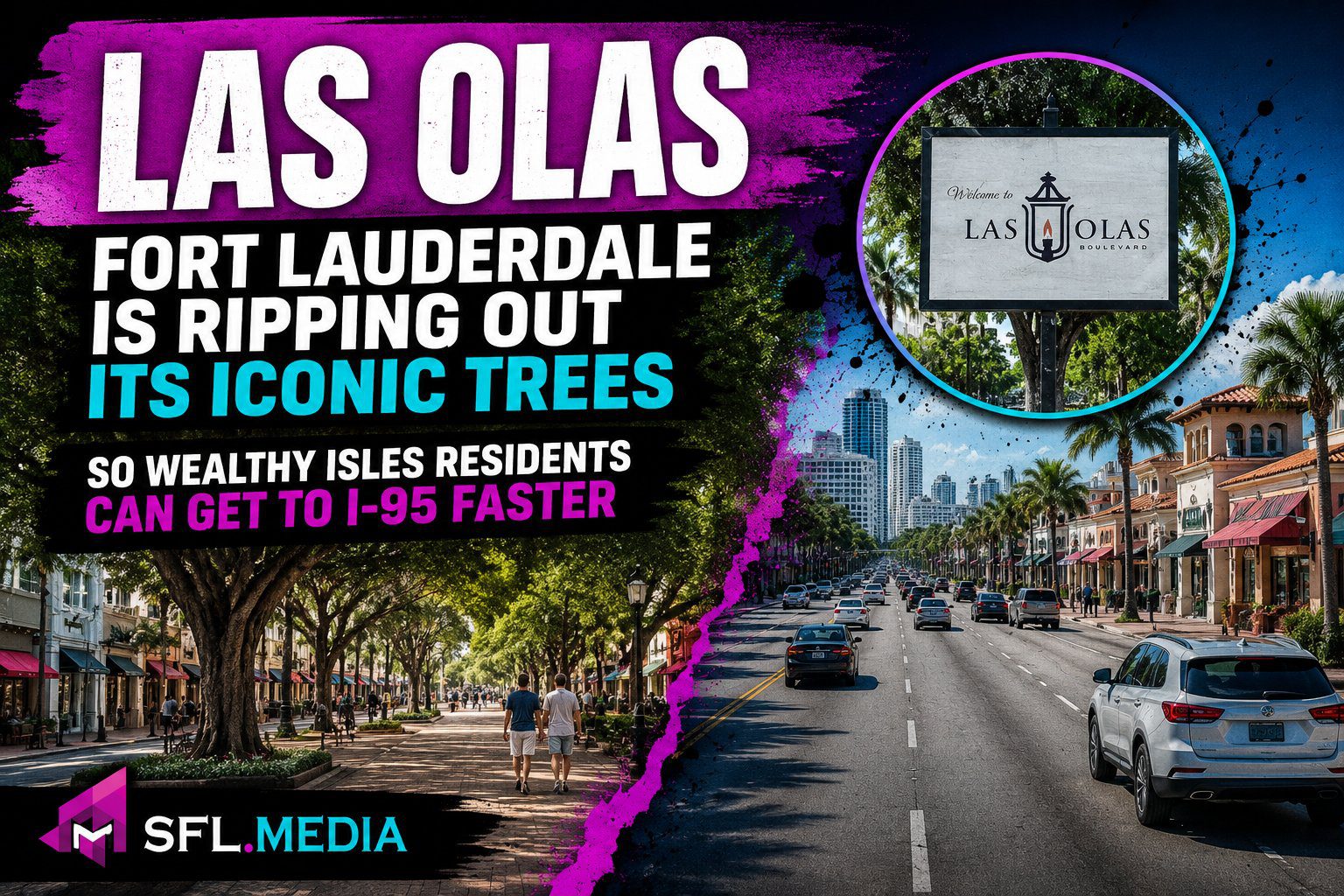
Las Olas: Fort Lauderdale Is Ripping Out Its Iconic Trees So Wealthy Isles Residents Can Get to I-95 Faster
Fort Lauderdale is preparing to fundamentally remake one of the most recognizable streets in South Florida, removing the historic center median and mature black olive trees that have defined Las Olas Boulevard for generations. City Hall describes the project as a mobility improvement, pointing to wider sidewalks, improved lighting, new landscaping, additional shade trees and a modernized streetscape. But beneath the language of beautification and mobility is a much larger transportation decision that Fort Lauderdale residents should understand before the chainsaws arrive: the city is increasingly treating historic Las Olas as a major east west automobile corridor serving traffic moving between the Beach and Las Olas Isles and the mainland transportation network leading toward U.S. 1, Broward Boulevard and I-95.
The four lane component of that transportation vision is not speculation. Fort Lauderdale’s own Las Olas planning documents call for four travel lanes, two in each direction, east of SE 15th Avenue and specifically discuss traffic originating from the Beach and Isles traveling west toward the Shops, Downtown, U.S. 1 and I-95. At the same time, Fort Lauderdale is moving ahead with removal of the historic median through the Shops, permanently changing the physical character and geometry of its most famous pedestrian district.
That should concern everyone who believes Las Olas is more valuable as the cultural and commercial heart of Fort Lauderdale than as a faster route out of some of the city’s wealthiest waterfront neighborhoods. Las Olas Isles is one of the most affluent communities in South Florida, filled with multimillion dollar waterfront estates, private docks and yachts. Those residents have every right to expect safe roads, reasonable access and competent city services, but their transportation needs must be balanced against the interests of the entire city and the thousands of residents, workers, businesses and tourists who use Las Olas as a destination rather than simply a road to somewhere else.
That is the fundamental problem with what Fort Lauderdale is doing. Las Olas became successful because it stopped functioning merely as a road to somewhere else. It became somewhere.
Las Olas Was Fort Lauderdale’s Historic Road to the Beach. Then It Became the Heart of the City
Las Olas has always been tied to transportation. The boulevard developed as Fort Lauderdale grew eastward toward the ocean and became the historic connection between the emerging city and its beach. Over generations, however, something far more valuable happened along the way. Restaurants, galleries, boutiques, hotels, bars and public spaces transformed the boulevard into a destination rather than merely a route.
Today, people come to Las Olas specifically to slow down. They walk between restaurants, sit outside, shop, cross the street, attend festivals, visit galleries and wait for rides. Valet attendants move vehicles throughout the evening, tourists wander between storefronts and downtown residents walk there for dinner. Businesses depend on the constant pedestrian activity that gives the district its economic energy, while drivers inevitably move more slowly because they are looking for restaurants, parking spaces and destinations.
That friction is not evidence that Las Olas has failed as a road. It is evidence that Las Olas succeeded as a place. The boulevard became valuable precisely because it evolved beyond its original transportation function and became one of the relatively few genuinely walkable entertainment districts in a metropolitan area overwhelmingly designed around automobiles. Treating the activity created by that success primarily as an impediment to traffic risks destroying the characteristics that made Las Olas economically and culturally valuable in the first place.
The City’s Own Plan Connects Four Lanes With Beach and Isles Traffic
Fort Lauderdale’s transportation documents make clear that Beach and Isles traffic is central to the city’s analysis of Las Olas. The planning documents describe westbound traffic originating from the Beach and Isles and traveling toward the Shops, Downtown, U.S. 1 and I-95. The city also identifies the unusual transportation limitations created by the geography east of SE 15th Avenue, where residents have fewer options for moving west toward the mainland road network.
The city’s long range analysis calls for four travel lanes east of SE 15th Avenue, with two lanes moving in each direction. That is not neighborhood gossip or an anonymous accusation. It is part of Fort Lauderdale’s own transportation planning, and the practical beneficiaries are obvious. The four lane section serves traffic originating in precisely the expensive waterfront neighborhoods east of the Shops that depend heavily on Las Olas as an east west route toward the mainland.
Fort Lauderdale is therefore confronting a fundamental choice that should be discussed openly. Should Las Olas increasingly be designed around moving automobiles from the Beach and Isles toward the mainland transportation network, or should automobile movement remain subordinate to the pedestrian, commercial and cultural function that transformed Las Olas into the heart of the city?
Las Olas Isles Is Spectacular, Expensive and Geographically Inconvenient
There is nothing wrong with living in Las Olas Isles. It is one of Fort Lauderdale’s signature neighborhoods and part of what makes the city internationally recognizable. Waterfront estates worth millions of dollars sit along canals with yachts tied directly behind them, providing residents with a lifestyle available in relatively few American cities. That extraordinary waterfront geography, however, comes with an unavoidable transportation tradeoff because there are only so many practical ways to travel west.
Las Olas Boulevard consequently carries significant traffic from the Isles toward the mainland. That inconvenience does not automatically mean the city’s central entertainment district should be redesigned around faster automobile travel. Residents throughout South Florida deal with congestion every day, often while traveling dramatically longer distances than the relatively short trip separating Las Olas Isles from the mainland highway network.
Someone living miles west of I-95 can spend substantial time crawling through Broward County traffic before reaching the interstate, while Miami commuters routinely endure some of the worst congestion in the region. Against that reality, sacrificing the character of Las Olas primarily to improve automobile throughput from affluent waterfront neighborhoods becomes increasingly difficult to justify. The convenience of motorists traveling from the Isles must be balanced against the interests of everyone who uses Las Olas as a destination.
Las Olas Is Not Commercial Boulevard, and Fort Lauderdale Should Not Make It One
South Florida already has plenty of roads designed primarily to move automobiles. Commercial Boulevard, Sunrise Boulevard and Broward Boulevard carry enormous volumes of traffic across Broward County and perform an essential transportation function. Nobody, however, confuses those roads with Las Olas. People do not travel to Fort Lauderdale to stroll along Commercial Boulevard after dinner. Tourists do not photograph Sunrise Boulevard because of its romantic streetscape, and restaurants do not build their identities around the intimate pedestrian environment of Broward Boulevard. Las Olas is valuable precisely because it is different.
Turning that environment into an increasingly automobile dominated corridor in pursuit of smoother traffic would sacrifice something Fort Lauderdale cannot easily reproduce. High capacity roads are abundant in South Florida. Authentic urban districts where people actually want to get out of their cars are not. Las Olas is one of them, and the city should be extraordinarily careful before compromising that advantage.
The Median Is More Than a Row of Trees
The fight over the black olive trees matters because the median is not simply decorative landscaping occupying inconvenient space in the middle of a roadway. It is part of the physical architecture that tells motorists they are entering a different kind of environment. The trees narrow the visual field, the median separates opposing traffic, the canopy gives the street a human scale and the physical barrier limits how the roadway can be configured.
Removing the median therefore changes much more than landscaping. It changes the geometry of Las Olas and the possibilities available to transportation planners in the future. Once that physical barrier disappears, the street becomes fundamentally easier to reconfigure than it is today.
Fort Lauderdale says the immediate Shops redesign will provide wider sidewalks, improved crossings, additional landscaping and substantially more trees planted along the sides of the boulevard. Those improvements could be genuinely beneficial, but they do not erase the larger transportation context in which the project is occurring. The city is removing a physical median from its premier pedestrian district while maintaining four lane automobile capacity elsewhere on the same corridor serving Beach and Isles traffic. Residents are entitled to examine those decisions together and demand a clear explanation of the city’s ultimate vision.
Thousands of Residents Asked the City to Save the Median
The public did not quietly accept the proposal. Thousands of people signed a petition calling on Fort Lauderdale to preserve the Las Olas median and its mature trees, arguing that the canopy is part of the boulevard’s history, identity and atmosphere. Residents also proposed alternatives that would allow pedestrian improvements without destroying the historic streetscape, including sacrificing additional curbside parking instead of sacrificing the median.
That suggestion exposes the real priorities behind any street redesign because Las Olas has a finite amount of public space. The city cannot maximize travel lanes, parking, sidewalks, landscaping, bicycle infrastructure, outdoor dining and a mature center median simultaneously. Something has to be sacrificed, and many residents told commissioners they were willing to sacrifice parking.
Fort Lauderdale chose the median instead. That may ultimately prove defensible from an engineering perspective, but it remains a policy choice rather than an inevitability. Residents are entitled to understand why preserving curbside automobile storage was considered more important than preserving a physical feature that has helped define Las Olas for generations.
The City Has a Legitimate Case About the Existing Trees
None of this means every argument coming from City Hall is without merit. Fort Lauderdale has legitimate engineering reasons for reconsidering the existing black olive trees. Consultants and arborists have raised concerns about their condition, constrained root systems and the potential damage major reconstruction could inflict on their long term stability.
City planners also argue that removing the median will allow Fort Lauderdale to create wider sidewalks and ultimately plant substantially more trees along the sides of the boulevard, putting shade directly above pedestrians, restaurants and storefronts instead of concentrating much of the existing canopy between opposing traffic lanes. If executed properly and permanently protected, that could produce a greener and more comfortable pedestrian environment.
That is a defensible urban design concept, but it makes the city’s long term transportation intentions even more important. If this is genuinely a permanent investment in pedestrians, Fort Lauderdale should protect the redesigned pedestrian environment from future conversion into additional automobile capacity.
Four Lanes Will Not Magically Fix Las Olas Traffic
There is a fundamental problem with treating roadway capacity as the answer to Las Olas congestion because the bottleneck is not simply the number of lanes. Las Olas is an entertainment district where cars slow because people are parking, valets are operating, ride share vehicles are loading passengers, delivery drivers are stopping, tourists are searching for destinations, vehicles are entering and exiting side streets and pedestrians are crossing throughout the corridor.
None of those conditions disappear because another travel lane exists. Fort Lauderdale is also growing rapidly, with thousands of residential units added around Downtown and Flagler Village and additional development continuing throughout the urban core. More residents mean more pedestrians, customers, deliveries, ride share trips and automobiles. Additional road capacity therefore does not guarantee permanently free flowing traffic in a growing urban center. Fort Lauderdale could sacrifice part of the historic character of Las Olas in pursuit of smoother traffic and eventually confront the same underlying congestion with more vehicles occupying more pavement.
More Road Capacity Can Produce More Traffic
Transportation planners have confronted this problem for decades. Increasing roadway capacity can temporarily reduce congestion, but additional capacity can also encourage additional driving and development patterns that eventually consume some of the space created, a phenomenon generally known as induced demand.
Las Olas presents an even more complicated situation because it is not a controlled access highway. It contains intersections, driveways, parking, restaurants, pedestrian crossings, valets and constant curbside activity. The capacity of the street is therefore constrained by considerably more than the number of painted travel lanes.
Fort Lauderdale could ultimately widen automobile capacity, alter the character of the boulevard, expose pedestrians to a larger roadway and still discover years later that traffic backs up during peak periods. The city would then have succeeded primarily in creating more space for congestion while sacrificing a historic streetscape that cannot simply be reconstructed overnight.
Fort Lauderdale Just Built a Pedestrian Destination Above the Tunnel
The city’s own recent investments make the transportation strategy even harder to reconcile. Fort Lauderdale spent millions creating public space above the Henry E. Kinney Tunnel, transforming part of Las Olas into a gathering area designed for pedestrians, events and civic activity. That investment reflects the direction successful modern downtowns increasingly pursue. Valuable urban land is being treated as public space rather than exclusively as a conduit for automobiles, with cities investing in sidewalks, outdoor dining, parks, public events, shade and pedestrian safety because those amenities create economic activity and improve quality of life.
Fort Lauderdale therefore needs to reconcile competing urban philosophies. Building major pedestrian gathering spaces while simultaneously designing the surrounding corridor around increasingly efficient automobile movement pulls Las Olas in opposite directions. A successful civic plaza and a mini highway represent fundamentally different visions for downtown, and the city needs to decide which vision ultimately takes priority.
More Automobile Capacity Creates More Exposure for Pedestrians
There is also a basic safety issue that should not be buried beneath discussions of mobility and traffic engineering. People cross Las Olas constantly to reach restaurants, parked vehicles, shops, bars and hotels. Families cross with children, older residents cross slowly, tourists cross while looking for directions and phones, and valet attendants repeatedly move across the roadway during the busiest periods.
A pedestrian crossing two travel lanes faces a fundamentally different environment from someone crossing four. Wider roadways increase exposure time, while street designs intended to improve automobile throughput can influence vehicle speeds and driver behavior. A narrow entertainment street where motorists expect pedestrians, parking activity and constant interruptions operates differently from a major arterial designed to move vehicles efficiently.
Fort Lauderdale’s current Shops design includes pedestrian improvements precisely because the city understands this conflict. Wider sidewalks, improved crossings, lighting and shade are worthwhile investments, but those improvements become increasingly contradictory if the larger transportation philosophy prioritizes pushing greater volumes of automobiles through the same pedestrian environment.
Las Olas Is Becoming More Important as Fort Lauderdale Grows
The timing of this debate could hardly be more consequential. Fort Lauderdale is undergoing one of the largest transformations in its modern history, with Downtown and Flagler Village continuing to add high rise residential development and thousands more people living within walking distance of Las Olas than a generation ago. That growth should make a great pedestrian oriented central street more valuable, not less. A growing downtown needs somewhere residents can walk to dinner, meet friends, attend events, shop and spend an evening without getting into a car every few minutes. Fort Lauderdale already has that street in Las Olas Boulevard. The city should therefore be extraordinarily careful about redesigning its signature street around the needs of people whose primary interaction with the district is driving through it. Transportation access matters, but so does protecting the enormous economic and cultural value generated by making Las Olas somewhere people actually want to stop.
There Is an Unavoidable Class Issue Here
Fort Lauderdale should not pretend transportation decisions exist in a socioeconomic vacuum. Las Olas Isles contains some of the most expensive residential real estate in the city, with multimillion dollar waterfront estates lining the canals and many homes featuring private docks and yachts. Residents of those neighborhoods have substantial economic resources and, like every citizen, have the right to participate in government and advocate for transportation improvements. They do not have a greater right to public infrastructure than everyone else. Las Olas Boulevard does not belong to whoever owns the most expensive property connected to it. It belongs equally to the restaurant worker crossing the street, the family walking after dinner, the tourist staying downtown, the small business owner paying rent, the cyclist traveling to work and the thousands of Fort Lauderdale residents who may never own a waterfront mansion.
If transportation policy prioritizes faster access from elite waterfront neighborhoods over the pedestrian environment used by the broader public, that becomes more than an engineering decision. It becomes a political decision about whose time, convenience, economic interests and safety government values most.
Fort Lauderdale’s Tree Regulations Make the Optics Worse
The controversy becomes especially difficult because Fort Lauderdale itself regulates tree removal. Property owners can face permitting requirements, replacement obligations and mitigation costs when removing protected trees because the city correctly recognizes that mature canopy provides environmental and community value.
There are legitimate differences between private tree removal and reconstruction of a public roadway. Infrastructure projects involve utilities, drainage, root systems and engineering considerations that private property decisions may not. Residents are nevertheless justified in demanding that government meet at least the same philosophical standard it imposes on everyone else.
If mature trees are valuable enough that citizens must justify removing them from private property, then City Hall should make an extraordinarily compelling case before removing an iconic canopy from the public’s most famous boulevard. Government cannot aggressively regulate the public’s treatment of mature trees while expecting unquestioning acceptance when it decides its own trees need to disappear.
Replacement Trees Do Not Settle the Larger Question
Fort Lauderdale argues that the project will ultimately produce more trees, not fewer. Planners want to relocate much of the canopy toward sidewalks and businesses, where new shade trees can directly benefit pedestrians rather than sitting primarily in the center of the roadway. That could ultimately improve the pedestrian environment, but replacement trees do not resolve the transportation question. If the city’s final vision is a permanently pedestrian focused Las Olas with wider sidewalks, abundant shade, safer crossings and slow automobile traffic, Fort Lauderdale should protect that vision in its planning documents.
If the long term transportation strategy instead prioritizes moving increasing volumes of Beach and Isles traffic west toward the mainland transportation network, residents deserve to understand that before the existing median disappears. Trees can be replanted over time, but the philosophy governing a street becomes considerably harder to reverse once infrastructure has been rebuilt around automobiles.
Fort Lauderdale Should Guarantee the Shops Will Remain a Pedestrian District
There is a straightforward way for commissioners to eliminate much of the suspicion surrounding this project. If Fort Lauderdale has no intention of expanding the historic Shops district into four through lanes, the City Commission should state that publicly and incorporate that commitment into the long term planning framework for the boulevard.
The city could designate the Shops as a pedestrian priority district, protect the widened sidewalks and replacement tree canopy, establish the intended number of through lanes and require substantial public review before any future expansion. Such protections would strengthen the city’s argument that removing the median is genuinely about improving the pedestrian environment rather than creating additional flexibility for automobiles.
If commissioners believe Las Olas should remain Fort Lauderdale’s premier pedestrian entertainment district, committing to that principle should be easy.
Las Olas Became Congested Because Fort Lauderdale Got Something Right
There is an irony running through this entire debate that City Hall should recognize before permanently changing the boulevard. Las Olas has traffic because people want to be there. Restaurants are busy, hotels attract visitors, tourists come downtown, people move into nearby apartments, developers build towers because residents want access to the district and businesses compete for storefronts because pedestrian activity has economic value.
The congestion Fort Lauderdale is attempting to manage is partly the byproduct of success. Cities across America spend enormous amounts of money trying to manufacture vibrant, walkable districts filled with restaurants, nightlife, retail and recognizable public spaces. Fort Lauderdale already has one. Destroying pieces of that environment to make it easier to drive through would risk undermining the very success the city should be protecting. Las Olas does not need to become more like Commercial Boulevard simply because it sometimes takes motorists longer than they would prefer to reach the interstate.
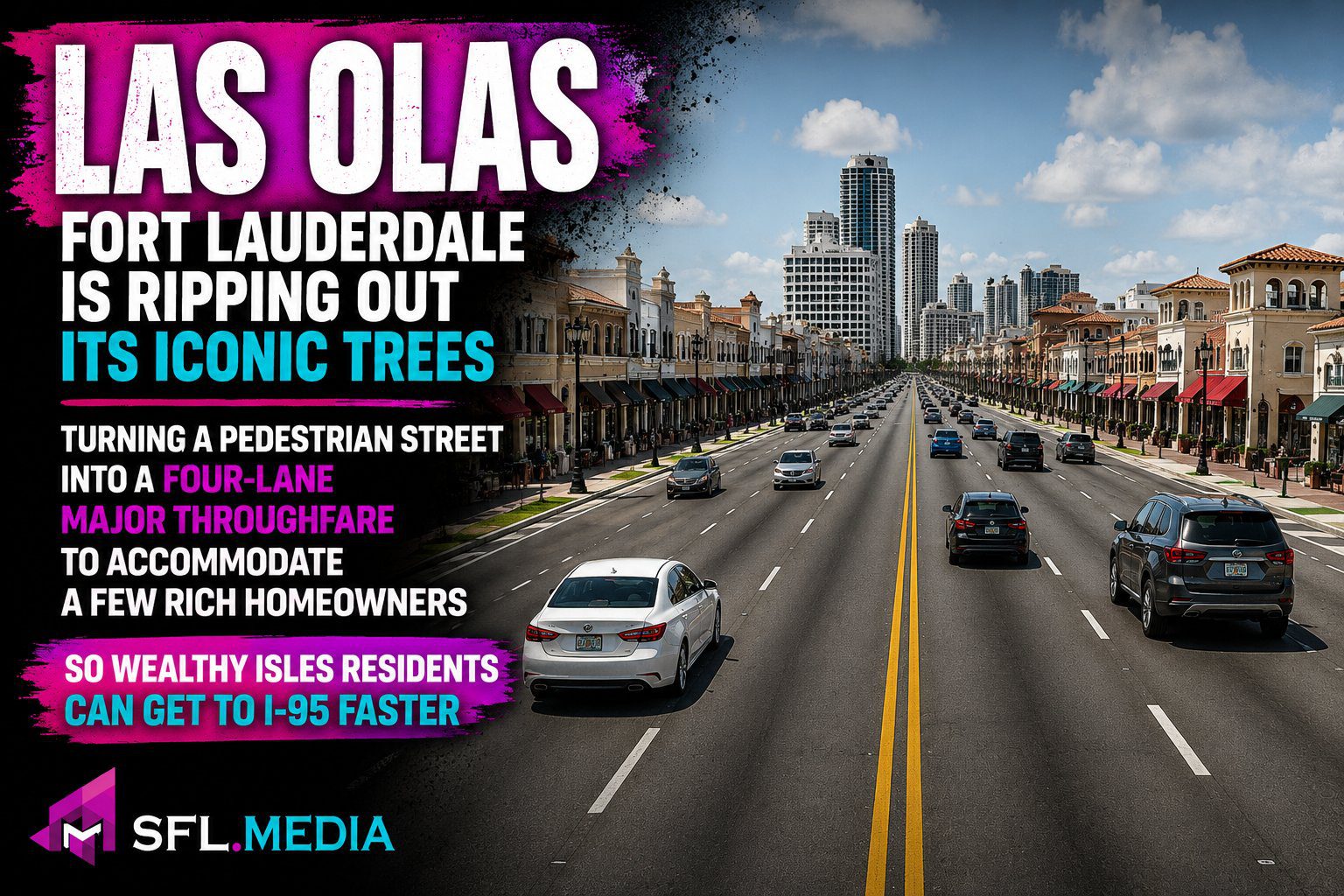
Las Olas Should Not Become a Mini Highway to I-95
The debate over Las Olas is ultimately much larger than a collection of black olive trees, a landscaped median or another municipal road project. It is about what kind of city Fort Lauderdale intends to become as billions of dollars of development transform its downtown. The city can continue building a dense, walkable urban center organized around people, restaurants, businesses, parks and public spaces, or it can continue treating every traffic delay as a problem requiring additional automobile capacity. Attempting to maximize both objectives eventually forces choices about which one matters more.
Fort Lauderdale’s own planning documents establish four lane capacity on portions of Las Olas east of SE 15th Avenue and explicitly analyze traffic originating from the Beach and Isles as it moves west toward the Shops, Downtown, U.S. 1 and I-95. Meanwhile, the city is removing the historic median through the Shops and permanently changing the physical geometry of its most iconic boulevard.
The practical beneficiaries of improved westbound automobile movement include some of Fort Lauderdale’s wealthiest waterfront neighborhoods. The potential costs are borne by everyone who uses Las Olas as something more important than a route toward the interstate. Fort Lauderdale should not sacrifice its signature street so anyone, rich or poor, can reach I-95 a few minutes faster, nor should it allow one of South Florida’s rare successful pedestrian districts to evolve into another automobile dominated thoroughfare while describing the transformation simply as beautification.
Las Olas is not merely a road connecting waterfront homes to the mainland. It is the historic, commercial and cultural heart of Fort Lauderdale. The city should plan its future accordingly.

Sources
City of Fort Lauderdale: Las Olas Boulevard Mobility Project
City of Fort Lauderdale: Las Olas Boulevard Vision Plan and Transportation Analysis
City of Fort Lauderdale: Las Olas Eastern Corridor Vision Plan
City of Fort Lauderdale: 2026 Las Olas Western Corridor Commission Record
WLRN: Fort Lauderdale Advances Las Olas Improvements and Removal of Iconic Median Trees
CBS News Miami: Fort Lauderdale’s Tree Lined Las Olas Boulevard Faces Major Redesign
WSVN 7News: Fort Lauderdale Commissioners Vote to Remove Las Olas Olive Trees














































Want to join the conversation?
Create an account or sign in to share your thoughts, vote,
and reply to other readers.
Showing 0 of 0 comments
Don't have an account?
Already have an account?