
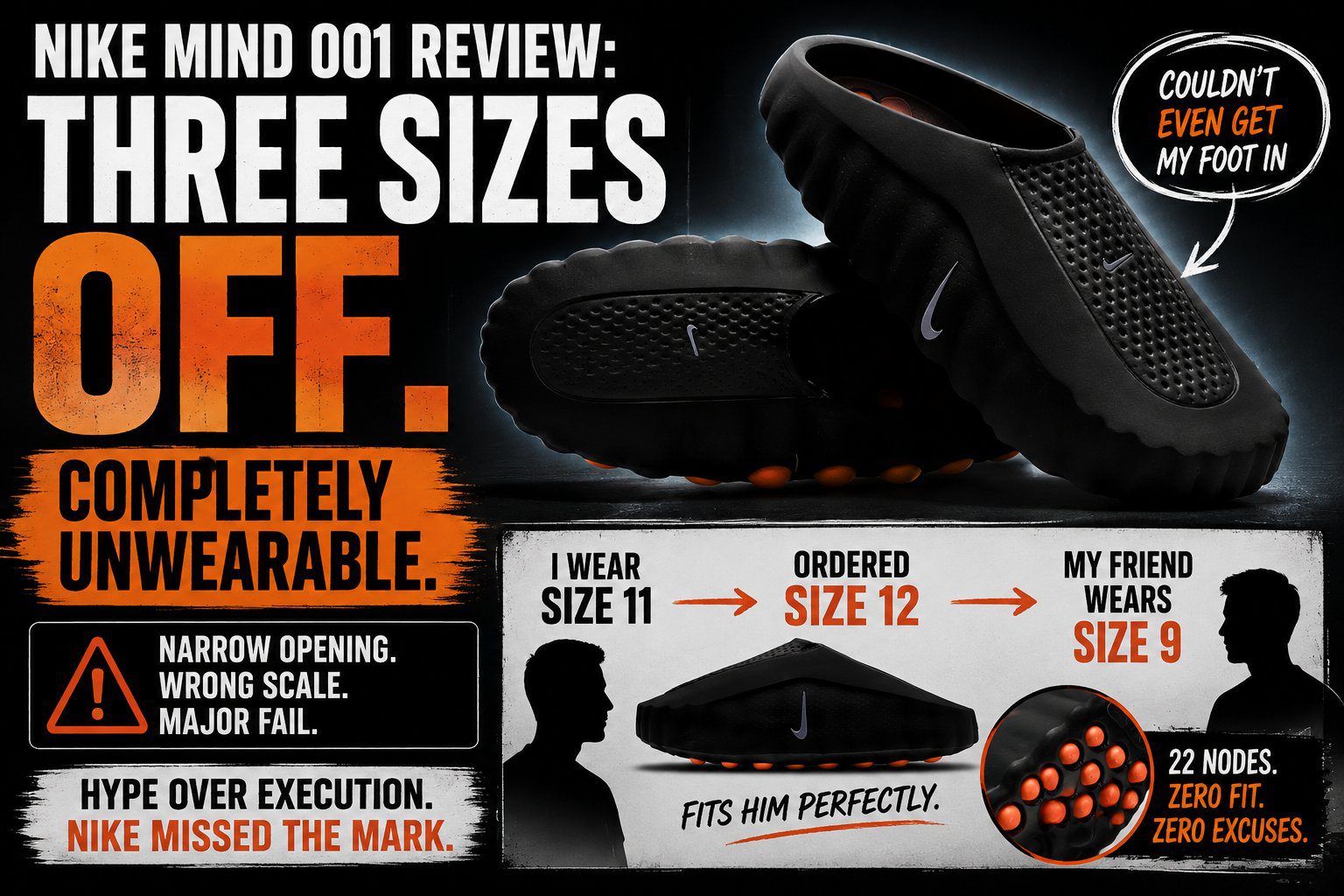
Mind the Gap: My Horrible Experience With Nike Mind and a Shoe That Couldn’t Get the Basics Right
I wanted to love the Nike Mind. Actually, after everything Nike put consumers through just to get a pair, I expected to love it. The Nike Mind 001 and Mind 002 arrived surrounded by the kind of marketing machinery Nike has spent decades perfecting: futuristic design, neuroscience, sensory stimulation and a new approach to connecting the human brain with what is happening underneath our feet. It sounded fascinating.
Nike describes Mind as the first footwear concept from its Mind Science Department, built around 22 independent foam nodes designed to interact with sensory receptors on the bottom of the foot. According to Nike, those nodes move like pistons as you walk, creating different sensations intended to increase sensory awareness and help athletes feel more present. That’s a hell of a sales pitch for a shoe. Unfortunately, none of that sophisticated neuroscience matters if you can’t get your foot into the damn thing. And that was exactly my experience.
I Wear a Nike Size 11. So I Ordered a 12.
I normally wear a size 11 in Nike. Before buying the Nike Mind, however, I did what consumers increasingly have to do before purchasing limited release sneakers: I researched the sizing. The message online was pretty clear: these things run small. Fine. Instead of ordering my normal size 11, I went up an entire size and bought a 12. That should have given me plenty of room. It didn’t.
When the shoes arrived, I tried putting them on and immediately realized something was seriously wrong. This wasn’t the normal sneaker problem where the toe box feels slightly cramped or you realize you should have gone up half a size. I could barely get my foot through the opening. The collar and throat of the shoe felt so constricted that my arch essentially hit a wall before my foot could properly enter the shoe. At that point, we’re no longer talking about personal preference. We’re talking about basic footwear geometry.
Then I Gave My Size 12 to Someone Who Wears a Size 9
This is where the experience went from frustrating to ridiculous. I handed the Nike Mind size 12 to a friend whose normal shoe size is a 9. He put them on, and they fit. Think about that. I normally wear an 11. I followed the warnings and ordered a 12. The shoe was still effectively unwearable for me. Then someone who normally wears a size 9 tried my supposedly size 12 shoe and could actually wear it comfortably. That is an extraordinary sizing discrepancy.
Foot shape obviously matters. Arch height, foot width and overall foot volume can dramatically affect how two people experience the same shoe, so my admittedly unscientific two person experiment doesn’t prove every Nike Mind runs three numerical sizes small. But it absolutely demonstrates the problem I experienced. If the architecture of a shoe is so restrictive that a customer sizing up from an 11 to a 12 can’t properly get his foot inside, while someone several sizes smaller can, something has gone badly wrong.
Whole Sizes Make the Problem Even Worse
The Nike Mind 001 presents another problem: sizing flexibility is limited. When a shoe already has unconventional fit and restrictive architecture, consumers need more sizing options, not fewer. Instead, buyers are left trying to determine whether they should order their normal size, size up or potentially size up significantly.
That uncertainty becomes particularly problematic when you’re dealing with a hyped release where availability can disappear quickly. With an ordinary sneaker, a sizing mistake is annoying. You return it, exchange it and move on with your life. Limited release sneaker culture changes that equation. When products sell out and consumers turn to secondary markets, a sizing mistake can become an expensive mistake because resale platforms operate under very different return policies than traditional retailers. Suddenly Nike’s unconventional sizing isn’t merely uncomfortable. It can cost consumers real money.
Nike Built a Neuroscience Shoe Before Perfecting the Shoe Part
This is what bothers me most about the Nike Mind experience. The technology is genuinely interesting. Nike says the company spent more than a decade developing the platform and studying how sensory input from the feet interacts with the brain. The Mind 001 uses 22 independent nodes underfoot that Nike describes as moving with the terrain and interacting with sensory receptors in the feet.
That’s innovative. But before we start talking about neuroscience, sensory receptors and mind body connections, perhaps we should establish whether a human foot can comfortably enter the shoe. That’s not sarcasm for the sake of sarcasm. It goes directly to product design. The most technologically sophisticated footwear in the world is useless if basic ergonomics prevent customers from wearing it.
Nike appears to have invested enormous resources into what happens underneath your foot while seemingly creating an upper that, at least for my foot, prevents you from comfortably reaching that technology in the first place. It’s like designing a Ferrari engine and forgetting to make the driver’s door big enough for the driver.
This Is What Happens When Hype Outruns Execution
Nike deserves credit for experimentation. Sneaker companies should take risks. Athletic footwear would be incredibly boring if every company simply produced another conventional foam midsole and called it innovation. But innovation doesn’t exempt a product from fundamentals. Fit matters. Sizing matters. Comfort matters. Accessibility matters. Quality control matters.
Nike has wrapped the Mind platform in an ambitious scientific narrative. The company isn’t merely selling another sneaker. It’s positioning this product as the beginning of an entirely new category of performance footwear. That raises expectations. If you’re going to tell consumers you’ve spent years studying the relationship between the brain and the foot, consumers can reasonably expect you to have spent some time studying how that foot gets inside the shoe.
Artificial Scarcity Magnifies Every Product Failure
There is also a broader problem with modern sneaker launches. Scarcity creates urgency, and urgency discourages careful purchasing. Consumers know that if they wait for extensive independent reviews, their size may disappear. When inventory is limited and demand is high, buyers are pushed toward making decisions quickly. Then the resale market takes over, and a shoe originally priced below many premium performance sneakers can suddenly cost considerably more simply because supply has disappeared.
That’s great for hype. It’s terrible for consumers trying to figure out something as fundamental as sizing. If Nike wants to create unconventional footwear with unconventional fit characteristics, it should make sizing guidance extraordinarily clear. Consumers shouldn’t need Reddit threads, YouTube reviews, sneaker forums and trial and error detective work to determine what number to order. A size should mean something.
The Nike Mind May Be Brilliant Technology Wrapped in Bad Ergonomics
I can’t tell you whether Nike’s 22 node system meaningfully improves focus because I couldn’t wear the shoe long enough to make that judgment. That’s ultimately the most damning part of my experience. I bought Nike Mind because I was genuinely interested in the technology and wanted to experience what Nike’s Mind Science Department had spent years developing. Instead, my entire experience became an argument with the opening of the shoe.
Maybe someone with a different foot shape will absolutely love it. Maybe Nike will refine future versions. And maybe the underlying technology really does represent an important new direction in footwear. But none of those possibilities erase what happened with my pair. I wear a Nike size 11. I bought a Nike Mind size 12. I couldn’t properly wear it. Someone who wears a size 9 could. For a company with Nike’s resources, history and decades of experience designing footwear around the human body, that’s an embarrassing result.
My Verdict: Get the Fundamentals Right Before Selling Me the Future
Nike Mind represents exactly the kind of experimentation I normally want to see from a company like Nike. Push boundaries. Build weird products. Experiment with neuroscience. Put 22 moving nodes underneath my feet and tell me you’re trying to connect my brain to the ground. I’m interested. But get the shoe right first. Consumers aren’t buying a neuroscience research paper. We’re buying footwear. After chasing the product, researching the sizing, going an entire size above my normal Nike fit and ultimately discovering that my size 12 worked better on someone who wears a size 9, my introduction to Nike Mind wasn’t futuristic. It was frustrating. Nike may have spent years trying to understand the connection between the foot and the brain. My brain received a very clear signal from my feet: These damn shoes don’t fit.



















































Want to join the conversation?
Create an account or sign in to share your thoughts, vote,
and reply to other readers.
Showing 0 of 0 comments
Don't have an account?
Already have an account?