

Democrats Miss Critical Pete Hegseth Impeachment Vote as AIPAC Linked Political Fundraiser Sparks Backlash
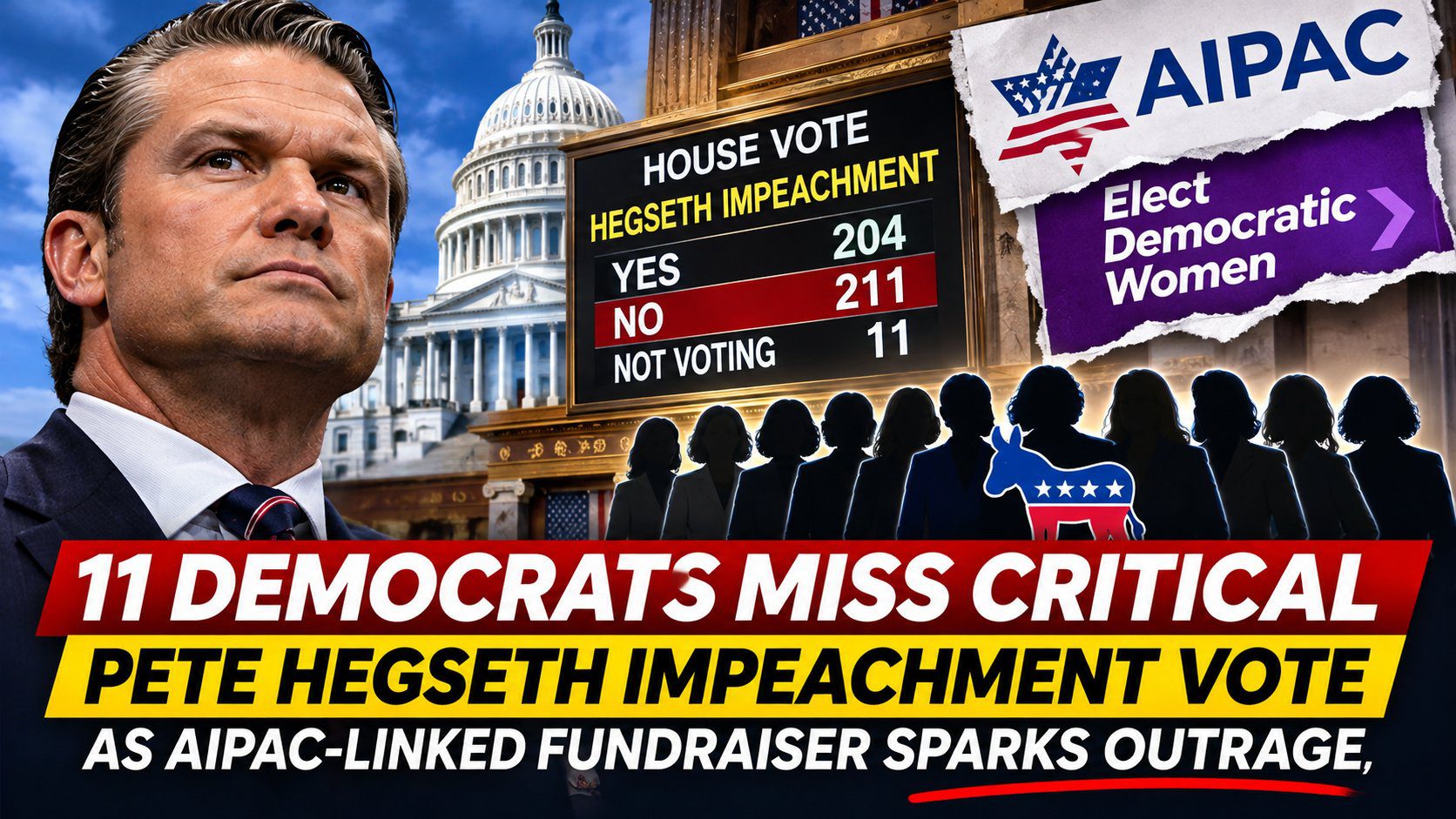
WASHINGTON, D.C. — Eleven House Democrats failed to participate in a crucial vote on impeaching Defense Secretary Pete Hegseth on Tuesday, November 10, allowing Republicans to sideline an impeachment effort by a narrow 211–204 margin and triggering fierce criticism of Democratic congressional leadership just days after the party’s sweeping midterm election victories.
The controversy intensified after several absent lawmakers blamed Washington traffic for preventing them from reaching the House chamber, with some reportedly returning from a reception hosted by Elect Democratic Women, a political organization whose affiliated super PAC has received substantial financial support from a political committee established by the American Israel Public Affairs Committee, commonly known as AIPAC.
The overlap between the missed votes, the political reception, and the organization’s financial connections to AIPAC quickly generated accusations that powerful pro-Israel interests had helped protect Hegseth, one of the Trump administration’s most outspoken supporters of military cooperation with Israel.
However, no verified evidence establishes that AIPAC organized the reception, directed lawmakers to miss the vote, or coordinated an effort to prevent Hegseth’s impeachment. The documented financial relationships and congressional absences nevertheless raise legitimate questions about political influence, legislative priorities, and the Democratic Party’s ability to deliver the accountability it promised voters.
The failed impeachment effort was particularly embarrassing because it originated not with Democratic leadership but with Republican Rep. Thomas Massie of Kentucky, a frequent critic of President Donald Trump’s military policies and expansive executive authority. Massie introduced eight articles of impeachment alleging serious abuses of power involving military operations, congressional war powers, and the defense secretary’s conduct in office.
Rather than allow the House to proceed toward a direct impeachment vote, Republican leadership successfully moved to refer Massie’s resolution to the House Judiciary Committee, effectively ending the immediate effort during the current congressional session.
The outcome left Democrats facing an uncomfortable reality: Even after an election that strengthened their position in Washington, the party had failed to assemble enough lawmakers for one of its most politically consequential votes.
How Republicans Shelved the Hegseth Impeachment Resolution
The House voted 211–204 to refer Massie’s impeachment resolution to the Judiciary Committee, with 210 Republicans and one independent supporting the motion. Every Democrat who participated opposed the referral, joined by Massie, the only Republican to break with his party.
Eleven Democrats and seven Republicans did not cast votes, creating a narrow margin that immediately attracted national attention. Had eight additional Democrats voted against the motion while every other recorded vote remained unchanged, the referral would have failed 211–212, allowing the impeachment effort to proceed to its next stage.
That mathematical possibility became the centerpiece of the backlash. Progressive activists and Democratic lawmakers argued that the party had missed an extraordinary opportunity to challenge a controversial Republican Cabinet secretary while the president’s own party was struggling to maintain its narrow House majority.
However, the full attendance picture complicates claims that the Democratic absences alone guaranteed Hegseth’s survival. Seven Republicans also missed the vote, and reporting by The Washington Post indicates that enough Republican members were nearby to potentially preserve the referral motion if voting had remained open longer. The vote, initially scheduled for 15 minutes, remained open for approximately 29 minutes before Republican leadership closed it.
The procedural distinction is equally important. Defeating the referral motion would not itself have impeached Hegseth, much less removed him from office. It would have opened the possibility of further House consideration, including a subsequent vote on the impeachment articles. Actual removal would have required conviction by a two-thirds majority of the Senate.
Nevertheless, the vote represented a meaningful political opportunity. Massie’s willingness to challenge Hegseth had created an unusual opening for Democrats to force a public confrontation over the Pentagon’s conduct, and that opportunity was lost.
Eleven Missing Democrats and a Series of Conflicting Explanations
The lawmakers who missed the vote were Nancy Pelosi, Lou Correa, Julia Brownley, Laura Gillen, Steven Horsford, Jonathan Jackson, Brittany Pettersen, Melanie Stansbury, Haley Stevens, Marilyn Strickland, and Frederica Wilson. Their explanations varied considerably, making it inaccurate to suggest that all 11 were attending the same political reception or that the entire group had deliberately chosen a fundraising event over congressional business.
Pelosi was in San Francisco participating in a Veterans Day event honoring military veterans. Her spokesperson said the former House speaker supported impeaching Hegseth and would have opposed the referral motion had she been present. Correa was away from Washington for medical reasons, while Horsford subsequently explained that a personal emergency had prevented him from voting. Horsford publicly accepted responsibility for his absence, acknowledging that the accountability he demands of others should also apply to himself.
Several other Democrats reported transportation problems near the Capitol. Stansbury, Gillen, Strickland, Pettersen, and Jackson were among those associated with traffic-related explanations, although their individual circumstances were not identical. Stansbury’s office described a traffic incident involving a police escort that prevented her from reaching the chamber before the vote closed. She later apologized publicly and entered her intended opposition to the referral into the Congressional Record, a symbolic action that did not alter the official tally.
Brownley also criticized the decision to close the vote while members were still attempting to reach the House floor. Pettersen similarly argued that Republican leadership ended the proceedings while lawmakers were approaching the chamber, suggesting that the timing of the closure contributed to the outcome.
Other absences remained less clearly explained in contemporaneous reporting. Wilson, the South Florida Democrat representing portions of Miami-Dade and Broward counties, did not publicly provide a confirmed explanation in the reporting reviewed for this article. Stevens also missed the vote without an independently established explanation directly connecting her absence to the Elect Democratic Women reception.
The distinction matters because the most inflammatory allegations surrounding the episode depend on treating all 11 absences as a coordinated action. The available evidence instead points to several unrelated circumstances combined with a breakdown in attendance and vote management.
The Elect Democratic Women Reception and the AIPAC Money Trail
The most politically explosive element of the controversy involves Elect Democratic Women, a political organization founded in 2018 to help elect Democratic women to Congress. Its affiliated super PAC, EDW Action Fund, has received financial support from United Democracy Project, the powerful independent-expenditure committee established by AIPAC.
According to reporting by Common Dreams and The New Republic, the EDW political network has been involved in directing approximately $2.4 million in AIPAC-linked funding into congressional races during the 2026 election cycle. That relationship has attracted particular attention because AIPAC’s political operations have become increasingly controversial within the Democratic Party, especially among progressive voters critical of U.S. military assistance to Israel and American involvement in the war with Iran.
The November 10 reception was reportedly scheduled from 4:30 p.m. until 6:30 p.m. at The Roost, a food hall approximately 1.5 miles from the Capitol. The House voting series was scheduled to begin at 5:30 p.m., creating an obvious scheduling conflict for lawmakers attending the event. Axios congressional reporter Andrew Solender reported that several lawmakers returning from the reception became trapped in heavy traffic on Independence Avenue near the Capitol complex. The New Republic subsequently examined the event’s connection to EDW Action Fund and the organization’s financial relationship with United Democracy Project.
That reporting established a legitimate connection between the political event and AIPAC-associated campaign financing. It did not establish that AIPAC sponsored the reception, controlled its scheduling, or instructed members of Congress to miss the impeachment vote. The distinction is essential. EDW, EDW Action Fund, AIPAC PAC, and United Democracy Project are separate political entities with different structures and spending activities. Financial support flowing between political organizations does not automatically establish operational control over their events or the decisions of individual lawmakers.
Nevertheless, the arrangement illustrates how sophisticated political fundraising networks can move substantial sums through organizations whose names and public missions do not immediately reveal every major source of their financial support. That is a legitimate subject for campaign finance reporting, particularly when the organizations involved have influence over competitive congressional primaries and the careers of sitting lawmakers.
How Much AIPAC Linked Money Have the Missing Democrats Received?
The controversy has also revived scrutiny of campaign contributions and outside political spending benefiting the 11 absent Democrats. Several have received financial support from AIPAC-associated organizations, other pro-Israel political committees, or independent expenditure groups that have supported their campaigns. Michigan Rep. Haley Stevens is among the most prominent examples. Her previous congressional and Senate campaigns have attracted substantial spending from AIPAC’s political network, including United Democracy Project, which has invested heavily in Democratic primaries involving candidates with differing positions on Israel.
Other absent lawmakers, including Laura Gillen, Marilyn Strickland, Steven Horsford, Julia Brownley, and Frederica Wilson, have received varying levels of support from pro-Israel political committees during their congressional careers. However, the widely circulated financial figures require careful interpretation. Direct campaign contributions, earmarked donations, and independent super PAC expenditures are legally and financially distinct. Money spent by a super PAC on television advertising or other independent communications does not enter a candidate’s campaign account, even when that spending benefits the candidate politically.
It is also misleading to classify every contribution from a pro-Israel organization as AIPAC funding. J Street PAC, for example, supports candidates favoring diplomatic approaches to the Israeli-Palestinian conflict and has frequently disagreed with AIPAC’s political priorities. Treating the two organizations as interchangeable obscures meaningful differences in their policy positions.
The Federal Election Commission maintains public records that can be used to trace direct contributions and independent expenditures. Those records can establish financial relationships, but they cannot, by themselves, establish that campaign support caused a lawmaker to miss a particular vote. The evidence is therefore sufficient to justify scrutiny of donor influence, political access, and the transparency of campaign finance networks. It is not sufficient to accuse the absent Democrats of accepting money in exchange for protecting Hegseth.
Why Hegseth’s Relationship With Israel Has Become Part of the Story
The debate surrounding AIPAC’s political influence has become more intense because Hegseth occupies a strategically important position in the administration’s military relationship with Israel. The defense secretary has publicly supported close cooperation between American and Israeli military forces, particularly during the conflict involving Iran. His position places him at the center of decisions involving military logistics, regional operations, defense cooperation, weapons transfers, and the implementation of Pentagon policies affecting the Middle East.
The political stakes have increased following Trump’s announcement that the United States intends to end approximately $4 billion in annual military assistance to Israel after 2026. That announcement, if implemented, would represent a substantial change in the longstanding financial relationship between the two countries. However, ending annual military assistance would not automatically terminate every existing defense agreement, weapons transfer, procurement arrangement, or military cooperation program. Those activities involve separate legal authorities, contractual obligations, appropriations, and executive branch decisions.
Hegseth’s leadership would therefore remain relevant to U.S. Israeli military relations even if the administration substantially reduced direct financial assistance.
Critics of AIPAC argue that maintaining a defense secretary strongly supportive of military cooperation with Israel could be strategically valuable to organizations seeking to preserve the bilateral security relationship. That argument identifies a plausible political interest, but it does not establish that AIPAC intervened in the November 10 impeachment vote.
The presence of a possible motive cannot substitute for evidence of an actual coordinated effort. Any claim that a political organization secretly engineered congressional absences would require documentation, communications, witness testimony, or other reliable evidence demonstrating that the alleged coordination occurred. No such evidence has emerged in the reporting reviewed for this article.
What Pete Hegseth Was Facing: Eight Articles of Impeachment
The impeachment effort involved allegations considerably more serious than ordinary disagreements over Pentagon management. Massie introduced eight articles accusing Hegseth of abuses of power involving military operations, congressional war powers, and the administration’s conduct during conflicts involving Iran and other countries.
The resolution challenged military actions allegedly undertaken without sufficient congressional authorization and raised questions about the legal justification for operations involving suspected drug-trafficking vessels in international waters. It also addressed broader concerns about executive authority and the military’s obligation to comply with federal and international law.
These allegations have emerged against the backdrop of prolonged controversy over the Trump administration’s military policies, including the war with Iran and operations involving Venezuela.
Massie’s argument centers on the constitutional division of military authority between Congress and the president. Article I gives Congress the power to declare war, raise and support armed forces, and control military appropriations, while Article II designates the president as commander in chief. The precise boundaries of those authorities have been disputed for decades, particularly when presidents initiate or expand military operations without specific congressional declarations of war.
Hegseth and the White House have rejected the impeachment effort, defending the administration’s military decisions and characterizing the allegations as politically motivated. The White House formally opposed Massie’s resolution, arguing that impeachment would undermine national security and interfere with the administration’s defense priorities.
It is important to distinguish the allegations contained in the resolution from established findings of wrongdoing. The filing of impeachment articles does not prove that Hegseth committed a crime, violated the Constitution, or engaged in impeachable misconduct. Those questions would require examination of the evidence and, if impeachment advanced, consideration by the House and Senate.
Massie nevertheless argued that Congress should debate the allegations directly rather than dispose of the resolution through a procedural maneuver. His willingness to challenge a defense secretary serving under a president from his own party made the confrontation especially unusual.
Democratic Leadership Faces an Embarrassing Accountability Test
The failed vote has intensified criticism of Democratic congressional leadership, particularly House Minority Leader Hakeem Jeffries and Democratic Whip Katherine Clark.
Clark’s responsibilities include tracking attendance, coordinating votes, and ensuring that members understand the importance of scheduled legislative business. Her connection to the controversy is politically awkward because she was also a founding member of Elect Democratic Women, the organization whose reception became a focal point of the backlash.
Clark herself attended the vote and opposed the Republican motion. She subsequently criticized the absences and told Democratic colleagues that the failure had disappointed Americans expecting accountability from their elected representatives.
That response did little to quiet criticism from progressive lawmakers and activists who questioned why members were attending political events when a potentially consequential impeachment vote was approaching. The leadership dispute is more complicated than a simple failure to notify members. The impeachment resolution was introduced on an accelerated timetable, and Republicans controlled the House schedule. Several Democrats had unavoidable personal or medical conflicts, while others claimed that traffic disruptions prevented them from reaching the chamber.
Nevertheless, the scheduled evening voting series was known in advance, and members attending political events away from the Capitol assumed the risk of transportation delays. The episode also illustrates the importance of vote-counting in a closely divided House. Congressional leadership cannot guarantee that every member will be present for every vote, but it is expected to identify potential attendance problems and coordinate responses when major legislation or politically significant resolutions are at stake.
Jeffries has maintained that Democrats remain committed to holding Hegseth accountable and that the failed procedural vote will not end the party’s efforts. With Democrats preparing to assume control of the House in January, congressional leaders will have opportunities to initiate investigations, compel testimony through lawful subpoenas, and potentially pursue new impeachment proceedings. The political challenge will be converting those promises into an organized legislative strategy.
South Florida’s Frederica Wilson Among the Missing Democrats
For South Florida, the controversy has a direct connection to Rep. Frederica Wilson, the veteran Democratic congresswoman whose district includes portions of Miami-Dade and Broward counties.
Wilson was among the 11 Democrats who did not participate in the November 10 vote. According to ABC News, she also missed voting activity earlier in the week but returned to the Capitol for votes on Wednesday. The outlet reported that her attendance had previously attracted scrutiny because of health related challenges, although no specific explanation for her absence from the Hegseth vote had been independently confirmed.
It would therefore be inappropriate to attribute Wilson’s absence to the EDW reception or to campaign donors without additional evidence. Her official voting record establishes that she was absent, but it does not establish why. The episode nevertheless presents a legitimate accountability question for South Florida constituents. Congressional representatives are responsible for participating in legislative proceedings, and constituents have a right to understand why their elected officials miss consequential votes.
That standard should apply equally to Democrats and Republicans. Seven Republican lawmakers also missed the procedural vote, although their absences did not prevent their party from prevailing. For a region with significant military, immigration, international trade, and national security interests, the oversight of Pentagon leadership is more than an abstract political dispute. Decisions made by the defense secretary can affect military personnel, federal spending, international operations, and the communities connected to those activities.
Could Democrats Still Impeach Hegseth in January?
The November 10 vote effectively sidelined Massie’s resolution for the remainder of the current congressional session, but it did not permanently protect Hegseth from impeachment. When the new Congress convenes in January 2027, Democrats will have an opportunity to introduce new impeachment articles, hold investigative hearings, seek relevant Pentagon records, and examine allegations involving the administration’s military operations.
A Democratic controlled House could approve articles of impeachment by a simple majority. Removal from office, however, would require conviction by a two thirds majority of senators present, assuming a full Senate of 100 members and all senators voting. That threshold remains a formidable obstacle regardless of which party controls the Senate. Impeachment and removal are separate constitutional actions, and a House vote to impeach does not automatically remove a Cabinet official from office.
The incoming Congress will also face difficult decisions about where to concentrate its investigative resources. The Justice Department, immigration enforcement agencies, the Pentagon, and other executive branch institutions are expected to face increased scrutiny following the midterm elections.
For Democratic leaders, the failed Hegseth vote has already provided a warning about the importance of legislative discipline. Controlling congressional committees and possessing subpoena authority will matter little if the party cannot consistently assemble the votes necessary to act.
The Real Scandal: Political Influence, Congressional Priorities, and a Missed Opportunity
The Hegseth controversy has produced two overlapping narratives, but the evidence supporting them is substantially different.
The first is firmly established. Eleven Democratic lawmakers missed a procedural impeachment vote that Republicans won by seven votes. Several lawmakers cited transportation delays, some were returning from a reception hosted by Elect Democratic Women, and that organization’s affiliated political operation has received significant AIPAC linked funding.
The second narrative alleges that AIPAC deliberately engineered the absences to protect a defense secretary supportive of U.S. Israeli military cooperation. That allegation remains unsupported by verified evidence.
The distinction is not a technicality. It is the difference between investigating documented political relationships and accusing identifiable people or organizations of a coordinated act of deception without proof. There are legitimate reasons to scrutinize the influence of large political donors, the financial relationships between super PACs, and the degree to which fundraising activities compete with congressional responsibilities. Those questions deserve serious reporting regardless of whether a secret conspiracy existed. But the documented failures are significant enough without embellishment.
A Republican congressman introduced eight articles of impeachment against a Republican defense secretary. The House held a closely contested procedural vote. Several Democrats were unable to reach the chamber, while others were absent for unrelated reasons. Republican leadership successfully referred the resolution to committee, and the immediate impeachment effort collapsed.
For Democrats, the timing could hardly have been worse. The party had just celebrated major midterm victories and was preparing to assume greater responsibility for congressional oversight. Instead of demonstrating unity and discipline, it found itself explaining why enough lawmakers had failed to participate in a vote involving one of the administration’s most controversial officials.
There is no established evidence that AIPAC secretly rescued Pete Hegseth. What the record does show is that Democratic absences helped Republicans sideline an impeachment effort, while political fundraising relationships and preventable attendance problems intensified public distrust. The incoming Democratic majority will have another opportunity to investigate Hegseth and determine whether the allegations against him warrant impeachment. Whether party leaders can deliver on that opportunity remains an open question. For voters demanding accountability from Washington, the standard should be straightforward: Elected officials must show up, cast their votes, disclose their political relationships, and defend their decisions with evidence rather than excuses.
















Loading comments…