
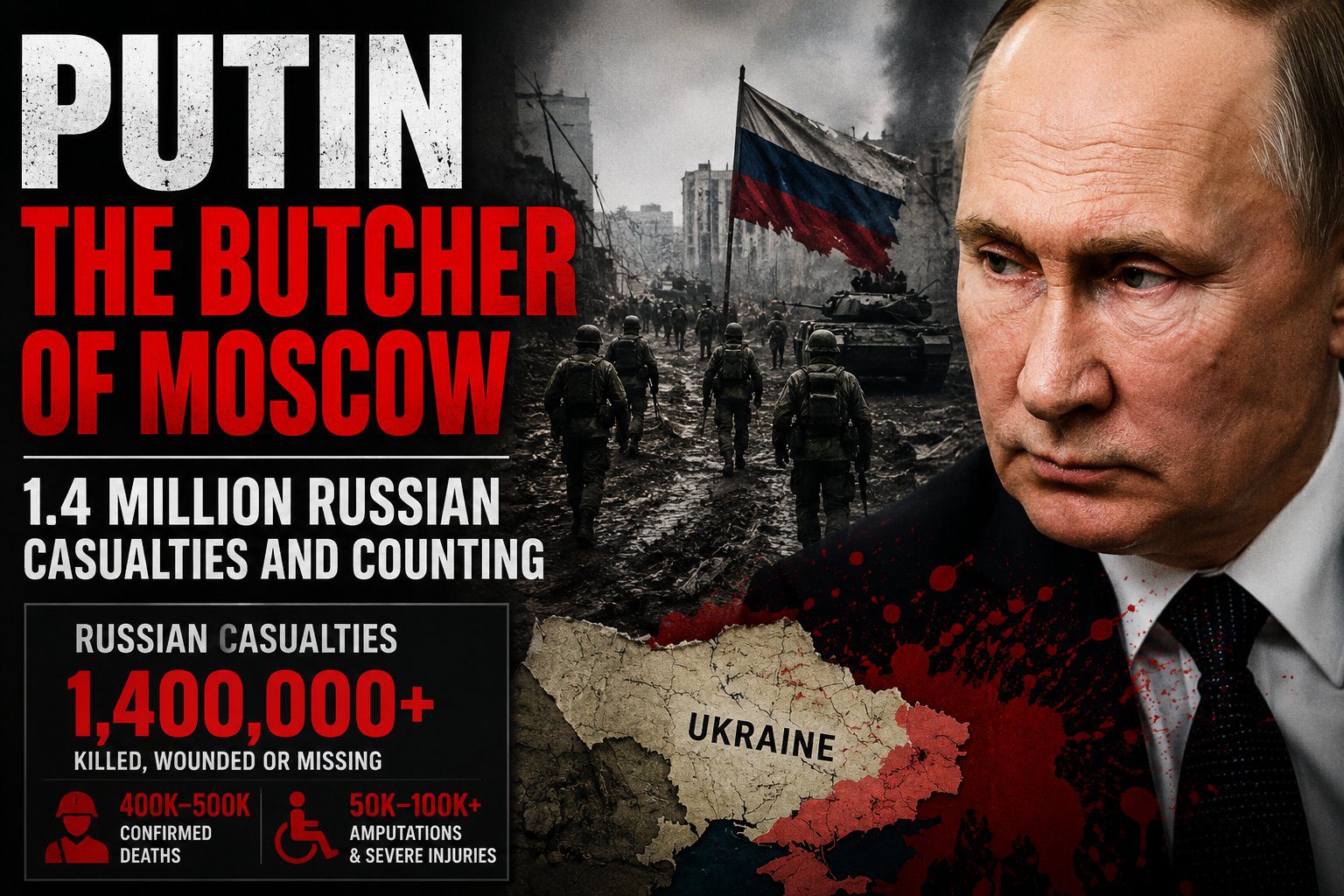
Putin’s Bloody Toll: How Russia’s “Butcher of Moscow” Has Burned Through More Than 1.4 Million Military Casualties
For more than four years, Russian President Vladimir Putin has waged a brutal war against Ukraine that has reshaped European security, devastated entire cities, and produced one of the deadliest military conflicts of the 21st century. Now, a new analysis from the Center for Strategic and International Studies paints an even darker picture, not only of the destruction inflicted upon Ukraine, but of the staggering human cost borne by Russia itself.
According to the report, Russia has suffered approximately 1.4 million military casualties since launching its full scale invasion in February 2022. Those figures include soldiers killed, wounded, or missing in action and represent one of the highest sustained casualty rates seen in modern warfare. If accurate, the numbers underscore what military analysts have warned for years: Putin’s strategy has come at an extraordinary cost in Russian lives.
A War Measured in Human Loss
CSIS estimates that Russian military casualties have reached roughly 1.4 million personnel by mid-2026, compared with an estimated 525,000 to 625,000 Ukrainian casualties. British defense intelligence has estimated that between 400,000 and 500,000 Russian troops may have been killed during the conflict, although exact figures remain impossible to independently verify while the war continues. Current battlefield assessments indicate Russia continues losing more than 30,000 troops each month through a combination of deaths, serious injuries, and missing personnel. Although Ukraine has also suffered devastating losses, most Western military analysts conclude that Russia continues to absorb casualties at a substantially higher rate.
Historic Losses Unlike Any Modern Conflict
Military historians say Russia’s losses have reached levels rarely seen since the Second World War. The cumulative number of Russian battlefield casualties now exceeds the combined American military deaths from every major conflict fought since 1945, including the Korean War, Vietnam War, the Iraq War, and the War in Afghanistan.
The scale has also surpassed Soviet-era losses in numerous post World War II military interventions, making Ukraine by far the bloodiest conflict Russia has fought in generations.
The Brutality of Drone Warfare
The nature of combat has evolved dramatically since the invasion began. Small first person view drones, precision-guided artillery, loitering munitions, and artificial intelligence assisted targeting have transformed battlefields into lethal kill zones where even minor troop movements can quickly be detected and attacked. Medical experts estimate that tens of thousands of soldiers on both sides have suffered catastrophic injuries requiring amputations.
Russian forces have reportedly experienced disproportionately severe outcomes because of repeated failures in battlefield medical evacuation. Unlike NATO doctrine, which emphasizes rapid evacuation within the so-called “golden hour,” many Russian wounded have reportedly remained stranded near front line positions for extended periods, increasing the likelihood of infection, permanent disability, or death.
A War of Attrition
Military analysts increasingly describe the conflict as a war of industrial scale attrition. Russia has continued launching costly assaults against heavily defended Ukrainian positions despite sustaining significant personnel losses. Western intelligence assessments suggest Russia has managed to replenish many of its losses through aggressive recruiting campaigns, financial incentives, prison recruitment, and mobilization efforts. However, analysts note that casualty rates have frequently matched or exceeded the pace of new recruitment, creating mounting pressure on Russia’s military manpower.
The Cost Beyond the Battlefield
The human toll extends far beyond military statistics. Hundreds of thousands of Russian families have lost sons, husbands, fathers, and brothers. Entire communities across Russia have experienced repeated funeral processions while thousands of wounded veterans return home with life altering physical and psychological injuries.
Ukraine has likewise endured immense suffering, with military casualties compounded by civilian deaths, widespread displacement, and extensive destruction of homes, infrastructure, schools, hospitals, and energy facilities. The conflict has become one of Europe’s largest humanitarian disasters since the Second World War.
Why “The Butcher of Moscow” Is Such a Controversial Label
Critics increasingly describe Putin as the “Butcher of Moscow” because they argue his military strategy has shown disregard not only for Ukrainian civilians but also for the lives of Russian troops sent repeatedly into costly offensives. Supporters of the Kremlin reject that characterization, arguing Russia is engaged in a necessary war against what it views as Western expansion and that casualty estimates released by Western organizations are inflated. Because neither Russia nor Ukraine publishes independently verifiable casualty figures, all public estimates should be viewed as approximations based on intelligence assessments, satellite imagery, open source investigations, and battlefield analysis.
More than four years after Russia launched its full scale invasion, the war has evolved into one of the deadliest conflicts of the modern era. Whether measured by battlefield casualties, long term disabilities, destroyed equipment, or shattered communities, the conflict has imposed an extraordinary cost on both nations. While the precise casualty totals remain subject to debate, the broader conclusion is not: Russia’s invasion has resulted in massive losses on both sides and fundamentally reshaped the European security landscape in ways that will be felt for decades to come.
















































Want to join the conversation?
Create an account or sign in to share your thoughts, vote,
and reply to other readers.
Showing 0 of 0 comments
Don't have an account?
Already have an account?