
Robert Bigelow Says We Survive Death and the Invisible Universe May Hold the Key to the Afterlife
LAS VEGAS — Robert Bigelow has spent decades putting serious money behind questions most billionaires would never touch publicly. Are humans alone in the universe? What exactly is consciousness? And, most consequentially, what happens to us when we die?
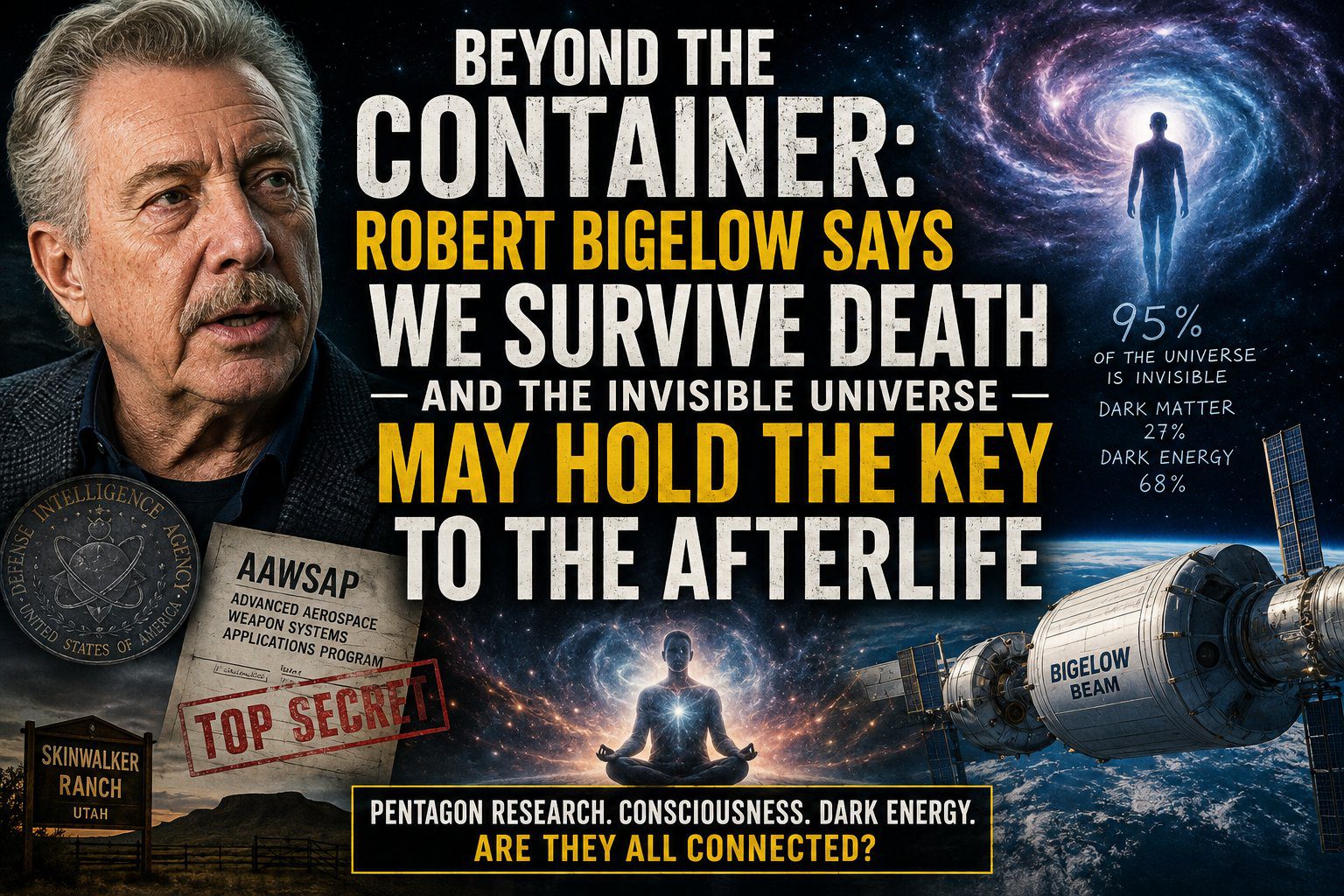
The Nevada billionaire built an aerospace company whose experimental habitat technology reached the International Space Station. A company he founded received millions of dollars through a Defense Intelligence Agency program investigating advanced aerospace and anomalous phenomena. He purchased Utah’s infamous Skinwalker Ranch and financed years of research into reports of unexplained activity. He later created the Bigelow Institute for Consciousness Studies specifically to investigate whether human consciousness survives physical death. After decades pursuing those questions, Bigelow says he has reached his own conclusion, the biological body is temporary, consciousness survives it, and death represents a transition rather than the destruction of the individual.
Bigelow has now ventured into even more extraordinary territory, speculating that the enormous invisible portion of the universe scientists describe through dark matter and dark energy could somehow be connected to a broader, nonphysical architecture of consciousness. If that sounds like science fiction, an important distinction needs to be established immediately, Bigelow’s ideas connecting consciousness with the universe’s mysterious “dark” sector are not established findings of physics, and there is no publicly available evidence demonstrating that the CIA, Pentagon or another branch of the U.S. government has scientifically established the existence or mechanics of an afterlife.
What makes Bigelow’s claims remarkable is not that he has proved them. He has not. It is that someone with his unusual combination of aerospace accomplishments, government contracting and decades of privately financed anomalous phenomena research believes the evidence has pointed him there.
Bigelow Says the Human Body Is a Temporary “Container”
Bigelow’s worldview begins with a deceptively simple metaphor: the human body is a container. The word separates the biological organism from whatever Bigelow believes constitutes the individual consciousness occupying it. Discussing consciousness and death with Joe Rogan in 2021, Bigelow framed the question this way:
“If the container decomposes and dies and is permanently offline, are there any aspects of your mind that continues? Does your consciousness continue?”
At the time, Bigelow presented that as one of humanity’s oldest unanswered questions. His subsequent work has pushed him toward a much firmer conclusion. Bigelow’s preference for the word “container” is important because containers are temporary. In his model, the physical body has a beginning and an end, while consciousness does not necessarily share those boundaries.
That concept now sits at the foundation of the Bigelow Institute for Consciousness Studies, or BICS, which Bigelow founded in 2020. The institute’s stated mission explicitly includes researching “the survival of human consciousness after physical death” and exploring the nature of what it calls the “afterlife.” Bigelow is therefore not merely saying that he hopes some part of humanity survives death. He has spent years and millions of dollars attempting to build an evidentiary case that it does.
Bigelow Believes Consciousness Carries More Than Memories Across Death
Bigelow’s model of surviving consciousness is considerably more elaborate than the familiar idea that a soul simply leaves the body. In his descriptions of discarnate consciousness, Bigelow argues that an individual carries personality, memories, character and the consequences of his or her choices beyond physical death. Death, under this theory, does not instantly transform a flawed human being into a perfected spiritual entity.
In discussing his conclusions, Bigelow has described continued free will as central to the process, saying, “You have free will on both sides.” He has also summarized his belief about the transition more bluntly: “You’re not an angel right then.”
The point is that whatever consciousness survives the body, in Bigelow’s framework, does not suddenly lose the personality constructed during life. Consciousness continues developing rather than becoming instantaneously perfected. That remains a philosophical and metaphysical proposition rather than an established scientific finding, but it illustrates how far Bigelow has moved beyond simply asking whether consciousness survives. He believes there is a larger process on the other side.
Bigelow Takes the Argument Into the Invisible Universe
The most provocative component of Bigelow’s emerging worldview involves one of the greatest unresolved problems in modern cosmology. Almost everything in the universe appears to consist of something human beings cannot directly see.
According to NASA’s current cosmological model, ordinary matter, stars, planets, gas, dust, people and essentially everything constructed from familiar atoms, accounts for only about 5% of the universe. Dark matter represents approximately 27%, while dark energy accounts for roughly 68%. In other words, approximately 95% of the universe consists of components whose fundamental nature remains unresolved.
Dark matter and dark energy are not interchangeable. Dark matter is inferred primarily through gravitational effects on galaxies, galaxy clusters and light, while dark energy is the name scientists give to the unknown phenomenon apparently driving the accelerating expansion of the universe. Scientists can observe their apparent effects without knowing exactly what either fundamentally is.
Bigelow sees that enormous unknown and asks a radically different question: What if some aspect of the unseen architecture of reality is connected to consciousness itself? In his broader model, discarnate consciousness does not necessarily disappear into a distant theological heaven. It could exist within a reality that overlaps or interacts with the physical universe while remaining largely inaccessible to ordinary human senses. That is where Bigelow’s consciousness research begins colliding with cosmology.
Dark Matter Really Does Pull on the Visible Universe
One reason the speculation is so provocative is that part of the underlying physics is completely real. Dark matter appears to exert gravitational influence on ordinary matter despite being invisible to telescopes. Scientists infer its presence from effects that cannot be adequately explained by the visible matter they detect. Stars orbit galaxies as though substantially more mass exists than astronomers can see, while gravitational lensing allows researchers to map otherwise invisible concentrations of mass through the way gravity bends light.
So the idea that an invisible component of reality can exert measurable influence on the visible universe is not paranormal speculation. It is mainstream cosmology. The enormous leap occurs when that invisible component is associated with consciousness, souls or an afterlife. There is currently no accepted astrophysical evidence demonstrating that dark matter contains consciousness, that dark energy constitutes an afterlife realm or that either represents another dimension populated by deceased individuals.
Bigelow’s proposition should therefore be treated as a hypothesis attempting to connect enormous scientific mysteries, not as an established discovery. Unknown does not mean supernatural. But unknown also means the scientific story remains unfinished.
Bigelow Is Not Some Anonymous Internet Conspiracy Theorist
That distinction matters because of who is making these claims. Bigelow is not a physicist, neuroscientist or academic cosmologist, but neither is he simply another online UFO personality. Bigelow founded Bigelow Aerospace in 1999 to develop expandable habitats for humans living and working in space. That effort eventually produced hardware used by NASA. The Bigelow Expandable Activity Module, known as BEAM, launched aboard a SpaceX Dragon spacecraft in April 2016 and was installed on the International Space Station. NASA used the expandable structure to determine whether lightweight inflatable habitats could withstand the environment of space while potentially providing significantly greater internal volume than conventional rigid modules.
BEAM worked. It was successfully expanded and pressurized, astronauts entered it, NASA collected years of performance data, and its mission continued well beyond its original demonstration period. Bigelow’s technology has therefore literally been attached to the International Space Station. That accomplishment does not make his theories about consciousness correct. It does, however, make his biography considerably more complicated than the stereotype normally associated with extraordinary claims about UFOs, paranormal phenomena and life after death.
Bigelow’s Pentagon Connection Is Real, but Often Exaggerated
Bigelow also had a genuine relationship with the U.S. national security apparatus. Beginning in 2008, Bigelow Aerospace Advanced Space Studies, or BAASS, received a Defense Intelligence Agency contract connected to the Advanced Aerospace Weapon System Applications Program, commonly known as AAWSAP. The program received roughly $22 million in government funding and was championed by then-Senate Majority Leader Harry Reid of Nevada along with Sens. Daniel Inouye of Hawaii and Ted Stevens of Alaska.
Researchers associated with the effort investigated unidentified aerial phenomena, advanced aerospace concepts and reports of unusual physiological or anomalous effects. Bigelow’s organization became one of the most unusual private contractors connected to Pentagon funded research.
That history is documented, but it is also frequently exaggerated. Bigelow’s status as a Pentagon contractor does not mean every conclusion he now holds about UAP, consciousness or death represents an official finding of the Defense Department, DIA or CIA. Likewise, the existence of classified government programs examining unconventional phenomena does not establish that the government secretly proved the existence of an afterlife.
Bigelow may believe government insiders know considerably more about consciousness and anomalous phenomena than has been publicly acknowledged. Without declassified records, independently verifiable evidence or direct testimony establishing that conclusion, however, it remains a claim rather than a demonstrated fact.
Skinwalker Ranch Helped Merge Bigelow’s UAP and Consciousness Research
Bigelow’s interest in anomalous phenomena predates his Pentagon contract. In 1996, he purchased Skinwalker Ranch in Utah, a property that had become famous for reports involving unexplained lights, unusual aerial objects, alleged creatures and other purported paranormal activity. Bigelow established the National Institute for Discovery Science and brought researchers to the property to investigate the reports.
Skinwalker Ranch later became associated with the broader network of Pentagon-funded anomalous-phenomena research. That history matters because investigators working within Bigelow’s orbit increasingly questioned whether apparently separate categories of unusual experiences, UAP encounters, alleged paranormal activity, physiological effects, altered states and consciousness phenomena, could somehow be manifestations of a larger underlying phenomenon.
That hypothesis remains deeply controversial, but it helps explain why Bigelow’s current obsession with consciousness is not disconnected from his decades of UAP research. To Bigelow, these questions increasingly appear to be different pieces of the same puzzle.
Bigelow Put $1.8 Million Behind the Question of Life After Death
Bigelow eventually moved beyond aerospace and anomalous-phenomena research and began funding the ultimate question directly. His Bigelow Institute for Consciousness Studies launched an international essay competition asking researchers to present what they considered the strongest evidence that human consciousness survives permanent bodily death.
Approximately 1,300 people applied, according to BICS. The organization ultimately received 204 essays from 38 countries and selected 29 winners who shared $1.8 million in prize money. Psychologist and longtime consciousness researcher Jeffrey Mishlove received the $500,000 first prize for an essay titled “Beyond the Brain: The Survival of Human Consciousness After Permanent Bodily Death.” Pim van Lommel received $350,000 for second place, while Leo Ruickbie received $150,000 for third.
BICS subsequently made an extraordinarily strong declaration about the project, describing the competition as having established “beyond a reasonable doubt” evidence for survival of human consciousness after permanent bodily death. That is BICS’s conclusion. It is not the scientific consensus.
The distinction is crucial. BICS designed its competition around a courtroom style evidentiary standard and selected judges to evaluate submitted arguments. That is fundamentally different from producing a reproducible laboratory finding independently validated across neuroscience, medicine and physics. Nevertheless, Bigelow has done something unusual even among wealthy believers in unconventional ideas, rather than merely talking about the afterlife, he has spent millions attempting to establish an evidence base for it.
What Evidence Are Afterlife Researchers Actually Studying?
The research Bigelow funds draws from several categories of claimed evidence, including near death experiences, apparent memories of previous lives reported by children, mediumship experiments, deathbed visions, terminal lucidity, shared death experiences and reports of accurate perception during periods of severe medical impairment.
Researchers sympathetic to survival theories argue that some cases contain information or experiences that conventional neurological explanations cannot adequately explain. Skeptics point to substantial alternative explanations and methodological problems, including memory reconstruction, confirmation bias, cultural influence, selective reporting, inadequate controls, oxygen deprivation, altered brain chemistry and the enormous difficulty of independently verifying extraordinary personal experiences. The debate remains unresolved. Bigelow has resolved it for himself. Mainstream science has not.
The Government Knows the Afterlife Claim Requires Extraordinary Evidence
The most explosive implication surrounding Bigelow’s comments is that elements within the U.S. government may know substantially more about surviving consciousness than the public has been told. There is historical precedent for American intelligence agencies investigating subjects outside conventional science. U.S. intelligence organizations spent years examining purported remote viewing during the Cold War. The Defense Department funded AAWSAP. Government agencies continue collecting and investigating reports involving unidentified anomalous phenomena. None of that proves Washington discovered an afterlife.
If the U.S. government actually possessed convincing evidence that individual human consciousness survives biological death, it would arguably constitute one of the most important discoveries in human history. A claim of that magnitude requires documentation of comparable magnitude. Until classified records emerge, independently verifiable data becomes available or credible firsthand government witnesses provide evidence capable of surviving serious scrutiny, the proposition that the government understands the afterlife cannot responsibly be presented as established fact. That does not mean journalists should ignore the allegation. It means the standard of evidence should rise with the magnitude of what is being alleged.
The Real Scientific Mystery Is Consciousness Itself
Strip away UAP, Skinwalker Ranch and intelligence programs, and Bigelow’s fundamental question becomes much harder to ridicule: What exactly is consciousness?
Modern neuroscience has established an extraordinary relationship between the brain and conscious experience. Brain injuries can alter personality. Anesthesia can apparently extinguish awareness. Psychoactive drugs can radically transform perception. Electrical stimulation of the brain can produce sensations and experiences. All of that provides powerful evidence that the brain is intimately involved with consciousness.
What science still lacks is a universally accepted explanation for why physical processes inside the brain produce subjective experience at all. Why does electrical and chemical activity inside biological tissue create the experience of being someone? Why is there an internal observer experiencing sight, pain, memory, love, fear and existence rather than merely a biological computer processing information without subjective awareness? Philosopher David Chalmers famously framed this as the “hard problem” of consciousness.
Bigelow’s worldview attacks that problem from the opposite direction. Instead of assuming the brain manufactures consciousness, he entertains the possibility that the brain functions more like a receiver, filter or interface for consciousness that exists independently. Under that model, destroying the receiver does not necessarily destroy the signal. The container dies. Whatever occupied it continues.
Bigelow Is Trying to Connect Three of Humanity’s Greatest Mysteries
That is ultimately what makes Bigelow’s theory worth examining while maintaining strict boundaries between evidence and speculation. Physics still cannot explain the fundamental nature of roughly 95% of the universe. Neuroscience still cannot completely explain consciousness. Human civilization has spent thousands of years asking whether consciousness survives death. Bigelow is suggesting these may not be three separate mysteries. They may be different manifestations of the same one.
There is currently nowhere near enough scientific evidence to establish that proposition. Mainstream cosmology does not identify dark matter or dark energy with consciousness, souls or an afterlife, and publicly available government evidence does not establish that American intelligence agencies have secretly solved death.
But Bigelow has spent decades operating at an extraordinary intersection of institutions relevant to those questions. His aerospace technology reached the International Space Station. His company participated in a real Defense Intelligence Agency program investigating anomalous phenomena. He spent years financing investigations at Skinwalker Ranch. His consciousness institute has distributed millions of dollars to researchers attempting to establish that something of the individual survives bodily death. Those credentials do not prove his conclusions. They make his conclusions worth accurately documenting.
The Most Important Word Is Still “Hypothesis”
Coverage of subjects like this often collapses into one of two bad extremes. The first is credulity: Bigelow worked with the government, therefore the government proved the afterlife exists. There is no public evidence supporting that conclusion. The second is reflexive ridicule: consciousness surviving death sounds impossible, therefore nobody investigating it deserves serious attention. That position mistakes skepticism for certainty.
The more defensible conclusion is considerably simpler. Robert Bigelow is an accomplished aerospace entrepreneur and former government contractor who has spent a significant portion of his fortune investigating questions outside mainstream science. He believes human consciousness survives bodily death. He describes the body as a temporary container. His institute explicitly researches an afterlife. And he is entertaining the possibility that the vast invisible architecture of the universe may somehow be related to a larger domain of consciousness.
Physics has not established that. Neuroscience has not established that. The U.S. government has not publicly established that. Those are the boundaries of what can currently be reported as fact. Beyond those boundaries sits an extraordinary collection of unanswered questions. Roughly 95% of the universe consists of dark matter and dark energy whose underlying nature remains unresolved. Consciousness remains one of science’s deepest puzzles. Death remains the one destination every human being reaches and from which no scientifically verified map has returned.
Bigelow believes those mysteries connect. If he is wrong, he will have spent millions pursuing one of humanity’s oldest hopes. If he is right, the implications would dwarf almost every scientific discovery of the modern era. Because proving that human consciousness survives physical death would not merely change what we think happens when we die. It would change what we think we are.
Sources
Bigelow Institute for Consciousness Studies — Official Website — BICS states that Robert Bigelow founded the institute to research the survival of human consciousness after physical death and the nature of the “afterlife.” (Bigelow Institute)
BICS — Official Mission Statement — Primary source for the institute’s stated mission of researching whether consciousness survives permanent bodily death. (Bigelow Institute)
BICS — 2021 Essay Contest and Published Evidence — BICS archive containing the winning essays and research submitted in its life-after-death competition. (Bigelow Institute)
BICS — Consciousness Challenge Research Reports — Primary-source collection of subsequent BICS-funded research involving mediumship, alleged discarnate consciousness and the “other side.” (Bigelow Institute)
BICS — Explanation of Its “Beyond a Reasonable Doubt” Position — Important primary source for accurately attributing BICS’s claim that its earlier competition produced evidence it considers sufficient to assume survival of consciousness. (Bigelow Institute)
NASA — Bigelow Expandable Activity Module (BEAM) — NASA’s official history of Bigelow Aerospace’s expandable habitat aboard the International Space Station, including its 2016 launch, installation and expansion. (NASA)
NASA TechPort — Bigelow Aerospace BEAM Partnership — NASA describes BEAM as a NASA-industry partnership with Bigelow Aerospace that developed the first human-rated expandable space habitat demonstrated on the ISS. (NASA TechPort)
Defense Intelligence Agency — Official AAWSAP Documentation — Particularly valuable primary-source documentation. DIA records state that in September 2008 the agency awarded Bigelow Aerospace Advanced Space Studies the AAWSAP contract and document the $10 million and $12 million appropriations associated with the program. (Defense Intelligence Agency)
Joe Rogan Experience #1612 — Robert Bigelow Full Interview — The original long-form Bigelow interview covering aerospace, UAPs and survival of consciousness.
Joe Rogan #1612 — Searchable Bigelow Transcript — This is particularly useful for the article because it verifies the “container” passage. Bigelow asks whether, after the bodily “container decomposes and dies,” aspects of the mind or consciousness continue. (PodScripts)
NASA — BEAM Launch and Space-Station Mission — Additional NASA documentation confirming that BEAM launched aboard SpaceX Dragon in April 2016 and was installed on the ISS for testing. (NASA)









































Want to join the conversation?
Create an account or sign in to share your thoughts, vote,
and reply to other readers.
Showing 0 of 0 comments
Don't have an account?
Already have an account?