
The Protest That’s Going to Force a Very Uncomfortable Conversation
Sometimes the best way to expose a contradiction is to take the rules literally and see what happens. That appears to be exactly what former NBA players Enes Freedom and Royce White are attempting to do.
Freedom and White have announced that they intend to declare for the 2027 WNBA Draft, presenting themselves as women for the purpose of competing in professional women’s basketball. This is not a serious attempt by two former NBA players to suddenly revive their basketball careers in the WNBA. It is a political protest, a legal challenge and, perhaps most importantly, an attempt to force the league to explain exactly where it draws the line when it comes to sex, gender identity and eligibility in women’s sports.
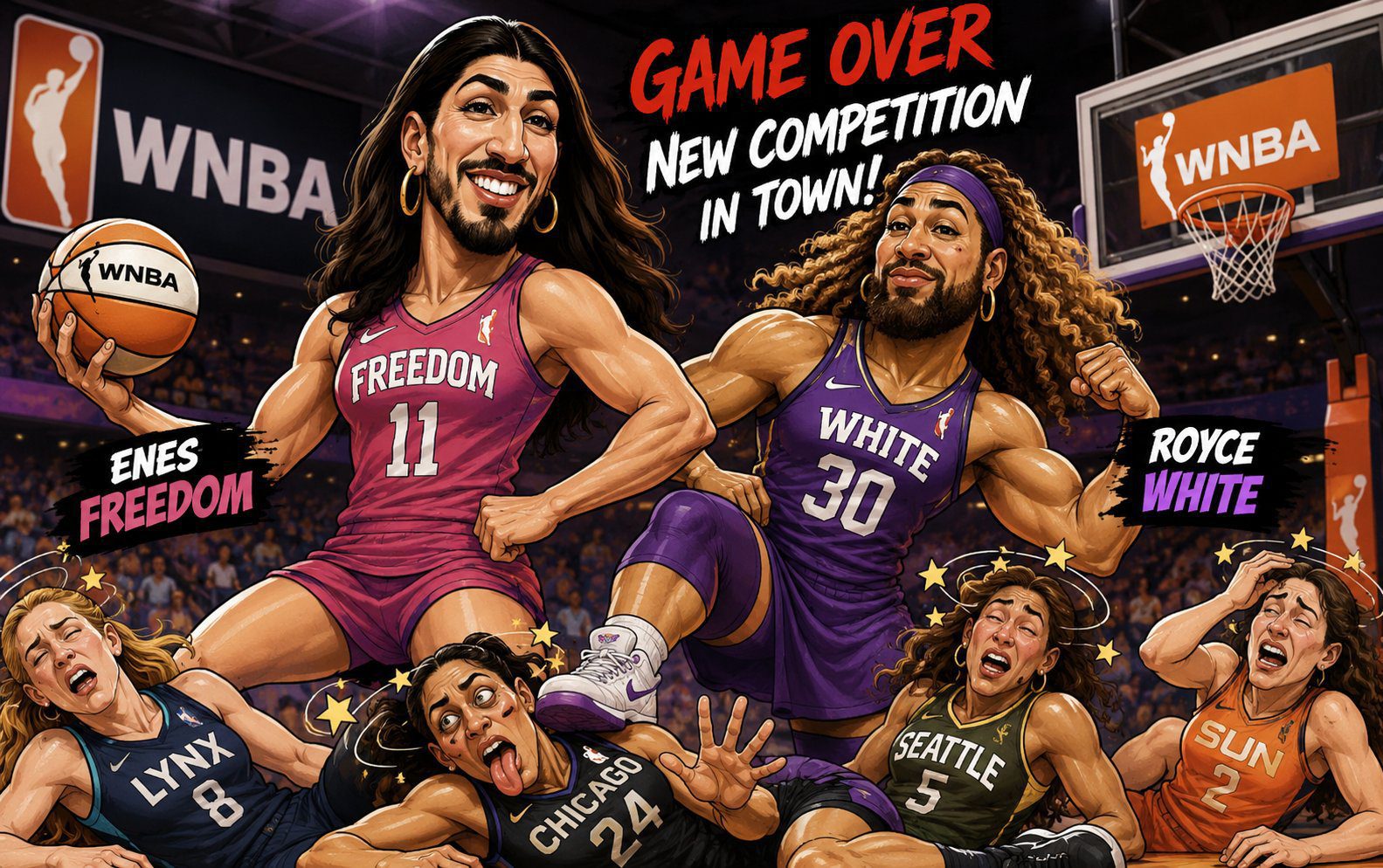
And whether you agree with them or think the entire thing is ridiculous, there is one thing that makes this interesting: it exposes a question that professional sports leagues have been increasingly forced to confront. What exactly does “woman” mean when determining eligibility for women’s athletics?
That is the question Freedom and White want answered.
Who Is Enes Freedom?
Enes Freedom, formerly known as Enes Kanter, is hardly some random guy who wandered into a basketball gym looking for attention. Born in Switzerland and raised in Turkey, Freedom became a major basketball prospect before moving to the United States. The Utah Jazz selected him with the third overall pick in the 2011 NBA Draft. He ultimately played 11 seasons in the NBA for teams including Utah, Oklahoma City, New York, Portland and Boston. He finished his NBA career averaging 11.2 points and 7.8 rebounds per game.
But Freedom became perhaps even more famous for what he did away from the basketball court.
He became an outspoken critic of authoritarian governments and human-rights abuses, particularly those associated with Turkish President Recep Tayyip Erdogan and the Chinese government. His political activism came with substantial personal consequences. According to his foundation, Turkey canceled his passport, targeted members of his family and issued arrest warrants against him. He has described receiving death threats and living under serious personal security concerns because of his activism.
In other words, Freedom has never exactly been the type of athlete who looks at a controversial subject and decides that keeping his mouth shut would be easier.
This latest stunt fits the pattern.
And Then There Is Royce White
Royce White has his own unusual history in basketball and politics.
White was a highly regarded basketball player from Minnesota, won Minnesota Mr. Basketball in 2009 and eventually became a standout at Iowa State. During the 2011-12 season, he led the Cyclones in all five major statistical categories, an extraordinarily unusual accomplishment. The Houston Rockets selected him 16th overall in the 2012 NBA Draft.
His NBA career, however, never developed the way many expected. White ultimately played only three NBA games for the Sacramento Kings, while spending time in the NBA G League and later playing professionally in Canada, where he became an MVP and two-time champion.
White eventually moved into politics and became the Republican nominee for the U.S. Senate in Minnesota in 2024. So, much like Freedom, he is not exactly allergic to controversy.
White followed Freedom’s announcement by saying he would also declare for the 2027 WNBA Draft. He went further, saying he identifies as a woman for the purpose of participating in professional basketball and indicated that he would challenge the league legally if he were denied fair treatment.
What Are They Actually Trying to Prove?
This is where the story gets interesting.
Freedom and White aren’t seriously suggesting that the WNBA should suddenly hand them uniforms and put them on the court. They are testing the logic of the argument surrounding transgender participation in women’s sports. And that is always what this was and is about.
Their basic position is, if gender identity is sufficient to determine eligibility, then why shouldn’t that principle apply consistently? If it isn’t sufficient, then what additional criteria should exist?
Sounds like a simple question, no? Apparently, humanity has managed to turn it into one of the most explosive arguments in modern sports.
The WNBA’s collective bargaining agreement states that only players who are women are eligible to play in the league. But the publicly discussed language does not provide a detailed definition addressing every question surrounding transgender eligibility. That ambiguity is precisely the opening Freedom and White are exploiting.
And that is the whole issue. WHAT IS A WOMAN? Not only is the WNBA being cloudy about this, but we have even seen our own government (Democrats) play the same game. When questioned, we have seen countless times that the answer is not given on what a “woman” is.
And their argument is particularly effective as political theater because both men have already demonstrated that they are capable professional basketball players.
Freedom is 6-foot-10 and played 748 NBA regular-season games. White is 6-foot-8 and was once a first-round NBA selection.
If either man actually appeared on a WNBA court, the physical disparity would be impossible to ignore.
That is the point.
The Hypocrisy Argument
From my perspective, this is where Freedom and White have landed on something worth discussing.
For years, the debate over transgender participation in women’s sports has centered around fairness, inclusion and the question of whether biological differences between males and females matter in athletic competition.
Those who argue for restrictions generally point to differences in average size, strength, speed, bone structure and other physiological characteristics. Those who support transgender inclusion argue that transgender women should not automatically be excluded from women’s sports because of their gender identity.
Both sides have legitimate questions that deserve to be debated.
But there is an obvious problem when organizations use vague language while simultaneously insisting that the rules are perfectly clear. If biological sex matters, if gender identity matters, then define that.
If hormone levels matter, if previous exposure to male puberty matters, establish the standard.
If none of those things matter, explain why. This isn’t hatred or anti-trans. It is the basic concept of having a rule.
And this is very important to understand. Freedom and White are essentially forcing the WNBA to confront that issue from an angle that the league probably wishes would simply disappear.
The WNBA Has Already Responded
The league clearly does not find the stunt amusing.
The WNBA recently condemned what it called “bad-faith efforts” surrounding transgender athletes and said there are currently no immediate eligibility matters affecting the league. The league also emphasized that it rejects efforts to demean or marginalize people.
There is an important distinction here: according to the WNBA, there is currently no transgender woman on a WNBA roster. Personally, I would disagree. Im Sophie Cunningham pointing at you, Brittney Griner!
This isn’t a situation where Freedom and White are responding to an actual transgender player currently dominating the WNBA. The controversy is largely about what the league’s rules should be if that situation arises in the future. And that may ultimately be the biggest reason their stunt has gotten so much attention. They have turned a theoretical argument into a hypothetical case study standing 6-foot-8 and 6-foot-10 tall.
Human beings do love hypotheticals until somebody actually tests them.
Will They Actually Wind Up Playing in the WNBA?
Almost certainly not. The WNBA (NBA) will never ever, ever, ever allow this!
Simply declaring for the draft does not automatically make either man eligible, and it certainly doesn’t require a WNBA team to draft or sign them. The 2027 WNBA Draft is not scheduled until next April, and the league has already indicated that it considers the effort a bad-faith attempt to stir controversy rather than a legitimate eligibility matter.
But that’s almost beside the point. The objective isn’t really to play basketball. The objective is to force the league to articulate its position. If the WNBA says that Freedom and White cannot participate because they are biologically male, then they have their answer. If the league says they cannot participate because they do not meet some other eligibility standard, then that standard can be examined. And if the league refuses to clearly explain the standard, Freedom and White can continue arguing that the rules are being applied selectively.
That is where the protest becomes potentially useful.
What Happens Next?
The most likely outcome is that the WNBA establishes clearer eligibility rules before the 2027 draft. This would actually be the most logical result.
Professional sports cannot operate indefinitely on ambiguous definitions when those definitions determine who is eligible to compete. The league needs rules that are clear enough that athletes, teams and fans understand what the standard is before somebody is standing at the draft table demanding an explanation.
The controversy could therefore accomplish something that shouting matches on social media haven’t: force the WNBA to put its policy into writing.
You don’t have to agree with Freedom and White, and every word they say. You don’t even have to like them. But challenging a rule by testing its logical boundaries is a legitimate form of protest.
The transgender-athlete debate isn’t going away. Neither is the question of competitive fairness in women’s sports.
If the WNBA believes biological sex should be irrelevant to eligibility, it should say so. If the WNBA believes biological sex is relevant, it should explain exactly why and establish a clear standard. If gender identity is the determining factor, then the league should explain how that principle is supposed to work when competing against the physical realities of professional basketball.
That’s the conversation Freedom and White have forced onto the table.
And perhaps the ultimate irony is that they probably won’t need to play a single minute of WNBA basketball to accomplish what they set out to do. They simply need the league to explain its own rules. Sometimes the most effective protest isn’t refusing to play by the rules. It’s asking everyone to explain what the rules actually are.




























































Want to join the conversation?
Create an account or sign in to share your thoughts, vote,
and reply to other readers.
Showing 0 of 0 comments
Don't have an account?
Already have an account?