

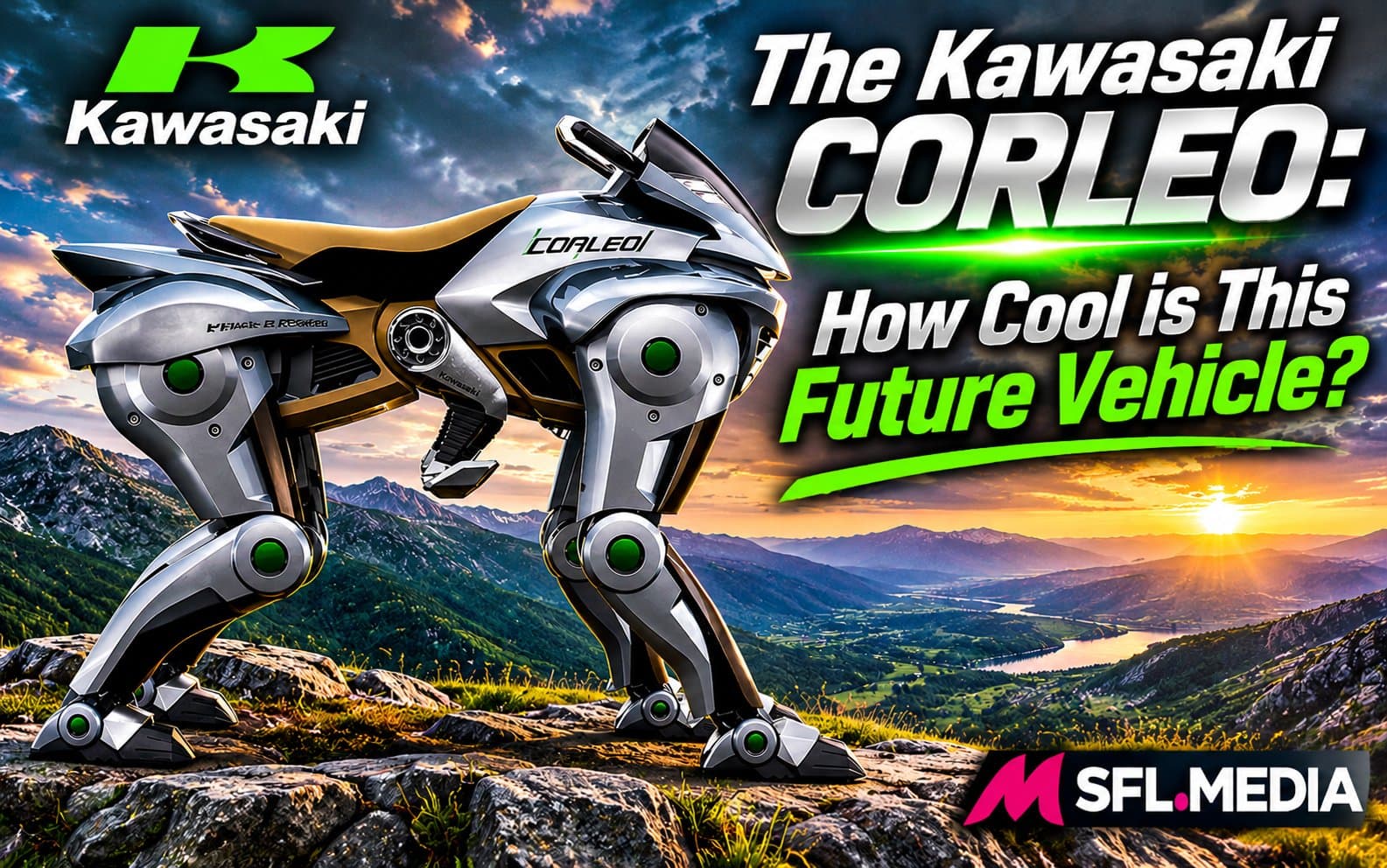
Kawasaki CORLEO: The Four Legged Hydrogen Powered Vehicle That Looks Like Something Straight Out of the Future
Imagine climbing onto a machine that looks like a cross between a motorcycle, a robotic horse and a four legged dog, then riding it across rocky mountains, uneven trails and terrain where traditional vehicles would struggle to go. There are no wheels, no conventional handlebars and no steering wheel. Instead, the machine responds to your body movements, shifting its robotic legs beneath you as it navigates the landscape. It sounds like something pulled straight out of a science fiction movie, but it is actually a project being developed by Kawasaki Heavy Industries.
Meet CORLEO, an experimental four legged, hydrogen powered personal mobility vehicle that could introduce an entirely new category of transportation. Unveiled at Expo 2025 Osaka in Japan, CORLEO combines Kawasaki’s extensive motorcycle engineering experience with advanced robotics to create a machine that moves more like an animal than a conventional vehicle. Unlike many futuristic transportation concepts that exist primarily as computer generated illustrations, Kawasaki has established a dedicated development program with the goal of bringing CORLEO to market by 2035.
The Inception: Where Did CORLEO Come From?
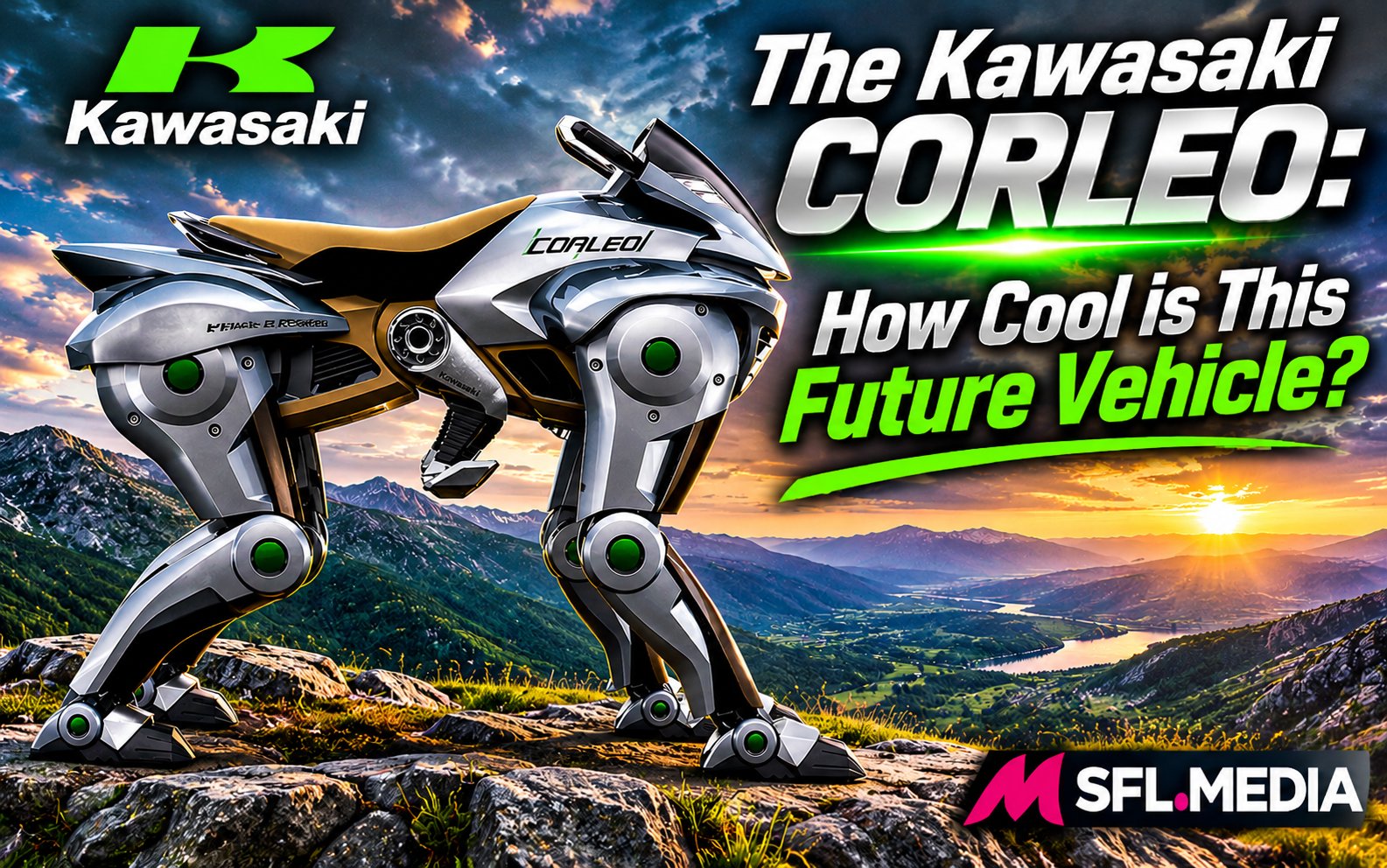
CORLEO was officially introduced to the public on April 3rd, 2025, when Kawasaki Heavy Industries announced that it would showcase the futuristic vehicle at the 2025 World Expo in Osaka, Japan. Kawasaki presented the machine as a vision of personal transportation in 2050, offering a glimpse into what mobility could look like in the coming decades.
The project was born from Kawasaki’s desire to combine two areas in which the company has considerable experience: motorcycle development and robotics. Kawasaki has spent decades engineering motorcycles, developing suspension systems, handling technology and powertrains. Its robotics division, meanwhile, has developed sophisticated systems capable of controlling complex mechanical movements. CORLEO brings those two worlds together in a way that has rarely been attempted before.
The company introduced the concept under the theme “Impulse to Move,” based on the idea that humans naturally find happiness and fulfillment through movement, exploration and experiencing the outdoors. Rather than designing another electric ATV or traditional off road motorcycle, Kawasaki wanted to create something capable of navigating difficult environments in an entirely different way. The result was a four legged robotic vehicle inspired by animal movement, particularly the agility and strength associated with a lion. Its name, CORLEO, reflects that inspiration. The machine is designed to provide a riding experience that feels more like riding an animal than operating a conventional vehicle.
How Does CORLEO Actually Work?
This is where things get particularly interesting. CORLEO does not use traditional wheels or tires. Instead, it has four independently moving robotic legs, each equipped with specialized suspension and rubber feet designed to maintain traction across different surfaces. The rider sits on a motorcycle style saddle and holds onto handgrips, while their feet rest in adjustable stirrups. There is no conventional steering wheel or traditional throttle. Instead, CORLEO detects changes in the rider’s center of gravity. By leaning forward, backward or shifting their weight from side to side, riders communicate their intended movements to the machine.
Think of horseback riding, except the horse is a sophisticated robotic machine powered by hydrogen. The onboard control system interprets the rider’s movements and coordinates the four legs to navigate the terrain. Kawasaki describes this approach as adaptive shared control. Essentially, the rider remains involved in controlling the machine while its robotic systems continuously monitor movement and stability. The technology is also designed to intervene when necessary to help prevent dangerous maneuvers.
For example, if the rider attempts a movement that could cause the vehicle to become unstable, the computer controlled system is designed to recognize the danger and adjust the machine’s movements. Kawasaki is also developing different operating modes, including walking and running, with longer term ambitions of allowing CORLEO to jump over obstacles and navigate particularly challenging terrain.
CORLEO Specifications: What’s Under the Hood?
CORLEO is not simply a robotic animal with a rider strapped to its back. It incorporates some fascinating engineering, particularly when it comes to its hydrogen power system, robotic legs and suspension technology. One of its most interesting features is its hydrogen powered propulsion system. Rather than relying on a conventional battery powered drivetrain, Kawasaki’s concept uses a compact hydrogen engine to generate electricity. That electricity powers the actuators responsible for moving the four robotic legs and controlling the vehicle’s body.
There is an important detail concerning the engine specifications. Kawasaki’s February 2026 technical review identifies a 150cc engine, while subsequent development materials describe a 333cc hydrogen engine. These figures appear to reflect different stages or specifications of the developing concept. Kawasaki has not yet established a definitive production engine specification, so neither figure should be treated as a confirmed final specification.
The four independently moving robotic legs are the defining feature of CORLEO. Each leg is designed to bend, extend and adapt to changing ground conditions. This allows the machine to step over rocks, navigate uneven surfaces and potentially jump over obstacles. Its electronic control systems coordinate the movements of all four legs to maintain balance and stability.
One of the cleverest engineering features is the swingarm suspension mechanism, which draws inspiration from motorcycle engineering. The system allows the rear leg assembly to move vertically in relation to the front assembly. When CORLEO travels uphill, downhill or across uneven ground, the suspension helps absorb impacts and maintain a more comfortable riding position. It also helps the rider maintain a better view of the terrain ahead instead of being forced to lean backward when climbing.
Instead of tires, CORLEO uses specialized rubber feet that resemble animal hooves. These split rubber structures are designed to provide traction and absorb irregularities in the ground. Kawasaki envisions the system working across different surfaces, including rocky terrain, loose gravel, grass, dirt and uneven woodland trails. The feet are also designed to help absorb landing impacts, reducing the amount of corrective work required from the robotic suspension system.
Another interesting feature involves the hydrogen storage system. Kawasaki has developed removable hydrogen storage alloy canisters that fit into the rear section of the vehicle. These canisters are designed to be interchangeable, potentially allowing users to carry replacement units and swap them when necessary rather than depending entirely on conventional fueling infrastructure.
CORLEO also incorporates advanced rider detection and safety technology. Its control system continuously monitors the rider’s body movements and the vehicle’s operating conditions. The adaptive shared control technology is designed to adjust how much control the computer exercises depending on the rider’s skill level and the danger of a particular maneuver. The objective is to make the vehicle accessible to less experienced riders without eliminating the excitement and control expected by experienced off road enthusiasts.
While Kawasaki has revealed several important technical details, a complete production specification sheet has not yet been released. Maximum speed, vehicle weight, operating range, horsepower, carrying capacity and retail price remain unconfirmed.

Could CORLEO Actually Climb Mountains and Jump Obstacles?
That’s precisely what Kawasaki wants to accomplish. Traditional off road vehicles depend on wheels and tires to maintain contact with the ground. While motorcycles, ATVs and four wheel drive vehicles are extremely capable, there are environments where large rocks, steep inclines, loose surfaces and deep obstacles can become serious limitations.
CORLEO approaches the problem differently. Its four legs can independently adjust their positions, allowing the machine to step over obstacles rather than simply attempting to roll over them. Kawasaki’s longer term development goals include walking, running, jumping and navigating difficult off road environments.
The company also envisions applications beyond recreational riding. Its ability to travel across challenging terrain could eventually make it useful in disaster response, rescue operations and other situations where conventional vehicles have difficulty reaching people. Kawasaki has also discussed developing stable operation at extremely low speeds and the possibility of tandem riding. These capabilities remain development objectives rather than confirmed features of a commercially available vehicle, but they demonstrate just how ambitious the project has become.
When Will CORLEO Be Available?
Here’s the important part: Kawasaki isn’t treating CORLEO as a one time publicity stunt. In December 2025, Kawasaki announced that it had established a dedicated development organization called the SAFE ADVENTURE Business Development Team. The team reports directly to the company’s president and is responsible for advancing CORLEO toward commercialization. The company has established several important milestones. A dedicated riding simulator is targeted for completion in 2027, followed by development of a new CORLEO model and potential deployment at Expo 2030 Riyadh in Saudi Arabia. Kawasaki’s current commercialization target is 2035.
The 2030 World Expo in Riyadh is particularly interesting because Kawasaki wants CORLEO to potentially serve as an on site mobility vehicle for security personnel and other workers attending the event. The company is also developing a riding simulator that will help refine the vehicle’s movements and handling characteristics in a virtual environment before full scale commercialization. Interestingly, Kawasaki is looking beyond transportation. The company believes the simulator could eventually become part of the gaming and esports industries, allowing people to experience the sensation of riding CORLEO without actually operating the physical machine. As of November 2026, CORLEO remains under development. There is no confirmed retail release date, production price or finalized consumer specification sheet.
Is CORLEO the Future of Transportation or Just an Expensive Toy?
That remains to be seen, but there are some genuinely interesting possibilities. For recreational users, CORLEO could eventually offer a completely different way to explore wilderness areas, mountains and off road trails. For tourism operators, it could create new experiences in locations where conventional vehicles are impractical. For emergency responders, a sufficiently capable version could potentially access remote areas following natural disasters, landslides or other emergencies. Its ability to navigate terrain using independently controlled legs could provide advantages in environments where traditional vehicles struggle.
There are also obvious challenges. Manufacturing four sophisticated robotic legs capable of supporting a human rider while navigating unpredictable terrain is considerably more complicated than building a traditional ATV. Durability, maintenance, hydrogen infrastructure, safety certification and production costs will all play important roles in determining whether CORLEO becomes commercially viable. Then there is the question of practicality. A four legged robotic vehicle might be incredible to ride, but it needs to demonstrate that it can outperform existing off road transportation in situations where that additional engineering actually matters.
Still, Kawasaki deserves credit for attempting something radically different. The automotive and motorcycle industries have spent decades refining wheels, engines and conventional suspension systems. CORLEO represents an attempt to rethink the basic architecture of personal transportation altogether.
The Bottom Line
Kawasaki CORLEO might be one of the strangest and most fascinating transportation concepts to emerge in recent years. It is a hydrogen powered, four legged robotic vehicle that takes rider commands through body movements, uses advanced computer controls to maintain stability and is being developed to travel across terrain that would challenge traditional off road machines. Whether it eventually becomes a common sight on mountain trails or remains a niche recreational machine is still an open question. The engineering challenges are substantial, and Kawasaki still has years of development ahead before consumers can potentially purchase one.
But one thing is certain: the idea of saddling up on a robotic animal and riding it through the wilderness is no longer confined to science fiction. Kawasaki has put a serious development program behind the idea, and with commercialization targeted for 2035, the future might be a lot closer than some people think.

















Reader discussion
Join the conversation
Want to join the conversation?
Create an account or sign in to share your thoughts, vote and reply to other readers.
No comments yet. Be the first to share your thoughts.
No comments