
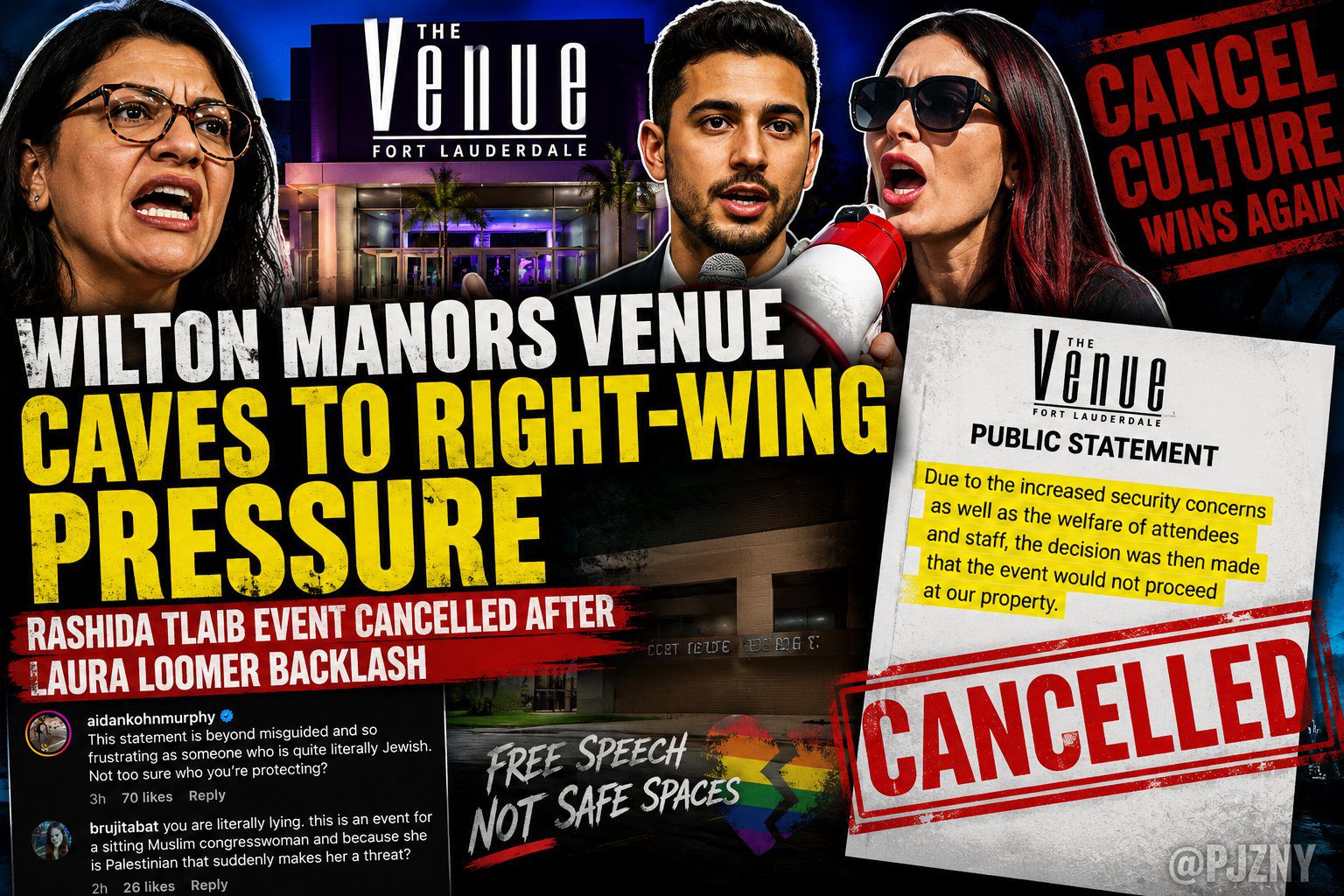
The Venue Fort Lauderdale Cancels Rashida Tlaib Event After Right Wing Backlash, Igniting Political Fight in Wilton Manors
WILTON MANORS, Fla. — A prominent event venue in one of South Florida’s most historically LGBTQ friendly and Democratic communities has canceled a political event involving progressive congressional candidate Elijah Manley and U.S. Rep. Rashida Tlaib, igniting accusations that the business capitulated to conservative political pressure rather than stand behind the political tolerance traditionally associated with Wilton Manors.
The controversy centers on The Venue Fort Lauderdale, a sprawling event complex at 2345 Wilton Drive in Wilton Manors that markets itself as one of South Florida’s premier event spaces. Despite the “Fort Lauderdale” branding, the property is located within Wilton Manors. The Venue announced that an event scheduled for Friday, August 14, 2026, would no longer take place at the property after management said it became aware of the gathering’s “full scope and nature” and reviewed promotional materials associated with it. The Venue cited increased security concerns and the welfare of employees and attendees in explaining its decision.
But the cancellation immediately created another question that the company’s statement did not fully answer: What specifically about a political event featuring a sitting member of Congress created a security concern serious enough to cancel it? That question has fueled a growing backlash online, particularly because the controversy unfolded amid criticism of the planned event from far right activist Laura Loomer and others on the political right.
The Venue Says Security Concerns Forced the Cancellation
In the public statement provided on Instagram, The Venue said management began addressing the matter after reviewing information about the scheduled event.
“Once we became aware of the full scope and nature of the event and reviewed the publicly circulated promotional materials, we immediately began addressing the matter. Due to the increased security concerns as well as the welfare of attendees and staff, the decision was then made that the event would not proceed at our property.”
The Venue also emphasized its ownership and relationship with South Florida’s Jewish community, stating:
“The Venue Fort Lauderdale is Jewish-owned and operated and our values and commitment to the Jewish community are deeply important to us.”
The business stressed that accepting a booking should not be interpreted as an endorsement of the political views, organizations, speakers, messaging or causes associated with an event. It also said it was reviewing its booking and vetting procedures to ensure the nature, sponsors, speakers, organizations and purpose of future events are fully disclosed before a reservation is accepted. Those explanations have not extinguished the controversy. Instead, critics have questioned why the religious identity of the venue’s ownership was relevant to explaining the cancellation of a political gathering involving Tlaib, a Palestinian American member of Congress and one of Washington’s most outspoken critics of the Israeli government.
There is an important distinction here. A private event venue can have legitimate reasons for taking security threats against employees and guests seriously, and political events involving nationally controversial figures can require substantial security planning. The public interest question is not whether The Venue should protect its employees and customers. It is what specifically happened between accepting the booking and canceling it.
Rashida Tlaib’s Appearance Turned a Local Race Into a National Political Flashpoint
Tlaib was scheduled to appear in connection with Manley, a progressive Democrat running in Florida’s 20th Congressional District. Manley is among the Democratic candidates appearing on Florida’s August 18 primary calendar. Tlaib’s participation transformed what might otherwise have remained a local congressional campaign event into another front in the national political battle over Israel, Gaza, antisemitism, Islamophobia and the Democratic Party’s increasingly visible internal disagreements over U.S. policy toward Israel.
Tlaib is the only Palestinian American woman currently serving in Congress and has become one of the Democratic Party’s most forceful critics of the Israeli government and American military support for Israel. Manley has likewise campaigned from the progressive wing of the Democratic Party and has called for conditioning U.S. military aid on compliance with human rights and international law standards. Those positions are controversial, particularly in South Florida, home to one of the nation’s largest Jewish communities. But controversial political positions are not, by themselves, evidence of a security threat. That distinction sits at the center of the dispute now surrounding The Venue.
Laura Loomer and the Exaggerated Fake Right Wing Backlash
The event drew attention from Laura Loomer, the Florida based far right activist and longtime Trump ally known for using social media to target political opponents, government officials and institutions. Loomer has spent years cultivating a political brand built around confrontation and online pressure campaigns. She previously worked with Project Veritas and Rebel News and became nationally known through provocative political stunts and inflammatory commentary, including repeated controversies surrounding her rhetoric about Muslims. She was previously banned from several major technology platforms before being reinstated on X.
Loomer has also twice sought congressional office in Florida. She won the Republican nomination in Florida’s 21st Congressional District in 2020 before losing the general election to Democrat Lois Frankel, and later unsuccessfully challenged Republican Rep. Daniel Webster in the 2022 GOP primary.
Her ability to influence political discourse now extends well beyond her unsuccessful congressional campaigns. Loomer has developed a substantial following within Trump’s political movement and has repeatedly demonstrated an ability to turn online allegations or criticism into sustained pressure against institutions and public officials. That makes the chronology surrounding The Venue’s decision relevant.
But it is equally important not to outrun the available evidence: South Florida Media has not independently established that Loomer personally caused The Venue to cancel the event, and the venue’s public statement does not identify Loomer as the reason for its decision. What is clear is that the planned event became politically controversial, criticism spread online, and The Venue subsequently announced that it would no longer host the gathering while citing security concerns and its commitment to the Jewish community.
The Venue’s Explanation Triggered Its Own Backlash
The reaction underneath The Venue’s public statement was swift and overwhelmingly critical in the comments reviewed by South Florida Media. Aidan Kohn-Murphy, who identified himself in the comment as executive director of Gen-Z for Change and as Jewish, challenged the venue directly.
“This statement is beyond misguided and so frustrating as someone who is quite literally Jewish. our org is rallying behind an incredible jewish candidate in @realelijahmanley. Not too sure who you’re protecting?”
Other commenters were even more direct. One accused the venue of canceling the gathering because Tlaib was scheduled to attend and alleged that Loomer’s criticism had prompted the decision. Another commenter wrote:
“you are literally lying. this is an event for a sitting Muslim congresswoman and because she is Palestinian that suddenly makes her a threat?”
Another asked:
“An event featuring a sitting Muslim congresswoman is objectionable according to your business?”
Those comments are allegations and opinions from social media users, not established facts about The Venue’s motivation. But they illustrate the public relations problem created by the wording of the venue’s own announcement. The company said it learned the “full scope and nature” of the event, cited security concerns, identified itself as Jewish owned and operated, and announced that the event would not proceed. Without greater specificity about what changed or what security information was received, critics have inevitably connected those statements to the identities and political positions of the people scheduled to participate. The Venue could substantially clarify the controversy by explaining that distinction.
This Happened in Wilton Manors, And That Matters…
The location makes this political fight particularly striking. The Venue sits at 2345 Wilton Drive in Wilton Manors, one of America’s best known LGBTQ communities and historically one of South Florida’s most recognizable liberal enclaves. The property itself has previously hosted events connected to that community. In 2019, the City of Wilton Manors promoted “Our Night OUT” at The Venue as part of festivities surrounding Stonewall Pride. Wilton Manors has built an international reputation around LGBTQ visibility, inclusion and political tolerance. That history makes a controversy involving the cancellation of a political event featuring a Palestinian American Muslim member of Congress particularly consequential.
The episode also arrives as Democrats confront a much larger problem across Florida: the deterioration of the political infrastructure that once allowed the party to seriously compete statewide.
Florida Democrats Have Been Losing Ground for Years
It would be easy to dismiss what happened at The Venue as another isolated culture war fight. It is more useful to view it against the political transformation that has occurred across Florida. Florida was once the quintessential presidential battleground. Democrats could win statewide elections, compete seriously for the governor’s mansion and rely on South Florida as the foundation of a broader statewide coalition. That political structure has deteriorated dramatically as Republicans have expanded their advantages in voter registration, fundraising, messaging, candidate recruitment and grassroots organization.
The Democratic National Committee did not single handedly cause Florida Democrats’ decline, and blaming one national organization for years of losses would oversimplify a much larger failure involving the Florida Democratic Party, candidate recruitment, turnout, fundraising, demographic changes and major shifts among portions of the Hispanic electorate.
But national Democrats have increasingly treated Florida as a difficult and expensive battlefield while directing finite resources toward states considered more immediately competitive. The strategic logic may make sense election by election. The long term consequences are considerably more dangerous. Political infrastructure disappears when nobody maintains it. Local organizations weaken, candidate pipelines shrink, volunteers disengage, donors lose confidence and opposition parties encounter progressively less resistance. Each defeat then makes the next election more difficult. Eventually, even traditionally liberal territory exists inside a statewide political ecosystem overwhelmingly shaped by the opposition. That is the larger political environment surrounding this fight in Wilton Manors.
When Political Pressure Works, It Gets Repeated
The most consequential question raised by the cancellation may ultimately have little to do with whether someone agrees with Rashida Tlaib. Americans are free to vehemently oppose Tlaib’s politics. Jewish Americans are free to condemn her positions on Israel. Palestinian Americans are equally free to support her. Loomer and other conservative activists are free to criticize the event, and The Venue is entitled to take credible threats and legitimate security risks seriously. But democratic culture becomes considerably more fragile when political outrage itself becomes enough to prevent opposing groups from assembling. If activists across the political spectrum discover that generating enough calls, messages, social media attention or reputational pressure can convince private venues to cancel political events, they have discovered an extraordinarily effective political weapon.
There is nothing inherently partisan about that tactic. Today it can be used against Rashida Tlaib. Tomorrow progressive activists can use the same playbook against a conservative speaker. Eventually businesses conclude that hosting controversial political figures simply is not worth the trouble. The result is not greater tolerance or public safety. It is a chilling effect in which private economic pressure determines which political viewpoints can find a room.
The Venue Needs to Explain What the Security Concern Actually Was
The Venue’s public statement raises several questions that remain unanswered. What changed after the booking was initially accepted? What specific information produced the security concerns? Did the venue receive credible threats? Were law enforcement agencies contacted? Did police or security professionals advise management that the gathering could not safely proceed? Was additional private security considered? Was the campaign offered an opportunity to address those concerns? And what specifically did The Venue mean when it said it became aware of the event’s “full scope and nature”?
Those questions matter because there is an enormous difference between canceling an event after receiving a credible security assessment and canceling because a controversial speaker generated political outrage. South Florida Media has not independently established that Loomer or any other activist directly caused the cancellation. Nor does the available public statement establish that Tlaib’s ethnicity, religion or political views were the reason for the decision. Those claims should not be reported as facts without evidence.
What can be documented is more limited but still significant: The event became the subject of political criticism, The Venue canceled it, and the company publicly cited security concerns, its Jewish ownership and a need to strengthen its vetting procedures.
Wilton Manors Is Facing a True Test of Its Political Identity
For decades, communities such as Wilton Manors have presented themselves as places where people whose identities and political beliefs were rejected elsewhere could participate openly in civic life. That principle is easiest to defend when everyone in the room agrees. Its real test comes when they do not.
Rashida Tlaib is controversial. Her views on Israel are controversial. Elijah Manley is running as a progressive in a contested Democratic primary. Political opponents have every right to challenge their positions aggressively. But disagreement is the basic operating system of democratic politics. A functioning political culture depends on allowing those disagreements to occur publicly rather than gradually allowing political intimidation, from the left or the right, to determine who gets a microphone and who gets a room. The Venue may have legitimate evidence that security concerns made Friday’s gathering impractical or unsafe. If so, explaining the nature of those concerns without compromising sensitive security information would go a long way toward answering the criticism.
Until then, the optics are difficult to escape: A political event involving a Palestinian American member of Congress was scheduled at a major venue in one of South Florida’s most famously liberal communities. The event became the target of conservative criticism. The venue canceled it and cited security concerns, its Jewish ownership and deficiencies in its booking vetting process. That sequence deserves scrutiny. And for a Democratic Party already struggling to remain competitive across Florida, seeing a progressive political event consumed by controversy in Wilton Manors itself should serve as another warning about how dramatically the state’s political landscape has changed.
Florida’s transformation did not happen overnight. Republicans spent years building organization, messaging, candidates and turnout while Democrats repeatedly failed to construct a comparable statewide political machine. Wilton Manors remains one of South Florida’s most recognizable progressive communities. But political identity is not something a city declares once and owns forever. It has to exist in practice. And sometimes the clearest test of political tolerance is whether people you strongly disagree with are still allowed through the door.
Sources
The Venue Fort Lauderdale — Ownership and Management Team — Official team page identifying founder Brett Tannenbaum and current management, including Roby Tannenbaum. (South Florida Wedding Venue)











































Want to join the conversation?
Create an account or sign in to share your thoughts, vote,
and reply to other readers.
Showing 1 of 1 comment
Don't have an account?
Already have an account?