
Trump Era Broadband Overhaul Sends Hundreds of Millions to Elon Musk’s Starlink as Rural Fiber Projects Disappear
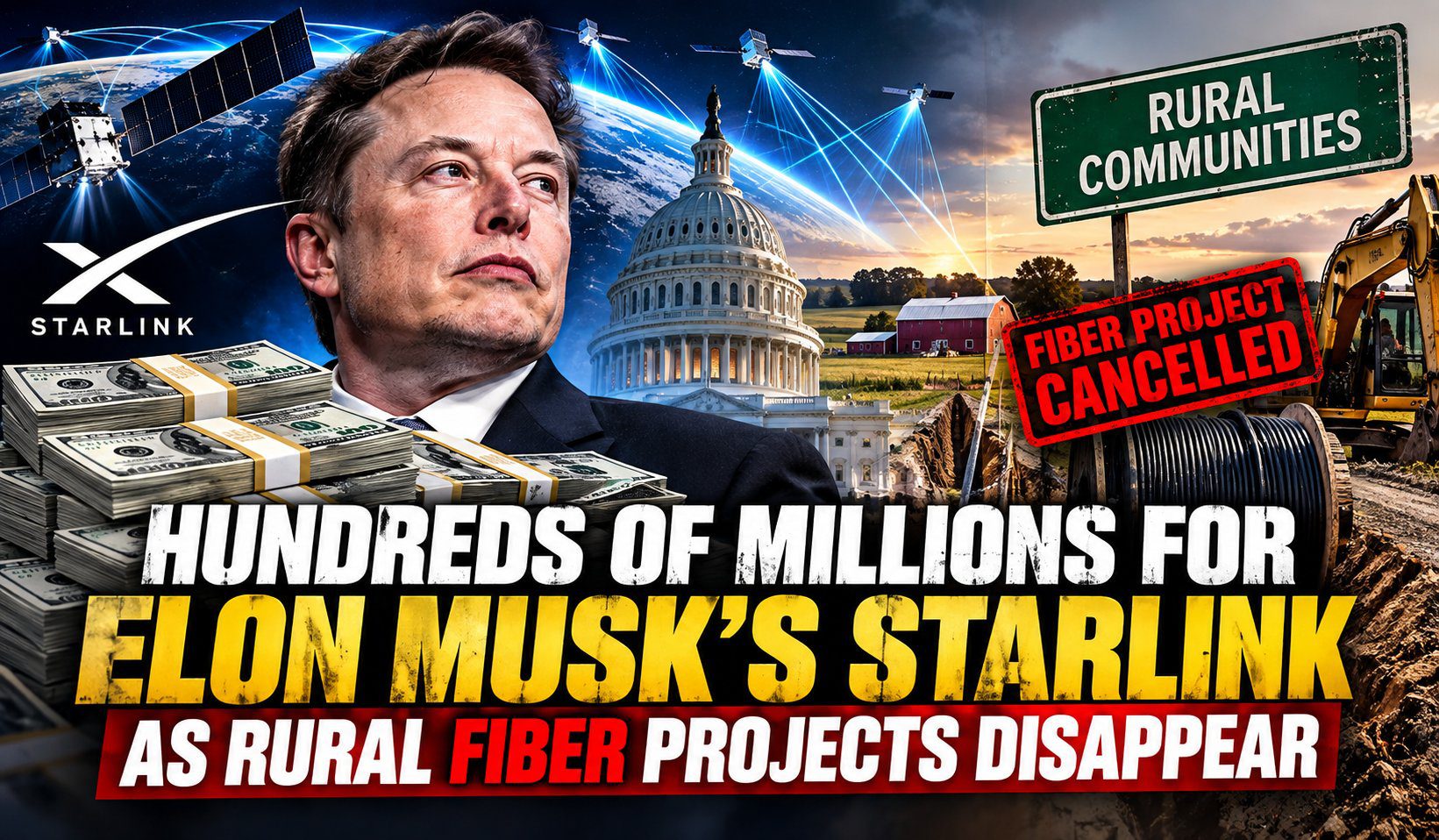
A federal broadband program created to bring high speed internet to some of the hardest to reach communities in America is undergoing a fundamental transformation, with hundreds of millions of dollars now flowing toward Elon Musk’s Starlink after the Trump administration rewrote key rules that previously favored permanent fiber optic infrastructure. The shift is at the center of a new investigation by More Perfect Union, which examined how changes to the $42.45 billion Broadband Equity, Access, and Deployment program, known as BEAD, have affected rural communities that had expected federally subsidized fiber networks but are now being assigned satellite service instead.
The investigation focuses heavily on Lake Providence, Louisiana, where a fiber project worth more than $6 million was replaced by a roughly $150,000 Starlink award covering 204 locations. The enormous difference in upfront cost illustrates exactly why the Trump administration says its revised approach is saving taxpayers billions. It also exposes the central dispute surrounding the overhaul: whether Washington is saving money by finding a more efficient way to connect remote Americans or sacrificing permanent infrastructure in poor rural communities in favor of a cheaper service delivered through a private satellite network.
That distinction matters because BEAD was never simply a program for purchasing internet subscriptions. Congress created it through the 2021 bipartisan infrastructure law as a massive public investment intended to close America’s remaining broadband gaps. The Biden administration strongly prioritized fiber as the most durable and scalable technology while permitting alternatives for locations where fiber was prohibitively expensive. The Trump administration dismantled that preference in 2025, ordering states to conduct a new “Benefit of the Bargain” selection process under technology-neutral rules that placed significantly greater emphasis on cost. Starlink emerged as one of the biggest beneficiaries.
Starlink Wins More BEAD Locations Than Any Other Provider
Starlink has received approximately $738.8 million in BEAD grants covering roughly 476,000 locations nationwide, according to industry reporting compiled from state awards. That gives SpaceX’s satellite service more BEAD funded locations than any other internet provider. The figure is slightly lower than the approximately $770 million cited in the More Perfect Union report, but the broader finding is the same: Starlink has become a major recipient of federal broadband subsidies following the rule changes.
The transformation began in June 2025, when the National Telecommunications and Information Administration, the Commerce Department agency overseeing BEAD, formally replaced parts of the Biden-era framework. Under the new policy, states were ordered to consider competing technologies on a more equal basis rather than giving fiber the strong preference it previously enjoyed.
Commerce Secretary Howard Lutnick argued that the Biden administration had burdened BEAD with unnecessary requirements and favored expensive technologies. The administration said its revised approach would connect Americans faster while dramatically reducing taxpayer costs, and NTIA says the restructuring ultimately produced approximately $21 billion in savings across the program.
Critics see a different calculation. Fiber generally requires expensive construction because companies must install physical lines, poles, underground conduit and related infrastructure. Once constructed, however, those networks can operate for decades and provide extremely high capacity. Starlink avoids most of those construction expenses because SpaceX has already built its satellite constellation, meaning connecting another rural household can require little more than providing access to the network and installing customer equipment. That makes satellite dramatically cheaper upfront, but it does not make fiber and satellite identical infrastructure.
A $6 Million Fiber Network Becomes a $150,000 Starlink Award
Few communities demonstrate that tradeoff more clearly than Lake Providence in East Carroll Parish, Louisiana. Under an earlier version of Louisiana’s broadband plan, more than $6 million was expected to support construction of a physical fiber network serving the area. Following the federal rule changes and Louisiana’s revised selection process, that project was replaced with an approximately $150,000 Starlink award covering 204 locations.
On a government spreadsheet, the savings are enormous. For residents and broadband advocates interviewed by More Perfect Union, however, the concern is that Lake Providence did not simply receive the same infrastructure for less money. The community lost the planned construction of a physical fiber network and instead received access to an existing commercial satellite system.
Local advocates argue that distinction could have consequences extending well beyond household internet speeds. Reliable fiber infrastructure can become part of a community’s economic foundation, supporting businesses, schools, health care facilities, remote workers and future development. Satellite broadband can provide connectivity almost immediately without waiting years for construction, making it particularly valuable for isolated homes and extraordinarily expensive-to-reach areas, but it does not leave behind the same physical network.
That is the central policy question now confronting communities across the country: whether the cheapest way to connect a household today is necessarily the best infrastructure investment for that community over the next several decades.
The Biden Program Was Fiber First, But Not Fiber Only
There is an important distinction in how the original BEAD program should be described. The $42.45 billion was not exclusively “Biden money for fiber,” and the law itself did not require every eligible household to receive fiber. Congress created BEAD as part of the Infrastructure Investment and Jobs Act signed by President Joe Biden in 2021. The Biden administration’s implementation strongly favored fiber because NTIA described fiber to the home as the “gold standard” and a future-proof technology capable of expanding with future bandwidth demands. However, even before Trump returned to office, NTIA had developed rules allowing low-Earth-orbit satellite systems and other alternative technologies to receive BEAD funding when serving particularly remote or expensive locations.
The Trump administration’s 2025 restructuring went substantially further by eliminating the previous technological preference and forcing states to conduct new competitive selection rounds focused heavily on cost. That opened a much wider door for Starlink.
Trump Administration Says It Saved Taxpayers $21 Billion
The Trump administration disputes the argument that its changes amount to abandoning rural communities. NTIA says its “Benefit of the Bargain” reforms restored BEAD to its statutory purpose, increased competition and prevented states from spending enormous sums extending fiber to locations that could be served much more cheaply by satellite or fixed wireless technology.
The administration says approximately $21 billion was saved through the restructuring while states continued developing plans intended to provide broadband availability to eligible locations. Louisiana has embraced that argument, saying its revised BEAD plan uses fiber, fixed wireless and satellite technology to achieve universal broadband coverage while controlling costs. In June 2026, Louisiana announced that it had formally signed its BEAD agreement with SpaceX to bring Starlink availability to 10,635 locations across more than 50 parishes.
The fundamental disagreement, therefore, is not whether Starlink can provide internet access. It can, and for some extremely remote locations it may offer connectivity far more quickly and economically than running miles of fiber to a handful of houses. The dispute is over what taxpayers were supposed to be purchasing with one of the largest broadband investments in American history: immediate connectivity at the lowest possible upfront price or permanent infrastructure capable of serving communities for generations.
Questions Grow Around Starlink’s Performance
The controversy is also complicated by questions about whether Starlink can consistently meet BEAD’s performance requirements as its subscriber base expands. An analysis highlighted by the Benton Institute for Broadband & Society found that Starlink faced performance, capacity and affordability challenges compared with terrestrial broadband technologies in areas where those alternatives were available.
BEAD generally requires funded broadband service to meet minimum performance standards, including download speeds of at least 100 Mbps and uploads of at least 20 Mbps. In January 2026, industry publication Fierce Network reported that SpaceX was asking states to agree to changes involving some BEAD performance measurements and capacity requirements for low Earth orbit satellite service. According to the report, NTIA advised states not to sign the proposed waiver.
That does not establish that Starlink is incapable of satisfying its federal obligations. It does, however, add another layer to the debate over whether satellite systems should receive public subsidies originally designed to solve America’s broadband infrastructure deficit.
Texas Starlink Awards Trigger Bipartisan Scrutiny
The controversy has become particularly intense in Texas, where state lawmakers have raised questions about how broadband money was awarded and whether Starlink received preferential treatment. Texas received more than $3 billion through BEAD, and after the Trump administration’s restructuring, the state developed a revised portfolio of broadband awards that included substantial funding for low Earth orbit satellite providers.
Starlink was awarded approximately $109 million to serve nearly 64,000 Texas locations. Questions intensified after Texas Broadband Development Office Director Bryant Clayton testified that the state changed its disbursement structure specifically for low Earth orbit providers following input from Gov. Greg Abbott’s office. Other broadband providers were generally expected to receive only a portion of their grants upfront, while the revised structure allowed satellite providers to receive a substantially larger share earlier.
Republican and Democratic lawmakers demanded greater transparency. Republican Lt. Gov. Dan Patrick and Republican House Speaker Dustin Burrows subsequently called for an audit of the state’s broadband office. In August, Texas temporarily halted BEAD disbursements while the controversy and review continued.
Democratic state Sen. Nathan Johnson, who is running for Texas attorney general, has said he would investigate whether SpaceX received preferential treatment. Johnson has been careful to frame the matter as something requiring investigation rather than as established corruption. There is currently no public evidence proving that Musk’s political contributions caused Starlink to receive BEAD awards or that SpaceX’s awards were obtained through an illegal quid pro quo. That distinction is critical.
Musk Spent More Than $250 Million Helping Trump Win
The appearance of potential conflicts has nevertheless attracted scrutiny because of Musk’s extraordinary political involvement in the 2024 election. Federal Election Commission filings showed Musk spent approximately $259 million supporting Trump’s election effort and allied groups, making him one of the largest individual political spenders in modern American history.
After Trump’s victory, Musk became deeply involved with the administration’s government restructuring efforts before the relationship between the two men later fractured publicly. The overlap between Musk’s political spending, his government role and the financial interests of companies he controls generated persistent conflict of interest concerns. But political access and policy outcomes benefiting a donor’s company are not by themselves proof that a government contract or subsidy was corruptly awarded.
More Perfect Union frames the BEAD changes as part of that broader relationship. The available evidence establishes that the Trump administration changed the broadband rules in ways that substantially expanded opportunities for satellite companies, that Starlink subsequently became the largest BEAD provider by number of funded locations, and that Musk had previously spent enormous sums helping Trump win the presidency. Establishing that those facts constitute corruption would require evidence of an improper agreement or intervention in the award process that has not been publicly demonstrated.
Brendan Carr Had Already Championed Satellite Broadband
The policy shift also did not emerge entirely from nowhere. Before becoming Trump’s FCC chairman, Brendan Carr authored the Federal Communications Commission chapter of the Heritage Foundation’s Project 2025 policy blueprint. Carr specifically praised the emergence of low Earth orbit satellite systems such as Starlink and Amazon’s then Kuiper project, arguing that satellite broadband had the potential to accelerate efforts to close the digital divide.
Carr called for federal regulators to move more quickly in approving satellite deployments. That history reinforces that support for satellite broadband was an articulated policy objective among Trump-aligned telecommunications officials before the administration took office. It also means the changes cannot accurately be reduced solely to a government decision suddenly invented to benefit Musk after the election.
The more consequential question is whether the administration’s technology-neutral rules appropriately balance cost against infrastructure quality and whether individual state award processes have been fair and transparent.
Fiber and Starlink Solve Different Problems
The national debate can easily become oversimplified into a competition between “good fiber” and “bad satellite.” The technological reality is more complicated. Starlink has transformed broadband availability in places where conventional infrastructure is extraordinarily difficult to build. Farms, mountain properties, islands, isolated homes and other remote locations can receive relatively fast broadband without waiting for a telecommunications company to trench fiber across miles of sparsely populated territory. In those circumstances, spending millions of dollars to connect a handful of properties with fiber can be difficult to justify.
Fiber has different advantages. It offers enormous capacity, extremely low latency, high reliability and a physical network that can potentially serve a community for decades. Building it is expensive precisely because taxpayers are financing infrastructure rather than simply access to an existing network.
BEAD was designed to address places where normal market economics had repeatedly failed to produce that infrastructure. The Trump administration has effectively changed the government’s calculation of when building it becomes too expensive.
Lake Providence Becomes the Test Case
That leaves places such as Lake Providence at the center of a national argument that is much larger than one Louisiana broadband contract. The government can point to the numbers and make a fiscal case: why spend more than $6 million constructing fiber when approximately $150,000 can provide satellite connectivity to the targeted locations?
Residents and broadband advocates can look at the same numbers and ask the opposite question: if the federal government created a once in a generation $42.45 billion infrastructure program specifically because poor rural communities had been left behind by the private market, why should those communities receive a satellite connection while wealthier and more densely populated areas continue building permanent fiber networks?
Both questions go directly to what BEAD is supposed to accomplish. The program began as an effort to close America’s digital divide. Under the Biden administration, that effort leaned heavily toward building fiber wherever economically reasonable, with alternatives available for exceptionally difficult locations. Under Trump, the program has been recast around technological neutrality, competition and dramatically lower deployment costs.
The result has produced billions in claimed savings and made Starlink one of the largest beneficiaries of America’s rural broadband program. Whether that ultimately represents smarter government procurement or a missed opportunity to build permanent infrastructure will not be determined by the size of the savings alone. It will depend on what rural communities receive in return and whether the connections being subsidized today remain fast, affordable and scalable years after the federal money is gone.

Sources & Further Reading
More Perfect Union — “We Investigated Starlink. The Corruption We Found Will Shock You”
https://www.youtube.com/watch?v=LQYnlg4pO9o
National Telecommunications and Information Administration — BEAD Program Overview
https://www.ntia.gov/funding-programs/high-speed-internet-programs/broadband-equity-access-and-deployment-bead-program
National Telecommunications and Information Administration — 2025 BEAD Restructuring Policy Notice
https://www.ntia.gov/other-publication/2025/bead-restructuring-policy-notice
National Telecommunications and Information Administration — “Benefit of the Bargain” BEAD Reforms
https://www.ntia.gov/press-release/2025/trump-administration-announces-benefit-bargain-bead-program-removes-regulatory-burdens-lowers-costs
National Telecommunications and Information Administration — Choosing the Right Mix of Broadband Technologies
https://www.ntia.gov/blog/2024/choosing-right-mix-technologies-achieve-internet-all
Connect Louisiana — Louisiana BEAD Program and Final Proposal
https://www.connect.louisiana.gov/bead/
Connect Louisiana — Louisiana Signs BEAD Agreement With SpaceX’s Starlink
https://connect.la.gov/press-releases/louisiana-signs-bead-grant-agreement-with-spacexs-starlink-continuing-push-for-statewide-broadband-access
The Texas Tribune — Texas Broadband Funding and Favoritism Questions
https://www.texastribune.org/2026/07/28/texas-broadband-funding-favoritism/
The Texas Tribune — Texas Pauses Broadband Funding Disbursements
https://www.texastribune.org/2026/08/12/texas-broadband-office-pauses-funds-disbursement/
Reuters — Elon Musk’s 2024 Political Spending
https://www.reuters.com/
Project 2025 — Brendan Carr’s FCC Chapter
https://static.project2025.org/2025_MandateForLeadership_CHAPTER-28.pdf
Benton Institute for Broadband & Society — Starlink and BEAD Performance Analysis
https://www.benton.org/headlines/opensignal-can-starlink-make-grade-bead-provider
Fierce Network — SpaceX BEAD Performance Waiver Request
https://www.fierce-network.com/broadband/new-spacex-waiver-seeks-alter-bead-performance-metrics


















































Want to join the conversation?
Create an account or sign in to share your thoughts, vote,
and reply to other readers.
Showing 0 of 0 comments
Don't have an account?
Already have an account?