
CNN Simulator Reconstruction Shows Just How Close Flydubai Flight FZ1073 Came to Catastrophe
A violent cockpit attack aboard a flydubai Boeing 737 MAX 8 bound for Tel Aviv sent the aircraft into an extraordinary high speed descent Wednesday, damaging part of its tail and forcing passengers and crew into a desperate fight to regain control before the jet ultimately landed safely in Saudi Arabia.
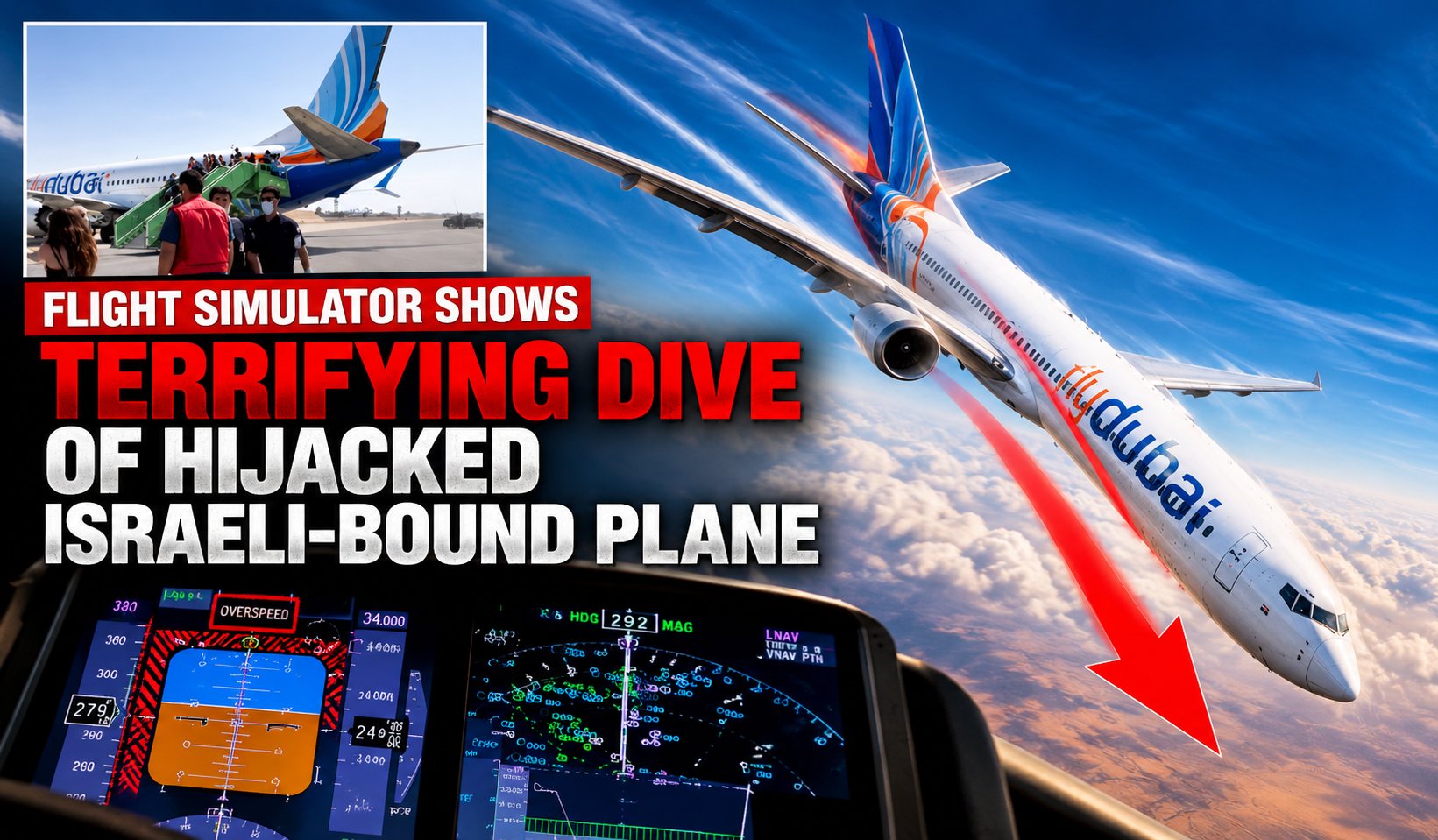
Now, aviation experts are beginning to reconstruct what happened inside the aircraft and, perhaps more importantly, what happened aerodynamically as the jet plunged thousands of feet in a matter of seconds. A flight simulator demonstration aired by CNN illustrated the extreme forces that would have been acting on the aircraft during the descent and raised questions about some of the earliest speed and altitude estimates circulating after the incident.
The emerging picture is extraordinary: an Indian captain stabbed inside the cockpit, an Omani co-pilot accused by Israeli officials of attempting to crash the aircraft, passengers forcing their way into the flight deck, off-duty pilots taking control, a severely damaged rudder and a Boeing 737 MAX that remained airborne despite a descent severe enough to generate extraordinary aerodynamic loads. The attacker’s motive, however, remains under investigation, and some details of the incident have not yet been independently established by aviation investigators.
Flight FZ1073 Suddenly Plunges Toward the Ground
Flydubai Flight FZ1073 was traveling from Dubai to Tel Aviv on September 30 when violence erupted inside the cockpit. The aircraft was carrying 174 people, according to reporting by Reuters and the Associated Press, when the co-pilot allegedly attacked Capt. Smit Machchhar, an Indian national, with a knife. Israeli officials say the co-pilot then apparently attempted to crash the aircraft.
Public flight tracking data captured an astonishing descent. Reuters reported that the aircraft lost nearly 14,000 feet in approximately 30 seconds, while other analyses have produced somewhat different figures depending on the portion of the ADS-B data being measured. Flightradar24 data cited in subsequent reporting showed an extreme instantaneous descent rate approaching 30,000 feet per minute.
Those numbers are important because some early reports and television reconstructions described an approximately 20,000 foot plunge in roughly 35 seconds and possible speeds approaching 700 mph. Those figures should currently be treated as preliminary estimates rather than established flight parameters. The aircraft’s flight data recorder and official investigation should eventually provide a much more precise reconstruction of its altitude, airspeed, pitch, control inputs and structural loads.
CNN Puts the Descent Into a 737 MAX Simulator
To demonstrate what such a descent could have looked and felt like from the flight deck, CNN used a Boeing 737 MAX 8 simulator with commercial pilots recreating the reported scenario. The simulation showed how quickly a steep nose-down attitude could push the aircraft toward its maximum operating speed. Overspeed indications appeared as the simulated jet accelerated, accompanied by cockpit warnings alerting the pilots that the aircraft was moving beyond its normal operating envelope.
That distinction is critical because a commercial airliner is not designed to sustain an uncontrolled high speed dive indefinitely. As speed increases, aerodynamic forces rise dramatically, potentially imposing enormous loads on the wings, tail, control surfaces and fuselage. The simulator experts cautioned that some of the earliest reported speeds would represent extraordinarily severe conditions. If the aircraft had actually remained near the most extreme estimated speeds for a sustained period, the structural consequences could have been considerably worse. Until investigators recover and analyze the aircraft’s recorded data, the exact maximum airspeed reached by FZ1073 remains uncertain.
Part of the Rudder Was Missing After Landing
Photographs and video of the aircraft after its emergency landing showed significant damage around the tail, including what appeared to be a missing section of the rudder. Independent aviation reporting also documented images showing part of the rudder missing from the vertical stabilizer.
The rudder is the movable vertical control surface attached to the aircraft’s vertical stabilizer. It helps control yaw, or movement of the aircraft’s nose from side to side. The vertical stabilizer itself provides crucial directional stability even when rudder authority is reduced, making the fact that the stabilizer remained attached particularly important. Complete failure of the vertical tail would represent a dramatically more dangerous structural event.
Reports that the aircraft landed with substantial rudder damage also provide physical evidence that the jet experienced an abnormal event, although investigators will have to determine exactly when and why the damage occurred. It would be premature to conclude solely from photographs that aerodynamic forces generated during the dive ripped the rudder apart.
The 737 MAX Survived an Extraordinary Structural Event
The survival of the aircraft is itself likely to become an important part of the investigation. A Boeing 737 MAX 8 is engineered with substantial structural safety margins, but those margins are not unlimited. Aircraft operating limitations exist precisely because excessive airspeed and unusual control inputs can expose an airframe to forces far outside normal commercial operations.
Yet despite the rapid descent and visible tail damage, the aircraft remained controllable enough to be flown to Tabuk, Saudi Arabia. The episode should not be interpreted as proof that a 737 MAX can safely withstand the exact speeds initially reported. Rather, it demonstrates that this particular aircraft survived an extraordinarily severe sequence of events whose exact aerodynamic loads have yet to be established.
A Stabbed Captain Made the Decision That May Have Saved Everyone
What happened inside the cockpit was even more remarkable. Israeli officials identified the injured captain as Smit Machchhar, an experienced Indian commercial pilot who previously flew for SpiceJet before joining flydubai. According to reporting and statements from Israeli Prime Minister Benjamin Netanyahu’s office, Machchhar was stabbed during the confrontation but remained conscious and managed to release the cockpit door.
That action may have been decisive. Reinforced cockpit doors were designed after the September 11 attacks specifically to prevent unauthorized people from reaching the flight controls. But the FZ1073 incident presented the opposite security problem: the alleged threat was already inside the fortified cockpit. According to passenger accounts, the wounded captain’s actions allowed people in the cabin to reach the flight deck and confront the attacker.
An Ordinary Passenger Rushed Into the Cockpit
Among those who intervened was Israeli passenger Yaniv Hayoun, who described forcing his way into the cockpit amid the chaos and confronting the pilot accused of trying to bring down the aircraft. According to accounts subsequently reported by the Associated Press and Israeli media, Hayoun helped overpower the attacker and attempted to manipulate the aircraft’s controls as the plane descended.
Hayoun was not a pilot. He reportedly said his limited understanding of what to do came from watching aviation disaster television programs. During the chaotic struggle, he pulled back on the controls in an attempt to stop the aircraft’s descent until trained pilots could take over.
Two additional flydubai pilots were traveling aboard the aircraft and eventually assumed control of the damaged jet, according to Reuters and AP reporting. They diverted the aircraft to Tabuk, where it landed safely. The combination of circumstances was extraordinary: a wounded captain remained functional long enough to facilitate access to the cockpit, passengers confronted the alleged attacker, and qualified pilots happened to be aboard and available to take command of the aircraft.
The Aircraft Broadcast the International Hijacking Code
Flight tracking data added another alarming piece of evidence as the crisis unfolded. The aircraft initially transmitted transponder code 7700, the international code used to declare a general aviation emergency. It subsequently transmitted 7500, the internationally recognized code for unlawful interference with an aircraft, including a hijacking, before returning to an emergency code.
The signals triggered an immediate security response. Israel scrambled military aircraft amid concerns that the passenger jet could have been hijacked and potentially redirected toward Israeli territory. The plane instead diverted to Saudi Arabia and landed at Tabuk.
Saudi Authorities Are Investigating the Co-Pilot
The alleged attacker has been identified by Israeli officials as an Omani national. Saudi authorities took him into custody after the emergency landing, while Machchhar was hospitalized for injuries sustained during the attack. Flydubai has been considerably more cautious than some Israeli officials in describing what occurred. The airline confirmed an “altercation” in the flight deck and said the underlying reasons and motives remained subject to formal investigation.
That distinction matters. Israeli Defense Minister Israel Katz has publicly characterized the episode as an attempted jihadist terrorist attack, while other Israeli officials have said terrorism is being investigated. At this stage, however, the attacker’s motive has not been publicly established by the Saudi investigation. The known facts, a stabbing, an extreme descent, an unlawful-interference transponder signal and an apparent attempt to interfere with the aircraft, do not by themselves establish the ideological motive behind the attack.
The Incident Exposes the Other Side of Cockpit Security
The FZ1073 attack also revives one of the most difficult questions in modern aviation security: how do airlines protect an aircraft when the threat comes from someone who is already authorized to be inside the cockpit?
After September 11, airlines around the world strengthened cockpit doors to prevent attackers from entering the flight deck. Those protections are extremely effective against an external cockpit breach, but they create a different vulnerability when an authorized pilot becomes the threat. The 2015 Germanwings Flight 9525 disaster demonstrated that danger when co-pilot Andreas Lubitz locked the captain out of the cockpit and deliberately flew an Airbus A320 into the French Alps, killing all 150 people aboard.
FZ1073 presented an unusual variation of that problem. Instead of being locked outside while the aircraft was deliberately destroyed, the wounded captain reportedly managed to release the reinforced door, giving passengers and crew access to the attacker. The very door designed to keep hijackers out had suddenly become an obstacle separating the cabin from a potential threat already inside.
Questions Now Turn to Security Screening
Another major unanswered question is how a knife capable of seriously injuring the captain reached the cockpit. Commercial pilots undergo airport security screening, employment vetting, medical examinations and other checks, although exact procedures vary by country, airport and airline. The size and type of weapon involved in the FZ1073 attack have not been conclusively established publicly.
Investigators will almost certainly examine where the weapon came from, whether it passed through normal airport screening, whether crew members were subjected to different security procedures and whether any warning signs existed before the flight. Those questions may ultimately prove more consequential to global aviation than the dramatic footage of the damaged aircraft.
U.S. Officials Say No Credible Domestic Threat Has Been Identified
U.S. officials said Wednesday that American authorities were reviewing the incident and existing security procedures but that there was no credible threat to the United States connected to the episode, according to reporting on the government’s response. That assessment remains preliminary because the motive of the alleged attacker has not been publicly established. For aviation authorities, however, the incident presents an uncomfortable combination of security problems: an insider threat, a weapon inside a cockpit, an aircraft carrying a large number of Israeli passengers, a rapid uncontrolled descent and a flight crew member allegedly attempting to interfere with the aircraft itself.
The Black Boxes Will Tell the Final Story
For all the extraordinary eyewitness accounts and simulator demonstrations, the most important evidence will ultimately come from the aircraft. Investigators can use the flight-data recorder to reconstruct control inputs, pitch angle, airspeed, altitude, engine settings and other parameters second by second. The cockpit voice recorder could establish what occurred between the pilots immediately before and during the confrontation.
That evidence will determine whether some of the spectacular early estimates, including reports that the aircraft approached 700 mph or descended roughly 20,000 feet in little more than half a minute, accurately describe the aircraft’s performance.
What is already clear is extraordinary enough. A commercial airliner carrying 174 people entered a catastrophic descent after violence erupted between its pilots. Its captain was stabbed, passengers entered the cockpit, an ordinary traveler helped fight the alleged attacker, additional pilots took control, part of the aircraft’s rudder was damaged or lost, and the aircraft transmitted the international code for unlawful interference.
And somehow, the Boeing 737 MAX landed.
No final investigation report yet exists, and investigators still have substantial work ahead of them. But FZ1073 may ultimately become one of the most unusual examples in modern commercial aviation of passengers, crew and sheer circumstance combining to prevent an airborne emergency from becoming a mass-casualty disaster.

Sources & Further Reading
Reuters — Passengers foil bid to crash Dubai-Tel Aviv flight after co-pilot stabs captain
Reuters — Passengers recount chaos aboard Flydubai Flight FZ1073
Reuters — Netanyahu praises stabbed Indian pilot Smit Machchhar
Associated Press — What to know about the terrifying Flydubai flight bound for Israel
Associated Press — Pilot stabs fellow pilot before passengers intervene
CBS News — Flydubai passengers recount alleged attempt to hijack and crash flight
CNN — Breaking coverage of the Flydubai cockpit incident and rapid descent
CNN — Flight FZ1073 passenger accounts and cockpit attack coverage
CNN — Flight Simulator Analysis of the Flydubai Incident — YouTube


















































Want to join the conversation?
Create an account or sign in to share your thoughts, vote,
and reply to other readers.
Showing 0 of 0 comments
Don't have an account?
Already have an account?