
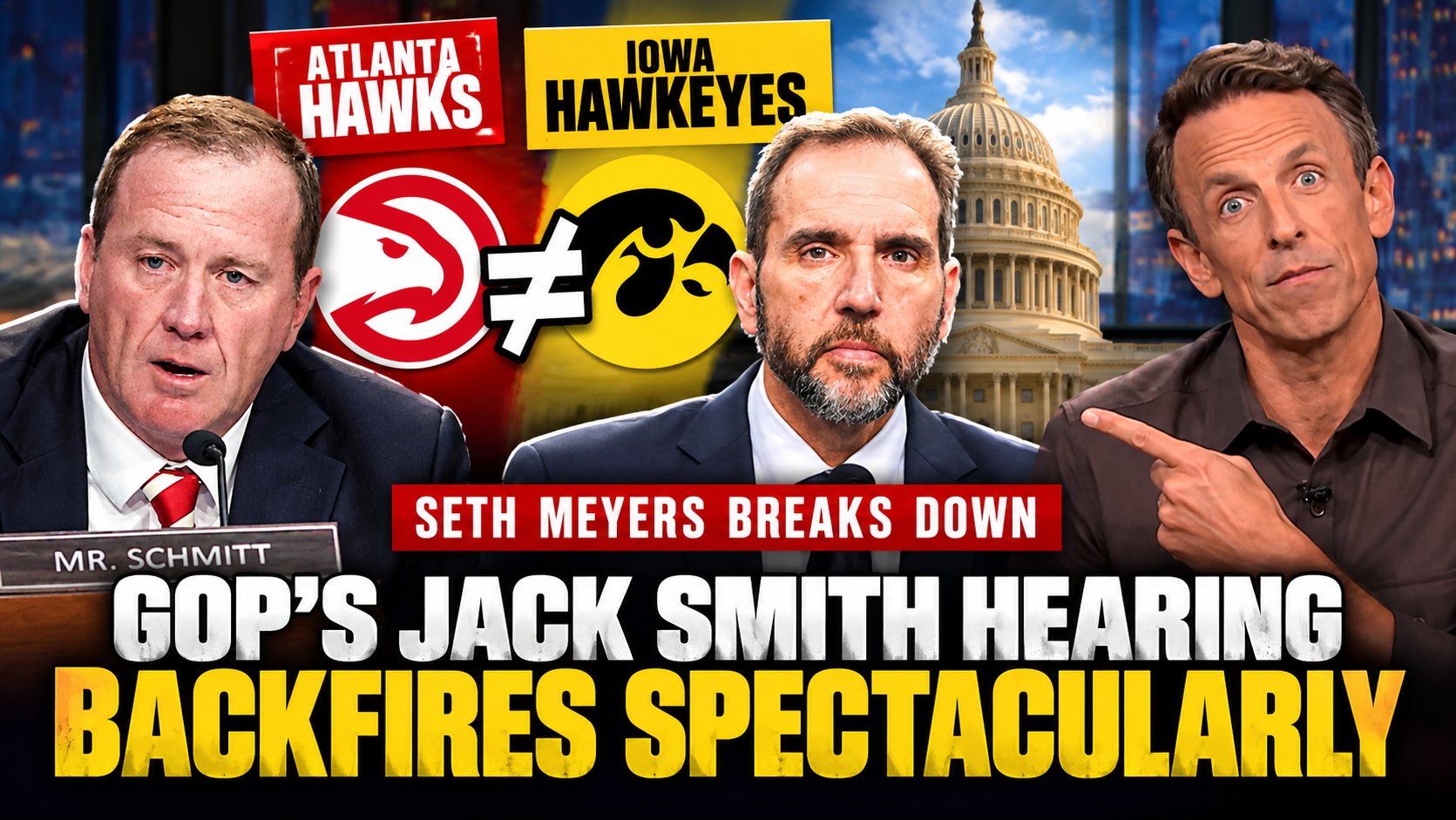
GOP Senator’s Jack Smith “Gotcha” Falls Apart After He Confuses the Atlanta Hawks With the Iowa Hawkeyes
Former Special Counsel Jack Smith’s appearance before the Senate Judiciary Committee was already expected to be one of Capitol Hill’s most combative hearings of the year. Republicans planned to scrutinize Smith’s investigations of President Donald Trump, while Democrats were prepared to defend the former prosecutor and revisit the evidence underlying his cases. Instead, one of the hearing’s most memorable exchanges centered on a basketball game and a remarkable mix up between the Atlanta Hawks and the Iowa Hawkeyes.
The September 29 hearing drew renewed national attention after Sen. Eric Schmitt, R-Mo., suggested Smith had lied about his whereabouts during a February 2024 basketball game and raised the possibility that Smith had secretly traveled to Atlanta while his office was prosecuting Trump. The accusation quickly unraveled when Smith explained that the game he attended was not an Atlanta Hawks NBA game in Georgia but an Iowa Hawkeyes women’s college basketball game against the University of Maryland in College Park, Maryland.
The mistake was subsequently confirmed in reporting by the Associated Press, Reuters, PBS NewsHour and other outlets. It also provided immediate material for late night television, with Seth Meyers highlighting the exchange during an A Closer Look segment and presenting it as an example of a congressional “gotcha” collapsing under basic factual scrutiny.
Republicans Called Jack Smith to Defend His Trump Investigations
Smith appeared before the Senate Judiciary Committee for a hearing formally titled “Oversight of Jack Smith’s Abuse of Authority and the Targeting of Republicans and Related Matters.” The title reflected the Republican majority’s position going into the proceeding: GOP senators have accused Smith and his former special counsel operation of abusing prosecutorial authority while investigating Trump and people in his political orbit.
Smith was appointed special counsel in November 2022 by then Attorney General Merrick Garland and ultimately brought two federal criminal cases against Trump. One concerned Trump’s efforts to remain in power following his defeat in the 2020 election, while the other involved Trump’s handling of classified documents after leaving the White House.
Both federal prosecutions ended without trials. Following Trump’s 2024 election victory, Smith moved to dismiss the federal cases in accordance with longstanding Justice Department policy against prosecuting a sitting president. Trump had pleaded not guilty and repeatedly characterized the prosecutions as politically motivated.
The investigations have nevertheless remained a major subject of congressional scrutiny. Republicans have focused in particular on investigative methods used by Smith’s team, including subpoenas that obtained phone records connected to Republican lawmakers and financial information gathered during the investigations. Democrats have argued that Smith’s prosecutors were following evidence surrounding Trump’s efforts to overturn the 2020 election and the events leading to the January 6, 2021, attack on the Capitol.
Eric Schmitt Tried to Connect Smith to Atlanta
One of the hearing’s most dramatic moments came when Schmitt questioned Smith about February 3, 2024. The Missouri Republican suggested Smith had attended an Atlanta Hawks game against the Golden State Warriors in Atlanta and used the alleged trip to question whether Smith had been truthful about contacts or coordination involving Fulton County District Attorney Fani Willis.
Willis had separately prosecuted Trump and several allies in Georgia over efforts to overturn the state’s 2020 election results. That separate prosecution had long fueled Republican allegations that state and federal investigators were coordinating politically against Trump.
Schmitt’s line of questioning therefore carried a serious implication. If Smith had secretly traveled to Atlanta while denying such contacts, Republicans could potentially argue that the trip contradicted his testimony or previous representations. There was just one problem: Smith said he had not attended the Atlanta Hawks game.
“I Definitely Did Not Go to a Hawks Game”
Smith appeared puzzled by the premise of Schmitt’s question and rejected it directly, saying he had not gone to an Atlanta Hawks game. The explanation emerged almost immediately: Smith had attended a basketball game that day, but it was an entirely different game in an entirely different state.
On February 3, 2024, the University of Iowa Hawkeyes women’s basketball team played the University of Maryland in College Park, Maryland. Iowa’s roster at the time included Caitlin Clark, then in the middle of the record breaking college career that would make her one of the biggest stars in American basketball. Smith told the committee that he had attended that game with family.
Schmitt’s accusation had apparently conflated the Atlanta Hawks, an NBA franchise based in Georgia, with the Iowa Hawkeyes, the University of Iowa athletic program. Instead of evidence placing Smith in Atlanta, the material being discussed placed him at a college basketball game in Maryland. The geographical difference was substantial. College Park sits outside Washington, D.C., while Atlanta is hundreds of miles away in Georgia. The two basketball games happened on the same date, but otherwise had no connection.
Amy Klobuchar Walked Through the Mistake
Sen. Amy Klobuchar, D-Minn., returned to the issue later in the hearing and laid out the distinction between the two teams, arguing that a serious allegation had been constructed from an elementary factual mistake.
The exchange quickly became one of the hearing’s most widely shared moments because the accusation had been framed not merely as a disagreement over Smith’s conduct but as a potential question about whether he had testified truthfully. Smith’s denial, followed by the clarification that he had attended an Iowa-Maryland game rather than an Atlanta Hawks game, transformed what was intended as a confrontation over possible misconduct into a debate over how the underlying evidence had been interpreted.
Schmitt did not abandon his broader criticism of Smith after the exchange. Republicans continued questioning the former special counsel over investigative tactics, subpoenas, contacts with other government officials and what they described as politically motivated prosecutorial decisions.
The Hearing Was About Much More Than Basketball
The viral basketball exchange overshadowed a hearing containing significantly more consequential disagreements about federal investigative power.
Senate Judiciary Committee Chairman Chuck Grassley, R-Iowa, accused Smith’s operation of politically motivated conduct and argued that congressional oversight had uncovered troubling investigative practices. Republicans questioned Smith over records obtained during the investigation, including data associated with lawmakers, donors and other individuals.
Smith defended his work and rejected claims that his prosecutions were motivated by politics. He told senators that his investigative decisions were based on evidence and said he stood behind the decision to bring criminal charges against Trump.
Smith also defended the underlying election investigation, saying his team had developed evidence that Trump engaged in serious criminal conduct following the 2020 election. Those assertions represent Smith’s prosecutorial conclusions; Trump denied wrongdoing, pleaded not guilty to the federal charges and maintained that the cases were politically motivated.
Smith further told the committee that threats of prosecution against him would not silence him, as Republicans continued examining his conduct after the end of the special counsel investigation.
Republicans Focused on Smith’s Investigative Methods
The hearing also exposed a substantive dispute that extends well beyond partisan rhetoric. Republicans have raised concerns about Smith’s acquisition of communications and telephone metadata connected to members of Congress as investigators reconstructed efforts to challenge the certification of the 2020 presidential election.
Republican senators argue that some of those investigative steps crossed constitutional and institutional boundaries and improperly swept lawmakers and private citizens into an investigation centered on Trump. Grassley has also raised questions about financial records and other information collected during Smith’s investigations.
Smith and his defenders have maintained that investigators were following evidence relevant to attempts to influence lawmakers during the period surrounding January 6 and that the investigative tools were used for legitimate law enforcement purposes.
Those disputes are considerably more significant than the basketball mistake because they involve unresolved questions about prosecutorial authority, congressional protections, privacy and the extent to which investigators can obtain information involving elected officials during a criminal investigation.
Seth Meyers Turns the Hearing Into Late Night Material
For Seth Meyers, however, the Hawks-Hawkeyes confusion was almost tailor-made for A Closer Look, the recurring Late Night segment that combines political news with comedy.
Meyers focused on the contrast between the seriousness of the accusation and the simplicity of the mistake. Schmitt’s questioning had suggested that Smith’s attendance at an Atlanta basketball game could expose a previously undisclosed connection to Georgia prosecutors. Instead, Smith had been watching women’s college basketball in Maryland.
The comedy came from how quickly the premise collapsed. The Atlanta Hawks and Iowa Hawkeyes have similar-sounding names, but they represent different sports organizations, compete at different levels and are based in different states. The exchange also demonstrated the risk inherent in congressional hearings built around confrontational questioning. Senators frequently have only minutes to establish a factual premise, question a witness and draw a conclusion. When the premise is incorrect, the entire sequence can unravel in real time.
Smith and Republicans Remain Locked in a Much Larger Fight
The viral moment should not obscure the broader significance of Smith’s appearance before Congress. His investigations represented an unprecedented confrontation between the federal criminal justice system and a former president who subsequently returned to the White House.
Republicans continue to argue that Smith’s investigations demonstrate how federal law enforcement can be weaponized against political opponents. Democrats counter that Smith was investigating extraordinary efforts to overturn a presidential election and that attacking prosecutors does not resolve the conduct those investigations examined.
Smith remains at the center of that dispute even though his federal cases against Trump never reached trial. Because the prosecutions ended without verdicts, many of the factual allegations contained in the indictments were never adjudicated before a jury.
That distinction remains important. Smith has continued to defend the evidence his team gathered and the charging decisions it made, while Trump and his allies continue to reject Smith’s conclusions and characterize the investigation as politically motivated.
A Serious Hearing Remembered for the Wrong Basketball Team
The September 29 hearing was designed to examine some of the most serious questions surrounding the federal investigations of Trump: the power of a special counsel, investigative access to lawmakers’ records, the boundaries of prosecutorial discretion and whether political considerations influenced one of the most consequential federal investigations in modern American history.
Yet one of its defining moments came down to something much simpler. Schmitt believed the evidence showed Jack Smith at an Atlanta Hawks game in Georgia. Smith said he had never attended that game. The basketball event Smith actually attended was an Iowa Hawkeyes women’s game against Maryland in College Park. The Hawks were not the Hawkeyes. Maryland was not Georgia. And an attempted confrontation over alleged coordination with Atlanta prosecutors became the moment late-night television could not resist.

Sources & Further Reading
U.S. Senate Judiciary Committee — September 29 Jack Smith Oversight Hearing
C-SPAN — Former Special Counsel Jack Smith Faces Senate Questions on Trump Investigations
Reuters — Former Trump Prosecutor Jack Smith Tells Senate He Will Not Be Silenced
PBS NewsHour — Schmitt Suggests Jack Smith Perjured Himself but Mixes Up Two Basketball Teams
U.S. Senate Judiciary Committee — Chairman Grassley Questions Jack Smith
U.S. Senate Judiciary Committee — Ranking Member Durbin’s Opening Statement








































Want to join the conversation?
Create an account or sign in to share your thoughts, vote,
and reply to other readers.
Showing 0 of 0 comments
Don't have an account?
Already have an account?