
John Oliver Takes On Brazil’s 2026 Election as Lula and Flávio Bolsonaro Head Into a Dead Heat Fight
Brazil is days away from one of the most consequential elections in the country’s recent history, with President Luiz Inácio Lula da Silva seeking another term against Sen. Flávio Bolsonaro, the eldest son and political heir of former President Jair Bolsonaro. The election has become a collision between two of Brazil’s dominant political movements, with nearly 159 million eligible voters preparing to choose not only a president but governors, 54 senators, all 513 members of the Chamber of Deputies and state and district legislators on October 4.
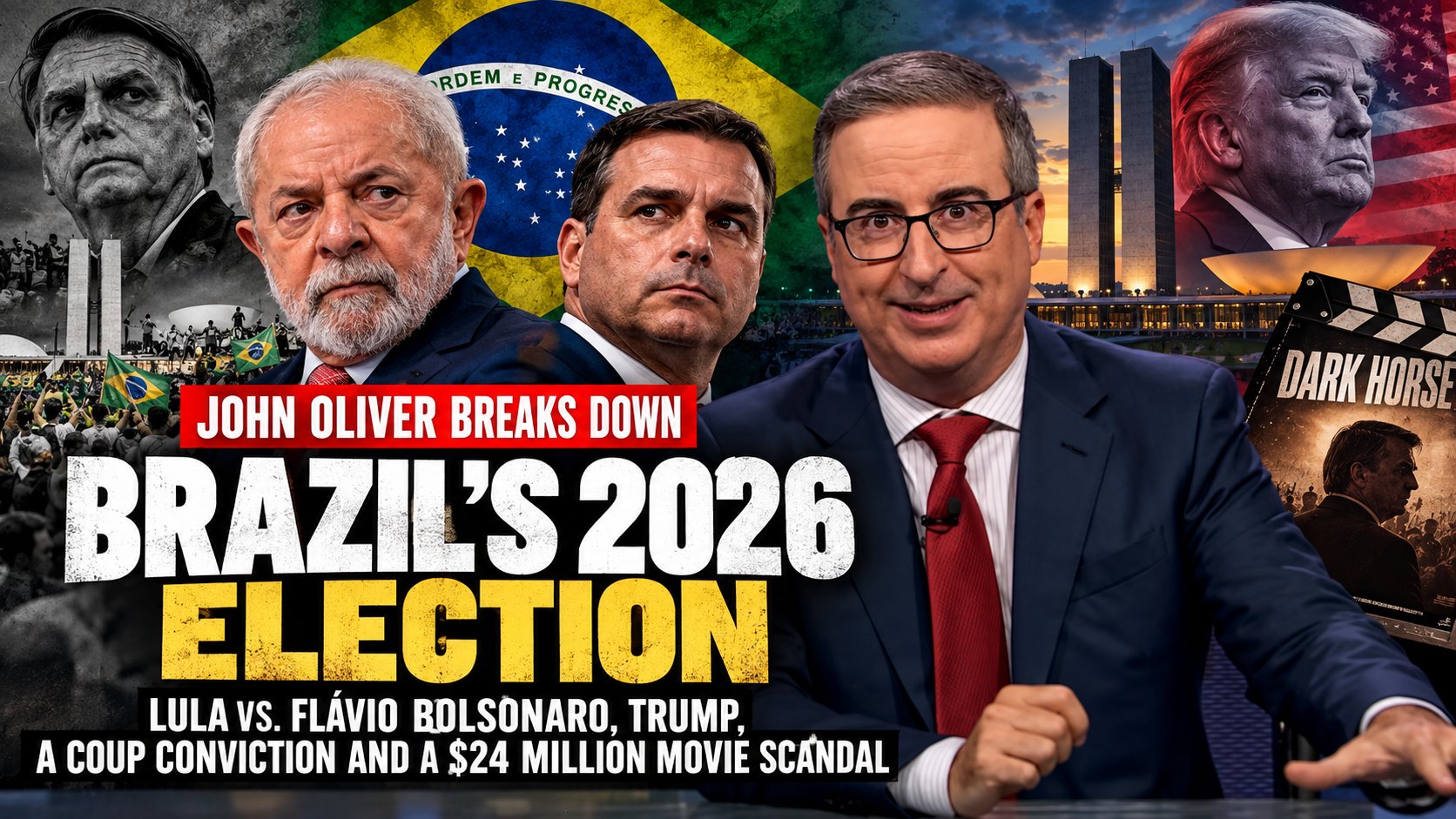
The race became the subject of a lengthy segment on HBO’s Last Week Tonight, where host John Oliver examined everything from Jair Bolsonaro’s criminal conviction and Donald Trump’s involvement in Brazilian politics to Flávio Bolsonaro’s attempt to inherit his father’s political movement and a widening controversy surrounding Dark Horse, a multimillion dollar biographical film about the former president.
Behind the comedy is a remarkably close election. Recent polls have generally shown Lula with an advantage in first round voting while hypothetical runoff polling between Lula and Flávio Bolsonaro remains within survey margins of error. If no presidential candidate receives more than 50% of valid votes on October 4, the top two candidates will advance to a runoff on October 25.
Brazil Is Effectively Fighting the Bolsonaro Lula Battle Again
Although Jair Bolsonaro is not on the ballot, his political legacy is central to the election. Flávio Bolsonaro has built his campaign around much of the conservative coalition assembled by his father while attempting to present himself as a less confrontational successor capable of expanding the movement beyond Jair Bolsonaro’s most committed supporters.
Lula, meanwhile, has framed the election around protecting democratic institutions, defending his government’s economic and social record and preventing Bolsonarism from returning to the presidency. His administration can point to reductions in inequality and low unemployment, but voters continue to express concerns about the cost of living and other economic pressures. The result is an election in which neither side is simply running on a policy platform; both campaigns are also asking voters to render another judgment on the political era that began with Jair Bolsonaro’s rise to the presidency in 2018.
Jair Bolsonaro’s Shadow Still Hangs Over the Election
The political backdrop is extraordinary. Jair Bolsonaro lost the 2022 presidential election to Lula, never formally conceded and left Brazil for Florida shortly before Lula’s inauguration. On January 8, 2023, Bolsonaro supporters stormed Brazil’s Congress, Supreme Court and presidential palace in Brasília following months of challenges to the country’s election system.
Brazilian prosecutors subsequently accused Bolsonaro and several allies of participating in a conspiracy to overturn the election result and prevent Lula from taking office. Bolsonaro was ultimately convicted over the failed coup plot and sentenced to more than 27 years in prison. His conviction removed him from the 2026 presidential contest but did not eliminate his political influence. Flávio has instead attempted to inherit the coalition his father built, effectively transforming the election into another contest between Lula and the political movement created by Jair Bolsonaro.
Donald Trump Became Part of Brazil’s Political Story
The Bolsonaro saga also crossed directly into American politics. President Donald Trump publicly defended Jair Bolsonaro and characterized the prosecution against him as a “witch hunt,” while his administration imposed economic and diplomatic pressure on Brazil, including tariffs and sanctions targeting Brazilian officials.
Those moves became politically useful to both sides inside Brazil. Bolsonaro supporters portrayed Trump’s intervention as international validation of their claims that Brazil’s courts had overreached, while Lula used the dispute to present himself as defending Brazilian sovereignty against foreign political pressure.
The controversy has continued into the 2026 campaign. Brazilian intelligence officials recently briefed French and German representatives about what Brazil described as alleged interference by the United States and Russia. Those allegations remain contested and do not by themselves establish that foreign activity has altered the election.
Lula Is Running on His Record and Against Bolsonarism
At 80, Lula is once again confronting questions about age as he campaigns for another presidential term. His public appearances and campaign messaging have repeatedly emphasized his energy and ability to continue governing, while his political argument has focused heavily on employment, social programs, inequality and the protection of Brazil’s democratic institutions.
Economically, the picture is more complicated than either campaign’s messaging suggests. Lula can point to low unemployment and social gains, but Brazil continues to face substantial fiscal pressures. Gross public debt has climbed above 80% of GDP, and both Lula and Bolsonaro have proposed fiscal adjustments while leaving some of the most politically difficult decisions unresolved. Lula has emphasized a gradual approach designed to protect social spending, while Bolsonaro’s advisers have promoted faster fiscal consolidation, privatization and limits on government spending.
Flávio Bolsonaro Is Selling a Different Version of His Father’s Movement
Flávio Bolsonaro’s central political challenge has been maintaining his father’s intensely loyal conservative base while convincing voters outside it that he represents something different. The senator has emphasized Christian values, market-oriented economic policies, tougher approaches to crime and opposition to the Brazilian left while presenting himself as more restrained than his father.
Yet the campaign remains inseparable from Jair Bolsonaro. The former president personally encouraged Flávio to become his political successor, effectively handing his eldest son control of the family’s presidential project. The campaign has also used artificial intelligence to preserve Jair Bolsonaro’s presence despite restrictions on his ability to participate directly in political communication, adding another unusual dimension to an election already dominated by questions about political succession and digital campaigning.
Then There Is the $24 Million Bolsonaro Movie
One of the strangest controversies hanging over Flávio Bolsonaro’s campaign involves Dark Horse, a biographical film about Jair Bolsonaro starring American actor Jim Caviezel. The production focuses heavily on Bolsonaro’s rise and the 2018 campaign in which he survived a stabbing, but the movie itself has increasingly become secondary to questions surrounding its financing.
Federal investigators have examined an investment structure that contemplated approximately $24 million for the production. Records obtained during the investigation indicate that multimillion-dollar financing was associated with the project, while Brazilian Federal Police have scrutinized whether the size of the proposed investment and the movie’s projected box-office returns were economically realistic.
Documents obtained by investigators reportedly projected possible box office revenue ranging from approximately $45 million to $100 million. Even the lower end would represent an extraordinary commercial performance for a Brazilian production, while the highest projection would significantly exceed historical domestic box-office benchmarks cited in Brazilian reporting. Federal Police reportedly considered the scale of those projections relevant to their examination of the financial structure.
Flávio Bolsonaro’s Messages Became Part of the Investigation
The controversy became substantially more consequential when communications emerged showing Flávio Bolsonaro discussing financing for the project with Daniel Vorcaro, the former Banco Master executive whose financial dealings have become the subject of extensive criminal investigations. Investigators obtained communications indicating that Flávio pressed Vorcaro about promised funding for the production. Brazilian reporting has placed the contemplated financing at approximately $24 million, while investigators have examined multimillion-dollar transfers associated with the broader financial structure.
Flávio has denied wrongdoing, and the existence of communications seeking financing does not by itself establish that he committed a crime. The Federal Police investigation is examining the origin, movement and ultimate destination of money associated with the project, including whether all funds described as financing the movie were actually used for production. The allegations remain under investigation and should not be treated as established findings of criminal liability.
The Movie Still Hasn’t Become the Campaign Weapon Its Backers Envisioned
Dark Horse was potentially positioned to become a powerful piece of political mythology surrounding Jair Bolsonaro, dramatizing the stabbing that nearly killed him during the 2018 campaign and presenting his rise through the language of a cinematic political biography.
Instead, the movie’s financing became a political controversy of its own. The production has faced uncertainty over its release, and Brazilian reporting in September indicated that it still lacked a firm premiere date. What was apparently intended to reinforce the Bolsonaro political narrative has therefore become part of the scrutiny surrounding Flávio Bolsonaro’s presidential campaign.
Brazil Is Voting for Far More Than President
The presidential contest naturally dominates international attention, but Brazil’s October 4 election will reshape much of the federal government. The country will elect all 513 members of the Chamber of Deputies and 54 senators, two thirds of the 81 member Senate, along with governors and state and district legislators.
Brazil’s Superior Electoral Court says approximately 158.7 million people are eligible to participate. The congressional results will determine the political environment facing whoever occupies the presidency, including the ability of the next administration to pass economic reforms, environmental policy, criminal justice legislation and other major initiatives. The election could also influence the future composition of Brazil’s Supreme Federal Court as vacancies emerge during the next presidential term, while the direction of environmental enforcement in the Amazon will continue to carry implications far beyond Brazil’s borders.
A Presidential Election With Global Consequences
John Oliver’s segment treats the election through the show’s familiar combination of comedy and political criticism, but the underlying contest is considerably larger than any single television segment. Brazil is Latin America’s largest country, one of the world’s largest democracies, a major agricultural and industrial power and home to most of the Amazon rainforest. Its relationships with the United States, China and Europe give Brazilian politics geopolitical significance well beyond South America.
The October election is also unfolding as political movements across the ideological spectrum continue reshaping governments throughout the Western Hemisphere. Lula remains one of the most internationally recognizable figures of the Latin American left, while Flávio Bolsonaro is attempting to demonstrate that the political movement created by his father can survive its founder’s criminal conviction and continue through a second generation.
For Brazilian voters, however, the decision will ultimately encompass more immediate concerns: prices, wages, public safety, corruption, government spending, social programs and confidence in the country’s institutions. The first round takes place October 4. If no candidate wins an outright majority of valid votes, Brazil returns to the polls October 25. Recent polling indicates that a hypothetical Lula Flávio Bolsonaro runoff remains extremely close, with different surveys producing narrow margins within statistical uncertainty. With Jair Bolsonaro’s legacy, Lula’s record, U.S. and Brazil tensions, a multimillion dollar movie financing investigation and control of Brazil’s government all converging in the same campaign, the country is heading into election day with unusually high political stakes.
Sources & Further Reading
Last Week Tonight with John Oliver — Brazil Elections 2026
Reuters — Lula Widens First-Round Lead as Runoff Remains Tight
Reuters — Lula Holds Thin Lead Over Flávio Bolsonaro in Datafolha Poll
Reuters — Flávio Bolsonaro Tests the Staying Power of His Father’s Political Legacy
Reuters — Lula’s Campaign and the Future of Latin America’s Left
Reuters — Economic Plans of Lula and Flávio Bolsonaro
Reuters — Brazil Briefed European Officials on Alleged U.S. and Russian Election Interference
Brazil Superior Electoral Court — Official 2026 Election Information
Brazil Superior Electoral Court — More Than 158 Million Brazilians Eligible to Vote
The Guardian — John Oliver Examines Flávio Bolsonaro and Brazil’s Election












































Want to join the conversation?
Create an account or sign in to share your thoughts, vote,
and reply to other readers.
Showing 0 of 0 comments
Don't have an account?
Already have an account?