
Kimberly Guilfoyle Accused of Seeking $100,000 Credit Card Bailout From GOP Donor While Promising Access to Trump Cabinet Officials
A reported collection of private messages raises serious questions about money, political influence, and access to the Trump administration after a Republican donor alleged that Kimberly Guilfoyle sought help paying a six figure American Express bill while promising introductions to some of Washington’s most powerful officials.
A $100,000 Credit Card Bill and Allegations of Political Influence
U.S. Ambassador to Greece Kimberly Guilfoyle is facing allegations that she repeatedly pressured a wealthy Republican donor to pay approximately $100,000 toward her personal American Express credit card balance while offering access to senior officials in President Donald Trump’s administration. The allegations, detailed in reporting by The Wall Street Journal, center on private communications between Guilfoyle and Eric Deters, a former Kentucky attorney, Republican political figure, and donor who claims he spent hundreds of thousands of dollars cultivating a relationship with the prominent Trump ally.
The reported exchanges took place in July 2025, shortly before Guilfoyle’s Senate confirmation hearing for the ambassadorship. According to the account provided by Deters, Guilfoyle sought financial assistance while discussing her ability to connect him with Cabinet officials whose positions could potentially help advance his interests. The allegations raise questions about whether personal financial arrangements were being linked to promises of government access, although no criminal wrongdoing has been established and Guilfoyle’s representatives dispute the account.
At the center of the controversy is a reported collection of approximately 300 pages of messages and financial correspondence assembled by Deters, who subsequently shared the material with journalists after becoming dissatisfied with what he described as Guilfoyle’s failure to deliver on her commitments. The dispute has since expanded beyond a private financial disagreement into a broader political controversy involving government ethics, donor influence, and the responsibilities of officials entrusted with representing the United States abroad.
The Messages: A Personal Credit Card Bill and a Promise of Access
The most damaging elements of the allegations involve messages that Guilfoyle purportedly sent Deters on July 3, 2025, six days before her scheduled Senate confirmation hearing. According to The Wall Street Journal and screenshots separately reviewed by CBS News, Guilfoyle provided instructions for transferring money directly to her American Express account and suggested that doing so would avoid the visibility associated with a conventional payment to her personally.
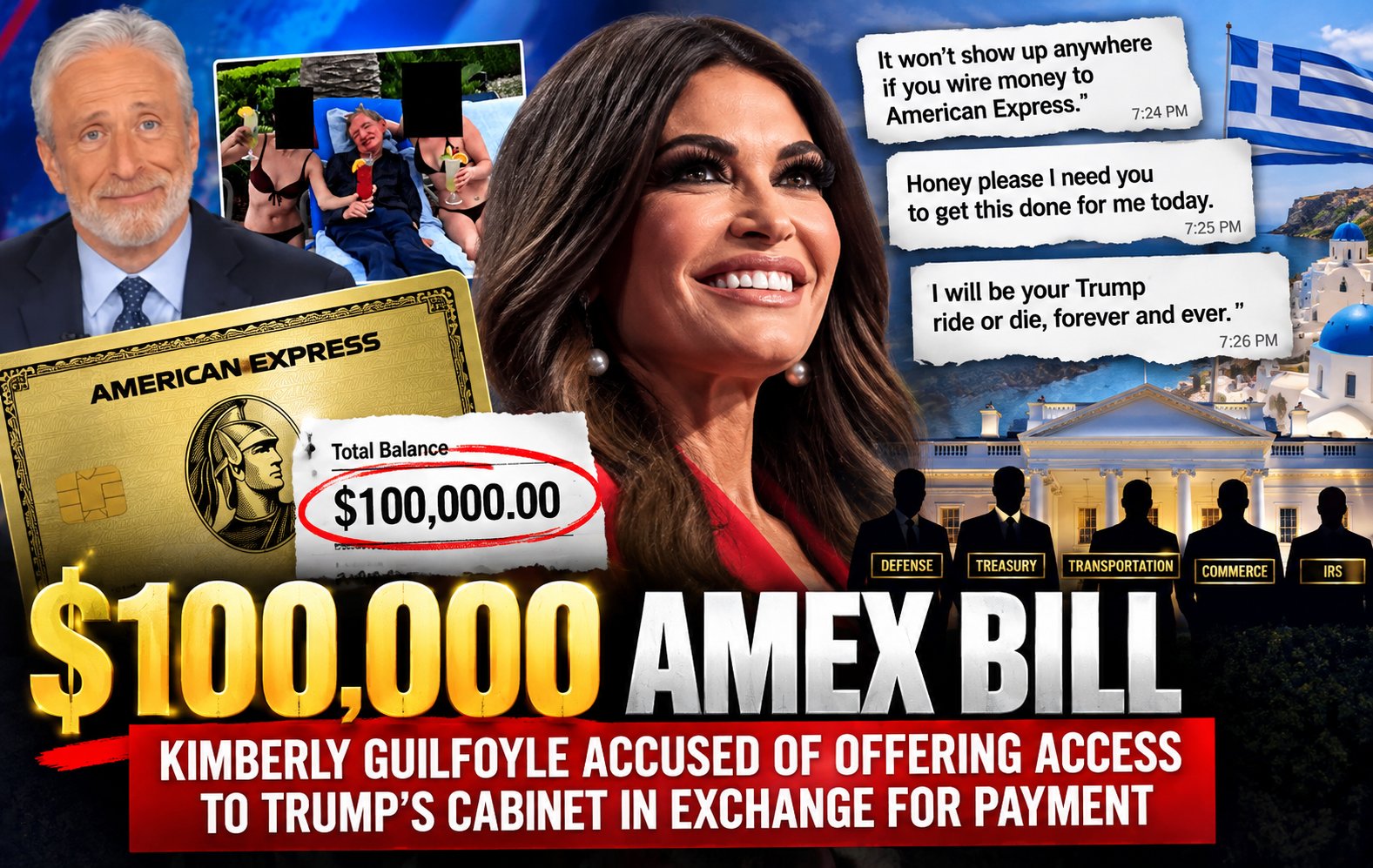
“It won’t show up anywhere if you wire money to American Express.”
In another message, Guilfoyle allegedly pleaded with Deters to complete the transaction that same day, writing, “Honey please I need you to get this done for me today.” The reported correspondence included a PDF containing American Express payment instructions, an unusually specific detail that has attracted attention because it appears to document not merely a discussion about financial assistance but a proposed method for transferring the money. Deters ultimately refused to make the $100,000 payment, telling reporters that doing so would have jeopardized his marriage.
The timing is central to the controversy. Guilfoyle was preparing to appear before the Senate as Trump’s nominee to become ambassador to Greece, a position that would place her inside the administration’s diplomatic establishment. The possibility that a pending ambassadorial nominee was privately seeking substantial financial assistance from a donor who wanted intervention from federal officials raises significant questions about conflicts of interest, financial disclosure obligations, and the potential monetization of political relationships.
Who Is Eric Deters, and Why Was He Paying Kimberly Guilfoyle?
Deters is a former Kentucky congressional candidate, political commentator, and former attorney who has maintained relationships within Republican political circles. According to the Journal’s reporting, he paid Guilfoyle approximately $300,000 for speaking engagements and appearances over several years and discussed potentially paying as much as $1 million if she could help him secure attention from senior Trump administration officials.
Deters was seeking assistance with personal legal and tax matters, including dealings involving the Internal Revenue Service and the Justice Department. His interests also extended to the case of Dr. Abubakar Atiq Durrani, a former Ohio surgeon who fled to Pakistan and has faced allegations arising from surgeries performed on patients in the United States. Deters has advocated on behalf of patients seeking accountability and wanted the administration to help advance efforts to bring Durrani back to face American justice.
According to the reported communications, Guilfoyle discussed her ability to contact senior officials, including figures connected to the Treasury Department, Justice Department, and IRS. The allegations are particularly consequential because Deters was not simply seeking an invitation to a political fundraiser or a photograph with a prominent official. He wanted government intervention in matters affecting his financial and legal interests, making the alleged relationship potentially more serious than an ordinary arrangement involving paid speaking appearances.
Deters has acknowledged that his decision to publicize the communications was motivated in part by anger and disappointment. In an October 9 interview with PBS NewsHour, he accused Guilfoyle of promising access she failed to provide and characterized the arrangement as an exchange of money for political influence. His admission that he is retaliating against someone he believes failed him is important context when evaluating his allegations, but it does not automatically invalidate the documentary evidence that multiple news organizations have reviewed.
A Republican Donor Turns Against the Trump Inner Circle
The controversy is especially notable because Deters is not a longtime Democratic critic attempting to damage the administration from the outside. He has supported Trump and cultivated relationships with members of the president’s political circle, making his accusations an unusual public dispute between individuals who once appeared to share political and financial interests.
Deters assembled a dossier containing nearly 300 pages of communications, photographs, financial information, and personal grievances involving Guilfoyle and other figures associated with Trump. CBS News reported reviewing a 292 page collection that included screenshots of the alleged messages, photographs of Deters with Trump family members, and other supporting materials. The existence of the collection establishes that Deters has supplied extensive material to journalists, although it does not independently authenticate every document or establish that every accusation contained in the dossier is true.
The broader implications extend beyond one donor’s dissatisfaction. The reported arrangement illustrates how access to powerful political figures can become a valuable commodity for individuals seeking favorable treatment, government attention, or introductions that ordinary Americans would struggle to obtain. Paying a public figure for a legitimate speaking engagement is not inherently improper, but a financial arrangement becomes far more troubling when the payments are allegedly connected to promises of influence over federal decision makers.
Guilfoyle’s Legal Team Disputes the Allegations
Guilfoyle’s representatives have challenged the authenticity of the messages and denied that she engaged in illegal or unethical conduct. Her legal team has maintained that the financial arrangements involved legitimate compensation for appearances and speeches at conservative events, rather than payments in exchange for government access. That distinction is central to the controversy. A private individual can generally receive compensation for speaking engagements and other legitimate professional services, subject to applicable disclosure and ethics requirements. However, the circumstances change substantially if compensation is requested or accepted in return for an agreement to influence official government action, particularly when the recipient is a nominee for a senior federal position.
The available reporting does not establish that Guilfoyle received the disputed $100,000 payment, and Deters says he refused the request. Nor has the public evidence established that Guilfoyle successfully obtained an improper government benefit for Deters. Those limitations are significant because a potential ethics violation, an improper solicitation, and a completed criminal bribery offense involve different legal questions and evidentiary standards. Nevertheless, the reported messages about avoiding a visible payment trail, combined with discussions of political access, have prompted scrutiny that extends beyond the question of whether the transfer was completed.
Marco Rubio Defends Guilfoyle as Questions Reach the State Department
Secretary of State Marco Rubio was drawn into the controversy during a visit to Greece, where he faced questions about the allegations against the ambassador. Rubio declined to accept the reporting as definitive proof of misconduct and defended Guilfoyle’s performance in her diplomatic assignment, describing her as a strong ambassador.
Vice President JD Vance also avoided reaching a conclusion, saying he wanted additional information before offering a substantive judgment. Their responses reflected the administration’s reluctance to publicly condemn a politically connected ambassador while questions remain about the underlying evidence.
Guilfoyle’s relationship with the Trump family adds another dimension to the dispute. A former Fox News personality and former fiancée of Donald Trump Jr., she became a prominent Republican fundraiser and campaign surrogate before receiving her diplomatic nomination. Her political prominence and personal connections have made the controversy particularly sensitive for an administration already facing scrutiny over the relationship between political access, private business interests, and public office.
House Democrats Demand an Inspector General Investigation
The allegations have now prompted formal congressional action. On October 10, Representative Gregory Meeks of New York, the ranking Democrat on the House Foreign Affairs Committee, called for the State Department’s Office of Inspector General to investigate Guilfoyle’s reported dealings with Deters and separate allegations involving a foreign company’s access to official meetings and company sponsored private travel.
Meeks also requested that Guilfoyle appear before members of the committee to answer questions under oath. The request substantially broadens the scope of the controversy, moving beyond the American Express payment allegation to examine whether the ambassador’s conduct and outside relationships complied with federal ethics requirements.
The request for an investigation is not a finding of wrongdoing, and it does not mean that prosecutors have filed criminal charges. It does, however, create a formal avenue for examining communications, financial arrangements, official meetings, and any relevant government records. Congressional investigators and the inspector general could potentially seek information that journalists and private individuals cannot independently obtain.
Trump and Rubio Reportedly Consider Removing Guilfoyle From Her Post
The controversy may now threaten Guilfoyle’s diplomatic career. According to an October 11 Associated Press report, Trump and Rubio are considering removing her as ambassador amid mounting allegations involving financial favors, improper gifts, and her conduct in Greece. The report describes growing frustration among senior administration officials, although no final decision to dismiss her has been announced.
The allegations reportedly extend beyond Deters and the $100,000 credit card request. Additional scrutiny has focused on Guilfoyle’s relationships with private business interests in Greece, including questions about company-sponsored travel, access to diplomatic meetings, and her interactions with foreign officials. These are separate allegations that require independent examination and should not be treated as established misconduct simply because they have emerged alongside the American Express controversy.
The prospect of her removal represents a significant escalation for an ambassador whose appointment reflected her longstanding political loyalty to Trump. If the administration ultimately dismisses her, the decision would raise further questions about the vetting process for politically connected diplomatic nominees and whether warning signs involving personal finances and private business relationships received sufficient attention before confirmation.
The Larger Question: Can Political Access Be Bought?
Beyond the personalities and the extraordinary details of the reported text messages, the Guilfoyle controversy raises a fundamental question about the relationship between wealth and political power in Washington: At what point does paying a politically connected individual for legitimate services become an attempt to purchase government influence?
The distinction matters because political fundraising, paid appearances, lobbying, and personal relationships routinely create opportunities for wealthy individuals to interact with elected officials and senior administration figures. Those activities are not automatically unlawful. However, the alleged exchange involving Guilfoyle is different in one crucial respect: Deters claims that substantial payments were connected to promises of assistance with specific matters involving federal officials.
The reported request to transfer $100,000 directly to an American Express account, accompanied by language suggesting the transaction would not be visible, makes the allegations especially difficult to dismiss as an ordinary disagreement over speaking fees. At the same time, the available evidence does not establish a completed bribery offense, and investigators would need to examine the authenticity of the messages, the nature of any agreements, the timing of the financial arrangements, and whether any official action was requested or taken in exchange for compensation.
For now, Guilfoyle remains at the center of an expanding controversy involving a disgruntled Republican donor, a reported six-figure personal debt, allegations of promised government access, and mounting congressional pressure for an independent investigation. Whether the matter ultimately produces disciplinary action, criminal scrutiny, or no formal finding of misconduct remains uncertain.
What is no longer in doubt is the political significance of the dispute. A prominent Trump ally serving as America’s ambassador to Greece is facing public allegations that she sought substantial personal financial assistance from a donor who wanted access to the federal government, and members of Congress are now demanding answers. The central question is no longer simply whether Kimberly Guilfoyle asked someone to pay her American Express bill. It is whether the money was being solicited as part of an arrangement to convert her political connections into private financial benefit and whether the government will conduct a sufficiently independent investigation to establish what actually happened.


















































Want to join the conversation?
Create an account or sign in to share your thoughts, vote,
and reply to other readers.
Showing 0 of 0 comments
Don't have an account?
Already have an account?