

The Pentagon May Be Sitting on the Biggest Technology Boom in Human History, America Can No Longer Afford to Keep It Secret
“I would love to tell you that after 20 years in journalism, I believe the U.S. government would never hide life-changing technology from the American people and turn it into a nuclear weapons delivery system. Unfortunately, this leak sounds exactly like the kind of short-sighted decision our defense establishment is capable of making.” — Patrick Zarrelli
For decades, the central argument surrounding UFOs and unidentified anomalous phenomena was deceptively simple: are they real? That debate is becoming obsolete. Congress has now held repeated public hearings about UAP. Former intelligence official David Grusch testified under oath in 2023 about what he described as a secret, multi-decade UAP crash retrieval and reverse engineering program. Former Pentagon official Luis Elizondo went further in written congressional testimony in 2024, declaring that UAP are real, alleging that the United States possesses UAP technologies, and describing what he believes is a secret technological arms race concealed from meaningful congressional oversight.
Senators Chuck Schumer and Mike Rounds even proposed legislation establishing federal eminent-domain authority over any recovered “technologies of unknown origin” and “biological evidence of non-human intelligence,” should such materials exist. None of that publicly proves that the United States has successfully reverse engineered an alien spacecraft, mastered gravity or developed science fiction transportation systems, but it does establish something politically significant: the issue has moved far beyond internet speculation and into Congress, classified briefings, statutory language and national-security oversight.
If even a fraction of the allegations now circulating through Congress, the military and the intelligence community are true, if classified American programs have made revolutionary breakthroughs in propulsion, energy, materials, spacetime engineering or related physics, then the United States may be making one of the greatest economic mistakes in its history by treating those discoveries primarily as weapons. At a time when America’s fiscal position is deteriorating and public trust in government secrecy has been badly damaged, Washington needs to answer a radically different question: what if America’s most important classified technology is worth more to the country as an industry than as a weapon?
Washington’s UAP Story Has Escaped the Fringe
The importance of the current UAP controversy is not that every whistleblower allegation should automatically be accepted. It is that the allegations have become serious enough that Congress itself has repeatedly investigated them. During the July 2023 House Oversight hearing, Grusch testified alongside former Navy Commander David Fravor and former Navy pilot Ryan Graves. The committee’s own summary said excessive classification surrounding UAP had fueled public mistrust, while witnesses described encounters, reporting barriers and information they believed the government had not adequately disclosed. The issue became even harder to dismiss after the November 2024 congressional hearing, when Elizondo’s written testimony contained an extraordinary declaration.
“Let me be clear: UAP are real.”
Elizondo then alleged that technologies not made by the United States or other governments were monitoring sensitive military installations and that the United States possessed UAP technology. He characterized the situation as a secretive technological arms race funded through improperly concealed government expenditures. Those remain his allegations, not independently established scientific findings, but they were formally submitted to Congress by a former Defense Department official and became part of an expanding public record lawmakers have repeatedly said deserves greater transparency.
During that hearing, Elizondo also told lawmakers that evidence suggests a relationship between UAP activity and sensitive military installations, nuclear assets and Department of Energy sites. The House Oversight Committee subsequently argued that greater transparency was necessary regarding UAP related programs, spending and encounters around American military facilities. This is no longer a conversation happening exclusively on UFO message boards. It is in the Congressional Record.
Congress Has Already Written Legislation for Recovered Non-Human Technology
Perhaps the strangest development in the entire modern UAP story is buried in the language lawmakers themselves have proposed. The Schumer Rounds UAP Disclosure Act included a section titled “Disclosure of Recovered Technologies of Unknown Origin and Biological Evidence of Non-Human Intelligence.” The proposed language said the federal government would exercise eminent domain over such material controlled by private individuals or corporations and make it available for review.
That does not establish that alien technology exists, but serious lawmakers do not normally draft detailed statutory frameworks governing government control and disclosure of extraordinary categories of material without some underlying concern motivating the legislation. Schumer himself acknowledged the broader trust problem on the Senate floor, arguing that the government had accumulated substantial UAP information over decades while refusing to share much of it publicly and warning that excessive secrecy fuels confusion, disinformation and mistrust. That point matters far beyond UFOs. The federal government’s credibility is finite, and Washington has been spending it.
America’s Secrecy System Is Running Out of Public Trust
UAP disclosures are arriving during a wider crisis of confidence surrounding government secrecy and accountability. The Pentagon itself acknowledged in 2024 that its seventh consecutive department-wide financial audit again resulted in a disclaimer of opinion, meaning auditors could not obtain sufficient evidence to issue an overall clean opinion on its financial statements. The Defense Department argued that progress was being made, but it also conceded that significant work remained.
Meanwhile, disputes surrounding the government’s handling of Jeffrey Epstein records continue generating political and legal pressure. These are different controversies and should not be collapsed into a single conspiracy theory, but politically they produce the same corrosive question: why should Americans automatically trust institutions that repeatedly ask them to accept secrecy without providing enough evidence to independently evaluate what is being hidden?
Secrecy can be legitimate. Nuclear launch procedures, intelligence sources, weapons vulnerabilities and active operations obviously cannot simply be published online. But secrecy without credible oversight eventually becomes indistinguishable from institutional self protection. That is where Washington is increasingly vulnerable.
The U.S. Air Force Really Did Study “Teleportation Physics”
One part of this story sounds so extraordinary that it deserves particularly careful treatment. The United States Air Force commissioned an actual study titled Teleportation Physics Study. The 2004 report, authored by physicist Eric W. Davis for the Air Force Research Laboratory, examined quantum teleportation as well as much more speculative concepts involving manipulation of spacetime geometry and vacuum electromagnetic properties.
The study specifically considered potential military and civilian applications and recommended additional theoretical and experimental research. This is where terminology matters. Quantum teleportation does not mean transporting a person, bomb or spacecraft instantaneously across the planet. In established physics, quantum teleportation concerns transferring quantum state information through entanglement combined with classical communication. Likewise, an Air Force research paper investigating exotic forms of matter transportation is not evidence that the Air Force successfully built such a machine.
But the existence of the study still matters. It establishes that the U.S. national security establishment has spent real money examining physical concepts that most Americans would consider science fiction. The proper journalistic question is therefore not whether the Air Force “proved teleportation,” but how far classified research may have progressed beyond what was released publicly.
The Nuclear Question Changes the Entire UAP Secrecy Debate
This is where the story becomes much bigger than whether the government has hidden evidence about UFOs. If any of the alleged breakthroughs in unconventional propulsion, spacetime manipulation or matter transportation have actually been achieved, their most sensitive application may not be civilian transportation at all. It may be their ability to undermine the assumptions upon which modern nuclear deterrence has rested for generations.
Modern strategic warfare depends heavily on geography, warning time and survivability. Intercontinental ballistic missiles must travel to their targets. Strategic bombers must reach defended airspace. Ballistic missile submarines derive much of their deterrent value from remaining hidden and therefore surviving a first strike. Early warning satellites and radar networks exist because even extraordinarily fast nuclear weapons still have to cross physical space before reaching their targets. That transit time is not merely a technological inconvenience. It is one of the foundations of nuclear deterrence.
“We Can Teleport a Nuke Into Putin’s Bedroom” — U.S. Defense Leak
If a military ever developed a genuine capability to manipulate spacetime, move matter without conventional transit or transport a weapon to a distant location essentially instantaneously, the strategic implications would be staggering. Warning times could potentially collapse. Hardened command facilities, missile infrastructure and other strategic assets could face an entirely different category of threat. A technological breakthrough capable of eliminating the conventional journey between weapon and target would not merely produce a faster missile; it could challenge the architecture built to detect, track and intercept strategic weapons in the first place. That possibility offers a much more serious explanation for why exotic propulsion or transportation research, if successful, could become among the most closely guarded technologies in the United States.
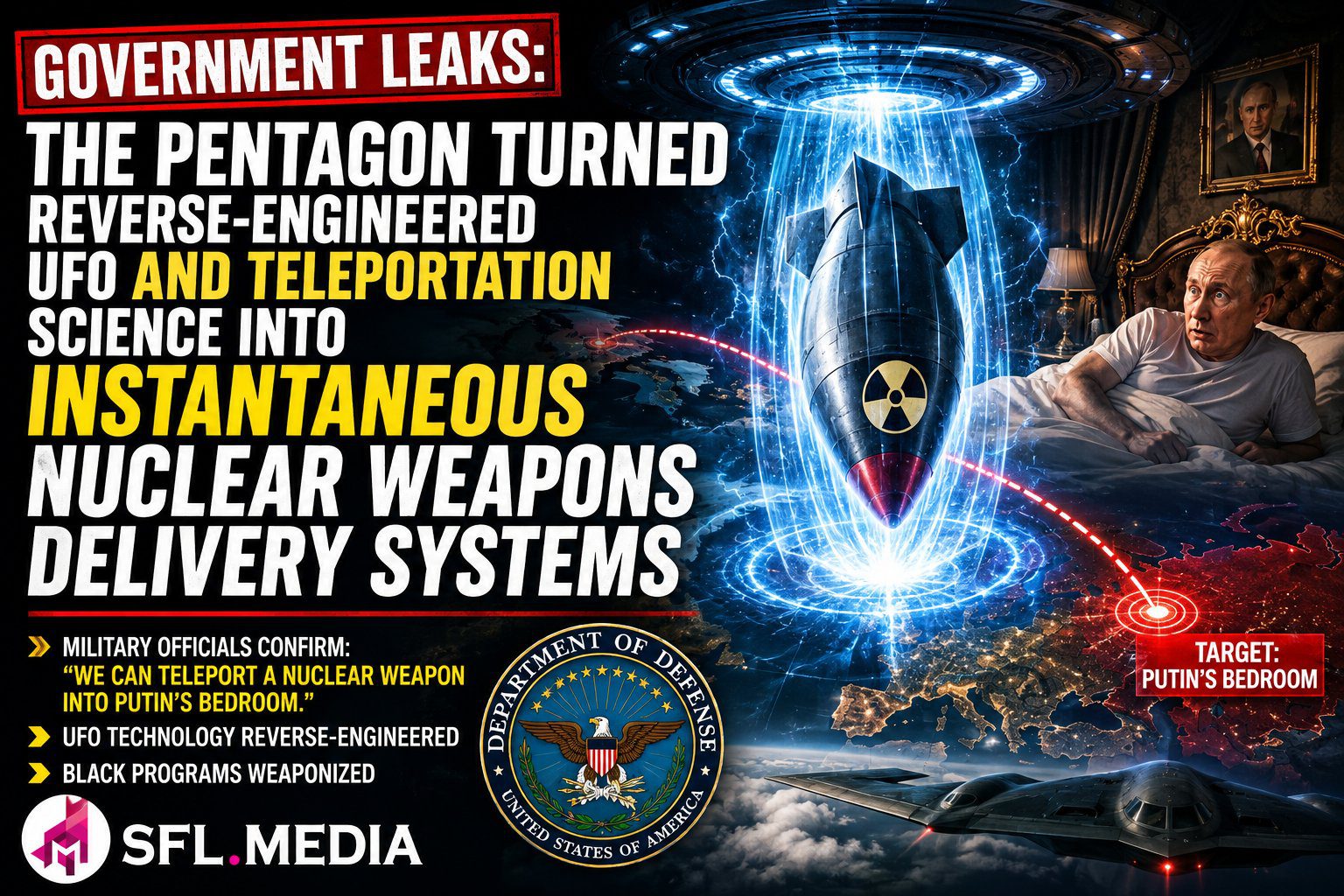
Why the “Nuclear Weapon in Putin’s Bedroom” Scenario Matters
The provocative scenario discussed in national security circles, placing a nuclear weapon directly into Vladimir Putin’s bedroom without a conventional delivery trajectory, sounds almost deliberately outrageous. But as a strategic thought experiment, it illustrates exactly why revolutionary transportation physics would immediately become a national security issue.
The revolutionary capability would not simply be getting the weapon there faster. It would be eliminating the defensive geography surrounding the target. There might be no conventional missile trajectory for early warning satellites to observe, no bomber to intercept and potentially no predictable approach corridor for existing missile defenses to engage. That would represent something fundamentally different from another generation of hypersonic missiles. It could represent an entirely new category of strategic warfare.
If the United States ever achieved anything approaching that capability, Washington would have an enormous incentive to conceal not merely the weapon itself but the underlying physics enabling it. Revealing a revolutionary civilian transportation technology could simultaneously reveal the scientific foundation for a military capability capable of disrupting the nuclear balance. That is a legitimate national security dilemma and potentially one of the strongest explanations for why breakthrough science could disappear behind classification.
Reverse Engineered UAP Technology Would Present the Same Strategic Problem
This is also where allegations surrounding reverse-engineered UAP become inseparable from nuclear strategy. Military witnesses have described unidentified objects displaying extraordinary apparent characteristics including rapid acceleration, unusual maneuverability, low observability and operation without obvious conventional propulsion. Observations are not explanations, and those reports do not by themselves establish gravity manipulation, spacetime engineering or extraterrestrial technology.
But military planners cannot simply ignore unexplained capabilities because the physics remain uncertain. If researchers studying recovered or observed UAP ever discovered how to reproduce even one genuinely revolutionary propulsion characteristic, military applications would inevitably receive immediate attention. A vehicle capable of extraordinary acceleration without conventional propulsion could alter weapons delivery. Technology capable of operating outside familiar aerodynamic constraints could potentially penetrate defenses differently from conventional aircraft. A genuine breakthrough involving inertia, gravity or spacetime would have consequences extending from surveillance and aerospace into strategic warfare. And technology capable of manipulating distance itself could potentially rewrite nuclear warfare completely.
The Nuclear Mission Could Help Explain the Government’s Obsession With UAP
The connection becomes even more significant because nuclear infrastructure repeatedly appears in the modern UAP debate. Elizondo told Congress that evidence suggests a relationship between UAP activity and sensitive military installations, nuclear assets and Department of Energy sites. That does not prove extraterrestrial intervention in America’s nuclear arsenal. But from a military-intelligence perspective, the reason for investigating such incidents is obvious. If unidentified technology repeatedly appeared around strategic nuclear assets, the government would urgently want to determine what it was, whether an adversary controlled it, how it penetrated restricted environments, how it operated and whether its capabilities could be reproduced.
Reverse engineering under that scenario would not merely represent scientific curiosity. It would become a nuclear-security imperative. If that research subsequently produced breakthroughs applicable to strategic weapons, the secrecy surrounding UAP research and the secrecy surrounding America’s nuclear weapons programs could become deeply intertwined.
This Could Explain Why the Most Important Science Receives the Highest Classification
Suppose scientists inside a classified program discovered an entirely new propulsion principle. Publishing the underlying physics might allow American aerospace companies to revolutionize transportation, but it might also provide foreign adversaries with the scientific foundation for developing weapons against which existing defenses are ineffective.
The government could reasonably conclude that revealing the civilian breakthrough would simultaneously reveal the military breakthrough. Classification would then protect not simply a secret aircraft or experimental weapon, but a strategic advantage potentially comparable to the most consequential military technologies developed during the nuclear age. That possibility gives the secrecy debate considerably more nuance. If the extraordinary whistleblower allegations ultimately prove true, presidents, military officials and intelligence agencies may not simply have been protecting the existence of non-human technology. They could also have been protecting what they believed was an overwhelming strategic advantage. But even that explanation creates a profound problem.
If Instantaneous Transportation Exists, Building a Faster Nuclear Weapon Would Be the Least Interesting Application
Some of the most explosive claims circulating around UAP disclosure go considerably further than anything established in the public record. They allege that deeply classified programs have achieved breakthroughs in spacetime manipulation, unconventional propulsion or instantaneous transportation and that national security planners have explored their potential for weapons delivery.
If those claims are substantially correct, using a civilization changing transportation technology primarily to deliver a nuclear weapon faster would represent a staggering failure of imagination. A technology capable of radically reducing transportation time could transform aviation, shipping, manufacturing, emergency medicine, disaster response, spaceflight and global logistics. A breakthrough in energy density could restructure the electrical grid. Genuine gravity control technology would remake aerospace. Revolutionary materials could transform construction, computing, medicine and industrial manufacturing. The Pentagon would naturally examine military applications first. That is what the Pentagon exists to do. The failure would be stopping there.
The Pentagon’s Job Is Defense. America’s Job Is Civilization.
National security is essential, but national security cannot become the sole organizing principle of American scientific development. America does not exist to maintain the Pentagon. The Pentagon exists to protect America. If the Defense Department discovers a technology capable of changing civilian civilization, the objective should be to preserve whatever narrow military advantage genuinely requires secrecy while moving every safe, non-kinetic application into the American scientific and commercial economy as rapidly as possible. A guidance system for a classified weapon may legitimately remain secret, while the underlying materials breakthrough that makes that guidance system possible may not need to remain classified forever.
A revolutionary propulsion technology may contain operational characteristics that adversaries should not receive. That does not automatically mean every civilian application of the underlying physics should remain imprisoned inside a Special Access Program for half a century. America needs a doctrine of selective technological declassification: protect the weapon, release the revolution.
The Manhattan Project Eventually Produced a Civilian Nuclear Industry
America has confronted versions of this dilemma before. Nuclear physics produced the most destructive weapons humanity had ever created, yet the underlying science did not remain permanently confined to weapons laboratories. Nuclear research eventually produced civilian power generation, medical applications, industrial technologies and entire fields of scientific research. The same broad principle later appeared with satellite navigation, networking, aerospace and other government supported technologies. America learned how to protect particular military capabilities while allowing related technologies to enter civilian life.
If revolutionary propulsion, energy, materials or spacetime technologies actually exist inside classified programs, Washington should be capable of confronting that distinction again. Keep targeting systems secret. Keep operational vulnerabilities secret. Keep whatever engineering details would allow an adversary to reproduce a catastrophic weapon secret. But release whatever underlying science and civilian applications can safely be separated from those capabilities. National security does not require technological paralysis.
NASA Already Demonstrated What Happens When Government Technology Reaches the Economy
There is a powerful historical model sitting inside the federal government itself. NASA has spent decades deliberately transferring government-developed technology into the civilian economy. Its Technology Transfer Program exists specifically to make federally developed inventions, patents and software available for commercial and public use. Federal space research has repeatedly produced commercial spinoffs, new companies, industrial capabilities and technologies with applications far beyond the original mission. NASA has understood the underlying principle for decades: government-developed science can become a national economic resource when it is allowed to leave the laboratory and enter the market. That is exactly how America should think about any revolutionary technology hidden inside the national-security system.
Imagine Applying the NASA Model to Black Programs
If classified programs contain nothing resembling the extraordinary technologies alleged by whistleblowers, an independent review process can establish that and close the issue. But if they do, America needs something substantially more ambitious than disclosure. It needs commercialization. Congress should establish an independent scientific and economic review process with appropriately cleared physicists, engineers, economists, technology transfer specialists and elected oversight officials empowered to examine deeply classified programs for civilian applications. Anything whose disclosure would directly compromise an active weapon could remain compartmented, while everything else should face a presumption of transition into productive civilian use.
Advanced materials could be licensed to American manufacturers. Energy technology could be transferred to utilities and startups. Propulsion breakthroughs could reach aerospace companies. Medical applications could move into university laboratories. New manufacturing techniques could be made available through federal licensing agreements. The government could retain patents where appropriate and license them to American companies, generating royalties while encouraging domestic manufacturing and industrial growth. Instead of another black-budget expense, the technology becomes an economic asset.
America’s Fiscal Problem Makes Technology Hoarding Even Harder to Defend
This is where the UAP debate intersects with something much larger than UFOs. America faces enormous long term fiscal pressure, and debt servicing increasingly consumes resources that cannot simultaneously be spent on infrastructure, science, defense, healthcare or tax relief. Economic growth is therefore itself a national security capability. A larger, more productive economy produces more taxable income, more investment, stronger companies and greater capacity to finance defense without destabilizing the nation’s finances. If the United States possesses transformative technologies but deliberately prevents them from reaching productive civilian markets, it would effectively be suppressing some of its own potential GDP.
That would be strategically backwards. The Pentagon depends upon the economy that funds it. Kneecapping civilian technological development in order to protect every possible military advantage can eventually weaken the economic foundation supporting the military itself. The paradox is difficult to ignore: the government could theoretically be protecting America’s military superiority by suppressing technologies capable of dramatically expanding America’s economic superiority.
America’s Greatest Weapon Has Never Been a Missile
America’s defining strategic advantage has rarely been merely possessing a secret invention. It has been turning inventions into industries. Semiconductors, aerospace, satellites, computing, GPS, biotechnology and the internet became strategically powerful because American researchers, entrepreneurs and corporations built enormous economic ecosystems around them. That is the difference between possessing technology and commanding a technological era.
If an extraordinary propulsion system sits underneath a tarp inside a classified hangar, America owns an extraordinary machine. If American universities can study its physics, American engineers can improve it, American companies can manufacture it and American entrepreneurs can build businesses around it, America owns the century. That should be the objective.
There Is a Difference Between Disclosure and Reckless Disclosure
None of this requires publishing nuclear weapons designs or handing China and Russia a blueprint for every American breakthrough. A mature disclosure framework could separate information into three broad categories: technologies whose release creates an immediate military vulnerability; dual use technologies whose underlying science can be commercialized while specific capabilities remain classified; and technologies with overwhelmingly civilian applications that should transition into public research and industry.
The nuclear implications make that distinction more important, not less. If a propulsion breakthrough could be adapted into an unprecedented strategic weapon, keep the engineering necessary to create that weapon compartmented. But that should not automatically sentence every related discovery in materials science, energy production, transportation or manufacturing to permanent secrecy.
The choice is not between revealing America’s most dangerous military secrets and burying an entire branch of physics. That is a false binary. The real question is whether America’s classification system is sophisticated enough to protect genuine national-security secrets without burying economically transformative science alongside them.
If Contractors Possess Recovered Technology, Congress Must Know
The Schumer-Rounds proposal raised another profound question: what happens if extraordinary materials or technologies are controlled by private contractors rather than directly by federal agencies? Its proposed eminent-domain language explicitly contemplated recovered technologies of unknown origin controlled by private persons or entities. Again, legislation contemplating something does not prove that the thing exists. But if privately held defense programs possess recovered or reverse engineered technology originating from government programs, there is a fundamental public policy issue regardless of its origin.
Government secrecy cannot become a mechanism through which a handful of contractors receive exclusive access to taxpayer-funded discoveries capable of transforming entire industries. At minimum, Congress must know what exists, who possesses it, what taxpayers funded, what intellectual property rights were granted, whether any discoveries have been incorporated into strategic weapons and why particular technologies remain classified. Without that oversight, secrecy stops protecting national security and starts protecting monopoly power.
The Moral Question Is Becoming Impossible to Avoid
The most serious version of these allegations creates an issue extending beyond economics. Imagine that classified programs possessed a revolutionary energy technology capable of dramatically reducing pollution, lowering electricity costs and expanding access to power around the world. Imagine revolutionary propulsion capable of eliminating enormous transportation costs. Imagine materials capable of transforming medicine or infrastructure.
At some point, withholding such technology indefinitely would stop being merely a classification decision. It would become a moral decision. Calling that a “crime against humanity” today goes beyond what the available public evidence can establish. We do not publicly know that such technology exists, much less that officials are intentionally suppressing proven civilian applications. But if evidence eventually establishes that transformative technologies were deliberately withheld for decades despite enormous preventable human costs, that language will inevitably enter the public debate. The government should understand the stakes before that happens.
War Cannot Be Humanity’s Highest Technological Ambition
Every major power needs weapons. Deterrence matters. Nuclear weapons unfortunately remain part of the geopolitical reality America must navigate, but preventing war is supposed to preserve civilization. It cannot become civilization’s primary purpose. The highest objective of American technological power should not be discovering how to destroy something on the opposite side of the planet five minutes faster or, in the most extraordinary version of these allegations, instantaneously. It should be discovering how to produce more energy, travel farther, cure more disease, manufacture better materials, build greater prosperity and push humanity beyond its current limitations.
Defense is part of that mission. It is not the entire mission. If the United States actually possesses science capable of collapsing distance, manipulating gravity or revolutionizing energy, history will not judge the country primarily by how quickly it learned to weaponize it. History will judge what America did with the civilization-changing possibilities that came with it.
Congress Needs to Ask Whether UAP Technology Has Entered America’s Nuclear Arsenal
Congress has spent enormous energy asking whether the government possesses recovered craft, anomalous materials or information concerning non-human intelligence. Those are legitimate questions, but lawmakers should now ask something much more direct: have technologies derived from UAP research, recovered materials, unconventional propulsion programs or exotic physics been incorporated into strategic weapons or nuclear-delivery programs?
If the answer is no, the government should be capable of saying so to appropriately cleared congressional investigators. If the answer is yes, Congress must determine what elements genuinely require continued classification and whether civilian applications have been unnecessarily trapped behind the same security wall. That question would fundamentally change the disclosure debate. The issue would no longer simply be whether Americans deserve to know what their government knows about UFOs. It would become whether American taxpayers unknowingly financed revolutionary scientific breakthroughs that were directed overwhelmingly toward warfare while potentially transformative civilian applications remained locked away.
The Government Can End the Speculation by Opening the Science
The extraordinary claims surrounding UAP reverse engineering will remain allegations until extraordinary evidence becomes available. That is not an argument for ending the investigation. It is an argument for accelerating it. Congress should demand a comprehensive accounting of classified research involving unconventional propulsion, recovered anomalous materials, vacuum physics, spacetime engineering and related technologies. Programs with legitimate national-security implications can be reviewed behind closed doors by appropriately cleared lawmakers and independent scientists.
But that review should contain a second mandate that has been largely absent from the UAP debate: what can safely be released? Not merely which documents can be published, but which technologies can be used. That is the question capable of turning disclosure from another Washington scandal into an American technological renaissance.
If There Is Nothing There, Prove It. If There Is Something There, Put America to Work.
Washington cannot indefinitely occupy the strange middle ground it has created. Congressional witnesses allege possession of extraordinary technology. Senators have drafted legislation governing recovered technologies of unknown origin. The Pentagon investigates UAP. The Air Force historically funded research into exotic transportation physics. Congressional committees publicly complain about excessive secrecy. Yet Americans are still told remarkably little about what sits behind the classified wall.
There is a straightforward way forward. If decades of investigation reveal no recovered craft, no revolutionary propulsion and no transformative classified physics, release enough evidence for Congress and independent experts to evaluate that conclusion. If transformative technology does exist, protect the narrow military applications that genuinely require secrecy and begin transferring the underlying science into America’s universities, laboratories, startups and industries.
NASA has demonstrated the power of that model for generations. America does not become safer by winning a secret technological arms race while losing its economic future. The United States became the world’s dominant economy because it repeatedly turned science into industry, industry into prosperity and prosperity into national power. If humanity’s next technological revolution is already sitting somewhere inside the American government, the most important thing Washington can do with it may not be building a better bomb. It may be opening the door.
Protect the nuclear secret. Release the human revolution.
Because if the most extraordinary allegations ultimately prove true, the greatest scandal may not be that Washington discovered technology capable of changing the world. It may be that Washington looked at the greatest technological revolution in human history and saw a faster way to deliver a nuclear weapon.

Sources
House Oversight — 2023 UAP Congressional Hearing
House Oversight — 2024 UAP Congressional Hearing
Luis Elizondo — Written Congressional Testimony
House Oversight — Transparency and Accountability in UAP Programs
House Oversight — UAP Secrecy and Public Trust
Schumer-Rounds UAP Disclosure Act
Congressional Record — Recovered Technologies of Unknown Origin
Congressional Record — Schumer on UAP Transparency
National Technical Reports Library — Air Force Teleportation Physics Study
Department of Defense — Department-Wide Financial Audit
NASA — Economic Impact and Technology Transfer Report
NASA — Technology Transfer and National Economic Return
NASA — Technology Transfer and Commercial Spinoffs
South Florida Media — David Grusch Congressional Testimony
South Florida Media — UAP Coverage
South Florida Media — Pentagon Technology and Human Progress




















































Want to join the conversation?
Create an account or sign in to share your thoughts, vote,
and reply to other readers.
Showing 0 of 0 comments
Don't have an account?
Already have an account?