

UPS Cargo Plane and Copa Airlines Passenger Jet Collide at Miami International Airport, Leaving Two Injured
Air traffic control recordings reveal that a UPS cargo aircraft was instructed to yield before its nose was struck by the wingtip of a Copa Airlines passenger jet. The collision occurred amid widespread aviation disruptions following a nationwide FAA ground stop.
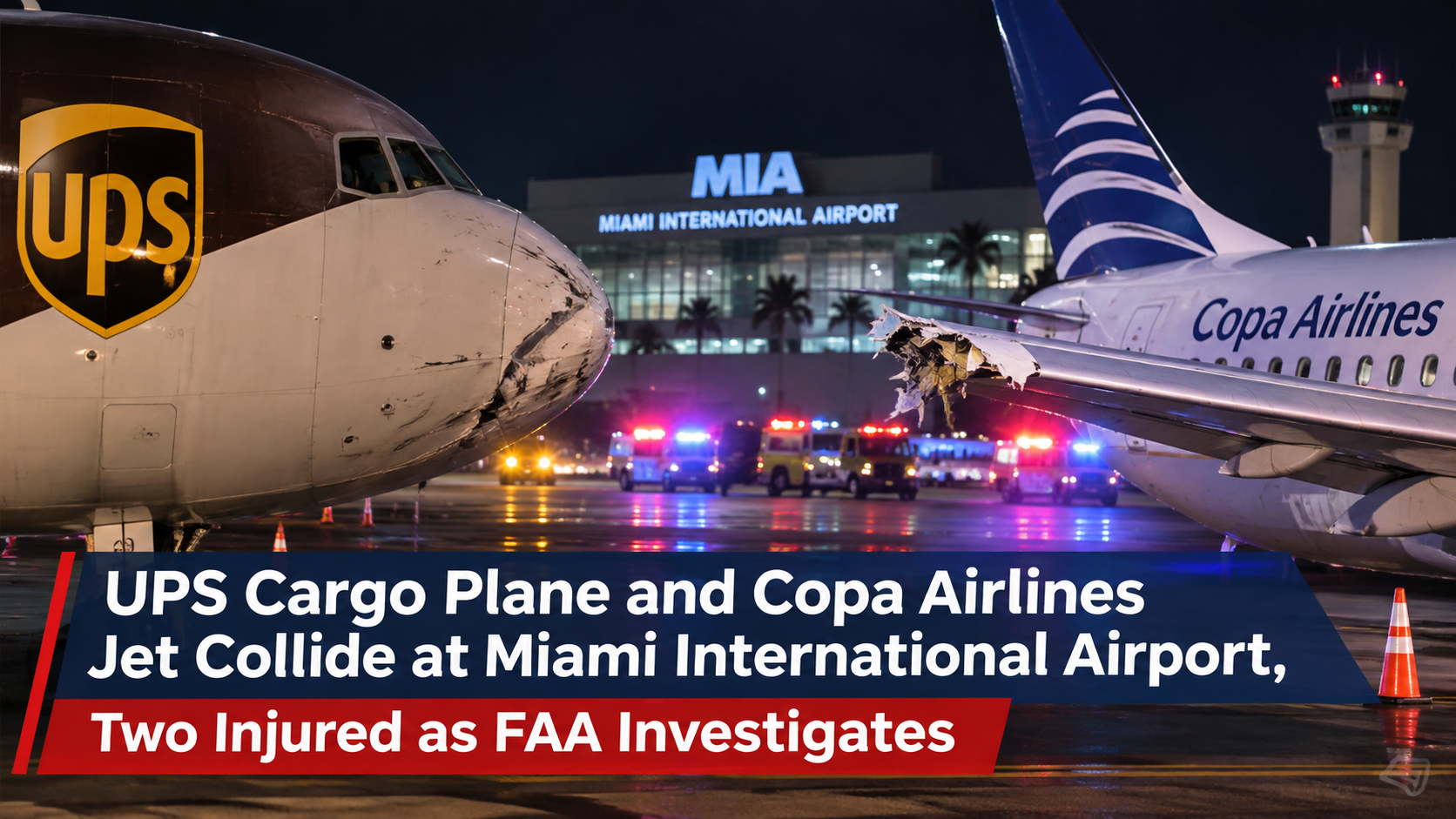
MIAMI, FLORIDA — A UPS cargo plane and a Copa Airlines passenger jet collided while taxiing at Miami International Airport on Saturday night, leaving two people with minor injuries and prompting a Federal Aviation Administration investigation into how the aircraft came into contact at a busy taxiway intersection.
The collision occurred at approximately 9:15 p.m. on November 14, when the left wingtip of a Copa Airlines Boeing 737 struck the nose of a UPS Boeing 767 cargo aircraft. According to the FAA, air traffic controllers had instructed the UPS crew to yield to the approaching passenger jet before the collision, raising questions about whether the cargo aircraft advanced beyond its intended stopping position.
Copa Airlines Flight 427 had just arrived in Miami from Panama City, Panama, while UPS Flight 358 was preparing to depart for Bogotá, Colombia. Both aircraft were maneuvering through the airport’s taxiway system when they made contact at an intersection, triggering an emergency response and temporarily forcing airport personnel to redirect ground traffic.
The incident occurred less than 24 hours after a major nationwide FAA ground stop disrupted thousands of flights across the United States, leaving airlines struggling to restore normal operations. Although the timing has drawn attention to the pressures facing the aviation system, authorities have not established any connection between the earlier technical outage and Saturday night’s collision.
Air Traffic Control Audio Reveals What Happened Before the Collision
Air traffic control recordings provide an unusually revealing account of the moments immediately following the collision, including an acknowledgment from the UPS crew that its aircraft had traveled too far. According to audio reported by CNN, a pilot aboard the Copa Airlines passenger jet alerted controllers to the incident with a brief statement:
“Somebody hit us.”
The controller subsequently contacted UPS Flight 358 to determine whether the cargo aircraft had made contact with the Copa jet. The UPS pilot acknowledged that the aircraft had advanced too far, explaining:
“Yeah, we went too far, and then he, he clipped us with the wing.”
The FAA later confirmed that the Copa Airlines Boeing 737’s wingtip had struck the nose of the UPS Boeing 767 while both aircraft were taxiing. Federal officials also confirmed that controllers had instructed the UPS crew to give way to the approaching passenger aircraft, an important detail that investigators will examine as they reconstruct the sequence of events. Following the collision, air traffic controllers instructed the Copa crew to remain in position and advised that emergency vehicles were responding. The passenger jet’s pilots subsequently reported apparent damage to the aircraft’s left wingtip, indicating that the collision had affected part of the wing structure.
Although the UPS pilot’s acknowledgment provides an important piece of evidence, it does not establish the complete cause of the accident. Investigators must still determine whether the aircraft’s positioning resulted from a misunderstanding of instructions, a misjudgment of available clearance, or another operational factor.
Two People Treated for Minor Injuries as Emergency Crews Respond
Miami-Dade Fire Rescue personnel responded to the taxiway collision and evaluated two people for minor injuries. Both individuals received treatment at the scene and neither required transportation to a hospital, according to Miami International Airport communications director Greg Chin. Initial information released by airport officials indicated that no injuries had been reported, but that assessment was subsequently updated to reflect the two people treated by emergency responders. Authorities have not publicly identified the injured individuals or specified whether they were passengers, flight crew members, or airport personnel.
Despite the collision involving two large commercial aircraft, airport officials reported that the incident did not significantly disrupt overall operations at Miami International Airport. Flights were redirected onto alternative taxiways while emergency personnel attended to the affected aircraft and the immediate area. UPS confirmed that its crew was safe and said the company would cooperate with authorities investigating the incident. In a statement carried by South Florida television station WSVN, the cargo carrier emphasized that employee and public safety remained its highest priority.
The full extent of the damage to either aircraft has not been publicly established. Aviation maintenance personnel will need to assess the affected structures and determine what repairs and inspections are necessary before the planes can safely return to service.
FAA Investigating Why UPS Aircraft Failed to Yield
The FAA’s confirmation that controllers instructed the UPS crew to yield is among the most significant details to emerge from the incident. Taxiway intersections require pilots to maintain precise awareness of their aircraft’s position, particularly when maneuvering large jets whose wings and fuselages extend considerable distances beyond the cockpit. A Boeing 767 cargo aircraft has a substantially larger footprint than many smaller commercial aircraft, making proper clearance and adherence to ground-control instructions especially important. Even at relatively low taxiing speeds, contact between two aircraft can damage critical structures and require extensive inspections.
The investigation will likely examine the instructions transmitted by air traffic controllers, the responses from both flight crews, the aircraft’s movements through the taxiway intersection, and whether either crew had sufficient visibility to recognize the developing hazard. Investigators may also review airport surveillance footage, recorded ground-control communications, and aircraft operating data to establish a more complete timeline. The available evidence suggests that the UPS aircraft advanced into a position where the Copa Airlines jet’s wingtip could make contact with its nose. However, determining whether that movement resulted from pilot error, a communication problem, or another contributing factor will require a formal review.
The FAA has confirmed that it is investigating the collision, but no final determination of responsibility has been announced.
Collision Comes One Day After Nationwide FAA Ground Stop
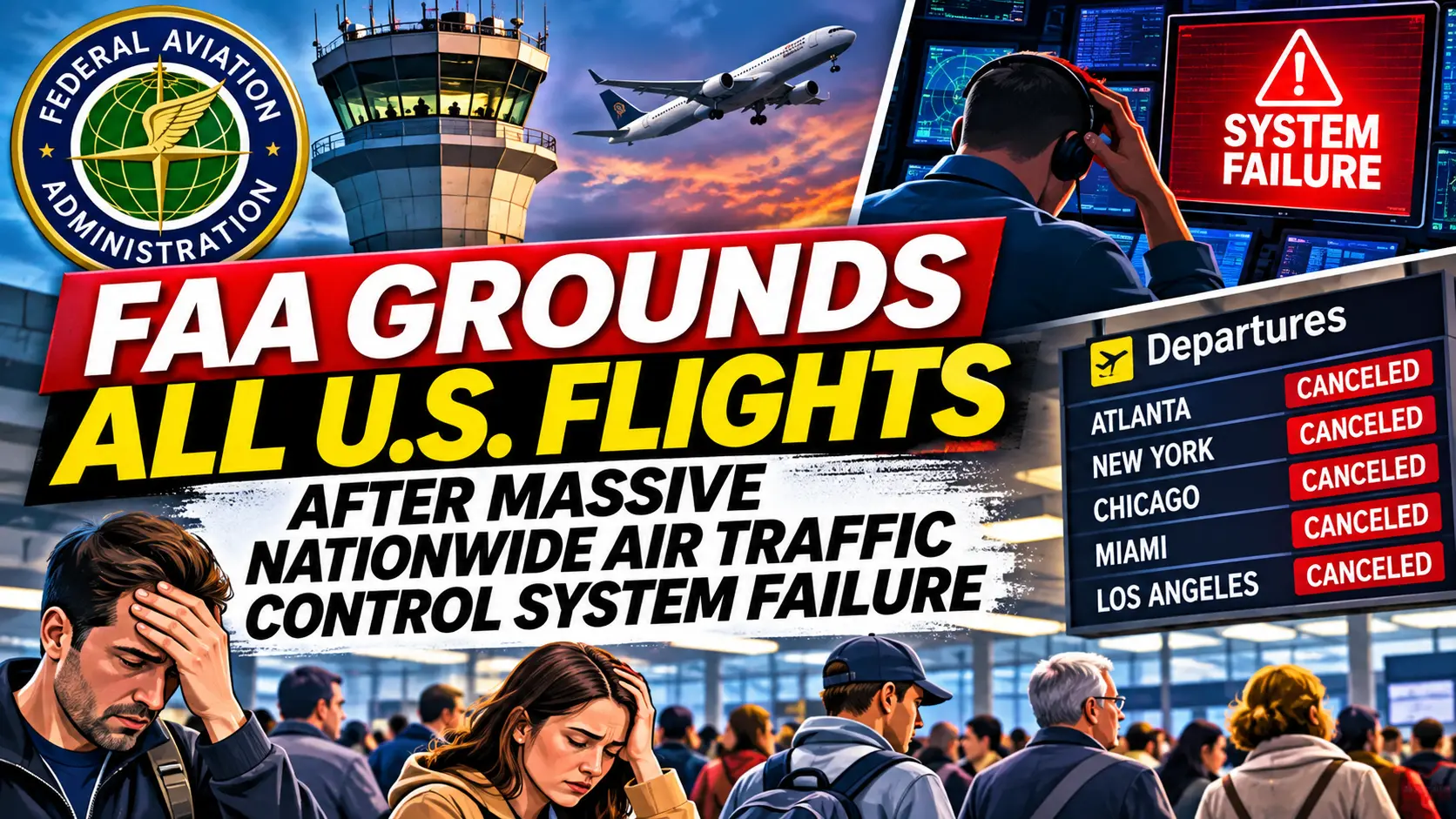
The Miami collision unfolded during an exceptionally difficult weekend for the American aviation industry, following a nationwide FAA ground stop on Friday that halted departures across the country and created widespread delays and cancellations. The unprecedented disruption was triggered by problems affecting air traffic control communications and radar systems, with federal officials identifying overloaded network equipment and technical failures as central issues. The shutdown lasted nearly five hours before authorities began restoring departures, but its effects continued well into Saturday as airlines attempted to reposition aircraft, crews, and stranded passengers.
According to Reuters, more than 6,400 flights were canceled across the United States on Saturday, with thousands of additional delays as the aviation system struggled to recover. Federal aviation officials warned that restoring normal schedules could take until late Sunday, particularly at major hubs where disruptions had created substantial backlogs.
Miami International Airport was among the facilities affected by the nationwide disruption, with passengers facing cancellations, delayed departures, and extended waits for rebooking. The collision between the UPS and Copa aircraft added another operational complication during an already challenging period for airport personnel. However, there is no verified evidence that the FAA’s earlier technical failure contributed directly to the taxiway collision. The ground stop and the aircraft accident are separate events, and any potential relationship between them would need to be established through evidence rather than timing alone.
Miami International Airport’s Critical Role in International Aviation
Miami International Airport serves as one of the country’s most important gateways for international passenger travel and air cargo, particularly between the United States, Latin America, and the Caribbean. Its operations involve a constant mixture of commercial passenger jets, international cargo aircraft, and other aviation traffic moving through an extensive network of runways, taxiways, and terminal areas.
That combination of aircraft types creates operational challenges that demand careful coordination between pilots and ground controllers. Large cargo jets such as the Boeing 767 routinely operate alongside narrow-body passenger aircraft, requiring controllers to account for differences in wingspan, turning radius, and the amount of space necessary to maneuver safely.
Unlike collisions during takeoff or landing, taxiway accidents generally occur at much lower speeds. Nevertheless, the structural consequences can be substantial, especially when an aircraft’s wingtip strikes another plane’s fuselage or nose. Such incidents can also create additional hazards if aircraft become disabled near active taxiways or emergency crews must enter areas normally used for aircraft movements. Saturday’s collision illustrates why ground operations remain a critical component of aviation safety, even when aircraft are traveling slowly and are not yet airborne.
Questions Remain as Federal Investigation Continues
The immediate emergency at Miami International Airport ended without serious injuries, but the collision has left investigators with several important questions about the events leading up to the impact. The FAA must determine precisely where the UPS aircraft was positioned when the Copa jet approached, whether the cargo crew correctly understood the instruction to yield, and why the two aircraft were permitted to come close enough for the passenger jet’s wingtip to strike the cargo plane’s nose. The investigation will also need to establish the extent of the damage and whether any airport procedures or communications contributed to the incident.
For passengers, the relatively minor injuries and limited airport disruption were fortunate outcomes. A collision involving two large commercial aircraft can have consequences far beyond damaged equipment, particularly when passenger cabins, fuel systems, or critical aircraft structures are involved.
The incident also comes at a moment when the FAA is facing renewed scrutiny over the reliability of the nation’s aging aviation infrastructure following Friday’s nationwide shutdown. Although the two events have not been linked, both underscore the importance of maintaining effective communications, reliable technology, and rigorous operational procedures throughout the aviation system. For now, the FAA investigation will determine whether Saturday night’s collision was an isolated ground-handling mistake or evidence of a broader procedural problem requiring corrective action.

Sources & Further Reading
-
CNN — Planes Collide at Miami Airport; FAA Confirms Yield Instruction and Opens Investigation
-
CBS News Miami — UPS Cargo Plane and Copa Airlines Jet Collide at MIA
-
Reuters — U.S. Aviation System Recovers From Nationwide FAA Ground Stop
-
Video Coverage — Two Planes Collide at Miami International Airport
-
South Florida Media — Breaking News, Aviation and South Florida Coverage







Loading comments…