

FAA Grounds Flights Nationwide After Massive Air Traffic Control System Failure, Stranding Thousands of Travelers Across America
A catastrophic telecommunications failure inside the Federal Aviation Administration’s air traffic control network forced the agency to halt departures nationwide Friday, triggering thousands of flight cancellations, widespread delays and one of the most significant disruptions to American aviation in years. Although the FAA eventually lifted the emergency ground stop, the incident exposed serious vulnerabilities in the nation’s aging aviation infrastructure just days before the Thanksgiving travel rush.
WASHINGTON, D.C. — The Federal Aviation Administration brought departing air traffic across the United States to a standstill Friday, November 13, 2026, after a major telecommunications failure disrupted critical air traffic control systems, forcing officials to impose a rare nationwide ground stop that left passengers stranded, airlines scrambling and airports struggling to manage thousands of delayed and canceled flights.
The extraordinary order, issued Friday afternoon, prevented commercial aircraft from departing airports throughout the country as federal technicians worked to diagnose failures affecting communications and radar information used by air traffic controllers. The emergency shutdown lasted approximately four hours before the FAA announced that departures could resume following technical assessments and safety checks.
The disruption quickly spread through the nation’s interconnected aviation network, affecting major carriers including American Airlines, Delta Air Lines, United Airlines, JetBlue and international operators serving American airports. Flight-tracking data showed thousands of cancellations and widespread delays, with hundreds of aircraft diverted and airline schedules thrown into disarray.
Transportation Secretary Sean Duffy said the problem involved instability in the systems supplying information to air traffic control facilities, including regional centers responsible for directing aircraft between airports. Department of Homeland Security Secretary Markwayne Mullin said investigators had found no indication that the incident resulted from a cyberattack or other deliberate act.
Although aircraft already airborne continued operating under established safety procedures, the FAA determined that allowing additional departures would create unacceptable operational uncertainty. Officials emphasized that the ground stop was a precautionary measure designed to protect passengers and flight crews while technicians evaluated the system.
The shutdown marked the first nationwide ground stop since January 2023, when a separate FAA computer failure disrupted domestic departures. It also renewed concerns about the reliability of aging technology supporting one of the world’s busiest and most complex aviation systems.
Nationwide Ground Stop Brings America’s Aviation System to a Standstill
The emergency began Friday afternoon when FAA technicians detected instability affecting communications and radar information used by air traffic control facilities across the United States. The problems were serious enough that officials determined they could not reliably maintain normal departure operations while investigating the failure.
At approximately 3:36 p.m. Eastern time, according to Duffy, the agency began experiencing instability involving radar and communications systems at regional control centers and Terminal Radar Approach Control facilities, commonly known as TRACONs. These facilities perform essential functions in the national air traffic network, helping controllers maintain separation between aircraft and coordinate their movements through increasingly crowded airspace.
The FAA subsequently ordered a nationwide ground stop, temporarily preventing departures while allowing aircraft already in flight to continue under controlled conditions. The agency described the decision as necessary because of extraordinary circumstances affecting aviation safety. The order created immediate congestion at major airports, where aircraft remained at gates or on taxiways while passengers waited for updates. Some flights that had already begun taxiing returned to their gates, while airlines canceled additional departures as the duration and severity of the disruption became clearer.
The shutdown also affected international aviation. Airlines operating flights between the United States and foreign destinations faced restrictions and uncertainty, while some carriers suspended remaining departures rather than risk aircraft and crews becoming stranded away from their scheduled operating locations. The disruption demonstrated how quickly a failure in a centralized aviation system can affect airports thousands of miles apart. Even when individual airport facilities remain operational, interruptions in the broader air traffic control network can prevent aircraft from moving safely and efficiently between them.
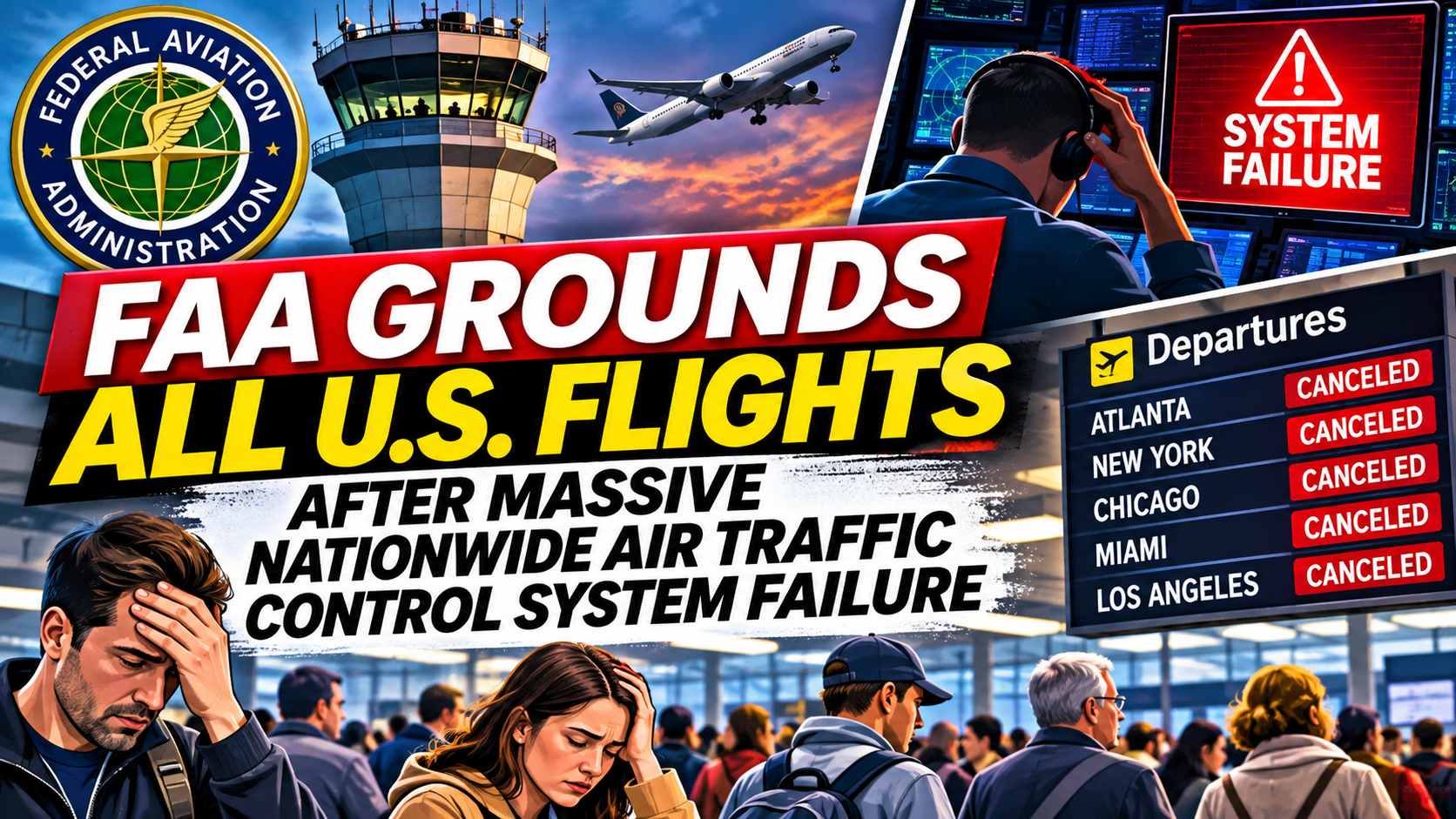
Thousands of Flights Canceled as Delays Spread Across the Country
The scale of the disruption became apparent as flight cancellations and delays accumulated throughout Friday afternoon and evening. According to FlightAware figures cited by ABC News, nearly 5,000 flights had been canceled nationwide by Friday evening, with hundreds of additional cancellations already scheduled for Saturday.
The totals continued changing as airlines assessed their ability to resume operations. The disruption affected domestic and international flights, leaving passengers waiting in terminals, searching for alternative transportation and attempting to reschedule trips.
United Airlines announced plans to cancel most of its remaining Friday departures, with limited exceptions for certain international services. JetBlue similarly suspended most remaining flights for the evening, while Air Canada canceled its remaining Friday services between Canada and the United States.
Other major airlines faced substantial operational problems as aircraft and flight crews became separated from their planned schedules. A plane scheduled to complete several flights in one day might remain stranded at its original airport, preventing it from operating subsequent routes even after the ground stop ended.
The disruption also affected connecting passengers, whose travel plans depended on aircraft arriving from other cities. A delayed departure in Chicago, Atlanta or Dallas could prevent passengers from reaching connecting flights in Miami, Fort Lauderdale, New York or Los Angeles, multiplying the consequences of the original shutdown.
Airlines warned that cancellations and delays could continue into Saturday because restarting the aviation network would require more than simply lifting the FAA’s order. Carriers needed to reposition aircraft, locate available crews, comply with federal flight-duty limitations and rebuild schedules disrupted by the emergency. The resulting delays were expected to create additional pressure on airports and airlines as the country approached the busy Thanksgiving travel period.
Aging Routers and Telecommunications Equipment Blamed for Nationwide Failure
The investigation quickly turned toward the FAA’s aging telecommunications infrastructure, including equipment responsible for transmitting radar and communications data between air traffic control facilities. At a White House briefing Friday evening, Duffy said the agency had experienced inconsistent information from routers operating within the national air traffic control network, creating instability serious enough to justify stopping departures across the country.
Duffy described an aging system that relies on outdated switching equipment, routers and copper communications lines, some of which date back decades. According to the transportation secretary, the infrastructure became overwhelmed by data, disrupting the reliable flow of information required for controllers to safely coordinate aircraft movements.
Mullin said the introduction of newer technology into older infrastructure appeared to have contributed to the overload. The explanation suggested that the problem involved the interaction of different generations of equipment rather than a single isolated failure, although investigators had not completed a comprehensive technical assessment of the incident.
Early accounts also raised questions about telecommunications equipment and network problems in the Chicago area. However, officials had not conclusively established that a malfunction near Chicago Midway International Airport caused the nationwide shutdown, nor had they publicly identified a specific software patch as the definitive trigger. Those distinctions are important because the preliminary findings identify a broad infrastructure failure, while the precise technical sequence that caused the national disruption remains subject to investigation.
Homeland Security Says No Evidence of Cyberattack or Sabotage
The sudden nationwide failure prompted speculation about whether the FAA’s systems had been targeted by hackers, foreign adversaries or other malicious actors. Federal officials moved to address those concerns Friday evening, stating that investigators had found no evidence of a cyberattack or deliberate interference.
Mullin emphasized that the available information pointed toward a telecommunications failure rather than terrorism, sabotage or an attack against the nation’s aviation network. Officials also said the outage did not appear connected to the FAA’s newer artificial intelligence assisted aviation management technology.
The administration maintained that aircraft already in the air were not placed in immediate danger because controllers and flight crews continued operating under established safety procedures. The nationwide ground stop was imposed to prevent additional aircraft from entering an already disrupted system while technicians worked to restore reliable communications and data.
That assurance does not diminish the seriousness of the failure. Air traffic control systems are designed around multiple layers of redundancy because interruptions in communications, surveillance or flight information can create significant operational hazards if they are not promptly addressed.
The FAA’s decision to stop departures reflected those safety concerns. Rather than allow traffic to continue expanding during an uncertain technical emergency, the agency temporarily restricted operations while specialists investigated the malfunction and verified that essential systems were functioning reliably.
South Florida Airports Among Those Affected by Nationwide Shutdown
The disruption reached Florida’s major aviation hubs, including Miami International Airport, Fort Lauderdale-Hollywood International Airport and Orlando International Airport, where passengers faced cancellations, delays and uncertainty as airlines responded to the federal order.
For South Florida, the timing was particularly disruptive. Miami and Fort Lauderdale serve as major gateways for domestic travel, international flights, Caribbean destinations and cruise passengers, making disruptions to their schedules consequential far beyond the airports themselves.
The nationwide shutdown also affected travelers attempting to reach South Florida through connecting airports. Associated Press reporting described one passenger traveling from California to Fort Lauderdale whose connecting flight was diverted to Kansas City, forcing him to seek alternative arrangements to reach his family.
At Orlando International Airport, officials warned passengers to verify their flight status before traveling to the terminal. The Greater Orlando Aviation Authority anticipated approximately 90 cancellations for Saturday, although the total remained subject to change as airlines worked to restore normal operations.
The incident highlighted how South Florida’s tourism economy depends on the reliability of the national aviation network. Even when local airport equipment is functioning normally, a failure elsewhere in the system can prevent aircraft and passengers from reaching their destinations.
FAA Lifts Ground Stop After Extensive System Testing
Following several hours of emergency troubleshooting, the FAA announced Friday evening that the nationwide ground stop had ended and that departing aircraft could begin resuming operations. The agency said technicians had thoroughly tested the affected systems to confirm they were stable and reliable before authorizing departures. The decision allowed airlines to begin rebuilding their schedules, although aviation officials warned that the recovery would be gradual.
The challenges extended well beyond the technical failure itself. By the time the ground stop was lifted, thousands of flights had been canceled, hundreds of aircraft had been diverted and airline crews were scattered across airports far from their intended destinations.
Restoring the network required airlines to determine which aircraft were available, which crews remained within federal duty limits and which routes could be operated without creating additional disruptions. Some passengers faced overnight delays, while others were rebooked on flights scheduled for Saturday or later.
The FAA’s announcement ended the immediate nationwide departure restriction, but it did not mean the aviation system had returned to normal. Officials warned that travelers should expect additional delays and cancellations as airlines worked through the backlog.
Congress Faces Renewed Pressure to Modernize America’s Air Traffic Control System
The nationwide outage intensified longstanding concerns about the condition of the United States’ air traffic control infrastructure, which relies on a complicated combination of older telecommunications equipment, modern computer systems and specialized aviation technology. Duffy used the emergency to call for additional federal investment, arguing that the aviation system cannot continue depending on aging equipment while handling the enormous volume of aircraft operating in American airspace.
Congress previously approved approximately $12.5 billion for air traffic control modernization, supporting improvements that include replacing older copper communications lines with fiber optic infrastructure and upgrading radio equipment. Administration officials said substantially more funding would be required to complete the broader modernization effort, with the White House seeking an additional $30 billion.
The transportation secretary also highlighted deteriorating physical infrastructure at air traffic control facilities, including outdated towers, malfunctioning elevators, inadequate air conditioning and other maintenance problems. While those issues were not identified as the direct cause of Friday’s shutdown, officials cited them as evidence of a larger system requiring sustained investment.
Modernizing air traffic control is particularly complicated because new technology must be introduced without interrupting existing operations. The system cannot simply be shut down for replacement, meaning upgrades must be carefully integrated with equipment that continues directing thousands of aircraft every day. Friday’s failure demonstrated the potential consequences when those systems become unstable. A telecommunications problem that might otherwise appear to be an internal technical issue was serious enough to halt departures across an entire country.
The 2023 FAA Shutdown Offered an Earlier Warning
The November 13 disruption was not the first time a technical failure inside the FAA forced the United States to suspend domestic flight departures.
In January 2023, a malfunction involving the agency’s Notice to Air Missions system, commonly known as NOTAM, prompted another nationwide ground stop. That system distributes critical safety information to pilots, including warnings about runway closures, navigation hazards and other conditions affecting flight operations.
The 2023 outage exposed weaknesses in the FAA’s technological infrastructure and generated calls for modernization. Although Friday’s incident involved different systems, both disruptions demonstrated the potential consequences of failures affecting services that are essential to national aviation operations.
The comparison is significant because the United States has now experienced two nationwide ground stops caused by FAA technology failures within four years. The earlier incident provided a warning about aging infrastructure, while the latest disruption showed that vulnerabilities remain despite ongoing modernization efforts.
Neither event establishes that the entire aviation system is unsafe. Both, however, illustrate how failures in critical centralized systems can have immediate consequences for airlines, airports, passengers and the broader economy.
Passengers Face Cancellations, Rebooking Problems and Limited Compensation
For travelers caught in the shutdown, the immediate challenge was determining when they could resume their journeys and what assistance airlines were required to provide. Under federal consumer protection rules, passengers whose flights are canceled are generally entitled to a refund if they decline the alternative transportation offered by the airline. Travelers who still wish to complete their journeys can typically be rebooked without additional airfare charges under airline policies and applicable requirements.
However, a federal air traffic control failure is generally considered outside an airline’s control, meaning carriers are not automatically required to provide additional compensation for expenses such as hotel accommodations, meals or ground transportation.
Some airlines may voluntarily offer assistance, and travelers should review the specific policies applicable to their tickets. Passengers who purchased travel insurance may also have coverage for certain expenses, depending on the terms of their policies. The FAA and airlines urged travelers to check their flight status directly with their carriers before heading to airports, particularly because published departure times could continue changing as aircraft and crews were repositioned.
A Nationwide Aviation Breakdown Exposes a Larger Infrastructure Crisis
The nationwide ground stop has become another warning about the vulnerability of critical American infrastructure and the consequences of allowing essential technological systems to age without comprehensive modernization.
For more than four hours, a telecommunications failure disrupted departures across the world’s largest aviation market, affecting thousands of flights and creating operational problems that could extend well beyond the initial emergency.
The FAA’s decision to ground departing aircraft helped prevent the technical malfunction from becoming a more serious aviation safety crisis. But the fact that such a sweeping intervention was necessary raises important questions about system redundancy, maintenance, modernization and the federal government’s ability to prevent similar failures.
The preliminary investigation points toward overloaded communications equipment and aging infrastructure rather than sabotage or cyberterrorism. Nevertheless, officials have not completed their technical review, and the full circumstances surrounding the failure remain to be established.
For airlines, the immediate priority is restoring schedules and transporting stranded passengers. For Congress and federal aviation officials, the larger challenge is determining how to modernize the national air traffic control network without introducing new vulnerabilities during the transition.
The incident demonstrated that a failure in essential communications infrastructure can disrupt an entire country’s aviation operations within minutes, even when individual airports and aircraft remain otherwise operational.
The FAA has restored departures, but the questions surrounding the system’s reliability remain. With the Thanksgiving travel season approaching, the latest breakdown has placed renewed urgency on a problem aviation officials have warned about for years: America’s air traffic control infrastructure needs major investment, and the consequences of delaying that work are becoming increasingly difficult to ignore.

Sources & Further Reading
-
Associated Press — FAA Lifts Nationwide Ground Stop Following Communications Failure
-
Reuters — U.S. Flights Resume After Air Traffic Network Failure
-
ABC News — FAA Ground Stop Live Updates and White House Briefing
-
NPR — Nationwide Ground Stop Lifted After Four-Hour Shutdown
-
WFTV Orlando — FAA Outage and Orlando International Airport Disruptions
-
South Florida Media — National News, Aviation and Investigations




















Loading comments…