
Trump Floats F-35 Sale to Turkey, Drawing Sharp Rebuke from Netanyahu
President Donald Trump’s suggestion that the United States could revive sales of the advanced F-35 Lightning II stealth fighter to Turkey has reopened one of NATO’s most contentious defense disputes, prompting an unusually direct public warning from Israeli Prime Minister Benjamin Netanyahu. The proposal would reverse a years long U.S. policy that removed Turkey from the multinational F-35 program after Ankara purchased Russia’s S-400 air defense system. That decision, made during Trump’s first administration and reinforced under subsequent administrations, was driven by concerns that operating the two systems together could compromise some of America’s most closely guarded military technology.
Now, with Trump signaling a willingness to revisit the issue, the debate has shifted from whether Turkey should ever receive the aircraft to whether the strategic benefits outweigh the security risks.
Why Israel Is Objecting
Netanyahu argues that providing fifth generation stealth fighters to Turkey would fundamentally alter the military balance in the Middle East. Speaking publicly after Trump’s comments, the Israeli leader warned that Turkey’s increasingly confrontational regional posture makes the country an unreliable recipient of America’s most advanced combat aircraft. Among Israel’s concerns are:
Turkey’s support for Hamas, which Israel classifies as a terrorist organization.
- Repeated diplomatic and military tensions with fellow NATO member Greece.
- Turkey’s continued military presence in northern Cyprus.
Increasingly hostile rhetoric toward Israel from Turkish President Recep Tayyip Erdoğan and senior officials.
For Israel, the issue extends beyond politics. The United States has long maintained a policy known as Israel’s “Qualitative Military Edge” (QME), designed to ensure Israel maintains superior military capabilities over potential regional adversaries. Israeli officials worry that introducing F-35s into Turkey’s arsenal could narrow that technological advantage.
Why Trump May Be Considering the Move
Trump’s argument reflects a different strategic calculation. Turkey remains one of NATO’s most important members despite years of strained relations with Washington. Its advantages include:
- NATO’s second largest standing military.
- Control of the strategically vital Bosporus and Dardanelles straits linking the Black Sea to the Mediterranean.
- A geographic position bordering Europe, Russia, the Caucasus and the Middle East.
Major U.S. and NATO military facilities, including Incirlik Air Base.
Trump has frequently favored transactional diplomacy, using major defense deals as leverage to secure broader geopolitical concessions. Supporters of restoring the F-35 sale argue that permanently excluding Turkey risks pushing Ankara closer to Russia and China, weakening NATO’s southeastern flank during a period of heightened global instability.
Why Turkey Was Removed From the F-35 Program
The controversy dates back to 2019. Turkey was not simply a prospective customer, it was an original industrial partner in the multinational F-35 program. That changed after Ankara purchased the Russian made S-400 surface to air missile system despite repeated warnings from Washington. American defense officials argued that allowing Russian radar systems to operate alongside F-35 aircraft could enable Moscow to collect valuable intelligence about the jet’s radar signature and stealth characteristics.
The concern was not merely political. Military planners feared the combination could provide Russia with data useful for detecting or countering one of the United States’ most advanced aircraft. As a result, Washington removed Turkey from the F-35 program and imposed sanctions under the Countering America’s Adversaries Through Sanctions Act (CAATSA).
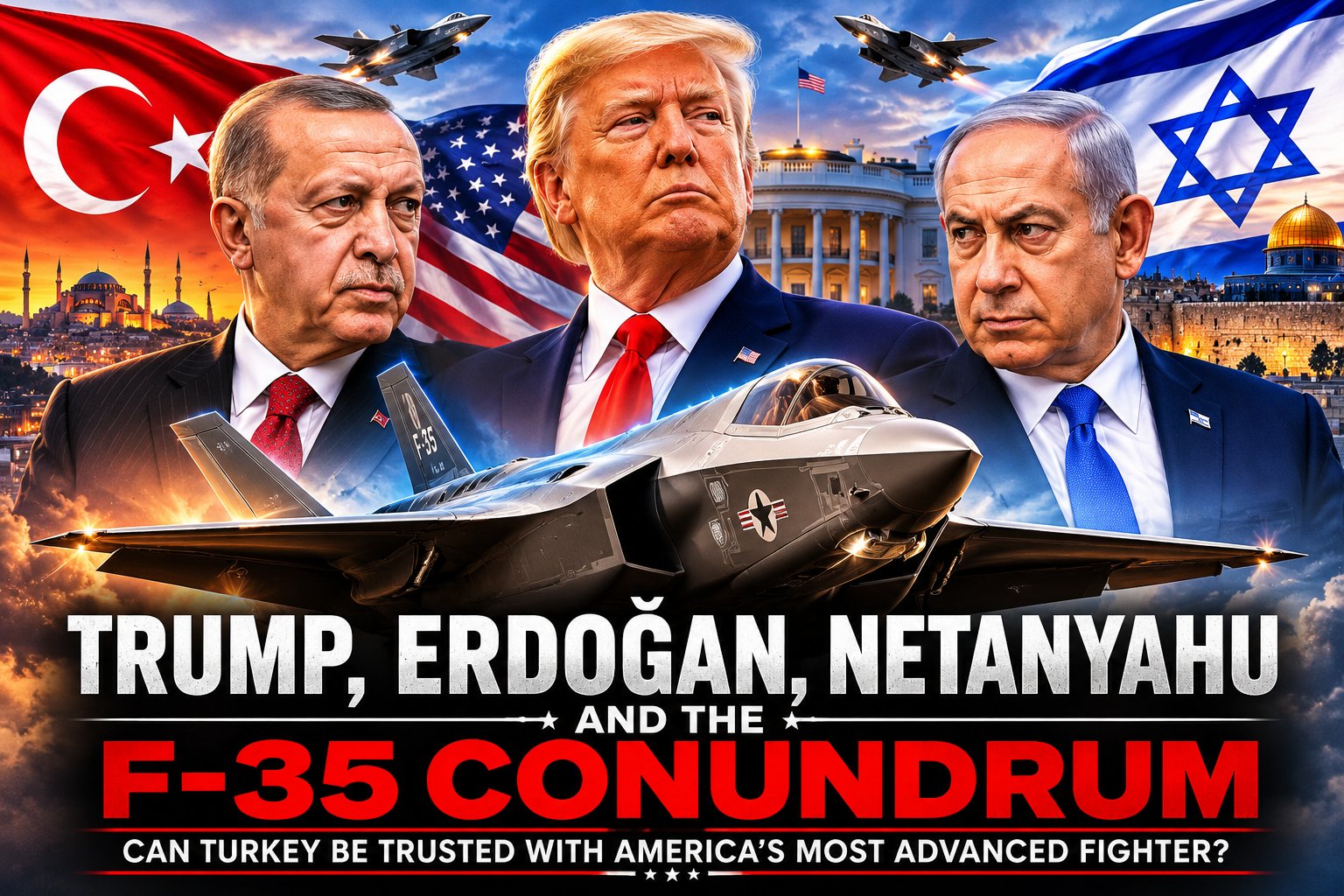
Can Turkey Be Trusted With the F-35?
That depends largely on which strategic risks policymakers consider most important.
Those opposing the sale argue:
Turkey still possesses Russian S-400 systems.
- Ankara has pursued an increasingly independent foreign policy that sometimes conflicts with U.S. interests.
- Relations with Israel have deteriorated sharply.
- Turkey has periodically threatened fellow NATO allies.
The F-35 contains some of America’s most sensitive military technology.
Supporters counter that:
Turkey remains a treaty ally within NATO.
- Keeping Turkey integrated into Western defense systems reduces Russian and Chinese influence.
- The United States retains significant leverage through software updates, logistics, spare parts and maintenance support.
Rebuilding military cooperation could strengthen NATO’s cohesion during heightened tensions with Russia.
Who Has the Stronger Argument?
The answer depends on the strategic objective. If the priority is protecting sensitive military technology and preserving Israel’s regional military advantage, Netanyahu’s concerns align with long standing Pentagon assessments that originally led to Turkey’s removal from the F-35 program. If the priority is rebuilding relations with a strategically important NATO ally and preventing Ankara from drifting further toward Moscow or Beijing, Trump’s approach reflects a broader geopolitical calculation.
Neither position is without risk. Approving the sale could reignite concerns over technology security and regional stability. Rejecting it could deepen Turkey’s estrangement from the Western alliance and encourage greater defense cooperation with America’s principal strategic competitors.
The dispute highlights a broader challenge facing U.S. foreign policy. Washington increasingly finds itself balancing military technology, alliance politics and regional security in an era where allies do not always share the same strategic priorities. For Israel, the issue centers on maintaining military superiority in a volatile region. For Turkey, it is about restoring its place within NATO’s premier defense program. For Trump, it appears to be another test of whether transactional diplomacy can repair fractured alliances without compromising America’s technological edge.
Whether the administration ultimately follows through on restoring Turkey’s access to the F-35 program could become one of the most consequential defense policy decisions of Trump’s second presidency, with implications reaching far beyond Ankara, Jerusalem and Washington.
















































Want to join the conversation?
Create an account or sign in to share your thoughts, vote,
and reply to other readers.
Showing 0 of 0 comments
Don't have an account?
Already have an account?