
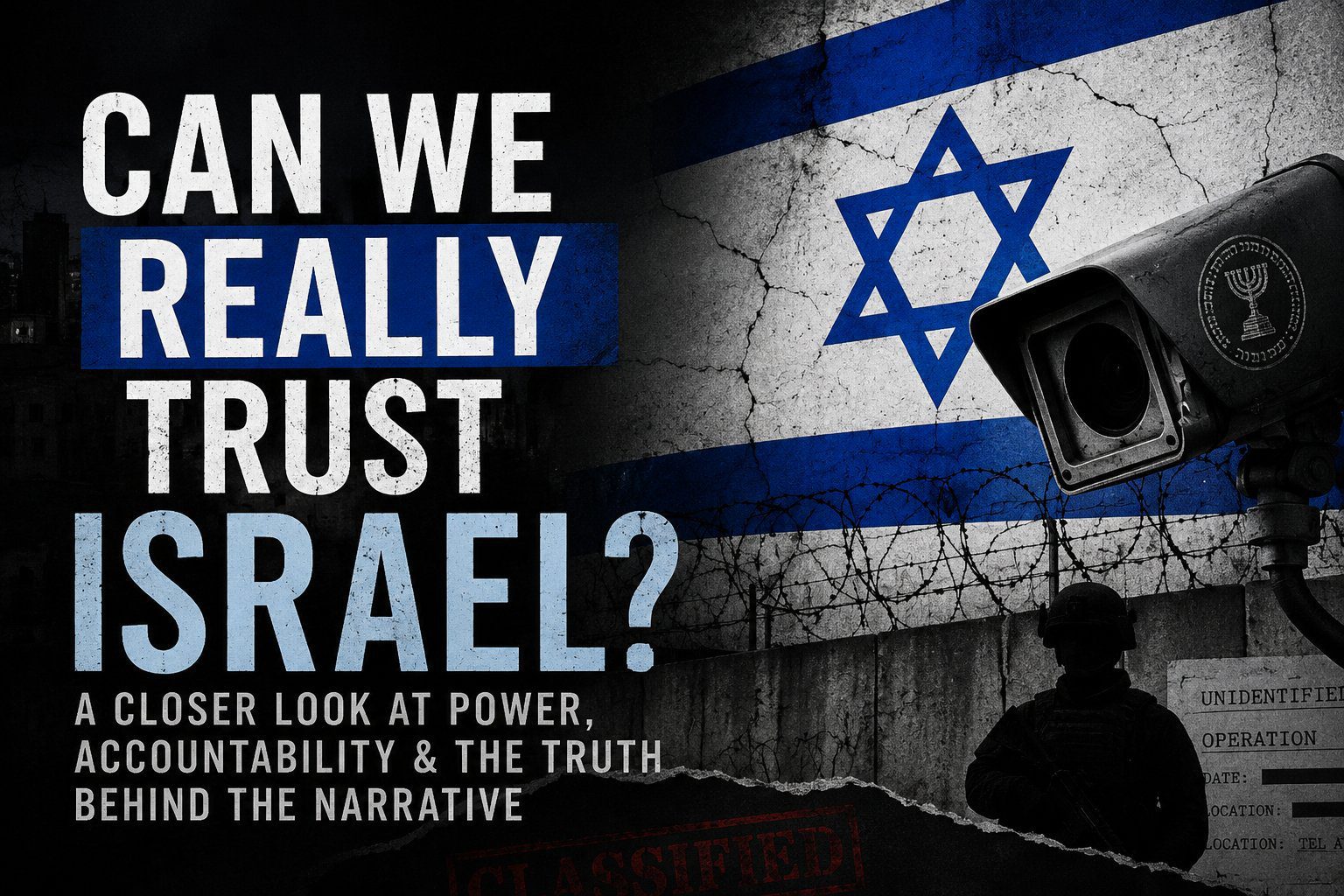
A Nation Built On Fear…
To understand Israel, Americans must first understand fear…
Not ordinary fear. Not the kind created by elections, economic downturns, or political instability. Israel was born from one of the greatest atrocities in human history. The Holocaust did not simply shape the Jewish state, it is woven into its national DNA. The memory of six million murdered Jews remains a living force in Israeli politics, military planning, education, and culture.
For many Israelis, history delivered a lesson that can never be forgotten: when Jews depend on others for protection, disaster follows.
That lesson became even more deeply ingrained after Israel fought multiple wars against neighboring states that openly questioned its right to exist. From the War of Independence to the Yom Kippur War, generations of Israelis grew up believing their country could disappear if it ever lowered its guard. The result is a national mindset unlike that of most Western democracies.
While Americans generally assume tomorrow will look much like today, many Israelis have spent generations hearing that tomorrow could bring another existential crisis. Whether that fear is justified or exaggerated is almost beside the point. What matters is that millions of Israelis, including many of their leaders, genuinely believe it. Fear changes how nations behave. It encourages secrecy. It rewards aggressive intelligence gathering. It prioritizes military strength over diplomatic restraint. It creates a willingness to take actions that outsiders may view as extreme but that insiders view as necessary. This does not excuse controversial decisions or place them beyond criticism. It does, however, help explain why Israel often approaches the world differently than its allies.
Understanding that difference is the first step toward answering a difficult question: when does survival become security, and when does security become justification for anything?
When Allies Operate Without Accountability: The Cases That Continue to Haunt Israel’s Reputation
For decades, Israel has presented itself to the world as a democratic ally committed to Western values, human rights, and the rule of law. It is a nation born from tragedy, built upon the promise that persecution and injustice would never again be tolerated. Yet critics argue that a growing body of evidence tells a more complicated story.
From controversial military operations and intelligence activities to allegations of extraterritorial assassinations, surveillance, and the deaths of journalists, a series of incidents have fueled an uncomfortable question: If these actions were carried out by nations considered adversaries of the United States, would Americans view them differently? The debate is no longer confined to activists or geopolitical rivals. It now includes former intelligence officials, human rights organizations, journalists, international investigators, and even some of Israel’s closest allies.
The Death of Shireen Abu Akleh
Few cases illustrate this controversy more clearly than the killing of Palestinian American journalist Shireen Abu Akleh.
On May 11, 2022, Abu Akleh was covering an Israeli military operation in the Jenin refugee camp. Wearing clearly marked press gear and standing alongside other journalists, she was fatally shot by a round that numerous independent investigations later concluded likely originated from Israeli military positions. The incident immediately became the subject of competing narratives.
Initial Israeli statements suggested Palestinian militants may have been responsible. Subsequent forensic examinations, media investigations, and international reviews increasingly pointed toward Israeli forces. Months later, Israel acknowledged a “high possibility” that one of its soldiers had fired the fatal shot but maintained the killing was accidental and declined to pursue criminal charges.
The controversy only intensified during Abu Akleh’s funeral. Images broadcast worldwide showed Israeli police charging mourners and striking pallbearers carrying her casket, nearly causing it to fall to the ground. The footage became one of the defining images of the conflict and further damaged Israel’s standing among press freedom advocates. To this day, no individual has been criminally charged for her death.
A History of Intelligence Operations Beyond Borders
Israel’s intelligence services are widely regarded as among the most capable in the world. The Mossad has earned a reputation for conducting daring operations across multiple continents, including the capture of Nazi war criminal Adolf Eichmann in Argentina, sabotage campaigns targeting hostile weapons programs, and operations aimed at preventing adversaries from acquiring advanced military capabilities.
Supporters view these actions as necessary for national survival in a hostile region. Critics see something else: a pattern of behavior that often appears willing to ignore international norms, foreign sovereignty, and diplomatic consequences whenever Israeli security interests are involved.
Over the years, numerous governments have accused Israeli intelligence services of conducting covert operations on foreign soil without authorization. Some incidents have sparked diplomatic crises, including allegations of forged passports, unauthorized surveillance, and clandestine activities within allied nations. While many operations remain classified or disputed, the perception that Israel often operates according to its own rules has become deeply embedded in intelligence circles.
The Uneasy Relationship With American Intelligence
Despite being close allies, the United States and Israel have not always trusted one another behind closed doors. The most famous example remains the Jonathan Pollard espionage case. Pollard, a U.S. Navy intelligence analyst, was convicted of spying for Israel after passing large quantities of classified American intelligence to Israeli handlers. The scandal shocked Washington and permanently altered how many within the U.S. intelligence community viewed Israel.
Former intelligence officials have repeatedly noted that Israel, like many nations, actively gathers intelligence even against its allies. Stories from intelligence circles have long circulated describing the intensity of this shadow conflict. Among the most infamous is an anecdote involving a CIA station chief in Tel Aviv whose family dog was allegedly mutilated by having its tail cut off after unknown intruders breached a secure residence.
The story has never been fully verified publicly. Yet its persistence reflects something important: the extent to which intelligence professionals themselves have viewed the relationship as far more adversarial than the public often realizes. Whether entirely factual or partially embellished through decades of retelling, the tale survives because it captures a broader reality of espionage: allies spy on allies, and intelligence services frequently operate according to a different set of rules than those publicly proclaimed by governments.
Democracy, Religion, and Power
Perhaps the most difficult question raised by critics is not whether controversial actions occurred. It is whether those actions are judged differently because of who committed them. Israel frequently emphasizes its democratic institutions, independent judiciary, and religious heritage when defending its place among Western nations. Those characteristics are real and important.
But critics argue that democratic values are measured not by rhetoric but by accountability. When journalists die without prosecutions, when intelligence operations cross international boundaries, when military investigations conclude without consequences, and when allies refuse outside scrutiny, questions naturally emerge about whether stated values align with actual conduct. No nation is judged solely by its ideals. Nations are judged by what they do when nobody is watching and by how they respond when the world is.
The Larger Question
The issue is not whether Israel has a right to defend itself. Every nation does. The issue is whether any nation should be exempt from the standards it demands of others. If transparency, accountability, freedom of the press, and respect for international law are universal principles, they must apply equally to friends and adversaries alike. That is ultimately why cases like Shireen Abu Akleh continue to resonate years later. They are not merely about one journalist, one military operation, or one country. They are about whether power itself is ever truly held accountable. And that remains one of the defining questions of modern geopolitics.
Survival, Exceptionalism, and the Difficult Reality of Alliance
Perhaps the most uncomfortable aspect of the Israeli question is that many of the country’s most controversial actions make perfect sense when viewed through the lens of how Israeli leaders see the world. Israel was founded in the shadow of the Holocaust and surrounded by hostile neighbors. Generations of Israeli political and military leaders have grown up believing that the ultimate responsibility of the state is not merely prosperity or diplomacy, but survival itself. In their view, failure is not measured in elections or policy mistakes. Failure means national extinction.
Critics argue that this worldview has produced a doctrine unlike that of most Western democracies. When leaders believe the very existence of their nation is perpetually at stake, actions that might otherwise be viewed as unacceptable can become justified in the name of security. Supporters of Israel see this as realism. Critics see it as a dangerous form of exceptionalism. The debate extends far beyond military operations. Historians continue to point to incidents such as the Jonathan Pollard espionage affair and allegations that Israeli intelligence aggressively pursued American nuclear and military secrets during the Cold War. To many Israelis, obtaining every possible strategic advantage was viewed as necessary insurance in an unforgiving region. To many Americans, it represented an ally willing to spy on its closest partner when it believed its own interests required it.
Religion further complicates the picture. Israel is a modern democracy, but it is also a state whose history and identity are deeply intertwined with ancient religious traditions. While most Israelis are secular or politically diverse, some nationalist and religious movements view the land of Israel through a biblical lens, believing the Jewish people have a unique historical and spiritual claim to territory throughout the region. Critics worry that when a nation combines a belief in existential threat with a belief in divine destiny, the result can be extraordinarily difficult to restrain. History offers countless examples of religion and fear amplifying one another, often producing outcomes that would be unacceptable under ordinary circumstances.
That does not mean Israelis are uniquely immoral. Far from it. Millions of Israelis share the same hopes, fears, values, and aspirations as ordinary Americans. They want security for their families, opportunity for their children, and peace with their neighbors. The challenge lies not in the character of individual Israelis but in the incentives created by the system itself.
A nation that believes it is constantly fighting for survival will often justify actions that others would reject. A nation that believes it possesses a unique historical mission may be more willing to accept risks and consequences others would avoid. That combination, whether justified or not, has shaped Israeli policy for decades. It is also why Israel will likely remain one of America’s most complicated allies. The relationship is built on genuine shared interests and democratic values. Yet it is also marked by recurring tensions, intelligence disputes, conflicting priorities, and fundamentally different perceptions of risk. The question is not whether Israel is friend or foe. The answer is clearly friend. The question is whether Americans fully understand how differently Israeli leaders often view the world, and what that difference means when the interests of the two nations no longer perfectly align.



















































Want to join the conversation?
Create an account or sign in to share your thoughts, vote,
and reply to other readers.
Showing 0 of 0 comments
Don't have an account?
Already have an account?