
Hong Kong Just Opened Convenience Stores Run by Humanoid Robots… Is This the Future For the World?
Hong Kong has officially taken another step toward the future, and this time the future is selling you snacks. Beijing-based robotics company Galbot has opened three fully autonomous convenience stores in Hong Kong, marking the company’s first expansion outside mainland China. The stores are located at the Hung Hom waterfront, Wan Chai waterfront and Kai Tak Sports Park, with two operating outdoors and one located indoors.
And these aren’t convenience stores where a human employee sits in the back somewhere waiting to take over when the robot gets confused. The stores are designed to be operated by humanoid robots, with a robot known as Xiao Gai handling the customer interaction, retrieving products and completing the transaction. Customers place their orders at a screen or interact with the robot, make their payment using options including cards, WeChat, Alipay or China UnionPay, and then watch as the robot goes to retrieve their purchase. The robot can also communicate with customers in Cantonese, Mandarin and English.
So basically, you walk into a store, tell a robot you want something, pay for it and wait for another machine to hand it to you. Humanity spent thousands of years developing civilization for this moment.
We Can Finally Have a Robot Hand Us a Pineapple Bun
The South China Morning Post sent reporter Llewellyn Cheung inside one of the stores to see what the experience was actually like. The resulting video shows a retail environment that feels less like a traditional convenience store and more like someone dropped a piece of a science-fiction movie onto a Hong Kong sidewalk. The stores sell snacks, drinks and other products, including merchandise inspired by Hong Kong favorites such as pineapple buns and egg tarts. Prices reportedly range from about HK$14 to HK$139, or roughly US$1.79 to US$17.73.
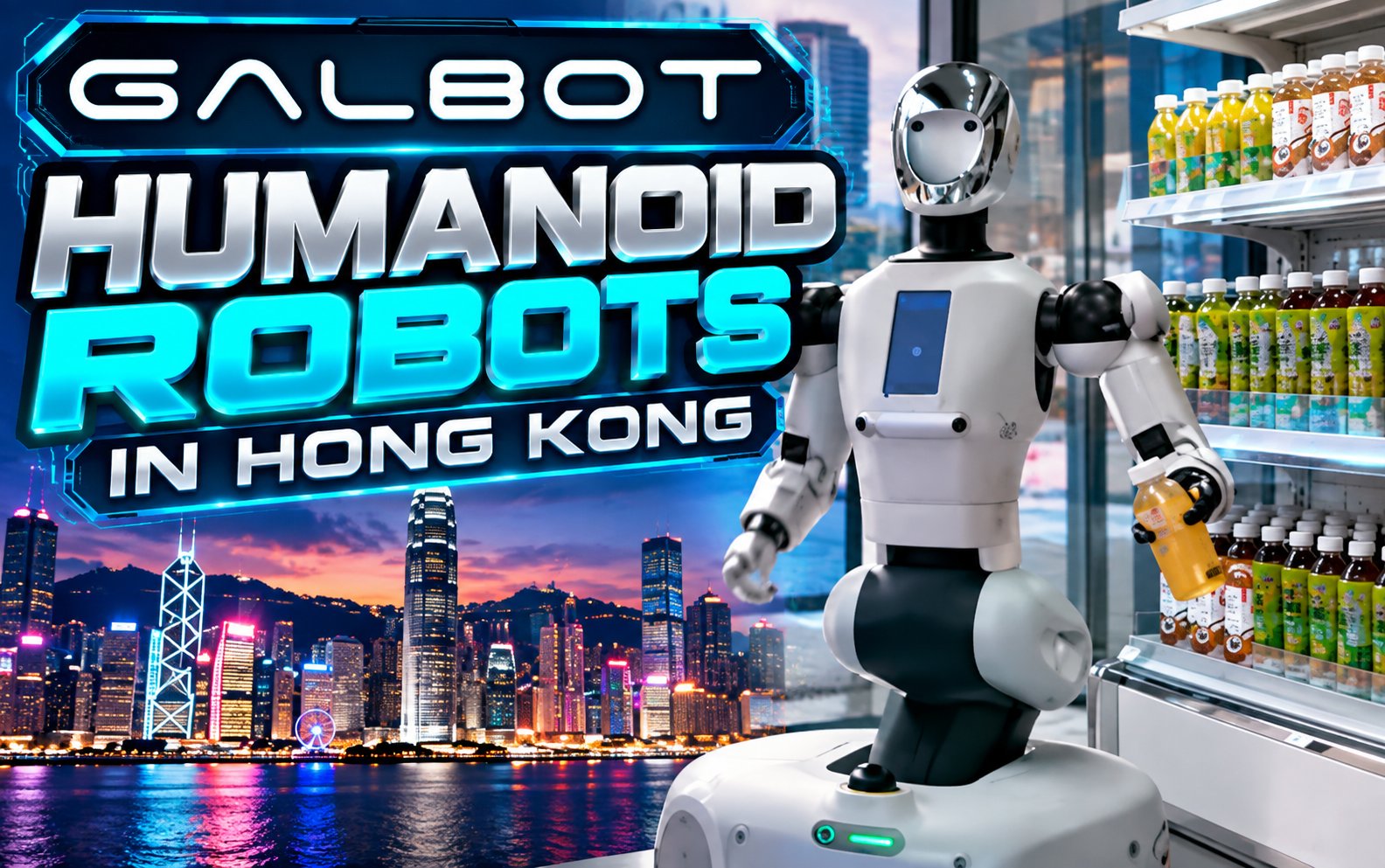
The robot itself is not exactly a tiny Roomba with a barcode scanner taped to it. The G1 humanoid used by Galbot is approximately 173 centimeters tall, or about 5 feet 8 inches, and was designed to perform tasks including retrieving products, stocking shelves and interacting with customers. Galbot says its retail technology isn’t just a fancy demonstration designed to make people stop and take pictures. The company already has around 200 robot-operated retail locations across nearly 50 cities in mainland China, meaning the Hong Kong stores represent an expansion of a system that has already been used commercially.
It is Far From Perfect as the Kinks Get Worked Out
There were, however, a few reminders that we haven’t quite reached the flawless futuristic society promised by science fiction. On the first day of operation, heavy rain and internet outages caused problems at the Hong Kong locations. Because apparently even the robot revolution has to deal with crappy Wi-Fi and Florida-level weather problems.
Customers nevertheless appeared fascinated by the technology. Some interacted with the robot, watched it perform tasks and even asked it to sing or entertain them. One shopper told Reuters that the experience was surprising and made him wonder what technology might look like five years from now. Another customer said the robot still seemed limited when confronted with unexpected situations.
And that’s probably the most interesting part of this entire experiment. The impressive thing isn’t that a robot can pick up a bottle of water. The impressive thing is that companies are increasingly trying to teach machines how to operate in the unpredictable real world instead of keeping them locked inside controlled laboratories.
Galbot’s founder and chief technology officer, Wang He, has said the company wants the technology to eventually handle increasingly complex instructions and tasks. The company has also discussed applications beyond retail, including manufacturing, education, culture, public services and eventually household environments.
That’s where things get interesting. Today, the robot is handing you a drink. Tomorrow, it could be stocking an entire store. Then it could be working in a warehouse, assisting in a factory, helping in a restaurant or performing tasks inside someone’s home.
At some point, the question stops being whether humanoid robots can perform useful jobs and becomes a much more complicated question: How many jobs will humans still be doing once robots become good enough to perform them cheaper, faster and around the clock?
We’re obviously not there yet. These machines still have limitations, and the Hong Kong rollout demonstrated that pretty clearly. But the technology is moving out of the laboratory and into ordinary public spaces. That makes these three little convenience stores more significant than they might initially appear. They’re not just places to buy snacks. They’re another experiment in figuring out what happens when artificial intelligence gets a body, wheels, arms, cameras and a job. And considering how humans usually handle powerful new technology, let’s hope we remember to read the instruction manual this time.

















































Want to join the conversation?
Create an account or sign in to share your thoughts, vote,
and reply to other readers.
Showing 0 of 0 comments
Don't have an account?
Already have an account?