
SFL.MEDIA Takes You Inside Florida’s First Super Tall Tower
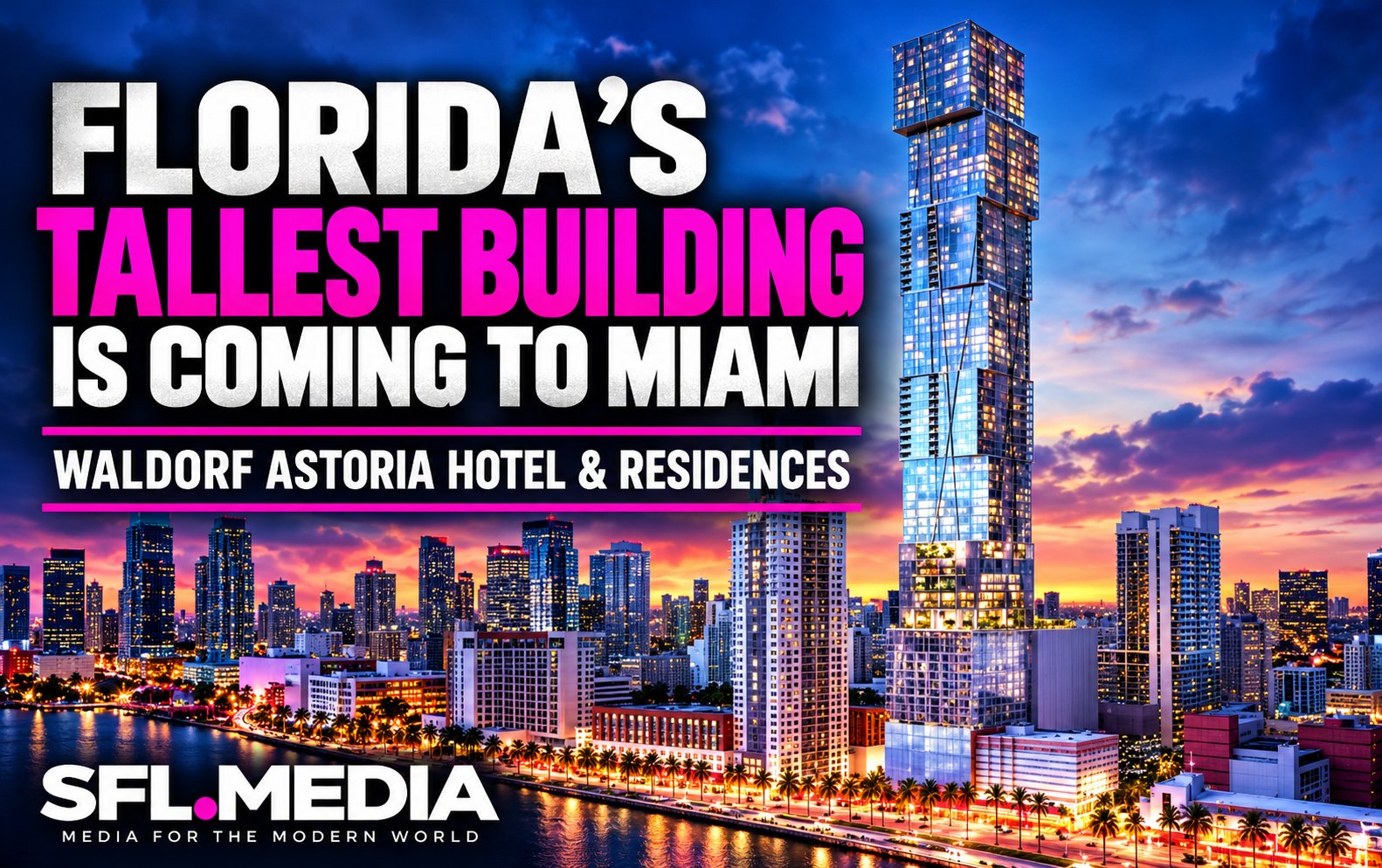
Miami is taking its skyline to an entirely new level, and this time, the competition isn’t just about luxury condos or another rooftop swimming pool. A massive skyscraper rising in downtown Miami is poised to become Florida’s first true super tall building, bringing a world famous hotel brand, hundreds of luxury residences, and a new standard of high-end living to South Florida. The project is the Waldorf Astoria Hotel & Residences Miami, a 100 story tower designed to rise approximately 1,049 feet above Biscayne Boulevard. Developed by Property Markets Group (PMG) and its partners, the skyscraper is expected to become Miami’s tallest building when completed, with an anticipated opening in 2028.
But what exactly is being built inside this enormous structure, who is paying for it, and why is Miami suddenly competing to construct some of the tallest buildings in the country? The answers reveal quite a bit about the direction of South Florida’s real estate market and the growing appetite for luxury developments.
What Is the Building Actually For?
The Waldorf Astoria Miami is a mixed use luxury development, meaning it combines private residences, hotel accommodations, restaurants, and hospitality amenities within one enormous tower. The project is planned to include 387 private residences and 205 hotel rooms and suites, creating a combination of luxury housing and upscale accommodations for visitors. The residential units are being marketed toward affluent buyers seeking expansive views of downtown Miami, Biscayne Bay, Miami Beach, and the Atlantic Ocean. Depending on the unit, residents can expect high end finishes, concierge services, exclusive lounges, and access to hotel style amenities. The development is designed to appeal to buyers who want the convenience of a luxury hotel combined with the privacy and ownership benefits of a condominium.
The hotel portion will operate under Hilton’s prestigious Waldorf Astoria brand, bringing the company’s luxury hospitality experience to downtown Miami. Planned amenities include swimming pools, private cabanas, a spa, fitness facilities, restaurants, bars, meeting spaces, and dedicated services for residents and hotel guests. The residential and hotel components will function as distinct but connected parts of the property, allowing owners to enjoy luxury services while hotel guests receive the hospitality experience associated with the Waldorf Astoria name. In other words, this is not simply another condominium building. It is an attempt to create a destination where wealthy residents, international travelers, business executives, and luxury tourists can live, stay, dine, and socialize without having to venture far beyond the property.
Who Is Building It?
The development is being led by Property Markets Group, commonly known as PMG, a real estate development company with a significant presence in South Florida. PMG has partnered with several investment and hospitality firms to bring the ambitious project to life, including Greybrook Realty Partners, Mohari Hospitality, and S2 Development. Hilton is the global hospitality company behind the Waldorf Astoria brand, while the architectural design combines the work of renowned architect Carlos Ott and Miami based Sieger Suarez Architects. Interior design is being handled by BAMO, and John Moriarty & Associates is serving as the general contractor.
The involvement of internationally recognized companies is significant. The developers are not simply trying to build a tall structure. They are creating a branded luxury property intended to compete with high end residential and hotel developments in major global cities. The Waldorf Astoria name is a major part of the project’s appeal. For wealthy buyers, the attraction extends beyond the physical apartment itself. The brand offers an association with luxury hospitality, personalized services, and an established international reputation. That combination can help developers command premium prices in a competitive real estate market.
The $1.2 Billion Price Tag and Who Is Financing the Project
The reported total cost of the development is approximately $1.2 billion, placing it among the most ambitious real estate projects in Florida. Financing on this scale requires substantial capital, and the developers have secured a major construction loan to help fund the project. In June 2024, PMG and its partners announced a $668 million construction loan from Bank OZK and Related Fund Management. At the time, the financing was described as the largest construction loan for a residential condominium development in Florida’s history.
It is important to distinguish the construction loan from the total project cost. The $668 million represents financing provided for construction, while the $1.2 billion figure reflects the reported overall cost of the development. The project’s broader financial structure involves its development partners, investors, and anticipated revenue from residential sales and hotel operations. The business model is relatively straightforward. Buyers purchase private residences, while the hotel generates revenue through room bookings, restaurants, bars, events, and other hospitality services. The developers are betting that wealthy buyers and luxury travelers will continue to pay a premium for a prestigious address in downtown Miami.
That is a substantial bet, but Miami has spent years attracting wealthy domestic and international buyers who view South Florida as a desirable place to live, invest, and conduct business.
Why Does the Building Look Like a Stack of Glass Cubes?
One of the most recognizable features of the Waldorf Astoria Miami is its unusual architectural design. Rather than following the conventional rectangular shape of a typical skyscraper, the tower is designed as nine glass volumes stacked vertically, with individual sections offset from one another. The concept was developed by Carlos Ott in collaboration with Sieger Suarez Architects. The result is a sculptural silhouette that resembles enormous glass boxes balanced above one another, creating a distinctive profile against the Miami skyline. The design is intended to make the building instantly recognizable from downtown, Biscayne Bay, and the surrounding waterfront. The extensive use of glass also allows for expansive views from the residences and hotel spaces.
However, building a tower more than 1,000 feet tall involves far more than creating an attractive architectural rendering. Engineers must account for substantial wind forces, structural loads, elevator systems, building movement, fire protection, and the complicated logistics of constructing upper floors hundreds of feet above street level. The tower’s planned height is approximately 1,049 feet above sea level, while its structure rises roughly 1,040 feet above ground level under the applicable height determination. That puts it comfortably within the category of super tall skyscrapers, which are conventionally defined as buildings reaching at least 300 meters, or approximately 984 feet.
Where Is the Waldorf Astoria Miami Located?
The skyscraper is located at 300 Biscayne Boulevard in downtown Miami, near Northeast Third Street and directly across from Bayfront Park. The location places it near Biscayne Bay, the city’s commercial district, restaurants, entertainment venues, and waterfront attractions. Bayside Marketplace and other popular destinations are also nearby, making the site attractive for hotel guests and residents who want access to downtown Miami’s restaurants, nightlife, shopping, and cultural activities.
The location is central to the project’s appeal. Rather than developing another luxury property in a suburban setting, the developers are targeting buyers who want to live in the middle of Miami’s urban environment. For international visitors, the downtown location also provides access to the city’s business district, cruise related tourism, and entertainment destinations. As Miami continues to develop its downtown waterfront, projects like the Waldorf Astoria are helping transform the area into a more prominent destination for luxury residential living and high end hospitality.
When Will It Be Finished?
Construction on the Waldorf Astoria Miami began in 2022, and the tower has progressed through its vertical construction phase. By August 2026, reports indicated that crews had begun working on the ninth and final glass cube section, with the concrete structure reaching approximately the 85th floor. The anticipated completion date is in 2028, with reports in August pointing to a target around June of that year. As with any major construction project, schedules can change because of construction logistics, financing, labor availability, inspections, and other complications.
When completed, the building is expected to become the tallest skyscraper in Miami and the first building in Florida to meet the conventional definition of a super tall tower. It would represent a significant milestone for the state’s architecture and real estate development industries. Of course, Miami has never been particularly shy about making ambitious promises when it comes to real estate. The ultimate test will be whether the finished building lives up to the vision presented in the glossy architectural renderings.
Is Miami Entering a Skyscraper Arms Race?
The Waldorf Astoria is part of a much broader wave of high rise development reshaping Miami’s skyline. Developers are pursuing increasingly ambitious projects aimed at luxury buyers, international investors, corporate tenants, and travelers seeking upscale accommodations. Another proposed project, Delano Residences Miami, is planned for 400 Biscayne Boulevard, near the Waldorf Astoria site. Developed by PMG in partnership with Ennismore, the project has been planned as a 90 story tower approximately 985 feet tall, with 421 residences and a public observation deck. Its final height and completion remain subject to the development process.
Meanwhile, Citadel has been developing plans for a major headquarters tower in Miami’s Brickell financial district, also expected to reach approximately 1,049 feet. Other proposed projects throughout downtown and Brickell could further change the city’s skyline, although their construction schedules and eventual completion remain uncertain. A super tall building is conventionally defined as a structure at least 984 feet tall. For decades, buildings of this scale were associated primarily with places such as New York, Chicago, Dubai, Hong Kong, and other major international cities. Miami’s move into this category reflects the city’s growing ambition to establish itself as a major global center for business, finance, tourism, and luxury real estate.
The competition is not just about bragging rights. A signature skyscraper can help attract international attention, strengthen a city’s identity, and give developers a distinctive selling point. In a market where multiple luxury towers are competing for the same pool of affluent buyers, height and architectural design can become powerful marketing tools.
What Does This Mean for Miami?
There is little doubt that the Waldorf Astoria Miami will be a major architectural achievement if it is completed as planned. It will introduce a globally recognized luxury hotel brand to downtown Miami, add hundreds of private residences, and establish a new landmark on the city’s waterfront. The project will also generate construction activity and support employment across multiple industries, from engineering and building trades to hospitality, maintenance, and food service. Once operational, the hotel and its associated restaurants and amenities could contribute to Miami’s tourism economy.
But the development also raises a larger question about the direction of South Florida’s real estate market. Luxury towers can attract investment, generate tax revenue, and strengthen a city’s international profile. At the same time, they can reinforce a development model that prioritizes high income buyers while ordinary residents continue to face expensive housing, insurance costs, traffic congestion, and other affordability challenges. A billion dollar skyscraper does not automatically make a city more affordable, improve its transportation system, or solve its infrastructure problems. Those outcomes depend on how the broader community develops around these projects and whether the benefits of economic growth extend beyond the luxury market.
For Miami, the Waldorf Astoria represents both ambition and a bet on the future. Its developers are betting that wealthy buyers and international travelers will continue paying a premium to live in, visit, and invest in South Florida. The project’s scale suggests that they believe demand for high end real estate and hospitality will remain strong. The larger question is whether the city can balance that investment with the needs of the people who live and work there every day.



















































Want to join the conversation?
Create an account or sign in to share your thoughts, vote,
and reply to other readers.
Showing 0 of 0 comments
Don't have an account?
Already have an account?