
Hope Florida’s $10 Million Scandal: DeSantis Appointed Judge Orders Grand Jury Findings Erased as Florida’s Political Money Trail Faces New Scrutiny
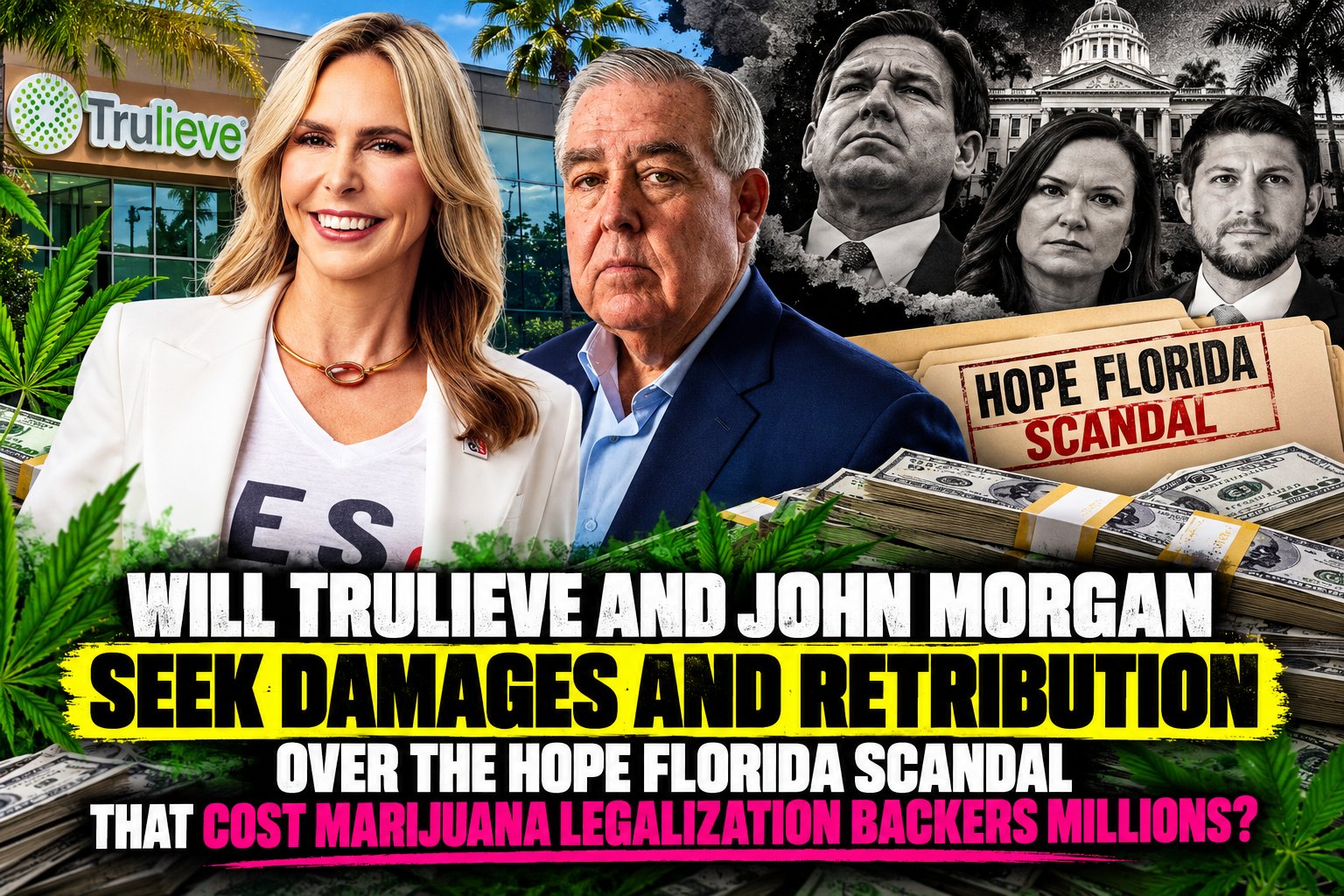
A $67 million healthcare settlement, a $10 million payment to a foundation associated with Florida’s first lady, and $8.5 million routed into a political committee opposing marijuana legalization have triggered a major controversy over public money, political influence, and judicial accountability. Now, an appellate ruling ordering a grand jury report expunged has intensified scrutiny of Governor Ron DeSantis, Attorney General James Uthmeier, U.S. Senator Ashley Moody, and Judge Lance Neff.
The Hope Florida controversy has entered a consequential new chapter, moving beyond questions about how millions of dollars connected to a healthcare settlement reached political organizations and into a dispute over whether the public will be permitted to examine the findings of a grand jury that investigated the transactions. What began as a controversy involving a charitable foundation associated with Florida First Lady Casey DeSantis has developed into a broader examination of government accountability, political financing, and the independence of Florida’s judicial system.
On October 7, 2026, Florida’s First District Court of Appeal ordered the expungement of a Leon County grand jury report that had concluded $10 million in settlement proceeds were misappropriated. The appellate opinion, written by Judge Lance Neff, rejected significant portions of the grand jury’s legal reasoning and determined that the report improperly accused private individuals of wrongdoing without criminal indictments. The ruling came approximately seven months after Governor Ron DeSantis appointed Neff to the appellate court and less than nine months after the grand jury completed its investigation.
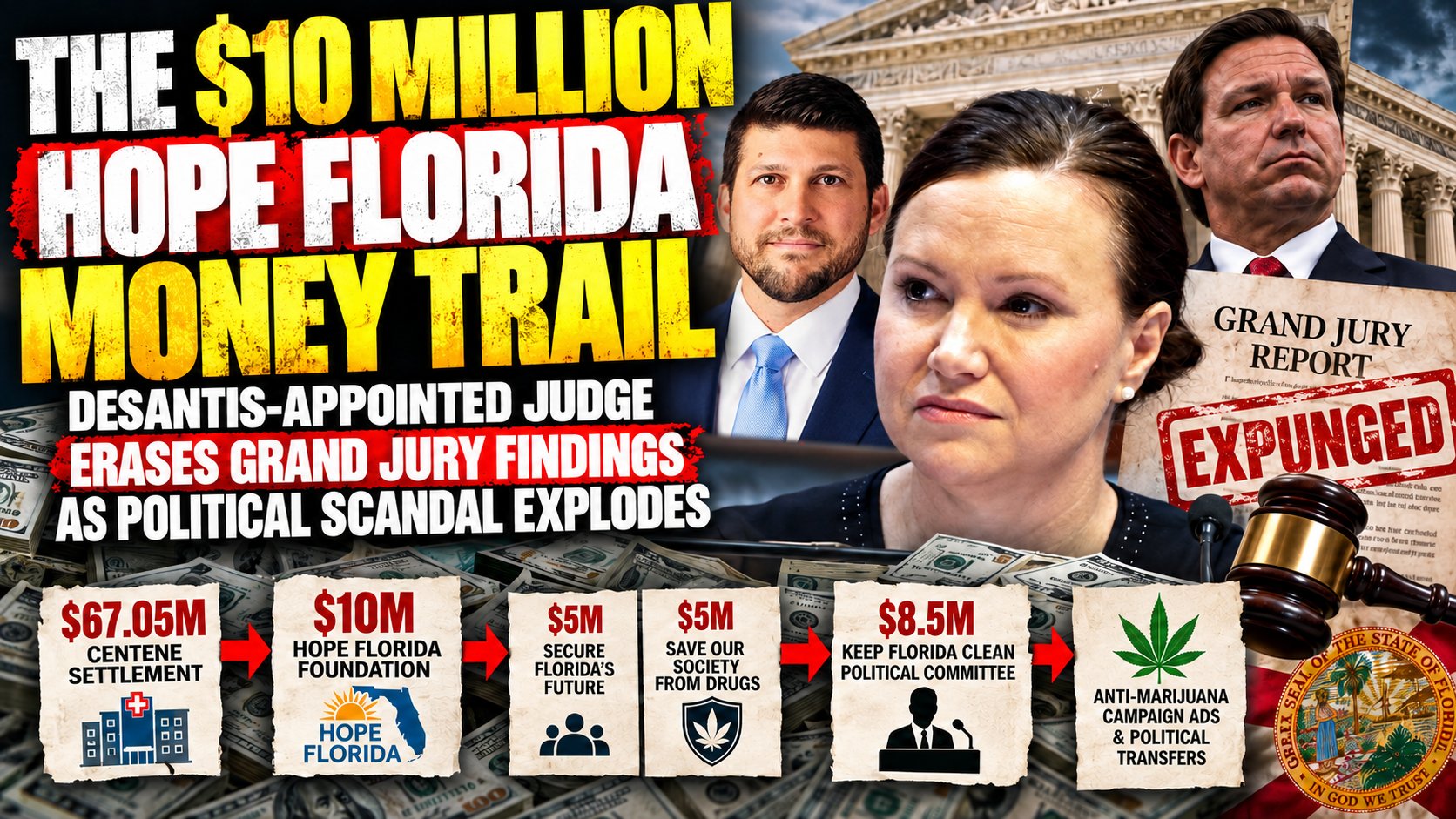
The underlying financial transactions are substantial even without the grand jury’s disputed legal conclusions. In September 2024, health insurance company Centene agreed to a settlement totaling approximately $67 million to resolve allegations involving overpayments connected to Florida’s Medicaid program. The agreement directed approximately $57 million to the state and a separate $10 million payment to the Hope Florida Foundation, the fundraising organization associated with an assistance initiative championed by Casey DeSantis. Within weeks, the foundation awarded two $5 million grants to nonprofit organizations, which subsequently transferred $8.5 million to Keep Florida Clean, a political committee chaired by then DeSantis chief of staff James Uthmeier. The committee was working to defeat Florida’s 2024 recreational marijuana amendment, a measure that ultimately received majority voter support but failed to reach the 60% required for adoption.
The grand jury concluded that taxpayer money had been misused for political purposes but did not indict anyone, explaining that investigators could not establish who specifically authorized the disputed arrangement. The appellate court subsequently disagreed with the grand jury’s characterization of the money and its authority to make certain accusations. Those competing conclusions now sit at the center of a government accountability dispute involving settlement negotiations, nonprofit grants, political campaign financing, and the judiciary’s authority to restrict publication of grand jury findings.
The $67 Million Settlement and the $10 Million Payment to Hope Florida
The controversy originated in negotiations between Florida officials and Centene Corporation, a major healthcare company accused of overcharging the state’s Medicaid program. The settlement, finalized September 27, 2024, required Centene to pay approximately $67.05 million, but the agreement separated the proceeds into two destinations. Florida’s Agency for Health Care Administration would receive approximately $57.05 million, while the Hope Florida Foundation would receive $10 million as a designated third party payment. The arrangement immediately created a significant legal and financial distinction between money paid directly to the state and money directed to a nonprofit organization closely associated with the governor’s signature family assistance initiative.
That distinction is central to the legal dispute. DeSantis administration officials have argued that the $10 million represented a separate private donation negotiated as part of the settlement rather than public money diverted from the state. The grand jury reached a different conclusion, treating the payment as money arising from a state negotiated settlement that should not have been redirected for political purposes. Independent legal experts have questioned the administration’s characterization, particularly because the state reportedly calculated the federal government’s share of the settlement using the full $67 million. The disagreement is not simply about which bank account received the money, but whether the state had a legal claim to the proceeds and whether directing part of the settlement to a foundation complied with the applicable requirements.
The negotiations themselves raise additional questions about how the foundation became part of the agreement. According to reporting based on documents and grand jury testimony, a September 10, 2024, briefing at the governor’s office included the Centene settlement, but an early draft contained no Hope Florida payment. A revised draft the following day added a $5 million donation to the foundation, and another revision less than 48 hours later doubled that figure to $10 million. The final agreement also gave the foundation an accelerated payment schedule: Centene had seven days to deliver the $10 million, while the state had 45 days to receive its first installment and up to a year to receive the balance.
The timing matters because Florida was approaching a consequential statewide election, with Governor DeSantis actively opposing a constitutional amendment that would legalize recreational marijuana for adults. The documents establish that the foundation payment was added late in the settlement negotiations and that the money moved rapidly afterward. They do not, by themselves, establish who conceived the arrangement or whether the participants shared an unlawful purpose. Nevertheless, the unusual payment structure and subsequent transfers make the decision-making process behind the settlement an important subject for public examination.
Following the Money: From Healthcare Settlement to Political Campaigns
The documented flow of the $67.05 million settlement.
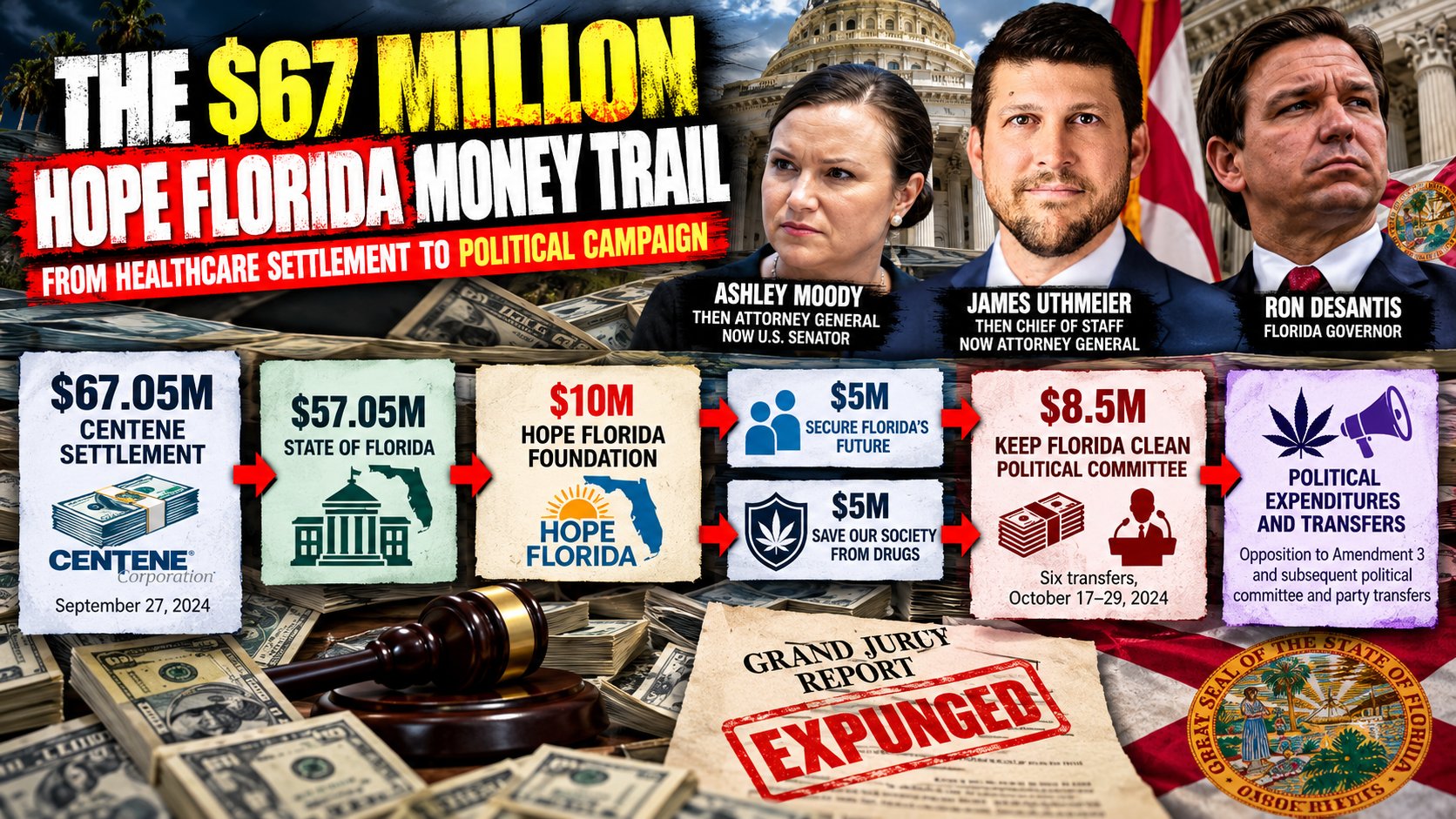
Six transfers, October 17–29, 2024
Political expenditures and transfers
Opposition to Amendment 3 and transfers to other political organizations
Settlement and subsequent transfers reported through investigative records. The $8.5 million represents contributions to Keep Florida Clean, not a finding that every dollar was spent directly on anti-marijuana advertisements.
The movement of the money after it reached Hope Florida provides the clearest evidence of how funds connected to a healthcare settlement became political resources. Centene wired the foundation $10 million on October 4, 2024. Within 18 days, the foundation had awarded two $5 million grants, one to Secure Florida’s Future, a nonprofit associated with Florida Chamber of Commerce President Mark Wilson, and the other to Save Our Society From Drugs, an organization that opposes drug legalization. Between October 17 and October 29, those two nonprofits issued six checks totaling $8.5 million to Keep Florida Clean, the political committee chaired by Uthmeier.
Keep Florida Clean was actively campaigning against Amendment 3 and subsequently transferred substantial sums to other political organizations, including the Republican Party of Florida. The transactions have been documented through investigative reporting, settlement records, and the grand jury’s examination of financial activity. The arrangement raises questions about whether the nonprofit organizations were functioning as independent recipients of charitable grants or as intermediaries in a coordinated political funding effort, particularly given the short period between the foundation’s receipt of the settlement money and the subsequent political contributions.
Florida campaign finance law restricts knowingly making or accepting contributions through another person’s or organization’s name, directly or indirectly, under certain circumstances. However, determining whether the transactions violated those provisions would require evidence of the participants’ knowledge, intent, and the legal classification of the contributions. The grand jury did not return criminal charges, and the appellate decision did not constitute a criminal trial establishing that any individual committed fraud or money laundering. The documented sequence nevertheless warrants scrutiny because it connects a government-negotiated settlement, a foundation associated with the governor’s wife, two nonprofit organizations, and a political committee chaired by one of the governor’s most senior advisers.
The central question is not simply whether each transfer was individually permitted, but whether the complete arrangement complied with settlement law, nonprofit obligations, campaign finance restrictions, and the public’s expectations for the handling of government negotiated funds. The financial records demonstrate where the money traveled; determining why it followed that particular route requires a fuller accounting of the communications and decisions behind the transactions.
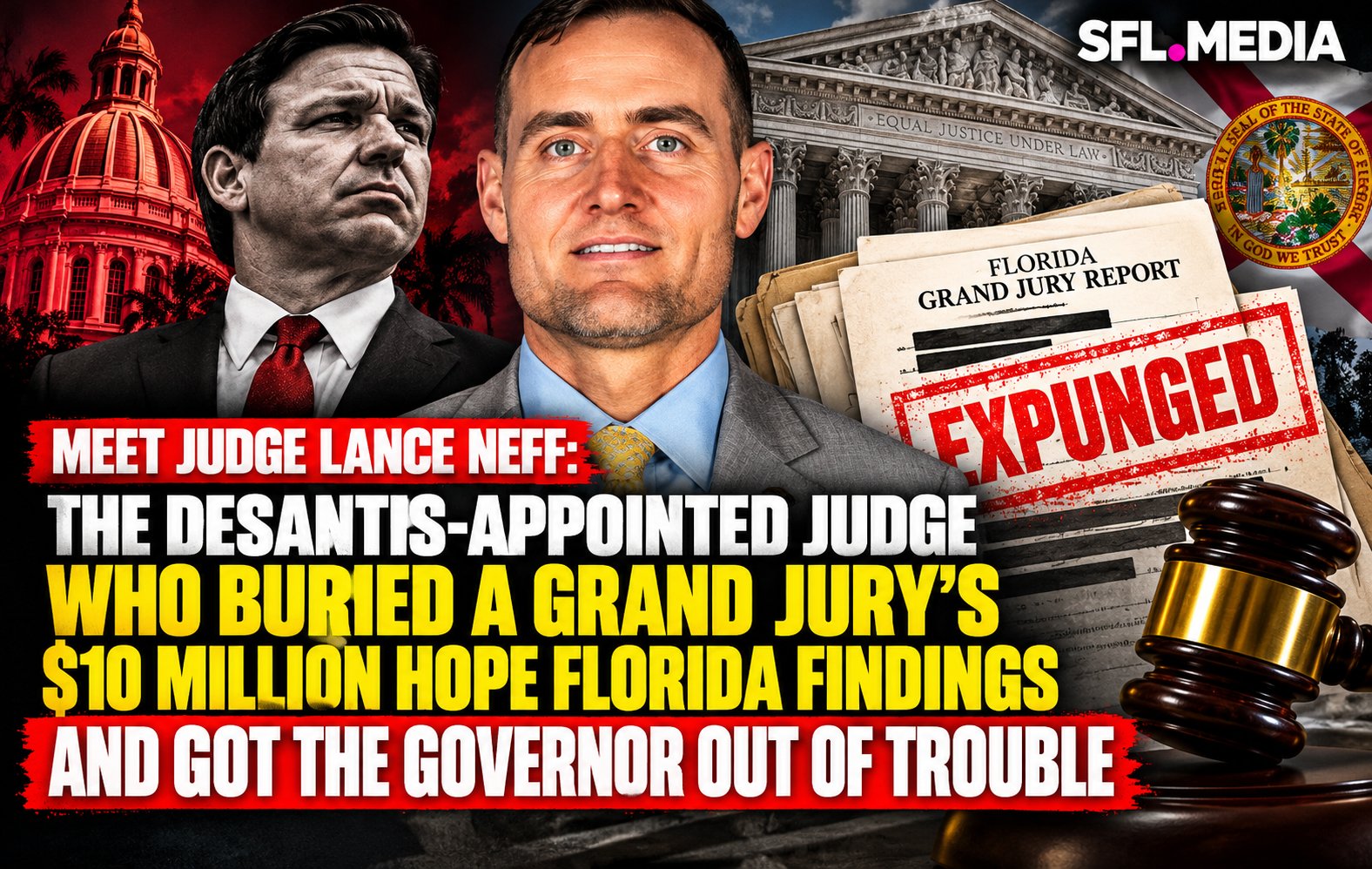
Judge Lance Neff: Two DeSantis Appointments and a Career in State Government
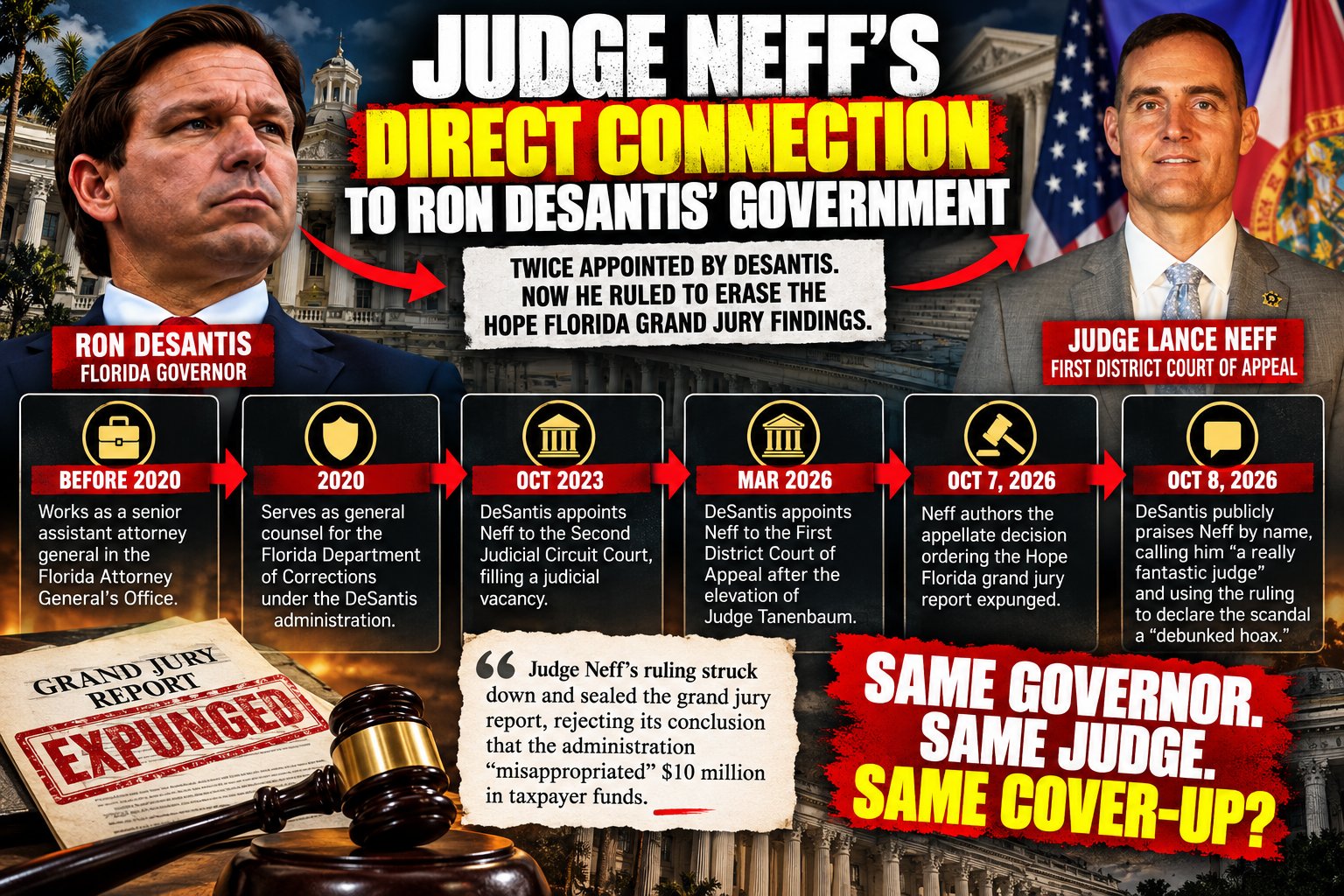
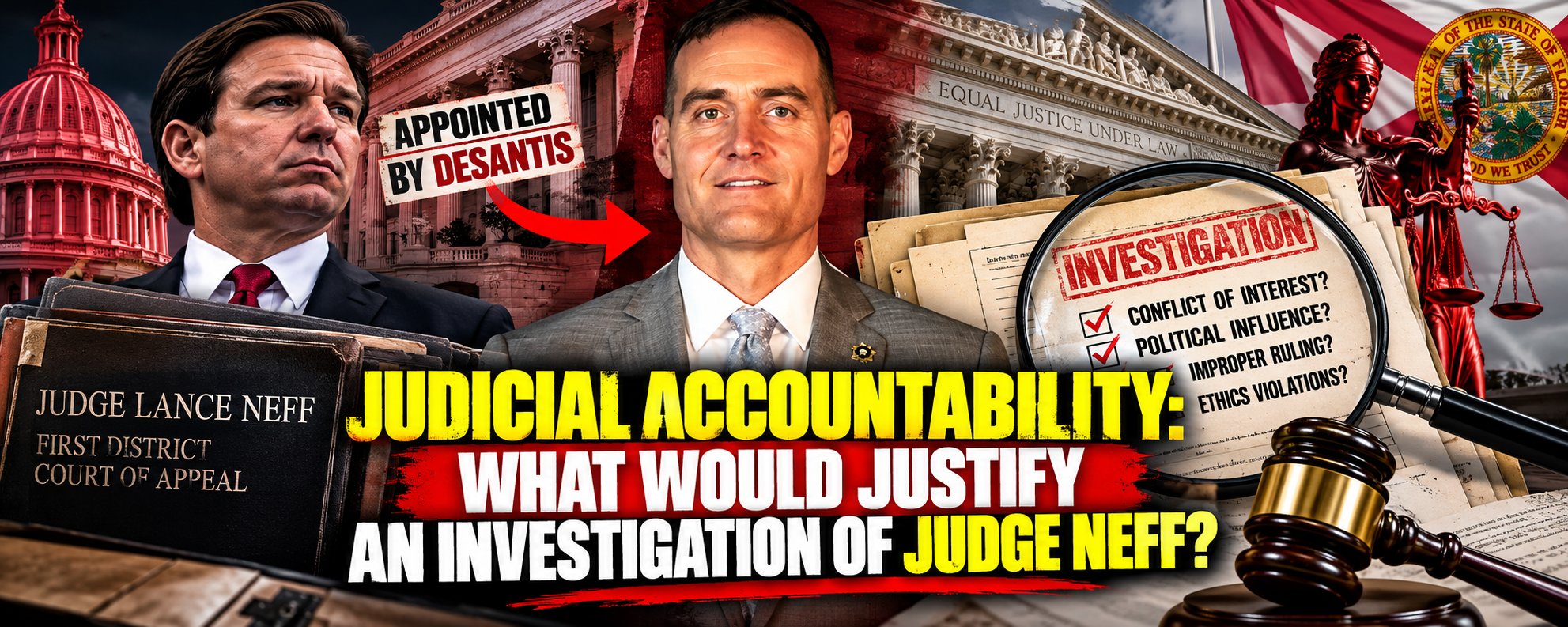
Judge Lance E. Neff’s role in the controversy has attracted attention because of his professional background, his judicial appointments, and the consequential nature of the appellate decision he authored. Neff was not a newcomer to Florida government when DeSantis elevated him to the First District Court of Appeal on March 2, 2026. Before joining the judiciary, he worked as a senior assistant attorney general and later served as general counsel for the Florida Department of Corrections beginning in 2020. His responsibilities placed him within the state’s executive branch legal apparatus during the DeSantis administration, and he also served in the Florida Army National Guard, including as a senior military legal officer.
In October 2023, DeSantis appointed Neff to the Second Judicial Circuit Court, filling a vacancy created by the death of Judge Kevin Carroll. In March 2026, the governor appointed him again, this time to the First District Court of Appeal following the elevation of Judge Adam Tanenbaum. Neff earned his bachelor’s degree from Valdosta State University and his law degree from Florida Coastal School of Law. His professional biography also identifies experience in complex litigation, corrections law, and Medicaid fraud enforcement, giving him a legal background that includes government representation and disputes involving public institutions.
That history is relevant because Neff has substantial experience representing government institutions, including agencies responsible for defending state decisions in litigation, and because the governor whose administration became the subject of the Hope Florida investigation appointed him to both judicial positions. Those facts establish a professional relationship through government service and judicial appointments, but they do not establish that DeSantis directed Neff’s ruling, that Neff had an undisclosed personal relationship with Uthmeier, or that the appellate judge acted improperly. Judicial appointments by governors are a routine feature of Florida’s constitutional system, and judges are expected to decide cases independently regardless of who appointed them.
Nevertheless, the sequence creates a legitimate question about public confidence in judicial independence. Neff joined the appellate court after the grand jury completed its report and subsequently authored an opinion invalidating that report in a matter involving the administration responsible for his appointments. Whether any circumstances required disclosure or recusal would depend on specific evidence of a disqualifying relationship or conflict, not merely the appointment history. The available record supports scrutiny of Neff’s background and judicial reasoning, while any allegation of improper influence would require additional evidence.
The Appellate Opinion: Why Neff Rejected the Grand Jury’s Findings
The October 7 appellate opinion did more than identify procedural problems. It directly challenged the grand jury’s interpretation of the settlement and its authority to characterize the conduct of private individuals. The court concluded that the Centene agreement was reached before a civil lawsuit had been filed, meaning statutory restrictions applicable to certain court settlements did not govern the transaction in the manner the grand jury suggested. The opinion also emphasized that Centene paid $10 million directly to Hope Florida rather than first depositing the money into state accounts, rejecting the grand jury’s conclusion that the funds had been unlawfully diverted from money already belonging to the state.
Neff’s opinion further criticized the grand jury for describing private recipients of the funds as participants in a sophisticated scheme despite returning no indictments against them. Florida law provides protections for individuals criticized in grand jury reports, including procedures governing confidentiality and opportunities to challenge accusations before publication. The appellate court determined that the handling of the report violated those protections and ordered the presentment expunged in full. The decision reflected the court’s view that grand jury reports must remain within statutory boundaries and cannot be used to publicly accuse individuals of wrongdoing without complying with applicable procedural safeguards.
The ruling also identified what the judges considered inconsistencies in the grand jury’s accounting of the settlement. The opinion stated that the $10 million foundation payment came from a component of the agreement associated with incentives and other damages rather than a specifically identified Medicaid overcharge. The court concluded that the grand jury’s interpretation did not adequately account for that distinction, a finding that directly challenged the report’s characterization of the payment as misappropriated taxpayer money.
The appellate decision, however, does not erase the underlying financial transactions. The $10 million payment to Hope Florida, the two $5 million nonprofit grants, and the subsequent $8.5 million in transfers to Keep Florida Clean remain documented events. The legal dispute concerns how those transactions should be classified, whether particular laws were violated, and whether the grand jury had the authority to publish its conclusions. Expunging a grand jury presentment is not the same as proving that every participant acted appropriately, just as the grand jury’s finding of misappropriation was not equivalent to a criminal conviction.
DeSantis Celebrates the Ruling and Praises Judge Neff by Name
Governor DeSantis responded to the appellate decision by publicly declaring that the ruling vindicated his administration. Speaking in Miami on October 8, the governor characterized the grand jury report as politically motivated and argued that the appellate court had rejected the central accusation of misappropriation. His remarks came as the administration continued criticizing the investigation and the disclosure of the confidential report to journalists, presenting the appellate decision as confirmation that the underlying allegations had been exaggerated or improperly framed.
DeSantis also singled out the author of the opinion for praise, describing Neff as a particularly strong judge and expressing appreciation for his ruling. The governor remarked on how forcefully the appellate court had rejected the grand jury’s conclusions, drawing additional attention to the relationship between the administration and the judge it had appointed. The public praise does not establish that Neff coordinated with the governor or wrote the decision to obtain political approval, but it underscores why the appointment history has become part of the public debate.
A governor defending his administration’s handling of settlement money received a favorable judicial ruling from a judge he had twice appointed, then publicly celebrated that judge’s reasoning. The opinion’s legal arguments must ultimately be evaluated on their merits, including the statutory interpretation, procedural protections, and precedents the court cited. The political circumstances surrounding the decision are relevant to public scrutiny but cannot substitute for evidence of judicial misconduct.
More Than $330,000 in Publicly Funded Legal Fees
The controversy has also generated another financial question: how much public money has been spent defending the administration and challenging the grand jury report. CBS Miami, citing reporting by the Florida Trident, reported that attorneys opposing publication of the grand jury findings were paid through the governor’s office using taxpayer funds. According to invoices obtained by the Trident, the attorneys charged rates as high as $895 per hour, with total fees exceeding $330,000 at the time of that reporting.
The expenditures add another dimension to the dispute because public funds were used to finance litigation seeking to suppress a report examining the handling of money arising from a government settlement. Government officials may have legitimate grounds to use public resources for legal representation in litigation connected to official duties, but the scope, authorization, and necessity of those expenses remain appropriate subjects for public examination. The financial records raise questions about who approved the legal representation, which officials or organizations benefited, what legal work was performed, and whether the state received an appropriate public benefit from the expenditure.
Those questions are distinct from the legality of the Centene settlement itself and would require examination of the relevant contracts, invoices, payment authorizations, and applicable state rules. The reported legal fees also illustrate how the controversy has expanded beyond the original $10 million transaction, generating additional public expenditures connected to the dispute over accountability and disclosure.
Ashley Moody Faces Renewed Questions About Her Role
U.S. Senator Ashley Moody, who served as Florida attorney general when the Centene settlement was negotiated, has faced renewed scrutiny over what her office knew about the $10 million payment to Hope Florida. The settlement agreement included approval from the attorney general’s office, although available records do not establish that Moody personally designed the arrangement or knew the money would subsequently reach political committees. Reporting by PolitiFact found that her office approved the agreement but that the extent of Moody’s personal involvement remained unclear. Her representatives have maintained that the office was one of several agencies involved and did not know how Hope Florida would ultimately spend the money.
CBS Miami has repeatedly sought answers from Moody about the settlement and subsequent transfers, identifying unresolved questions about whether she discussed the arrangement with DeSantis or his advisers, whether she knew the money might be used for political purposes, and whether she considered the ultimate destination of the funds appropriate. The station also published a video report examining an interview in which Moody was questioned about her role in the controversy. The exchange has attracted attention because of the unresolved questions surrounding the attorney general’s office and the legal review that preceded the settlement.
The distinction between approving the original settlement and knowingly facilitating political expenditures is important. The first is documented through the agreement and reporting; the second would require additional evidence. Moody’s involvement in the settlement process makes her a relevant witness to the decision-making, but her participation alone does not establish criminal responsibility. What remains unresolved is the extent of her knowledge, the advice her office provided, and whether attorneys raised concerns about directing settlement proceeds to a nonprofit organization without restrictions governing subsequent political expenditures.
Those questions are particularly significant because the attorney general’s office is responsible for representing the state’s legal interests, including in matters involving large settlements and potential recoveries of public money. A complete accounting of the office’s involvement would help establish whether the Hope Florida provision received appropriate legal review and whether officials anticipated the possibility that the foundation’s grants could eventually support political activity.
James Uthmeier’s Central Role and the Unanswered Campaign Finance Questions
James Uthmeier occupies a significant position in the documented sequence because he served as DeSantis’s chief of staff during the settlement negotiations and chaired the political committee that received most of the money distributed by Hope Florida’s nonprofit grantees. Records reviewed by investigative journalists indicate that Uthmeier had been involved in the state’s dispute with Centene years before the September 2024 settlement. Emails show that he handled aspects of the state’s claim beginning in 2021 while serving as the governor’s general counsel. By the time the settlement was finalized, he occupied a senior position in the governor’s office, while Keep Florida Clean was actively campaigning against recreational marijuana legalization.
The grand jury identified Uthmeier as a central figure because of his authority over officials involved in the settlement and his relationship to the political committee receiving the funds. However, investigators reported that they could not establish who specifically directed the payment to Hope Florida. Uthmeier has denied wrongdoing and described the investigation as politically motivated. His public response to questions about the grand jury report has also drawn attention, particularly an August 27 press conference in The Villages during which he challenged a journalist who questioned him about the leaked report and suggested that discussing confidential grand jury material could implicate legal restrictions.
The exchange prompted criticism because asking public officials questions about government conduct is protected journalistic activity. It also highlighted the increasingly contentious relationship between state officials and reporters investigating the controversy. The legal questions surrounding the settlement remain separate from those involving press access and public accountability, but both concern the extent to which officials must explain government decisions when substantial public interests are involved.
A separate issue attracting attention is whether the nonprofit transfers should receive additional scrutiny under Florida’s campaign finance laws. Reporting by WUSF identified a statute prohibiting certain knowingly concealed or indirect political contributions and noted that the grand jury’s analysis had not addressed that provision. The existence of the statute does not establish that the transfers violated it, but it identifies a potentially relevant legal question that differs from the settlement-law arguments considered in Neff’s appellate opinion. Determining whether campaign finance restrictions were violated would require examining the purpose of the transfers, communications among the participants, and whether the organizations acted independently or pursuant to a coordinated arrangement.
The IRS Whistleblower Complaint Opens Another Avenue of Scrutiny
The Hope Florida controversy has also attracted attention from federal tax authorities. On October 2, WUSF reported that the Internal Revenue Service had taken up a whistleblower claim concerning the movement of money from Hope Florida through nonprofit organizations and into Uthmeier’s political committee. The complaint raises questions about the obligations of tax-exempt organizations, the purposes for which charitable funds were distributed, and whether the nonprofits involved complied with applicable federal requirements.
The existence of an IRS whistleblower matter is not evidence that the agency has found wrongdoing or that criminal charges will follow. It does, however, show that the controversy extends beyond the state grand jury proceedings and the appellate court’s interpretation of Florida law. The federal tax questions are particularly relevant because the two nonprofit recipients were organized under Section 501(c)(4), which permits certain political activities subject to restrictions and organizational requirements. The legality of their conduct depends on the facts of the transfers, the organizations’ purposes, their overall activities, and the applicable tax rules.
The IRS matter and the state appellate decision concern different legal issues. A ruling that the grand jury exceeded its authority does not necessarily resolve federal questions about nonprofit compliance, just as the filing or examination of a whistleblower complaint does not establish a tax law violation. The federal review represents a separate potential avenue for examining the financial transactions, although its eventual findings and any enforcement consequences remain unknown.
Florida Voters Supported Marijuana Legalization, but the Amendment Failed
The political objective of Keep Florida Clean is central to understanding the controversy. In November 2024, Florida voters considered Amendment 3, which would have legalized recreational marijuana for adults aged 21 and older. Approximately 55.9% of voters supported the measure, giving it a clear statewide majority but leaving it short of the 60% supermajority required to amend Florida’s constitution. DeSantis strongly opposed the amendment, and Keep Florida Clean was a major vehicle for that opposition.
The political committee’s receipt of millions of dollars originating from the Hope Florida grants therefore connects the settlement controversy to a campaign in which the governor was personally and publicly invested. The funding arrangement is particularly significant because it involved money originating from a settlement negotiated by state officials, a foundation associated with the governor’s wife, and a political committee chaired by one of his closest senior advisers. The documented transfers establish the financial relationship among those organizations, while the question of whether the arrangement was legally coordinated remains unresolved.
It is important to distinguish the majority vote from the amendment’s legal outcome. Most participating voters supported legalization, but Florida’s constitution required a higher threshold. The amendment’s defeat was legally valid under that rule, even though the proposal received more votes in favor than against. The unresolved public-interest question is whether funds associated with a government-negotiated healthcare settlement were appropriately directed through charitable and nonprofit organizations into a campaign aligned with the governor’s political priorities. That question remains significant regardless of the amendment’s eventual defeat.
What the Grand Jury Actually Found and What It Could Not Prove
The Leon County grand jury’s January 2026 report was notable both for the seriousness of its conclusions and for its decision not to seek criminal indictments. According to the Associated Press, the grand jury determined that the administration had misappropriated $10 million and that the money was ultimately used for political purposes. However, investigators said they lacked sufficient evidence to identify who was legally responsible for authorizing the disputed arrangement. Witnesses did not establish who directed the foundation payment, creating an evidentiary obstacle to prosecution.
The absence of indictments matters because a grand jury can examine conduct, receive testimony, and identify concerns without establishing the elements necessary to charge a particular person with a crime. Its findings can inform public accountability, but they are not convictions and do not carry the same evidentiary weight as facts established through a criminal trial. The appellate court’s subsequent decision adds another legal limitation, determining that the grand jury exceeded its authority in portions of the report and that the document should be expunged.
The ruling challenges the report’s legal conclusions and publication, but it does not eliminate the need to account for the documented financial transfers. The central unresolved questions remain who proposed the Hope Florida provision, why the foundation received accelerated payment terms, what officials understood about the intended use of the grants, and whether the nonprofit and political committee transfers were independently planned or coordinated. Those questions concern the underlying financial activity rather than the grand jury’s authority to publish its conclusions.
Judicial Accountability: What Would Justify an Investigation of Judge Neff?
The controversy surrounding Judge Neff raises an important distinction between a controversial judicial decision and judicial misconduct. Florida judges are subject to ethical obligations involving impartiality, conflicts of interest, and conduct that could undermine public confidence in the judiciary. The Florida Judicial Qualifications Commission has authority to investigate alleged judicial misconduct and recommend discipline when supported by evidence. Disbarment, however, is a separate attorney discipline matter, and neither removal from the bench nor loss of a law license follows automatically from an unpopular or disputed ruling.
Neff’s professional history, his two appointments by DeSantis, and his authorship of the Hope Florida opinion are documented facts. They provide legitimate grounds for journalists to examine his judicial record, disclosures, and any potentially relevant relationships, but they do not, without more, demonstrate that he violated judicial ethics rules. A substantiated complaint would require evidence of conduct such as an undisclosed disqualifying conflict, improper communications, personal involvement in the underlying controversy, or another violation of judicial standards. The available reporting does not establish those circumstances.
The appropriate accountability question is therefore whether additional records reveal a relationship or conflict beyond Neff’s government employment and appointments. His decision can be subjected to rigorous legal criticism, and the public can demand transparency about the court’s reasoning, without presuming misconduct that has not been demonstrated. Maintaining that distinction is essential because judicial independence requires both meaningful accountability for actual misconduct and protection against discipline based solely on disagreement with a judge’s legal conclusions.
The Questions Florida Officials Still Need to Answer
Nearly two years after the Centene settlement, the basic financial sequence is well documented, but several essential questions remain unresolved. The available records show how the settlement provision changed, where the money went, how quickly it moved, and which political committee ultimately received most of the foundation’s grants. What remains less clear is the decision making behind those transfers, including the communications among government officials, foundation representatives, nonprofit leaders, and political operatives during the weeks leading up to the 2024 election.
A complete public accounting would require identifying the official who first proposed the Hope Florida payment, determining why the amount increased from $5 million to $10 million during negotiations, and establishing why the foundation received a faster payment schedule than the state. It would also require examining communications among the governor’s office, the Agency for Health Care Administration, the attorney general’s office, Hope Florida officials, the nonprofit recipients, and Keep Florida Clean. Those records could help determine whether the subsequent political contributions were independently decided by the nonprofits or contemplated during the original settlement negotiations.
The roles of Moody and Uthmeier deserve particular examination because of their documented institutional responsibilities during the settlement process. Moody’s office approved the agreement, while Uthmeier held senior executive authority and chaired the political committee that received the subsequent contributions. Those facts do not prove unlawful coordination, but they make the officials relevant to determining who knew what and when. The administration should also be able to explain the public purpose served by the $10 million payment, the safeguards governing its distribution, and the basis for spending public money on litigation to suppress the grand jury report.
These are questions of government transparency regardless of whether any criminal offense occurred. The public has an interest in understanding how settlements involving state healthcare programs are negotiated, how third party payments are authorized, and whether adequate safeguards exist to prevent money associated with government agreements from being redirected into political activity without meaningful oversight.
A Court Can Expunge a Report. The Financial Records Remain.
The October appellate ruling represents a significant legal victory for the DeSantis administration and the individuals who challenged the grand jury’s presentment. It rejects important aspects of the grand jury’s reasoning and establishes that the report exceeded the lawful boundaries the court identified. Those conclusions deserve to be reported accurately, even as the underlying transactions continue to attract scrutiny.
The ruling does not change the fact that a $67 million settlement included a $10 million payment to Hope Florida, that the foundation distributed the money to two nonprofits, or that those organizations subsequently transferred $8.5 million to a political committee chaired by the governor’s chief of staff. Nor does it resolve every question about the negotiations, the nonprofit transfers, federal tax compliance, or the use of taxpayer funds to finance the litigation. The underlying records remain relevant to understanding how the arrangement developed and whether the participating organizations complied with their legal responsibilities.
The Hope Florida controversy is therefore not simply a dispute over whether a grand jury used the correct legal terminology. It is a broader examination of how a state-negotiated healthcare settlement became connected to political spending, how senior officials handled the resulting scrutiny, and how Florida’s institutions responded when investigators questioned the arrangement. The appellate court has addressed the legality and publication of the grand jury report, but the public accounting of the underlying transactions remains a separate matter.
For Floridians, the most consequential issue is whether the state can provide a complete, documented explanation for the movement of the money. The financial records establish a series of transactions involving millions of dollars, organizations closely connected to the governor’s political priorities, and a campaign that helped defeat a constitutional amendment supported by a majority of participating voters. Determining whether those transactions were lawful, appropriately authorized, and consistent with the public interest requires evidence that extends beyond the appellate court’s ruling.
The grand jury’s report may have been ordered expunged, but the questions raised by the documented money trail have not disappeared.
Sources and Further Reading

SFL Media — Previous Investigations and Related Reporting
1. SFL Media — August 28, 2026: DeSantis, Wife, Hope Florida, and Florida’s Sitting Attorney General Misappropriated $10 Million in Taxpayer Money in a Scheme to Fight Legal Weed
2. SFL Media — October 2, 2026: Trump Pulls a Hope Florida, Redirects $20 Million in Taxpayer Money to Fund Right Wing Advertising
Court Records, Government Documents, and Judicial Background
3. Florida First District Court of Appeal: Hope Florida Grand Jury Presentment Decision — October 2026
4. Florida Governor’s Office: Governor Ron DeSantis Appoints Lance Neff to the First District Court of Appeal — March 2026
5. Florida Governor’s Office: Lance Neff’s Original Judicial Appointment — October 2023
6. The Florida Bar: Judge Lance Neff Takes a Seat on the First District Court of Appeal
Independent Investigations and News Reporting
7. Associated Press: Florida Grand Jury Findings on the $10 Million Hope Florida Payment
8. WUSF Public Media — October 2, 2026: IRS Takes Up Whistleblower Claim Involving Hope Florida Money That Flowed to Uthmeier’s Political Committee
9. WUSF Public Media — October 8, 2026: Appeals Court Expunges Hope Florida Grand Jury Report
10. PolitiFact — August 2026: Examining Ashley Moody’s Role in the Hope Florida Medicaid Settlement
11. CBS News Miami: DeSantis Responds to the Hope Florida Grand Jury Ruling
12. CBS News Miami: Senator Ashley Moody Faces Renewed Scrutiny Over Her Role in the Hope Florida Scandal
13. CBS News Miami — Video Report: Senator Ashley Moody Questioned About Her Role in the Hope Florida Scandal
14. Local 10 News — October 8, 2026: DeSantis Responds After Court Orders Grand Jury Report Critical of Hope Florida Expunged
15. News 6 Orlando — August 27, 2026: Florida Attorney General James Uthmeier Confronts Journalist Over Hope Florida Questions
Additional Investigative Reporting and Financial Records
16. Florida Trident — October 2, 2026: IRS Reviews Whistleblower Complaint Over Hope Florida Funds
17. Florida Trident: Hope Florida Money Trail — Detailed Timeline and Supporting Documents
18. Florida Trident: Leon County Grand Jury Report — Original Document (PDF)
19. The Florida Trib — October 9, 2026: How State Officials Fought for Months to Keep a Lid on the Hope Florida Report
20. Florida First District Court of Appeal — October 7, 2026: Official Appellate Opinion Ordering Expungement of the Grand Jury Report (PDF)



































Want to join the conversation?
Create an account or sign in to share your thoughts, vote,
and reply to other readers.
Showing 0 of 0 comments
Don't have an account?
Already have an account?