
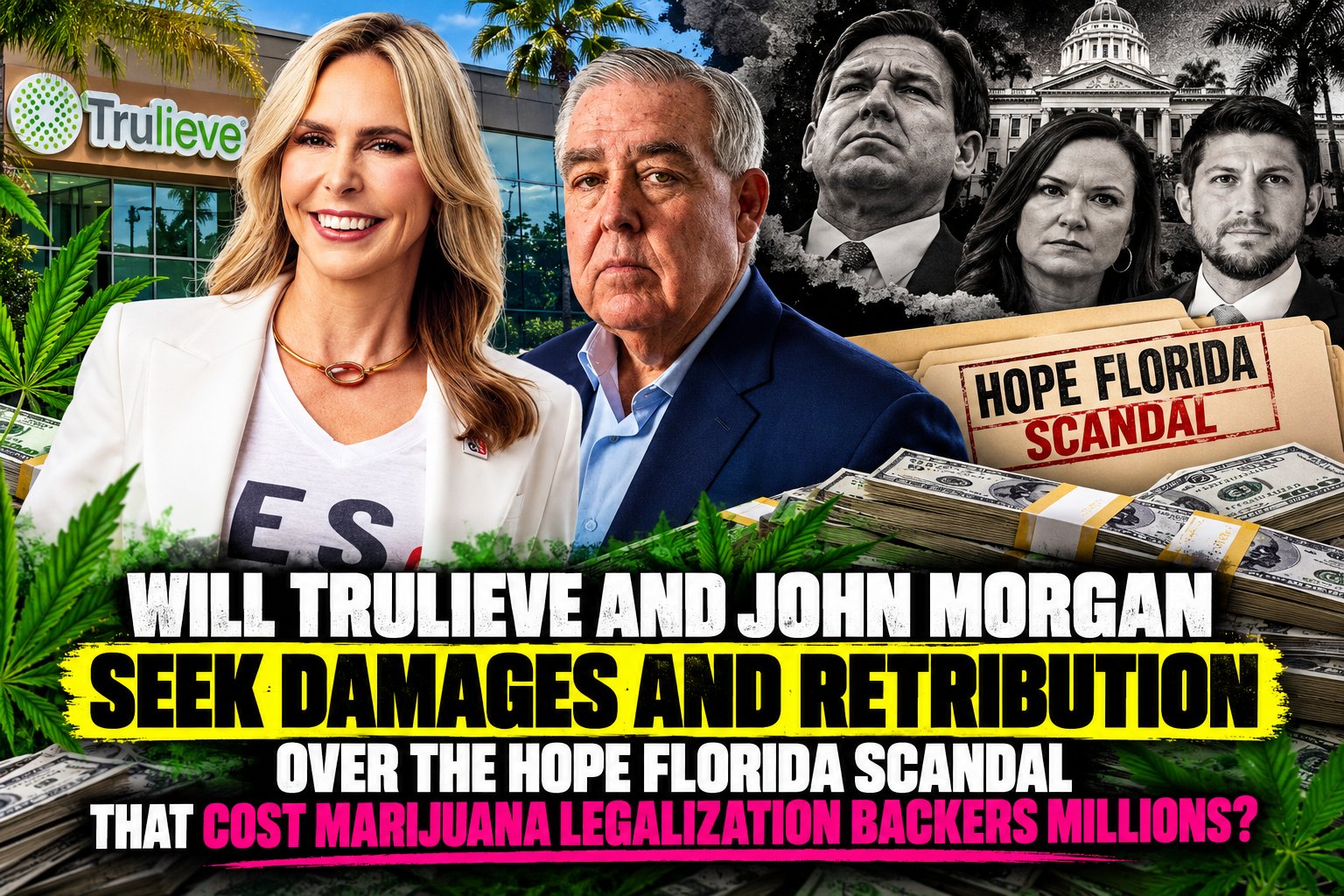
Florida’s $150 Million Marijuana War: Will Cannabis Power Players Seek Retribution Against DeSantis, Moody, and Uthmeier Over the Hope Florida Scandal?
Trulieve and other cannabis companies spent a fortune trying to legalize recreational marijuana in Florida. Now, revelations about $8.5 million in settlement-related money flowing to the opposition campaign raise a new question: Will the industry’s biggest financial backers pursue legal and political accountability?
A $150 Million Campaign, a Defeat at the Ballot Box, and an $8.5 Million Political Money Trail
Florida’s marijuana legalization movement spent more than $150 million trying to persuade voters to approve Amendment 3 in 2024. The campaign, overwhelmingly financed by cannabis giant Trulieve, secured nearly six million votes and a clear majority of the electorate. Yet the proposal failed because Florida requires constitutional amendments to receive at least 60% approval, leaving the industry with an extraordinary financial setback and legalization supporters with another political defeat.
Nearly two years later, revelations about a controversial funding arrangement involving Governor Ron DeSantis’s administration have introduced a potentially more consequential question: What legal, financial, or political accountability could the businesses and voters who supported Amendment 3 seek from the officials involved?
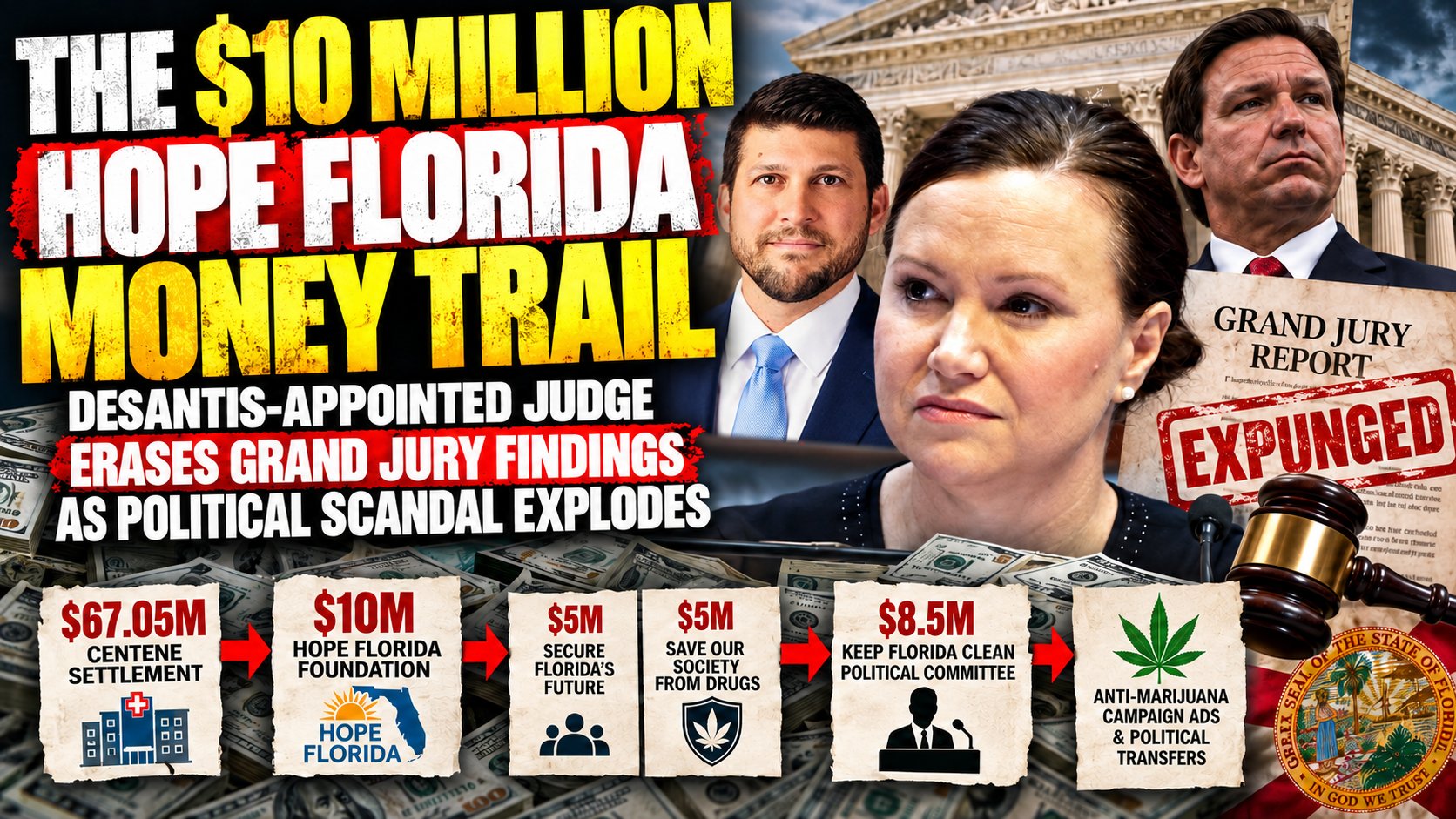
At the center of the controversy is a $67.05 million settlement negotiated with healthcare corporation Centene, including a separate $10 million payment to the Hope Florida Foundation. The foundation subsequently distributed that money to two nonprofit organizations, which transferred a combined $8.5 million to Keep Florida Clean, a political committee chaired by James Uthmeier, then DeSantis’s chief of staff. The committee opposed Amendment 3, placing settlement related money into the same political battle in which private cannabis companies were investing unprecedented sums.
The financial transactions are documented, but their legal interpretation remains disputed. A Leon County grand jury concluded that the $10 million had been misappropriated, although it did not indict anyone. On October 7, 2026, a Florida appellate court ordered the grand jury’s presentment expunged, rejecting its principal legal theory and finding violations of statutory protections governing reports that criticize individuals without indictments.
That ruling gave DeSantis and his allies a significant legal victory, but it did not erase the underlying financial transfers or settle every possible question involving campaign finance, nonprofit tax compliance, and government ethics. For Trulieve, its chief executive Kim Rivers, other cannabis industry contributors, and Florida’s legalization movement, the issue now extends beyond the defeat of a ballot initiative. It concerns whether the political opposition was financed through arrangements that deserve independent scrutiny and whether those involved can be held accountable if violations are established.
Trulieve Spent Nearly $145 Million Trying to Legalize Marijuana
The scale of Trulieve’s investment is essential to understanding the stakes. Contemporary reporting based on Florida Division of Elections records showed that Smart & Safe Florida, the committee sponsoring Amendment 3, had raised approximately $152 million by Election Day in 2024. Trulieve accounted for roughly $144.6 million of that total, representing approximately 95% of the campaign’s reported contributions.
Those figures are considerably higher than the roughly $100 million commonly cited earlier in the campaign and provide a more accurate picture of the final financial commitment. The company funded an extensive statewide effort involving petition gathering, advertising, public relations, legal work, and voter mobilization. Other cannabis businesses, including Verano, Curaleaf, Cresco Labs, and additional operators, also contributed, although their investments were substantially smaller than Trulieve’s.
For Trulieve, the proposed amendment represented a significant opportunity to expand Florida’s existing medical marijuana market into adult use sales. For voters, the measure offered the possibility of legal possession and purchase of marijuana by adults 21 and older. Supporters argued that legalization would create a regulated market, establish clearer consumer protections, and reduce the consequences of criminal prohibition, while opponents warned about public consumption, corporate market power, and the potential effects on children.
DeSantis emerged as one of the measure’s most visible opponents. His administration and allied political organizations challenged the amendment’s language and the commercial interests behind it, portraying legalization as an effort by large marijuana companies to dominate Florida’s cannabis market. The campaign became a high profile contest between a governor determined to defeat the measure and an industry prepared to spend extraordinary amounts to win voter approval.
On November 5, 2024, Amendment 3 received approximately 55.9% support. The result represented a majority of voters but fell more than four percentage points short of the constitutional threshold. Although the campaign’s defeat was decisive under Florida law, the majority vote also demonstrated that support for recreational marijuana legalization extended well beyond the industry’s financial backers.
Trulieve Has Already Demonstrated a Willingness to Fight in Court
There is a documented precedent for Trulieve pursuing legal action against opponents of Amendment 3. In October 2024, the company filed a defamation lawsuit against the Republican Party of Florida and the owners of two television stations, alleging that advertising opposing legalization contained false and deceptive statements about the amendment and the company’s role in the proposed market.
The lawsuit challenged messaging that portrayed Amendment 3 as a corporate monopoly measure and suggested that its language would prevent Floridians from growing marijuana at home. Trulieve argued that the advertising misrepresented the amendment and was designed to mislead voters. The Florida Republican Party defended its campaign messaging, and the dispute became part of the broader political battle over whether the initiative would benefit consumers or primarily serve existing medical marijuana operators.
Independent fact checking added another dimension to that dispute. PolitiFact rated false the claim that Amendment 3 would establish a marijuana monopoly, explaining that the proposal would permit existing medical operators to sell adult use products while allowing the Legislature to authorize additional licensed businesses. The amendment did not create an exclusive constitutional franchise for Trulieve or prohibit future market entrants.
The earlier litigation is important because it establishes that Trulieve was prepared to challenge campaign conduct through the courts rather than relying exclusively on advertising and political advocacy. However, it does not establish that the company has filed a new lawsuit over Hope Florida, that its lawyers have concluded the settlement transfers violated election law, or that Rivers has approved a new legal strategy targeting DeSantis, Moody, or Uthmeier.
No such coordinated litigation effort has been independently confirmed. Whether the company will pursue additional action remains an open question, and any new case would require an identifiable legal claim supported by evidence rather than political outrage alone.
Kim Rivers and the Business Case for Demanding Accountability
As Trulieve’s chief executive, Kim Rivers became a prominent public advocate for Amendment 3 and a leading voice defending the regulated cannabis industry against criticism from the governor and opposition advertisers. During the campaign, she challenged claims about marijuana products being marketed to children and argued that legalization would allow consumers to obtain tested products through a regulated system rather than through unlicensed sellers.
Rivers’s position reflected both the company’s commercial interest and its public policy argument for legalization. Trulieve had invested enormous sums in an election whose outcome could reshape its future market, while its opponents repeatedly questioned the company’s motives and the amendment’s potential effects. The Hope Florida disclosures now create a new issue for the company to evaluate: whether the funding that reached Keep Florida Clean complied with the laws governing political contributions and nonprofit organizations.
There is no independently verified public statement from Rivers accusing Judge Lance Neff of participating in a cover up or announcing a campaign to punish state officials over the settlement. Nor is there verified evidence that she has authorized new litigation specifically concerning Hope Florida. Those allegations should not be attributed to her without an identifiable interview, corporate announcement, or direct quotation.
Nevertheless, the company has a legitimate interest in examining the funding trail. The relevant question is whether a business that spent nearly $145 million participating in Florida’s electoral process will seek records, support independent review, or pursue litigation if evidence emerges that unlawful conduct affected the campaign. The existence of substantial spending does not automatically give Trulieve a right to recover its losses, but it makes the integrity of the election financing system a matter of direct concern.
How $10 Million From a Healthcare Settlement Reached Political Organizations
The Hope Florida controversy began with a September 2024 agreement resolving allegations that Centene Corporation had overcharged Florida’s Medicaid program. The settlement totaled $67,048,611, with $57,048,611 allocated to the state and a separate $10 million payment directed to the Hope Florida Foundation, a direct-support organization associated with First Lady Casey DeSantis’s assistance initiative.
The structure of the agreement is important because the $10 million did not first enter a state treasury account before being transferred to the foundation. It was paid directly by Centene as part of the settlement. The DeSantis administration and the appellate court relied on that distinction in rejecting the grand jury’s assertion that the payment represented state money unlawfully diverted from an existing public account. Critics have questioned whether that structure adequately addresses the government’s responsibility for negotiating the overall settlement and determining the destination of its proceeds.
After receiving the money, Hope Florida approved two $5 million grants to Secure Florida’s Future and Save Our Society From Drugs. The organizations subsequently transferred a combined $8.5 million to Keep Florida Clean through six checks issued between October 17 and October 29, 2024, immediately before the November election. Reporting on the grand jury investigation identified $3.75 million from Secure Florida’s Future and $4.75 million from Save Our Society From Drugs, establishing the specific path through which most of the foundation’s grants reached political spending.
The investigation also raised questions about the grant applications and the purposes described by the nonprofit recipients. Reporting on the grand jury’s findings indicated that the applications represented the grants as supporting activities associated with Hope Florida rather than political campaigning. The subsequent transfers to Keep Florida Clean therefore became central to the controversy, particularly because Uthmeier chaired the committee while serving as the governor’s chief of staff.
The grand jury further traced substantial amounts from Keep Florida Clean to other political organizations, including the Republican Party of Florida. Those additional transfers complicate the question of exactly how much of the original $8.5 million financed advertisements specifically targeting Amendment 3 rather than other political activities. The record supports describing the money as entering a political operation opposing legalization, but not attributing every dollar to a particular advertisement without supporting expenditure records.
DeSantis, Moody, and Uthmeier: Who Could Face Accountability?
The roles of Governor Ron DeSantis, former Florida Attorney General Ashley Moody, and current Attorney General James Uthmeier differ substantially, and those distinctions matter when considering potential legal consequences. DeSantis was the most visible political opponent of Amendment 3 and led the administration under which the Centene settlement was negotiated. Moody headed the attorney general’s office involved in the settlement process. Uthmeier served as the governor’s chief of staff while chairing the political committee that received the $8.5 million.
Their participation in government and opposition to legalization are not, by themselves, evidence of wrongdoing. Public officials may advocate for or against ballot measures within applicable legal restrictions, and political committees may receive lawful contributions. The questions raised by Hope Florida concern the authorization of the settlement payment, the representations made when the foundation approved the grants, the subsequent use of those funds, and whether political contributions were properly reported.
For Moody, further examination would need to establish what her office knew about the $10 million payment, who approved the settlement language, and whether the agreement complied with applicable requirements governing state-negotiated recoveries. For Uthmeier, the relevant questions include his involvement in arranging the nonprofit contributions, his knowledge of the original grant purposes, and whether the transactions complied with campaign finance law. For DeSantis, the issue is whether evidence establishes his personal participation in disputed financial decisions, rather than simply his public opposition to marijuana legalization.
The Leon County grand jury concluded that the $10 million had been misappropriated, but it did not indict anyone. Its presentment was subsequently ordered expunged by the First District Court of Appeal. No criminal guilt has been established through that process, and the appellate court rejected the report’s central legal theory. Any further enforcement action would require an independently supportable legal basis.
Could the Cannabis Industry Seek Financial Damages?
The most aggressive response available to Amendment 3’s financial backers would be civil litigation, but the existence of a controversial funding trail does not automatically establish a viable lawsuit. Trulieve and other donors would need to identify a recognized cause of action, demonstrate that they have standing to bring it, establish legally cognizable harm, and overcome any applicable immunity, procedural, or limitations defenses.
A claim seeking reimbursement of campaign contributions would face particularly difficult questions of causation. Trulieve’s spending was voluntary political expenditure intended to influence a statewide vote, not a contractual payment guaranteeing that the amendment would pass. Even if a court found that particular opposition contributions violated the law, the company would still need a legal basis for recovering its own campaign expenses and evidence connecting the alleged violation to a compensable injury.
Nor would an unlawful contribution, if established, automatically invalidate the election. Florida’s certified results showed that Amendment 3 failed to reach the required 60% threshold. Reversing an election result would involve a separate and exceptionally demanding legal process, including questions about available remedies and whether any proven irregularity affected the outcome. The documented $8.5 million transfer, standing alone, does not demonstrate that the measure would otherwise have passed.
The more realistic legal possibilities include seeking public records, supporting administrative complaints, examining campaign finance disclosures, or pursuing a narrowly defined civil claim if additional evidence establishes a specific legal violation and an actionable injury. Whether any cannabis company intends to take those steps remains unconfirmed.
Florida’s Campaign Finance Laws Could Present a More Serious Problem
One significant avenue for further examination involves Florida’s prohibition on certain contributions made through intermediaries. State law addresses contributions made or accepted through or in the name of another person, including arrangements intended to disguise the true source of political money. The provision has attracted attention because the Hope Florida transactions involved multiple organizations between the original settlement payment and the political committee.
The existence of intermediaries, however, does not automatically establish an unlawful contribution. Nonprofit organizations can receive grants and make political contributions within applicable rules. A potential violation would depend on evidence concerning the parties’ knowledge, the purpose of the transfers, and whether the organizations acted independently or served as conduits to conceal the true contributor.
Reporting by the Florida Trident identified this campaign finance issue as a potentially distinct legal question from the settlement statutes addressed by the grand jury and the appellate court. Florida State University election law professor Michael Morley explained that the relevant rules are intended in part to prevent the use of intermediaries to disguise contribution sources.
The distinction is especially important because Judge Neff’s opinion did not adjudicate a separate prosecution under Florida’s contribution-conduit prohibition. The appellate court addressed the grand jury presentment and the legal theories contained within it. Its ruling should not be treated as a blanket determination that every possible campaign finance issue arising from the transfers has been resolved.
For the cannabis industry’s backers, a properly documented complaint concerning political contribution reporting could offer a more targeted path to accountability than a broad lawsuit alleging that the entire election was improperly influenced. Such a complaint would still require evidence of a violation, and any enforcement decision would belong to the appropriate authorities.
The IRS Review Creates Another Potential Path to Consequences
The federal dimension of the controversy has become increasingly important. On October 2, 2026, WUSF and the Florida Trident reported that the Internal Revenue Service was reviewing a whistleblower claim involving the Hope Florida funding chain. The complaint was filed by Republican state Representative Alex Andrade, who had previously examined the settlement through legislative oversight.
The complaint focuses attention on the two nonprofit organizations that received Hope Florida’s grants and subsequently contributed to Keep Florida Clean. Organizations classified under Section 501(c)(4) of the Internal Revenue Code may participate in political activity, but they remain subject to federal tax requirements concerning their operations, reporting, and organizational purposes. A review could examine whether the organizations accurately represented their activities and complied with the conditions associated with their tax treatment.
The reported IRS review does not establish that either nonprofit violated federal law. The agency has not publicly announced findings of wrongdoing in connection with the complaint, and the existence of a whistleblower submission should not be confused with a completed enforcement investigation or criminal prosecution. Nevertheless, the federal tax questions are distinct from the state appellate court’s ruling, meaning that expungement of the grand jury presentment does not itself resolve them.
There is also an important limitation concerning federal healthcare oversight. Claims that the Department of Health and Human Services or the Centers for Medicare & Medicaid Services have already launched formal investigations into the settlement transfers have not been independently substantiated. Questions about Medicaid-related settlement accounting and potential federal interests may warrant examination, but a confirmed investigation cannot be reported without evidence that one exists.
John Morgan and Florida’s Legalization Movement
Prominent attorney John Morgan helped establish Florida’s modern medical marijuana framework through his support for the successful 2016 constitutional amendment. His advocacy made him one of the state’s best known figures in cannabis reform, although the 2024 adult-use campaign was principally financed and organized by Trulieve and Smart & Safe Florida.
Morgan’s history is relevant because it demonstrates that Florida’s marijuana movement has previously combined substantial private financing, statewide political organization, and legal advocacy to change public policy. However, his earlier involvement does not establish that he is currently organizing litigation against DeSantis, Moody, or Uthmeier, or that he has demanded a federal prosecution arising from Hope Florida.
The same caution applies to other cannabis industry donors. Verano, Curaleaf, Cresco Labs, and additional companies supported Amendment 3 financially, but their contributions do not establish that they have jointly agreed to pursue legal action over the settlement. No coordinated donor lawsuit or collective demand for penalties has been independently verified. The industry’s financial stake is documented, and Trulieve’s willingness to litigate campaign disputes is established by its 2024 defamation lawsuit. What remains unanswered is whether those businesses view the Hope Florida disclosures as grounds for new legal action and, if so, what evidence and remedies they believe would support such a case.
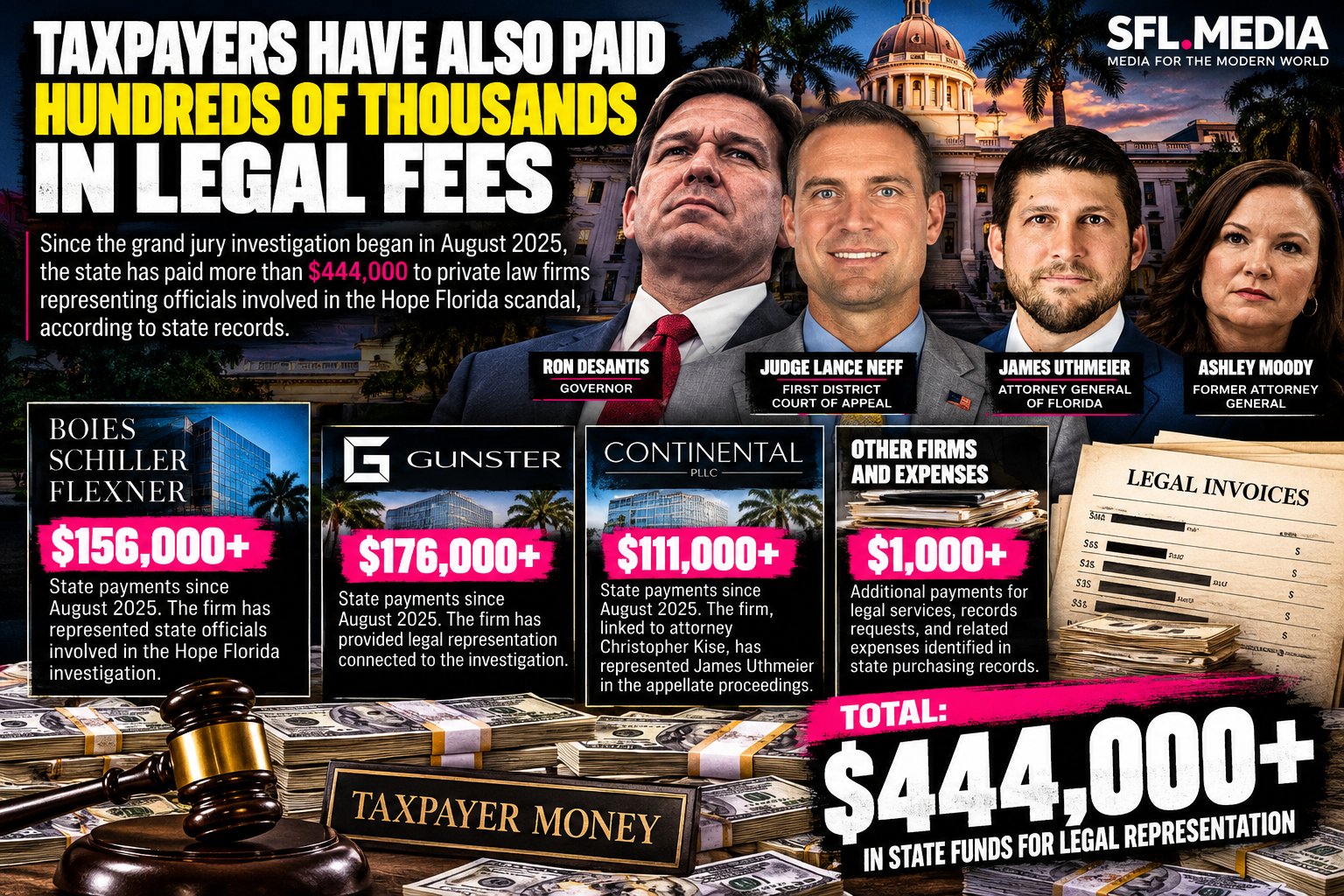
Taxpayers Have Also Paid Hundreds of Thousands in Legal Fees
The controversy has also generated substantial expenses for Florida taxpayers. Reporting published in October 2026 identified more than $444,000 in state payments to private law firms for legal representation associated with the Hope Florida proceedings. The expenditures add another financial dimension to a controversy that began with a government-negotiated healthcare settlement and subsequently involved a statewide political campaign.
Reported payments included more than $156,000 to Boies Schiller Flexner, more than $176,000 to Gunster, and more than $111,000 to Continental PLLC. Attorney Christopher Kise, associated with Continental, represented Uthmeier during the appellate proceedings. The expenditures raise questions about the circumstances under which public funds may be used to provide legal representation for government officials facing scrutiny over actions connected to their official responsibilities.
Government agencies may have legitimate reasons to retain outside counsel, particularly when litigation involves official duties, confidential records, or complex legal questions. The existence of substantial legal fees does not establish misuse of public money. Nevertheless, the spending deserves examination because it places additional taxpayer resources into a dispute involving government officials and political financing.
For legalization supporters, the legal fees illustrate the difference between privately financed political advocacy and the institutional resources available to government officials. Trulieve and other businesses financed their election campaign with corporate money, while the state has incurred public expenses defending officials and agencies involved in the subsequent controversy. Whether those expenditures were appropriate depends on the contracts, legal authority, and work performed, not simply on the political affiliations of the participants.
Judge Lance Neff’s Ruling Did Not Erase the Money Trail
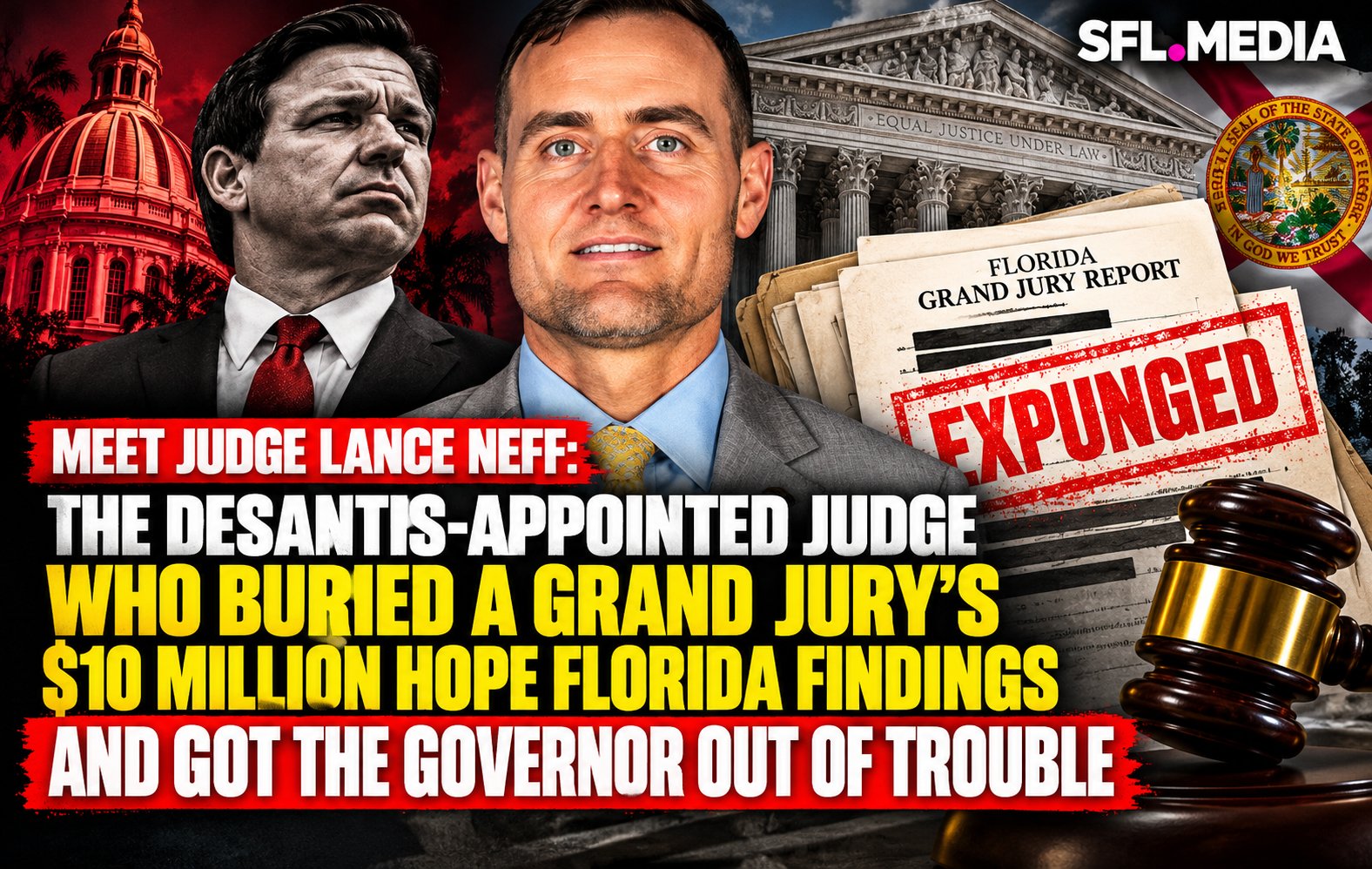
On October 7, the First District Court of Appeal ordered the Leon County grand jury’s presentment expunged in full. Judge Lance Neff authored the principal opinion, joined by Judge M.K. Thomas, while Judge Ross Bilbrey agreed with the outcome on narrower grounds. The decision concluded that the grand jury exceeded its authority in publicly accusing identifiable individuals of wrongdoing without indicting them and that statutory protections governing confidential presentments had been violated.
Neff had been appointed to the appellate court by DeSantis in March 2026, following an earlier appointment to the circuit bench by the same governor in 2023. Those appointments are documented, and the court’s ruling provided the administration with a significant legal victory. They do not, without additional evidence, establish improper influence or judicial misconduct. The opinion also rejected the grand jury’s interpretation of the settlement, emphasizing that the $10 million was paid directly by Centene to Hope Florida as a third-party donation rather than being transferred from money already held by the state. The court concluded that the statutes cited by the grand jury did not support its misappropriation finding.
That decision is consequential, but it does not eliminate the independent records of the settlement, foundation grants, nonprofit transfers, and political contributions. It also does not decide every conceivable question under federal tax law or Florida campaign finance law. Those distinctions are central to understanding why the controversy continues despite the appellate ruling.
What Would Real Accountability Look Like?
Accountability could take several forms, depending on what further examination establishes. A campaign finance inquiry could determine whether the nonprofit transfers complied with disclosure requirements and restrictions on conduit contributions. A federal tax review could evaluate whether the organizations accurately reported their activities and complied with the rules governing their tax-exempt status. Legislative oversight could examine how the settlement was negotiated and whether Florida needs stronger restrictions on third-party payments associated with government recoveries.
Civil litigation is another possibility, but it would require a legally sustainable claim, identifiable defendants, and evidence of compensable harm. Criminal penalties would require proof of specific offenses under applicable law, and no person should be treated as criminally responsible merely because a grand jury criticized the transactions or because a political opponent demands punishment. Administrative penalties, repayment obligations, or changes to nonprofit status would likewise depend on the authority of the relevant agency and the facts established through proper proceedings.
Political accountability is separate from legal punishment. Voters, donors, businesses, and advocacy groups can seek greater transparency, demand explanations from elected officials, support legislative reforms, and make the issue part of future campaigns. Those responses do not require a criminal conviction, but they should be grounded in accurate descriptions of the transactions and the court’s findings.
The most consequential unanswered question is whether the cannabis industry’s major financial backers will move beyond their previous election spending and use the available legal and political mechanisms to demand an independent accounting. As of this reporting, their intentions concerning new Hope Florida specific litigation have not been established.
The $150 Million Question: Will Florida’s Cannabis Power Players Fight Back?
Florida’s marijuana legalization supporters entered the 2024 election with an extraordinary financial commitment and left with a majority of the vote but no constitutional victory. The campaign’s defeat was lawful under the state’s 60% requirement, and there is no established evidence that the Hope Florida transfers changed enough votes to determine the outcome.
What emerged afterward was a documented funding trail that raises questions extending beyond marijuana policy. A state-negotiated healthcare settlement included a $10 million payment to Hope Florida, two nonprofit organizations received that money, and $8.5 million subsequently reached a political committee chaired by the governor’s chief of staff. A grand jury condemned the arrangement without issuing indictments, and an appellate court later rejected its central legal theory and ordered the report expunged.
For DeSantis, Moody, and Uthmeier, the controversy concerns the exercise of government authority and the financial arrangements surrounding a politically sensitive settlement. For Trulieve, Kim Rivers, John Morgan, and other supporters of legalization, it raises a different question: whether they will seek further scrutiny of the money trail and pursue available remedies if evidence supports violations of law.
The documented transactions justify continued examination, but they do not establish that the election was stolen, that every official involved committed misconduct, or that cannabis companies are entitled to recover their campaign spending. Those conclusions would require evidence and legal findings beyond what is presently available.
The more immediate demand is straightforward: a complete, independently verifiable accounting of how the settlement payment was negotiated, why the foundation grants were approved, what the nonprofit organizations represented about their intended activities, and how the money ultimately financed political operations. Florida’s cannabis industry spent more than $150 million trying to change the law. The question now is whether its most powerful backers will invest comparable determination in finding out whether the law was followed by the people who opposed them.






































Want to join the conversation?
Create an account or sign in to share your thoughts, vote,
and reply to other readers.
Showing 0 of 0 comments
Don't have an account?
Already have an account?