
David Jolly Says Florida’s Republican Advantage Is Cracking as Governor’s Race Enters Final Stretch
Former Republican Congressman Points to Affordability, Immigration Backlash and Democratic Election Swings as Evidence Florida’s Political Landscape Is Changing
Florida Democratic gubernatorial nominee David Jolly is making an aggressive argument as the 2026 governor’s race enters its final stretch: the Republican advantage that transformed Florida from the nation’s premier battleground into one of the GOP’s strongest large states is no longer as secure as recent election results might suggest.
Jolly, a former Republican congressman who later left the party and became a Democrat, is running against Republican Rep. Byron Donalds in the November 3 election to succeed term limited Gov. Ron DeSantis. Democrats have not won Florida’s governorship since Lawton Chiles was reelected in 1994 and have not won a statewide race since 2018. President Donald Trump carried Florida by roughly 13 percentage points in 2024, underscoring how dramatically the state moved to the right during the previous decade.
Jolly nevertheless argues that the political environment has changed. Pointing to Democratic overperformance in recent special and municipal elections, economic anxiety and fractures within both parties, he says the margins that once separated Republicans from Democrats are shrinking. His argument is not that Florida has already returned to its old swing state identity, but that the political assumptions built around the state may now be colliding with an electorate increasingly focused on housing, insurance, healthcare, food, utilities and the overall cost of living.
Jolly’s Argument: “The Delta Is Gone”
At the center of Jolly’s case is what he describes as a disappearing Republican electoral advantage. During his CBS News interview, Jolly argued that internal polling available to both campaigns shows a fundamentally different race than Florida’s recent partisan history would suggest, claiming that Democrats would be ahead if the election were held under the current political environment.
That remains a campaign assertion rather than an established measurement of the electorate. Public polling has varied, and individual surveys should not be treated as proof that either candidate currently leads statewide. What is independently measurable, however, is movement in a series of recent Florida elections in which Democratic candidates have performed substantially better than the party did in comparable previous contests.
Jolly pointed to congressional special elections shifting by approximately 15 to 16 percentage points toward Democrats, state legislative races producing even larger swings and Democratic victories in places where Republicans had recently performed strongly. Those results have given Democrats evidence for their argument that voter enthusiasm and political conditions have changed, even if they do not establish what will happen in a much higher turnout statewide general election.
Special elections are imperfect predictors. Turnout is typically lower, the participating electorate can differ substantially from a presidential or gubernatorial election, and highly motivated voters can disproportionately influence the outcome. Repeated movement across unrelated races can nevertheless provide evidence of changing voter intensity, which is why both parties are closely watching Florida’s recent results.
Jolly has compared the broader political environment to a “1974 post Watergate moment,” arguing that economic frustration, dissatisfaction with Washington and political exhaustion could overwhelm Florida’s recent partisan history. The comparison is Jolly’s interpretation rather than a historical equivalence, but the economic pressure underlying his argument is central to the campaign.
Affordability Has Become the Center of Jolly’s Campaign
Rather than building his gubernatorial campaign primarily around national ideological disputes, Jolly has attempted to make affordability the organizing theme of his candidacy. Housing prices, homeowners insurance, rent, electricity, healthcare and food costs have become recurring themes as he argues that Florida’s economic growth has increasingly failed to translate into affordability for working and middle class residents.
Florida’s rapid population growth and years of rising property values have generated enormous wealth for some homeowners while making entry into the housing market increasingly difficult for younger and working class residents. Insurance has become particularly important as homeowners confront premiums shaped by hurricane exposure, reinsurance costs, litigation history and the enormous concentration of valuable property along vulnerable coastlines.
The issue has become sufficiently central that Donalds and Jolly are now fighting directly over competing insurance proposals. Donalds has attacked Jolly’s proposal to move hurricane wind coverage from private insurers into a state-backed structure, characterizing it as a potential new cost for homeowners. Jolly argues the proposal would substantially reduce premiums by changing how catastrophic wind risk is financed. The dispute illustrates how thoroughly affordability, rather than simply national partisan identity, has moved toward the center of the gubernatorial campaign.
Jolly is betting that those pocketbook pressures can reach voters who previously supported Republican candidates. Donalds is making his own affordability argument, emphasizing market oriented policies, workforce development and opposition to Democratic proposals he says would increase government intervention and costs. The general election is therefore developing into more than a referendum on national politics; it is also becoming a debate over what state government can realistically do about Florida’s increasingly expensive cost structure.
Immigration Could Test Republican Gains in South Florida
Immigration represents another potentially consequential dividing line. Republicans made dramatic gains among Hispanic voters in Florida during the Trump era, particularly in Miami-Dade County, helping dismantle the Democratic coalition that once made South Florida the foundation of the party’s statewide strategy.
Jolly argues that aggressive immigration enforcement is now creating political risk for Republicans among some of those same communities. His argument centers partly on Haitian and Venezuelan immigrants who have lived legally in the United States under Temporary Protected Status and other humanitarian programs, as well as mixed status families with deep roots in Florida.
The issue was highlighted when Donalds appeared on CBS’s Face the Nation in August. Moderator Margaret Brennan questioned him about the potential economic consequences of ending Haitian TPS, citing concerns from Florida Republican Reps. Carlos Gimenez and Maria Elvira Salazar about removing workers from industries already experiencing labor shortages.
Donalds defended the administration’s approach, arguing that temporary immigration programs cannot continue indefinitely and that the country needs consistent immigration enforcement. He said Florida should expand internships, apprenticeships, workforce training and adult retraining programs to prepare Floridians to fill positions in healthcare and other industries.
The exchange illustrated the broader disagreement between the candidates. Donalds argues that immigration policy must prioritize legal immigration, enforcement and assimilation. Jolly argues that the administration’s approach has crossed from enforcement into unnecessary disruption and cruelty, particularly when long-established families and legally present immigrants are affected.
“Alligator Alcatraz” Has Become a Political Symbol
Few immigration issues have become more politically recognizable in Florida than the Everglades detention facility widely known as “Alligator Alcatraz.” Jolly has called for the facility to be closed, incorporating it into his broader criticism of state and federal immigration enforcement and arguing that Florida can enforce immigration laws without embracing practices he considers unnecessarily punitive.
The facility’s significance extends beyond the physical detention center itself. For Jolly and other critics, it has become a symbol of an immigration system they say prioritizes political spectacle and deterrence over humane treatment. Republicans have defended stronger detention and deportation policies as necessary components of restoring immigration enforcement after what they describe as years of inadequate federal border control under the Biden administration.
The political question is whether voters who previously moved toward Republicans because of border-security concerns distinguish between stronger enforcement and the methods used to carry it out. That distinction could be especially important in South Florida, where immigration policy is not an abstract national debate but an issue that directly affects families, workplaces and communities.
Haitian, Venezuelan and Cuban Voters Could Be Central to the Debate
That question carries particular significance across South Florida. Cuban Americans have historically been more Republican than many other Hispanic constituencies, while Venezuelan voters have also moved toward Republicans amid intense opposition to the socialist government in Caracas. Haitian Americans represent another substantial constituency, particularly in Miami-Dade and Broward counties.
Jolly is attempting to separate border enforcement from the treatment of legal immigrants and people living in the United States under temporary protected status. His argument is that voters can favor a secure border while opposing policies they believe destabilize established families and communities.
Donalds and Republicans counter that temporary immigration status cannot automatically become permanent and that the United States must consistently enforce the limits established by immigration law. In his Face the Nation interview, Donalds specifically argued that temporary programs need defined endpoints while Florida simultaneously develops domestic workers to fill critical jobs.
The dispute creates a potentially revealing test of whether the Republican coalition assembled in South Florida during the Trump era remains durable when immigration enforcement directly affects communities that helped fuel those Republican gains.
Jolly Rejects Democratic Socialism, But Says Democrats Can Campaign Together
Jolly is also navigating ideological differences inside his own party. Florida Democrats nominated state Rep. Angie Nixon for the U.S. Senate race against Republican Sen. Ashley Moody. Nixon is a member of the Democratic Socialists of America, while Jolly’s political identity is rooted in his history as a former Republican who now presents himself as a moderate Democrat.
Jolly has made clear that he rejects socialism and identifies himself as a capitalist, while also saying ideological disagreements do not prevent Democratic candidates from campaigning around issues on which they agree. Nixon and Jolly have both emphasized affordability, housing, healthcare and economic pressure on Florida families, even as they occupy substantially different positions within the Democratic coalition.
That distinction matters because Republicans are attempting to connect Jolly with the Democratic Party’s progressive wing, while Jolly is attempting to construct a broader coalition that includes Democrats, independents and Republicans dissatisfied with the direction of their former party. Florida Democrats, meanwhile, are arguing that disagreements over ideology do not eliminate common ground on the cost of living.
The tension presents a straightforward general election challenge: whether candidates with substantially different political philosophies can emphasize shared economic priorities without allowing those differences to fracture the broader Democratic ticket.
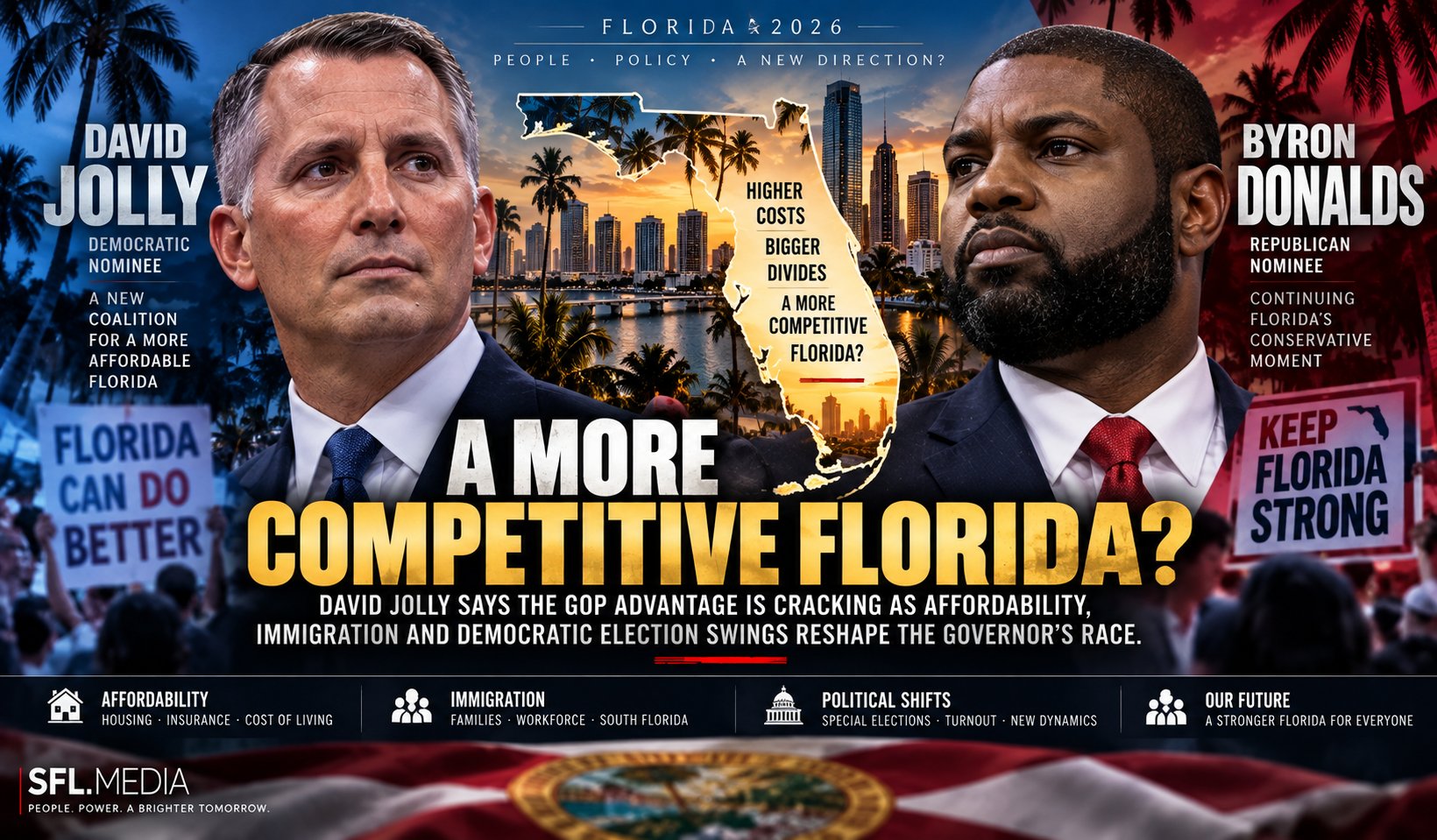
Donalds and Jolly Offer Two Very Different Political Paths
The governor’s race presents Florida voters with candidates who arrived at their current positions through remarkably different political trajectories.
Donalds has become one of the most visible Trump aligned Republicans in Congress. A former Florida state legislator elected to the U.S. House in 2020, he became associated with the House Freedom Caucus and the party’s conservative wing. Trump endorsed Donalds, and the congressman has positioned himself as an ideological continuation of the Republican transformation that moved Florida decisively to the right.
Jolly traveled in the opposite direction. He represented Florida in Congress as a Republican, became increasingly critical of Trump and the modern GOP, left the Republican Party and eventually joined the Democrats. His candidacy is consequently built in part around the proposition that Florida contains a meaningful bloc of independents, moderates and former Republicans willing to cross party lines.
Those biographies make the race an unusually direct test of two competing arguments about Florida politics: whether the state’s Republican transformation has become structurally durable, or whether enough voters remain politically movable to produce genuinely competitive statewide elections.
Race Has Also Entered the Campaign
The contest carries another historic dimension. If elected, Donalds would become Florida’s first Black governor. The racial significance of his candidacy has become part of the campaign alongside substantive disagreements over voting rights, education, historically Black colleges and universities and economic disparities.
Jolly has criticized Donalds’ record on voting-rights legislation and attacked earlier comments Donalds made about Black families during the Jim Crow era. Donalds has said those remarks were mischaracterized and that he was discussing changes in Black family structure rather than defending segregation.
The candidates have also clashed over education and support for Florida A&M University, one of the nation’s most prominent historically Black universities. Jolly has advocated increased support for FAMU and has argued that Florida government should more aggressively address racial disparities in healthcare, education and economic opportunity. Donalds has criticized Democratic approaches he associates with diversity, equity and inclusion policies and argues that opportunity should be expanded without embedding DEI frameworks into government policy.
The distinction is important because race is both historically significant to the contest and politically contested. The candidates’ records and proposals can be evaluated directly without reducing the election itself to racial identity.
Florida’s Recent History Still Heavily Favors Republicans, but Recent Elections Have Changed the Conversation
Any assessment of Florida’s political environment begins with the scale of the Republican Party’s gains. Republicans control the governor’s office and both chambers of the Legislature, while Trump won Florida three consecutive times and expanded his margin dramatically between 2016 and 2024. DeSantis won reelection by nearly 20 percentage points in 2022, and Democrats have repeatedly struggled to convert population growth and demographic change into statewide victories. Those are structural realities that a handful of special elections cannot erase.
But Democratic overperformance in recent lower-turnout elections has nevertheless changed the political conversation. Democrats can point to legislative, congressional and municipal contests in which their candidates improved substantially over recent partisan baselines, while Republicans can point to statewide registration trends, presidential results and years of electoral dominance as evidence that Florida’s broader realignment remains intact.
The result is a political environment containing two realities at once: Republicans enter the general election with the advantages created by years of statewide victories and organizational dominance, while Democrats can point to recent election results suggesting that the size of that advantage may be changing.
The Real Test Comes November 3
Jolly’s declaration that Florida’s political “delta is gone” is ultimately a campaign argument that voters will test in November. Special-election swings can demonstrate enthusiasm but cannot guarantee general-election outcomes. Internal polling can identify opportunities but is produced for campaigns, while public surveys provide snapshots rather than election results. Florida’s Republican registration advantage and recent statewide voting history remain significant, while Democratic victories and overperformance in recent special and municipal elections provide evidence that political behavior is not static.
What has clearly changed is the conversation surrounding the race. For much of the past several election cycles, Florida increasingly disappeared from the list of states where Democrats expected to compete seriously statewide. The 2026 governor’s race is forcing both parties to revisit some of the assumptions behind that conclusion.
Jolly is arguing that affordability, immigration backlash, independents and disaffected Republicans can assemble a coalition fundamentally different from the Democratic coalitions that repeatedly lost statewide. Donalds is arguing that Florida’s movement toward Republicans represents a deeper and more durable political realignment capable of surviving temporary dissatisfaction and Democratic gains in lower-turnout elections.
On November 3, Florida voters, not polling, special-election extrapolations or either campaign’s theory of the electorate, will determine the outcome.
Sources & Further Reading
- CBS News — David Jolly Says Florida Politics Are at a “1974 Post-Watergate Moment” — Jolly’s CBS News The Takeout interview discussing the governor’s race, Florida’s changing political environment and his argument that recent elections show movement toward Democrats.
- CBS News — Full Face the Nation Transcript: Byron Donalds, August 23, 2026 — Donalds discusses Haitian Temporary Protected Status, immigration enforcement, Florida’s workforce, healthcare and his gubernatorial campaign.
- CBS News Miami — David Jolly on the Governor’s Race, Hope Florida and Data Centers — Extended September 2026 interview with Jolly covering his campaign and policy agenda.
- CBS News Miami — Florida Democrats, David Jolly and Angie Nixon Discuss Party Unity and Socialism — Documents Jolly’s statement that he rejects socialism and identifies as a capitalist while discussing areas of agreement within the Democratic ticket.
- Florida Division of Elections — David Jolly Official 2026 Candidate Record — Official state record confirming Jolly as the Democratic gubernatorial nominee and Gwen Graham as his running mate.
- Florida Division of Elections — Byron Donalds Official 2026 Candidate Record — Official state record confirming Donalds as the Republican gubernatorial nominee and Bryan Avila as his running mate.
- CBS News Miami — David Jolly Selects Gwen Graham as Running Mate — Background on the Democratic gubernatorial ticket and Graham’s selection.
- PolitiFact — Fact-Checking Jolly and Donalds on Florida Homeowners Insurance — Detailed examination of Jolly’s proposed state-backed wind insurance plan, Donalds’ criticism of the proposal and assessments from insurance experts.














































Want to join the conversation?
Create an account or sign in to share your thoughts, vote,
and reply to other readers.
Showing 0 of 0 comments
Don't have an account?
Already have an account?