
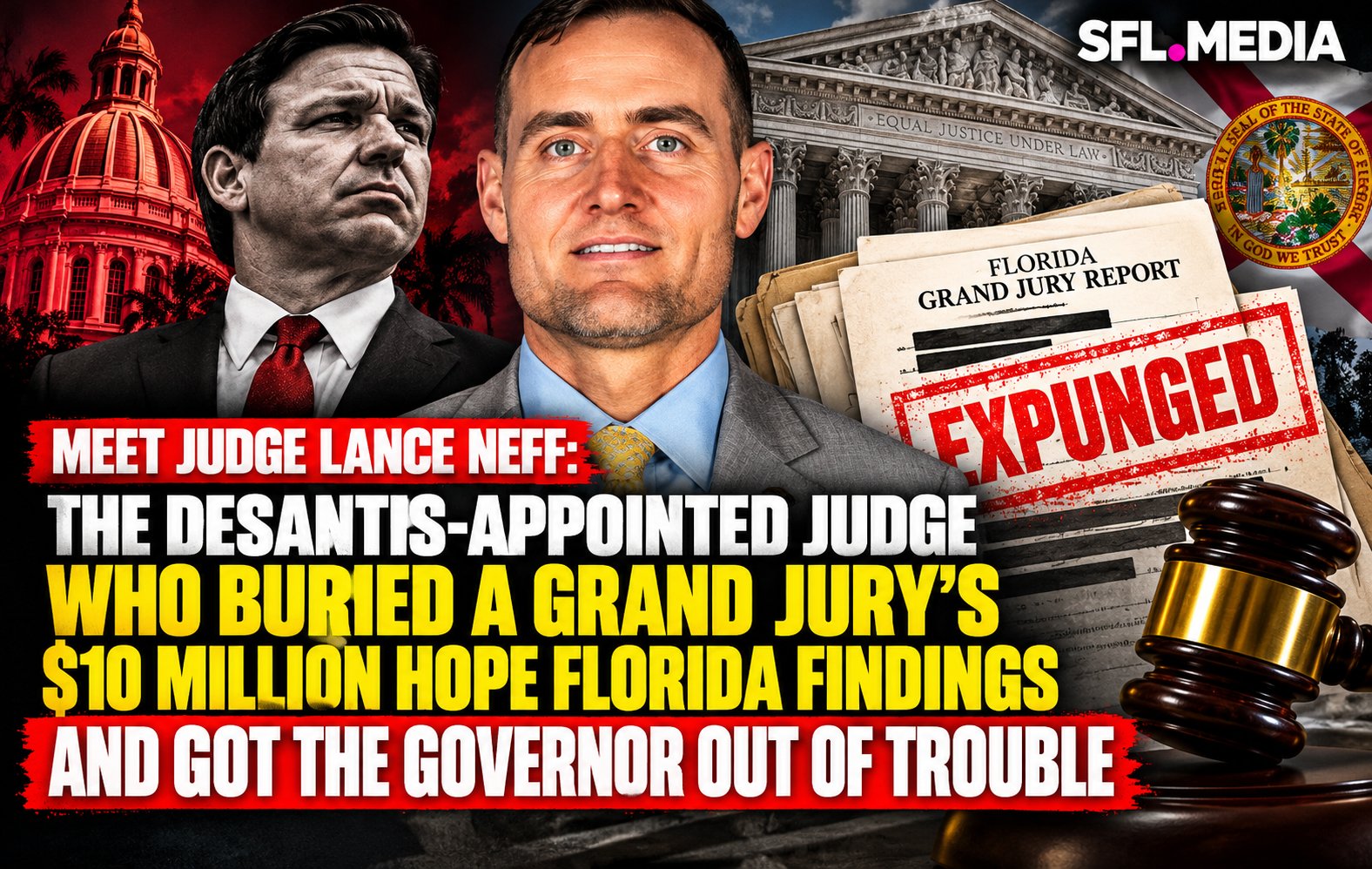
Meet Judge Lance Neff: The DeSantis Appointee Who Erased a Florida Grand Jury’s Findings in the $10 Million Hope Florida Scandal
From Florida’s attorney general’s office to the DeSantis administration and ultimately the appellate bench, Judge Lance Neff’s career has repeatedly intersected with the state’s political leadership. His decision to expunge a grand jury report examining the Hope Florida money trail has raised questions about judicial independence, government transparency, and the limits of citizen oversight.
The Judge Who Made a Grand Jury Report Disappear
A Florida grand jury spent months examining how $10 million connected to a state negotiated healthcare settlement moved through the Hope Florida Foundation and eventually helped finance political efforts against recreational marijuana legalization. Jurors reviewed financial transactions, investigated the roles of senior state officials, and concluded that settlement money had been misappropriated. Although the grand jury did not return criminal indictments, its findings raised serious questions about the administration of Governor Ron DeSantis, the involvement of former Attorney General Ashley Moody, and the activities of current Attorney General James Uthmeier.
Then the case reached Florida’s First District Court of Appeal, where Judge Lance Neff authored an opinion ordering the grand jury’s entire presentment expunged. The October 7, 2026, ruling rejected significant portions of the grand jury’s legal reasoning and concluded that the report exceeded the boundaries of Florida law by criticizing identifiable individuals without criminal indictments and violating statutory confidentiality protections. The decision overturned a lower court’s approach that would have allowed a limited portion of the report to survive, giving the DeSantis administration a substantial legal victory in one of Florida’s most closely watched government accountability controversies.
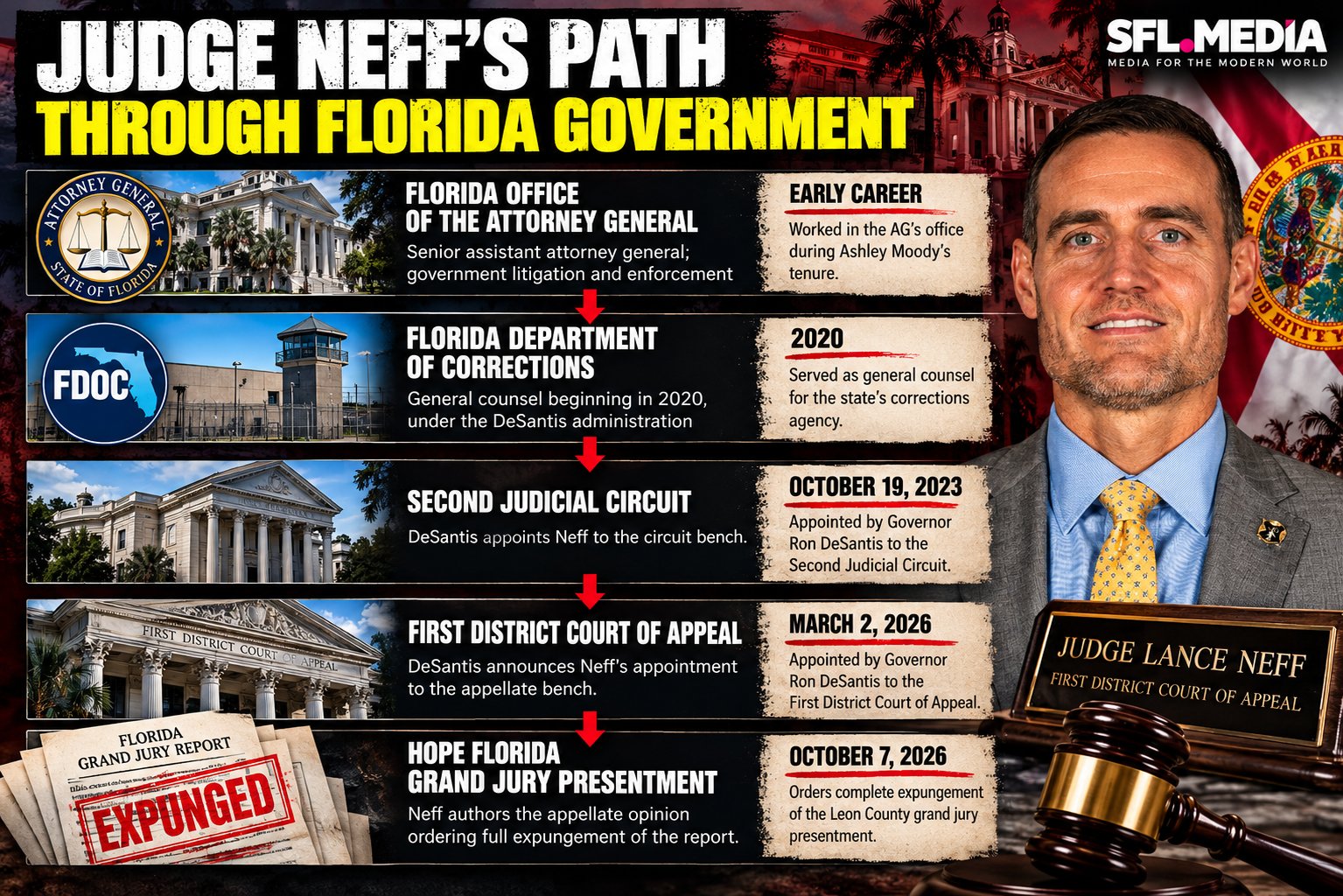
The ruling immediately brought Neff’s professional history into sharper focus. Before becoming an appellate judge, he worked in the Florida attorney general’s office, served as general counsel for the Department of Corrections under the DeSantis administration, and received two judicial appointments from the governor. His elevation to the First District Court of Appeal came in March 2026, after the grand jury had completed its investigation and approximately seven months before he authored the opinion that eliminated its presentment from the official record.
Those connections are documented, but they do not establish that Neff acted under political instructions or that his decision was improperly influenced. The significance of his background lies in the institutional relationships, appointment history, and judicial reasoning that can be examined through public records. His ruling also presents a broader question about Florida’s accountability system: What happens when a citizen grand jury investigates government conduct, only for an appellate court to determine that its conclusions cannot lawfully be published?
Who Is Judge Lance Neff?
Lance E. Neff is a judge on Florida’s First District Court of Appeal in Tallahassee, where he hears appeals involving state government, civil litigation, criminal matters, and other disputes arising within the court’s jurisdiction. His professional background includes extensive government legal work, military service, and judicial experience. According to official biographies and Florida Bar reporting, Neff earned his bachelor’s degree from Valdosta State University and his law degree from Florida Coastal School of Law before building a career that included complex litigation, corrections law, and Medicaid fraud enforcement.
Before joining the judiciary, Neff worked as a senior assistant attorney general in Florida’s Office of the Attorney General, where his responsibilities included litigation involving government agencies and enforcement matters. He later became general counsel for the Florida Department of Corrections in 2020, serving as a senior legal adviser to one of the state’s largest executive agencies during the DeSantis administration. His military background includes service as a lieutenant colonel and judge advocate in the Florida National Guard, with legal leadership responsibilities and deployment experience. He has also been identified as a Florida Bar board certified civil trial lawyer.
Neff’s judicial career began with an appointment from DeSantis on October 19, 2023, when the governor selected him to serve on the Second Judicial Circuit Court following the death of Judge Kevin Carroll. On March 2, 2026, DeSantis announced Neff’s elevation to the First District Court of Appeal, filling the vacancy created when Judge Adam Tanenbaum was appointed to the Florida Supreme Court. Neff was among six candidates recommended by the appellate court’s Judicial Nominating Commission, meaning his selection followed Florida’s established judicial appointment process rather than bypassing it.
The appointments established a direct and continuing professional relationship between Neff and the governor. Both advancements in Neff’s judicial career came through decisions made by DeSantis, while his earlier work placed him within executive branch legal institutions operating under the same administration. That history is relevant to understanding why his participation in the Hope Florida appeal has attracted scrutiny, although gubernatorial appointment and prior government employment do not independently demonstrate a judicial conflict of interest.
From Ashley Moody’s Attorney General’s Office to the DeSantis Administration
Neff’s professional connection to Florida’s political leadership predates his judicial appointments. As a senior assistant attorney general, he worked within the state’s principal legal office, an institution responsible for representing Florida’s interests in litigation, providing legal services to government agencies, and pursuing certain enforcement matters. His experience included complex litigation and issues involving corrections and Medicaid fraud, giving him familiarity with the legal framework governing state agencies and disputes involving public funds.
That employment creates an institutional connection to Ashley Moody, who served as Florida attorney general from January 2019 until her appointment to the United States Senate in 2025. Moody’s office was involved in approving the Centene settlement that subsequently became central to the Hope Florida controversy, making Neff’s earlier service within the same institution relevant background. However, available records do not establish that Neff personally participated in the Centene negotiations, worked on the Hope Florida arrangement, or had a special relationship with Moody concerning the settlement.
The distinction matters because employment within the same government institution does not necessarily establish personal involvement in a later controversy. Florida’s attorney general’s office employs numerous attorneys who work across different divisions, agencies, and litigation matters. Any claim that Neff possessed confidential information about Hope Florida or maintained a disqualifying professional relationship would require specific evidence identifying his role, communications, or involvement in the underlying events.
Neff’s subsequent position as general counsel for the Florida Department of Corrections brought him directly into the DeSantis executive branch. Beginning in 2020, he advised a major state agency on legal matters while James Uthmeier also occupied senior positions in the governor’s administration. Their government service overlapped, but the available records do not establish that Uthmeier directly supervised Neff or that the two collaborated on the Centene settlement. The overlap is a documented institutional connection, not proof of a personal alliance or coordinated political activity.
Two Appointments, One Governor: The Documented DeSantis Connection
The clearest connection between Neff and DeSantis is established by the governor’s own judicial appointment announcements. DeSantis selected Neff for the circuit bench in October 2023 and elevated him to the appellate court in March 2026, advancing his judicial career on two separate occasions. The second appointment placed Neff on the court that would later decide whether the Leon County grand jury’s findings concerning Hope Florida could remain part of the official record.
The governor’s February 27, 2026, appointment letter to Neff provides additional documentation of that professional relationship. In the correspondence, DeSantis expressed his “utmost confidence” in Neff’s ability to serve with distinction. Such language is consistent with the ordinary practice of gubernatorial judicial appointments and does not establish an agreement concerning any future case. Nevertheless, it demonstrates the governor’s formal endorsement of the judge shortly before Neff joined the appellate court.
The chronology has become a central feature of the controversy. The grand jury issued its presentment on January 28, 2026, DeSantis announced Neff’s appellate appointment in early March, and Neff authored the expungement opinion on October 7. That sequence establishes that Neff joined the court after the grand jury completed its work but before the appeal was resolved. It does not establish that DeSantis selected him specifically to influence the Hope Florida litigation, particularly given the role of the Judicial Nominating Commission in recommending candidates.
The appointment history nevertheless raises a question about public confidence in judicial independence. Florida’s appellate courts regularly review disputes involving the executive branch, and judges appointed by governors are expected to decide those cases impartially. When an appellate decision concerns the conduct of the administration responsible for a judge’s appointments, the public has a legitimate interest in examining the judge’s professional relationships, any applicable disclosure obligations, and the legal reasoning supporting the outcome. The appropriate measure is whether the decision follows the law and whether any evidence establishes a conflict beyond the ordinary appointment relationship.
The $10 Million Hope Florida Scandal That Reached Neff’s Court
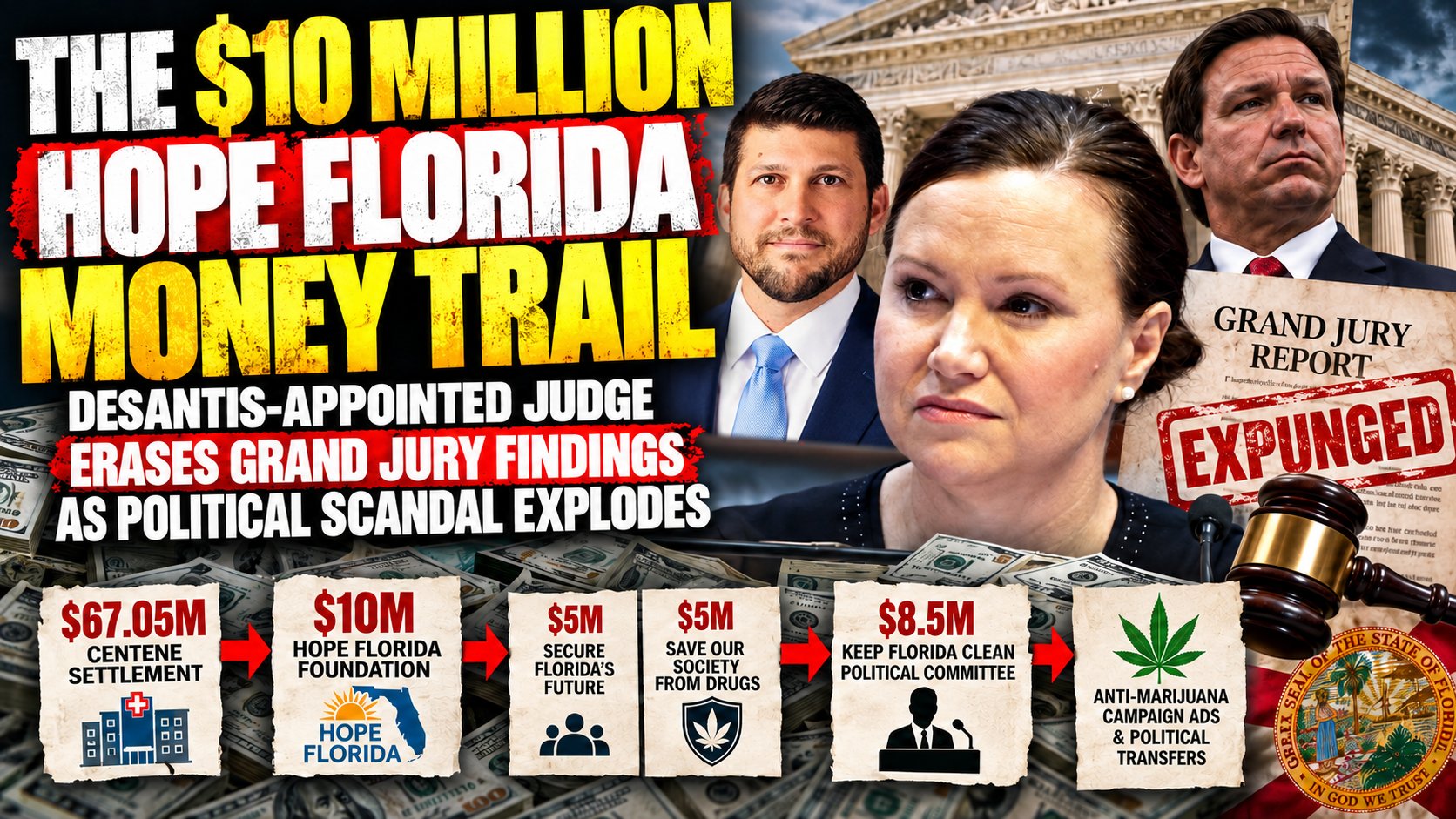
The controversy originated in a September 2024 settlement between Florida and Centene Corporation, a major healthcare company accused of overcharging the state’s Medicaid program. The agreement totaled approximately $67.05 million, with roughly $57.05 million directed to the state and $10 million paid to the Hope Florida Foundation, an organization associated with First Lady Casey DeSantis’s signature assistance initiative. The separate foundation payment became controversial because it originated in negotiations involving the state’s recovery of money connected to healthcare programs.
Hope Florida subsequently awarded two $5 million grants to Secure Florida’s Future and Save Our Society From Drugs, nonprofit organizations organized under Section 501(c)(4) of the federal tax code. Those organizations later transferred a combined $8.5 million to Keep Florida Clean, a political committee chaired by Uthmeier, who served as DeSantis’s chief of staff during the relevant period. The committee was campaigning against Amendment 3, the 2024 constitutional amendment that would have legalized recreational marijuana for adults. Although approximately 56% of participating voters supported the measure, it failed because Florida requires 60% approval for constitutional amendments.
The financial arrangement attracted scrutiny because money originating in a state negotiated healthcare settlement ultimately reached a political committee closely aligned with the governor’s position on marijuana legalization. Investigators examined whether the settlement proceeds had been properly directed to the foundation, whether the nonprofit grants were consistent with their stated purposes, and whether the subsequent political contributions complied with applicable law. The transactions were documented, but questions remained about who proposed the foundation payment, why the money followed that particular route, and what the participants understood about its ultimate use.
A Leon County grand jury investigated the matter and issued a 116-page presentment in January 2026, consisting of a 19 page report and supporting exhibits. The grand jury concluded that the $10 million had been misappropriated in connection with political spending, but it did not indict anyone because investigators could not establish sufficient evidence to identify a particular individual legally responsible for the disputed arrangement. The absence of indictments became central to the subsequent appellate dispute because the report criticized identifiable individuals while acknowledging that criminal charges were not supported by the available evidence.
What Judge Neff Actually Ruled
Neff’s October 7 opinion, issued in In re: Leon County Grand Jury Presentment, Fall of 2025, examined the limits of grand jury authority under Florida law. The appellate court concluded that the grand jury had improperly characterized the $10 million payment as misappropriated, criticized identifiable individuals without indicting them, and failed to comply with statutory confidentiality protections governing the report’s distribution. The opinion rejected the grand jury’s reliance on Florida Statutes Sections 45.062 and 216.216, explaining that the Centene settlement was reached before a civil lawsuit had been filed and that the provisions invoked by the grand jury did not apply in the manner the report suggested.
The court also emphasized that Centene paid the $10 million directly to Hope Florida rather than first depositing the money into a state account. On that basis, Neff rejected the grand jury’s characterization of the payment as money diverted from funds already belonging to the state. The opinion further questioned aspects of the grand jury’s accounting, including its treatment of settlement components associated with other potential damages and incentives to resolve the dispute. These findings challenged the legal foundation of the grand jury’s misappropriation conclusion, although they did not constitute a comprehensive adjudication of every potential issue involving the subsequent nonprofit and political committee transfers.
A separate part of the opinion concerned the rights of individuals criticized in grand jury reports. Neff wrote that the presentment effectively accused named people of serious wrongdoing despite the absence of criminal indictments, raising concerns about reputational harm and the procedural protections afforded to those individuals. The court also determined that the state attorney’s office improperly distributed the confidential presentment before the affected parties had received the full opportunity provided by Florida law to challenge its publication.
The decision was not Neff acting alone. Judge M.K. Thomas joined his opinion, while Judge Ross Bilbrey agreed that the report should be expunged but would have based that result solely on the improper disclosure issue rather than reaching the merits of the grand jury’s conclusions. The three judge panel therefore agreed on the outcome, although not on every reason supporting it. That distinction matters because the ruling represented an appellate court decision rather than a unilateral order issued by one judge.
Why the Court Ordered the Entire Report Expunged
One of the most consequential aspects of the ruling was the decision to require full expungement rather than allowing a heavily redacted version of the grand jury’s findings to remain. The circuit court had already ordered approximately 112 of the presentment’s 116 pages expunged or repressed, including witness information, exhibits, and substantial portions of the investigative findings. The remaining dispute concerned whether the limited surviving material could lawfully be published. Neff’s opinion concluded that the report’s central accusations and legal conclusions were so interconnected that the remaining material could not properly stand on its own.
Florida Statute Section 905.28 establishes procedures for challenging grand jury presentments that criticize identifiable individuals without resulting in indictments. The law requires notice to affected individuals and provides an opportunity to seek repression or expungement before publication, with public release stayed while qualifying challenges proceed. The appellate court relied on those protections and Florida precedent concerning grand jury authority, reputational harm, and premature disclosure. It would therefore be inaccurate to suggest that Neff invented an unprecedented legal procedure or ordered the report expunged solely because the grand jury used the word misappropriation.
The scope of the remedy nevertheless has significant implications for government transparency. The grand jury investigated a documented series of financial transactions involving a state-negotiated settlement, a foundation associated with the first lady, nonprofit organizations, and political expenditures. By ordering the entire presentment expunged, the appellate court removed the formal investigative conclusions that the jurors had prepared for potential public examination. The underlying settlement documents, political contribution records, and independently obtained evidence remain separate from the expunged presentment, but the court’s decision substantially restricted the report’s official publication.
The case illustrates the tension between two recognized legal interests: the public’s interest in examining possible government misconduct and the right of individuals not charged with crimes to be protected from improper accusations issued through secret grand jury proceedings. Florida law recognizes both interests, and the appellate court determined that the protections afforded to the individuals criticized in this report had been violated. Whether that interpretation strikes the appropriate balance is a legitimate subject of legal analysis, particularly when the investigation concerns the actions of senior government officials.
The Appeal’s Unusual Procedural History Raises Additional Questions
The proceedings leading to the October decision have drawn scrutiny beyond the substance of Neff’s opinion. Reporting by the Florida Trident describes an appellate process in which no party presented a substantive defense of the grand jury report’s conclusions. State Attorney Jack Campbell, whose office oversaw the grand jury investigation, had initially challenged the lower court’s partial expungement decision but later withdrew his appeal. The state was represented in the appellate proceedings through specially appointed counsel because Uthmeier, the attorney general, was himself among the individuals involved in the dispute.
The Florida Trident reported that the court’s opinion recorded no argument from the state defending the presentment’s substance and that parties seeking access to the report were not permitted to participate in the appeal in the manner they sought. The appellate court’s reasoning treated confidentiality as extending to proceedings associated with motions to repress or expunge grand jury material. Those restrictions were significant because the judges considered arguments seeking to eliminate the report while the ordinary adversarial process was constrained by secrecy rules and the procedural posture of the case.
The timing also attracted attention. According to the Trident, the appellate court received the record on September 9 and issued its decision on October 7, approximately four weeks later. The relatively rapid resolution came shortly before Florida’s November election, in which Uthmeier was on the ballot. The timing alone does not establish that the court accelerated the case for political reasons, but the combination of confidentiality restrictions, limited adversarial participation, and the ruling’s political consequences warrants careful examination of the docket and procedural orders.
These details are important because appellate decisions are ordinarily tested through competing legal arguments. When a politically consequential case proceeds without a party fully defending the challenged document, the public may have fewer opportunities to see the competing interpretations tested in open court. That does not invalidate the appellate court’s jurisdiction or its authority to enforce confidentiality requirements, but it provides context for understanding why the process has become part of the controversy.
DeSantis Celebrates the Decision as a Victory for His Administration
Governor DeSantis responded to the appellate decision by declaring that it vindicated his administration’s handling of the Hope Florida settlement. Speaking publicly on October 8, he criticized the grand jury report and portrayed the ruling as a decisive rejection of allegations that his administration had improperly redirected settlement funds. The governor also praised Neff’s opinion, drawing additional attention to the fact that the judge responsible for the court’s principal reasoning had received two judicial appointments from DeSantis.
The administration’s response emphasized the appellate court’s conclusion that the $10 million payment to Hope Florida was not misappropriated under the legal theories advanced by the grand jury. DeSantis and his allies argued that the ruling demonstrated the underlying controversy had been exaggerated and that the grand jury had exceeded its authority. The decision provided substantial support for challenging the report’s legal conclusions, particularly its characterization of the settlement and its treatment of individuals who had not been indicted.
However, the appellate ruling did not resolve every question involving the Hope Florida transactions. The court did not conduct a criminal trial of DeSantis, Moody, Uthmeier, or the nonprofit recipients, nor did it adjudicate every potential issue under federal tax law or campaign finance law. Its decision addressed the grand jury’s presentment, the legal theories it advanced, and the statutory rules governing publication. The documented transfers from Centene to Hope Florida, from the foundation to two nonprofits, and from those organizations to Keep Florida Clean remain matters of public record.
The governor’s praise of Neff also does not establish that the judge acted to secure political approval. Judges are routinely appointed by governors and later decide cases involving their administrations, sometimes ruling for the state and sometimes against it. The relevant questions concern the reasoning of the decision, the existence of any disqualifying relationship, and whether applicable judicial procedures were followed.
Taxpayers Have Also Paid Hundreds of Thousands in Legal Fees
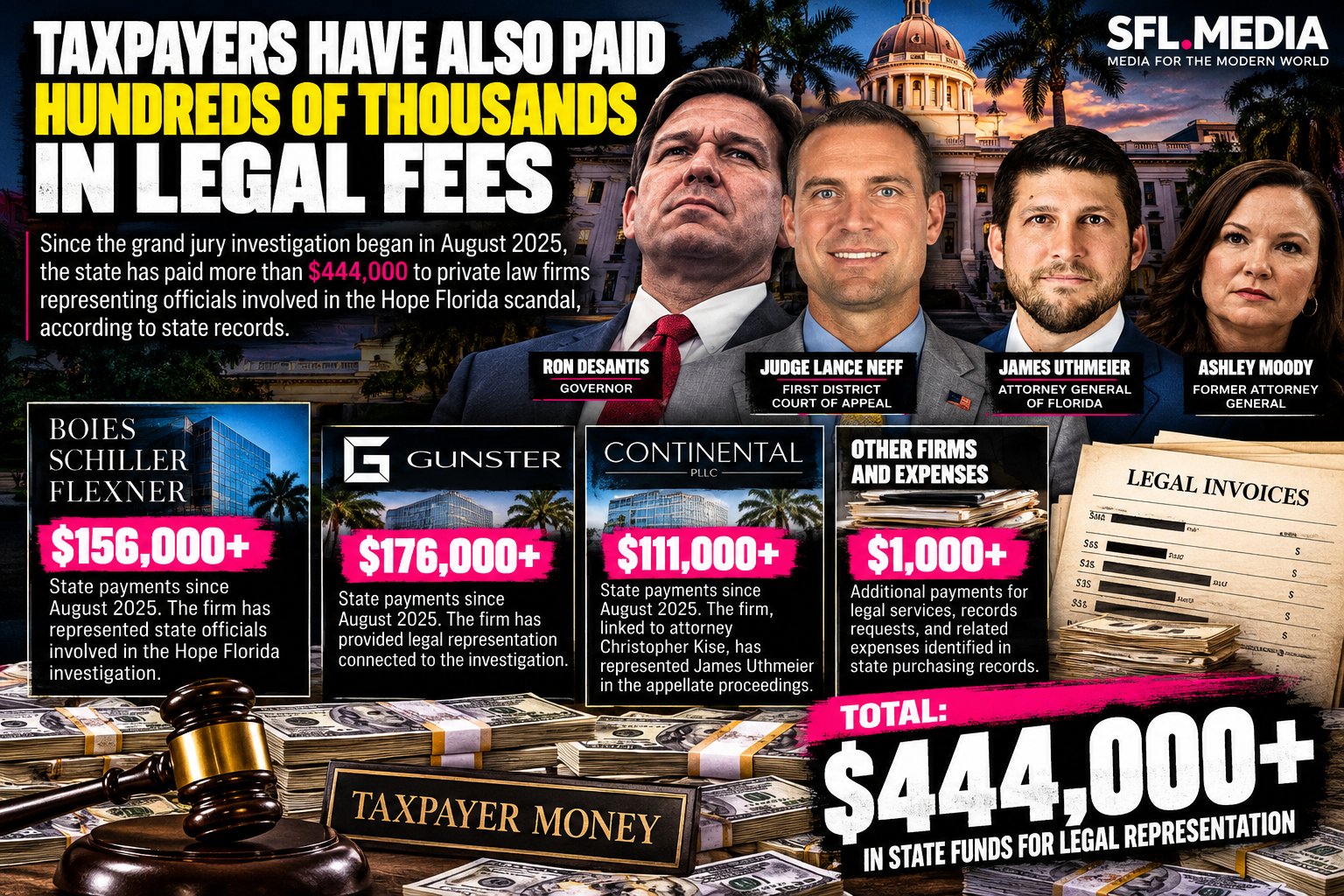
The legal battle over the Hope Florida grand jury report has generated substantial public expenditures beyond the original settlement. An October 9 investigation by the Florida Trib found that law firms hired to represent state officials scrutinized during the grand jury proceedings had received more than $444,000 in state funds since the investigation began in August 2025. The reporting was based on state purchasing records and contracts, with some attorneys billing at rates approaching $900 per hour.
According to the Trib’s review, the firms included Boies Schiller Flexner, Gunster, and Continental PLLC, whose work was connected to representation of officials or agencies involved in the controversy. The records identified payments exceeding $111,000 to Continental, a firm associated with attorney Christopher Kise, who represented Uthmeier in the appellate proceedings. The reporting also identified substantial payments to firms connected with other participants in the legal dispute, although the underlying contracts did not always identify individual clients.
Those expenditures create a separate accountability question because taxpayer funds were used for legal representation during proceedings concerning a government negotiated settlement and the subsequent effort to restrict publication of the grand jury’s findings. Public officials and government agencies may have legitimate reasons to retain outside counsel in matters connected to their official duties, but the authorization, scope, and public purpose of those expenditures remain appropriate subjects for scrutiny.
The reported payments also raise questions about whether the legal representation complied with applicable state rules and attorney general opinions governing publicly funded counsel for employees involved in grand jury investigations. Determining whether particular expenditures were improper would require examination of the contracts, invoices, the identity and official status of each client, and the legal authority supporting the payments. The existence of large legal bills is not itself proof of misconduct, but the spending adds another significant financial dimension to the Hope Florida controversy.
Could Neff’s Government Connections Create a Judicial Ethics Problem?
The question of judicial ethics is more demanding than the question of political appearances. Florida judges are required to act impartially, avoid improper communications, disclose certain conflicts, and disqualify themselves when applicable legal standards require recusal. The Florida Judicial Qualifications Commission has authority to investigate alleged judicial misconduct and recommend discipline when supported by evidence. These safeguards are intended to preserve public confidence in the judiciary while protecting judges from discipline based solely on disagreement with their decisions.
Neff’s prior government employment and two appointments by DeSantis are relevant background, but those facts alone do not demonstrate an ethical violation. Florida governors appoint judges through a constitutionally established process, and appointed judges routinely hear cases involving government agencies or officials who selected them. A rule automatically disqualifying gubernatorial appointees from such matters would fundamentally alter the state’s judicial system and is not the standard established by Florida law.
A more substantive inquiry would examine whether Neff personally participated in the Centene negotiations, previously advised an agency or official concerning Hope Florida, possessed confidential information material to the dispute, maintained a financial interest in the outcome, or engaged in undisclosed communications about the appeal. Evidence of such circumstances could raise distinct questions under judicial ethics and disqualification rules. The available reporting does not establish that any of those circumstances occurred, and there is no demonstrated basis in the reviewed record for concluding that Neff committed judicial misconduct.
There is also an important distinction between criticizing the substance of an appellate opinion and alleging wrongdoing by its author. A judicial decision may be challenged as overly restrictive of public oversight, legally incorrect, or inconsistent with the appropriate balance between confidentiality and transparency without establishing that the judge violated ethical obligations. Legal disagreements are ordinarily addressed through further judicial review, while disciplinary proceedings require evidence of conduct that breaches judicial standards.
What an Independent Examination of Neff’s Record Could Establish
A comprehensive examination of Neff’s relationship with the DeSantis administration would begin with his judicial appointment applications, professional disclosures, employment history, and any relevant records of judicial disqualification. His applications to judicial nominating commissions, financial disclosure filings, and publicly available government records could help establish the scope of his professional relationships and whether any matters connected to Hope Florida arose during his earlier legal service.
Records concerning Neff’s work as general counsel for the Department of Corrections could also clarify the extent of his involvement with senior executive officials. Although his position placed him within the DeSantis administration, the available material does not demonstrate that Uthmeier directly supervised him or that they collaborated on the Centene settlement. Establishing a closer operational relationship would require contemporaneous documents, communications, or testimony rather than inference from overlapping government employment.
The appellate proceedings themselves provide another avenue for examination. The complete docket, briefs, procedural orders, panel assignments, and any motions concerning judicial disqualification could help explain how the case reached the panel, why particular parties were excluded from participation, and how the court reached its decision to require full expungement. Those materials would also provide context for evaluating whether the court’s handling of the appeal followed ordinary procedures for confidential grand jury matters.
An inquiry grounded in these records could determine whether Neff’s documented connections were limited to routine government service and judicial appointments or whether additional circumstances existed that warranted disclosure or recusal. Such an examination would be more informative than assuming that a favorable ruling for the administration necessarily resulted from political coordination.
What Happens When a Grand Jury Investigates the Government?
Florida grand juries occupy an unusual position within the justice system because they can investigate potential criminal conduct, compel testimony, review financial records, and issue indictments when the evidence supports criminal charges. They also have recognized authority to examine certain aspects of government administration and report findings concerning public affairs, even when no indictment results. That broader oversight function makes grand juries an important mechanism for examining official conduct outside the ordinary legislative and executive review processes.
The courts, however, have established limits on grand jury reports that publicly criticize identifiable individuals without charging them with crimes. Grand jury proceedings occur largely in secret, and individuals criticized in a presentment do not necessarily receive the opportunity to challenge testimony, cross-examine witnesses, or present a defense comparable to the protections available in criminal proceedings. Florida’s statutory procedures for repression and expungement reflect an effort to prevent the grand jury process from becoming a means of issuing unsupported public accusations.
Neff’s opinion relied on those protections, concluding that the Hope Florida grand jury exceeded its lawful authority by declaring conduct unlawful while declining to indict anyone and by allowing confidential material to be distributed prematurely. The court’s reasoning therefore rested on established legal principles concerning due process and grand jury confidentiality, even as its application to this particular investigation has generated debate.
The consequences for public oversight remain significant. The grand jury investigated a documented financial sequence involving a healthcare settlement, a foundation associated with the governor’s wife, nonprofit organizations, and political campaign financing. Its report was intended to communicate investigative findings, but the appellate court concluded that the presentment could not lawfully be published in the form the jurors produced. The case illustrates how legal protections for individuals criticized in secret proceedings can limit the public release of investigative conclusions, particularly when no criminal charges result.
The Larger Question of Judicial Independence and Government Accountability
The Hope Florida controversy has become a test of several overlapping accountability systems. The executive branch negotiated the settlement, a foundation associated with the first lady received a substantial payment, nonprofit organizations transferred most of the foundation’s grants to a political committee, and a grand jury investigated the arrangement. The judiciary then intervened to determine whether the grand jury’s conclusions could lawfully become public, while the administration defended the transactions and celebrated the appellate ruling.
Each institution operates under different legal responsibilities. The grand jury could investigate potential wrongdoing but could not indict without sufficient evidence. The appellate court could determine whether the presentment complied with Florida law but did not conduct a comprehensive audit of every transaction. The governor could defend his administration’s actions, but public statements do not substitute for documentation explaining how the settlement was negotiated, how the foundation grants were approved, or why the money ultimately reached political organizations.
Neff’s ruling illustrates the difficulty of separating those institutional questions from Florida’s political environment. He previously worked in executive-branch legal positions, received two appointments from DeSantis, and authored an appellate opinion that substantially benefited the administration’s position in a major controversy. Those facts make his career and judicial reasoning newsworthy, while the absence of evidence establishing improper influence remains an essential limitation on any allegation concerning his conduct.
The public interest questions extend beyond Neff personally. Floridians still have reason to examine who proposed the Hope Florida payment, why the money moved through the particular organizations involved, what safeguards governed the foundation’s grants, and whether the relevant laws adequately address such arrangements. The case also raises broader questions about how courts should balance grand jury confidentiality with the public’s interest in investigating government officials and state-negotiated settlements.
Meet Judge Lance Neff: The Report Was Expunged, but the Financial Questions Remain
Judge Lance Neff’s name is now closely associated with one of Florida’s most consequential government accountability controversies. His October 7 opinion directed the expungement of the Leon County grand jury’s presentment, rejected its central legal conclusions, and provided the DeSantis administration with a substantial judicial victory. It also brought renewed attention to a career that moved from the attorney general’s office to an executive agency and then through two gubernatorial judicial appointments.
The ruling is a matter of public record, as are Neff’s appointments and the documented financial transfers connected to Hope Florida. Those records support examination of his professional background, the appellate court’s interpretation of Florida law, and the transparency implications of expunging an investigative report. They do not establish that Neff was instructed to protect the governor, that his appointment was arranged to influence the appeal, or that he committed judicial misconduct.
The distinction matters because public scrutiny of powerful institutions depends on the accuracy of the underlying evidence. The appellate court has addressed the legal status of the grand jury’s presentment, but the settlement, nonprofit transfers, political expenditures, and public funds spent on related litigation remain subjects of legitimate reporting. The judicial decision did not erase the transactions or eliminate the broader questions about how they were authorized.
For Judge Lance Neff, the October ruling will remain a significant part of his judicial record. For Florida, the larger debate concerns whether the state’s institutions can provide a complete accounting of the Hope Florida transactions while maintaining both judicial independence and meaningful public oversight. The grand jury’s findings have been ordered expunged, but the documented movement of millions of dollars through the settlement and political funding arrangements remains available for examination.

Sources & Further Reading
SFL Media — Previous Investigations
Primary Court Records and Florida Law
Judicial Appointments and Judge Neff’s Background
Independent Investigations and News Reporting
















































Want to join the conversation?
Create an account or sign in to share your thoughts, vote,
and reply to other readers.
Showing 0 of 0 comments
Don't have an account?
Already have an account?