
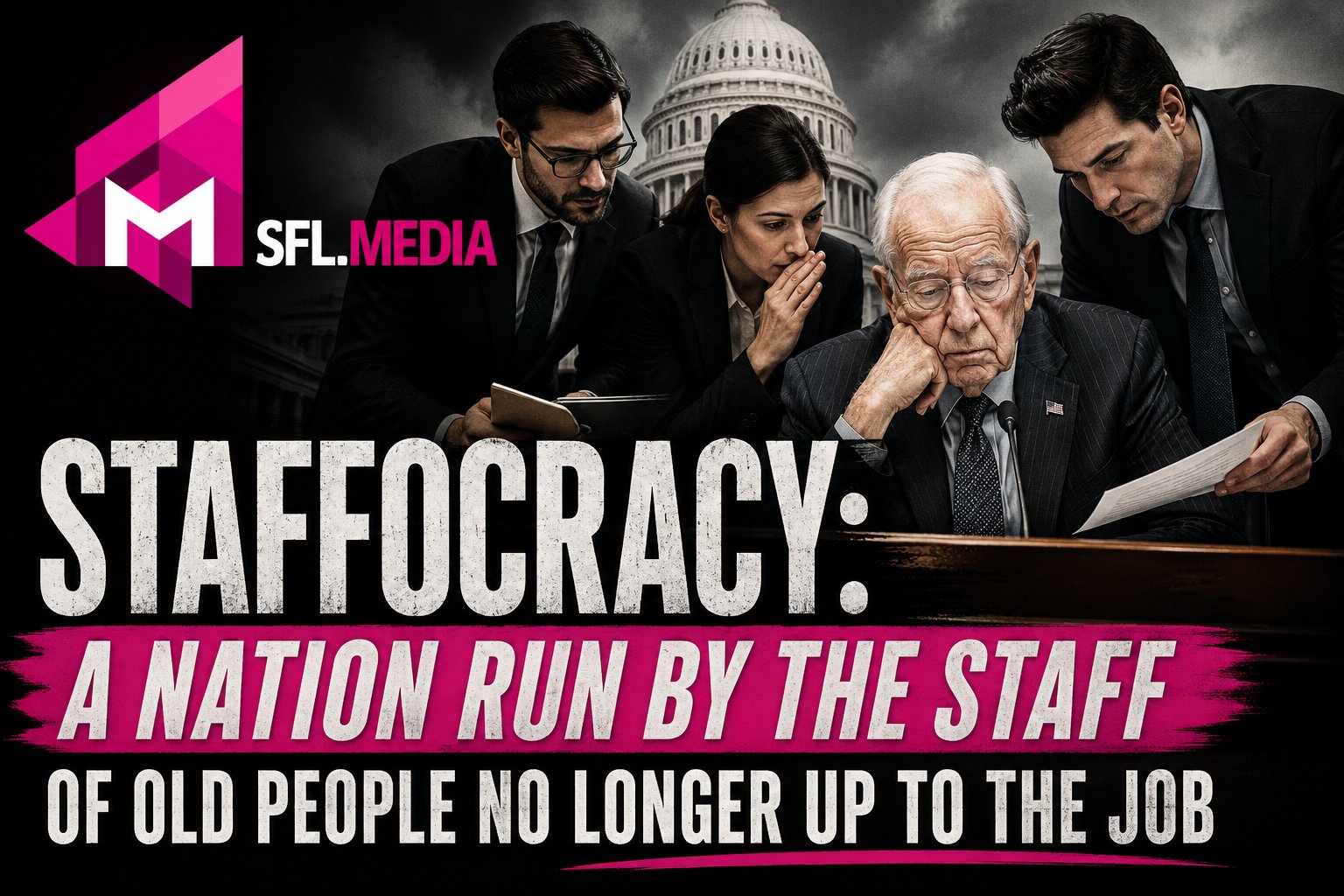
The Rise of the Staffocracy: Is America Becoming a Nation Governed by Unelected Staff?
WASHINGTON — The framers of the United States Constitution envisioned a government led by elected representatives who would debate legislation, oversee the executive branch, and remain directly accountable to the American people. Nearly 250 years later, critics across the political spectrum have begun asking whether that vision has quietly evolved into something very different.
As Congress ages and many of its most influential members continue serving well into their 80s and 90s, an increasing share of the day to day work of governing is performed by chiefs of staff, legislative directors, committee counsels, policy advisers, and communications teams, professionals who wield significant influence but are never elected by voters.
Some observers have begun describing this phenomenon as a “staffocracy”: a system in which elected officials remain the public face of government while much of the operational, legislative, and strategic work is carried out by an unelected professional staff.
Whether that label fairly describes modern Washington is a matter of debate. What is not disputed is that congressional staff play an indispensable role in writing legislation, advising lawmakers, conducting oversight, negotiating policy, and helping offices function in an increasingly complex government.
An Aging Congress
The United States has one of the oldest national legislatures in the democratic world. The median age in the Senate is approximately 64, while the House of Representatives averages roughly 57. By comparison, the median age of the U.S. population is about 39. Among the oldest serving lawmakers are Senator Chuck Grassley, now in his 90s, along with several House members and senators in their 80s.
Age alone does not determine effectiveness. Many older lawmakers remain active committee leaders, prolific legislators, and influential negotiators. Others have demonstrated remarkable stamina throughout decades of public service. However, a series of highly publicized health incidents involving both Democratic and Republican lawmakers has renewed questions about whether Congress has adequate mechanisms to address cognitive or physical decline while in office.
When Staff Become the Government’s Operating System
Every member of Congress relies on staff. Legislative aides research bills. Committee counsel draft statutory language. Communications directors shape public messaging. Chiefs of staff coordinate legislative priorities, negotiations, and scheduling. These functions have always existed.
The concern raised by some government scholars is not that staff perform these jobs, it is whether, in cases where an elected official becomes significantly impaired, staff effectively begin making decisions that voters assumed were being made by the elected representative. Unlike cabinet secretaries or federal judges, congressional staff receive no Senate confirmation, hold no independent constitutional authority, and answer primarily to the member who employs them. Yet they often possess deep institutional knowledge that exceeds that of newly elected lawmakers.
Lessons From Recent History
Questions about the balance between elected leadership and staff influence intensified following several high profile cases involving aging lawmakers. Before her death in 2023, Senator Dianne Feinstein faced repeated public scrutiny over reports of memory lapses and dependence on aides during Senate proceedings. News reports documented instances in which staff reminded her how to vote or briefed her immediately before committee hearings. Decades earlier, Senator Strom Thurmond served until age 100. By the end of his tenure, numerous accounts from former staff members and journalists described an office in which aides handled much of the senator’s daily legislative responsibilities.
Former Senate Majority Leader Mitch McConnell’s public freezing episodes similarly prompted questions about whether age and health should receive greater attention in evaluating fitness for office, although McConnell repeatedly maintained he remained capable of fulfilling his duties. These examples span political parties and ideological lines, illustrating that concerns about aging leadership are not confined to either Republicans or Democrats.
Governing a Digital Nation
Congress now regulates issues that would have been unimaginable even twenty years ago. Artificial intelligence. Quantum computing. Cryptocurrency. Cybersecurity. Social media algorithms. Biotechnology. Global data infrastructure. During hearings on these topics, lawmakers occasionally ask questions that generate viral attention because they reveal unfamiliarity with modern technology.
Those moments often become symbols of a broader criticism, that legislative expertise increasingly resides within committee staff and outside experts rather than the elected officials asking the questions. Supporters counter that legislators have always relied on specialists, just as presidents rely on military commanders and judges rely on clerks. Modern government, they argue, is simply too technically complex for any individual to master every policy area.
Why Experience Can Become Entrenchment
Congress rewards seniority. Long serving lawmakers accumulate committee chairmanships, fundraising networks, institutional relationships, and procedural expertise. Their offices often become among the most powerful on Capitol Hill. That influence extends to their staff. Chiefs of staff for committee chairs routinely negotiate legislation affecting hundreds of billions of dollars, coordinate with executive agencies, and engage with lobbyists, advocacy groups, and industry representatives.
When an influential member retires, much of that office’s institutional power disappears overnight. This creates incentives for both political parties and congressional offices to preserve seniority whenever possible. Critics argue that this dynamic can discourage retirement even when health concerns emerge. Others contend that voters remain the ultimate check, since every senator and representative must continue winning elections to remain in office.
The Accountability Question
The central debate surrounding the idea of a “staffocracy” is not whether staff members matter, they unquestionably do. The question is where meaningful decision making authority ultimately resides. Voters elect representatives expecting those individuals to exercise judgment, deliberate on legislation, and remain personally accountable for their decisions. If an elected official delegates substantial responsibilities because of age, illness, or diminished capacity, accountability becomes more difficult to evaluate.
Staff members cannot be voted out of office. Committee counsels do not campaign. Legislative directors do not appear on ballots. Yet these professionals often help shape legislation long before the public ever sees it. That reality has prompted renewed discussion about congressional transparency, succession planning, medical disclosure standards, and whether term limits or age-related reforms deserve greater consideration.
What the Founders Expected
America’s founding generation was remarkably young. Thomas Jefferson was 33 when he drafted the Declaration of Independence. James Madison was 25 during the Revolutionary era and later became the principal architect of the Constitution. Alexander Hamilton was just 21 when the Revolution began. Jefferson argued that government should continually adapt to the needs of living generations rather than remain bound by the past. In an 1816 letter to Samuel Kercheval, he wrote:
“Institutions must advance also to keep pace with the times.”
James Madison emphasized that republican government depends on elected officials remaining accountable to those who entrusted them with public office. In Federalist No. 57, he argued that constitutional government must both select capable leaders and preserve mechanisms that keep them faithful to the public trust. Those writings did not establish age limits or mandatory retirement. They did, however, reflect a broader concern that representative government remain responsive to changing generations rather than becoming disconnected from the people it serves.
A Debate That Is Growing
Whether America is truly becoming a “staffocracy” depends largely on how one defines political power. No congressional staff member can cast a vote on the House or Senate floor. No aide can sign legislation into law. Those constitutional powers remain with elected officials. At the same time, few observers dispute that modern government increasingly depends on professional staff whose expertise, continuity, and institutional knowledge often extend well beyond the tenure, or sometimes the capacity, of the elected officials they serve.
As Congress continues to age and government grows more technologically complex, the conversation is likely to intensify, not over whether staff are essential, but over how much influence unelected advisers should wield in a constitutional system built on electoral accountability.
















































Want to join the conversation?
Create an account or sign in to share your thoughts, vote,
and reply to other readers.
Showing 0 of 0 comments
Don't have an account?
Already have an account?