
Colombia’s First Major Tungsten Discovery Could Put the Country at the Center of a New Critical Minerals Supply Chain
Collective Mining’s Apollo system in Caldas has revealed high grade tungsten alongside gold, silver and copper, potentially giving the Western Hemisphere a strategically important new source as the United States moves to reduce defense industry dependence on Chinese and Russian supply
For more than two centuries, tungsten’s history has carried a distinctly Spanish connection. The extraordinarily dense, heat resistant metal was first isolated in Spain in 1783 by brothers Juan José and Fausto Elhuyar, who successfully reduced tungsten oxide into elemental tungsten. More than 240 years later, another Spanish speaking country is emerging in the story of one of the modern world’s most strategically important minerals.
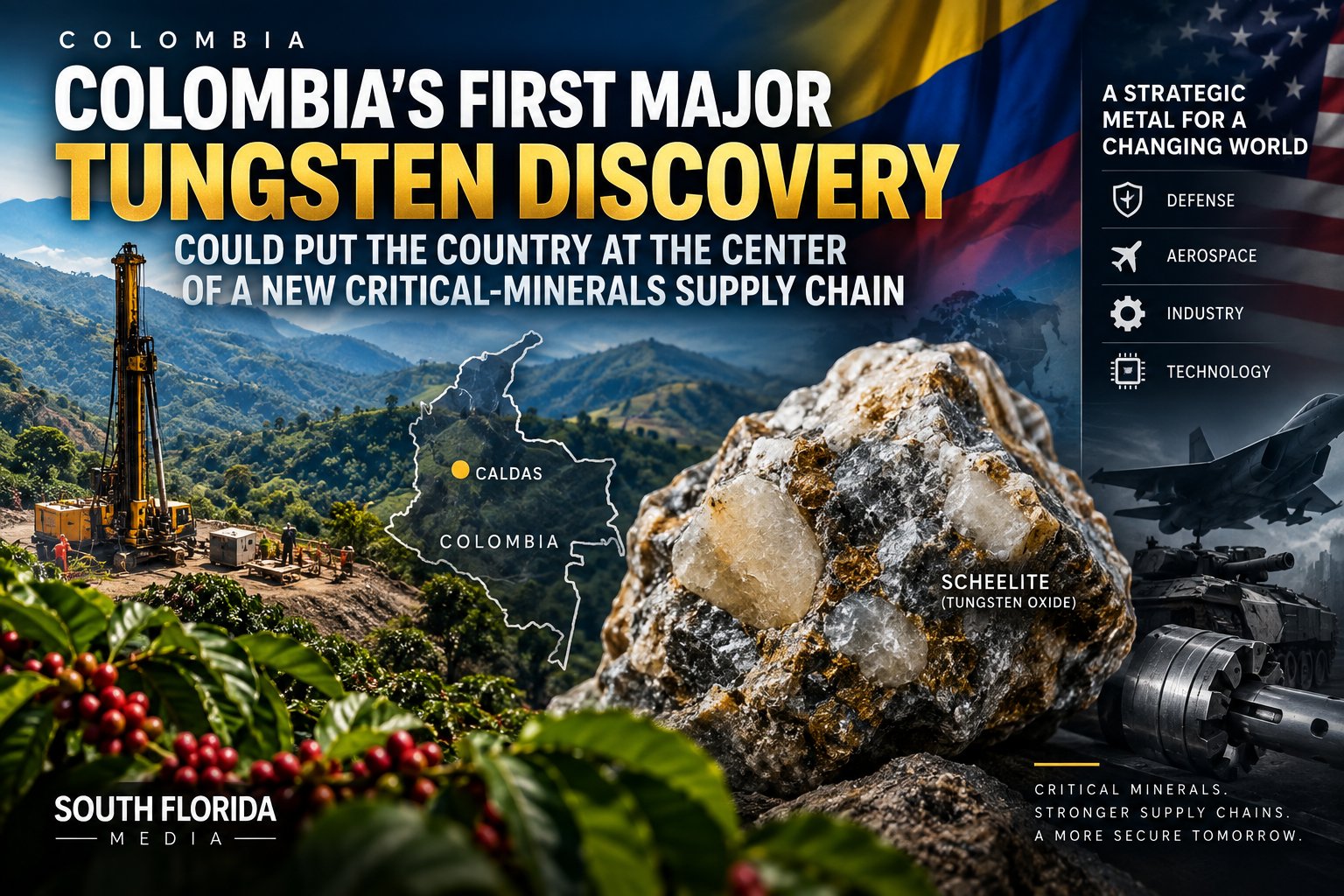
This time, it is Colombia. Canadian exploration company Collective Mining Ltd. has identified what it describes as the first known source of potentially economic tungsten ever recorded in the country, buried within the company’s Apollo polymetallic system at the Guayabales Project in Caldas. The discovery is particularly significant because the tungsten is not sitting alone in an isolated mineral body. It occurs alongside gold, silver and copper in a large mineralized system that Collective Mining has been aggressively drilling and expanding.
What began as exploration focused primarily on precious and base metals has therefore developed into something considerably more strategically important. Detailed assays revealed substantial concentrations of tungsten-bearing scheelite in the shallow portions of Apollo, including mineralization beginning essentially at the surface. More recent drilling has also identified tungsten enriched mineralization hundreds of meters underground, suggesting that tungsten could be a more significant component of Apollo’s geology than initially understood.
The timing could hardly be more consequential. Tungsten is classified as a critical mineral by the United States because of its importance to defense, aerospace, heavy industry and advanced manufacturing. China dominates global tungsten production and holds the world’s largest identified reserves, while geopolitical tensions have pushed Washington toward increasingly aggressive efforts to secure alternative supplies of critical minerals outside China and other strategic competitors.
For Colombia, a country far better known internationally for coffee, oil, coal and gold than strategic metals, Apollo could eventually represent an entirely new category of mineral resource.
There is, however, an important distinction between an extraordinary exploration discovery and a proven commercial mine. As of September 8, 2026, Collective Mining was preparing to release Apollo’s maiden mineral resource estimate after the market close, with management scheduled to discuss the results on September 9. Until those numbers are incorporated into the geological picture, descriptions of Apollo as a massive commercially proven tungsten mine would be premature. The drilling and metallurgical results are significant, but the final scale, economics, reserves and mineability of the project still require considerably more work.
Geologists Were Looking for Gold, Silver and Copper, Then Tungsten Appeared
Apollo is located within the Guayabales Project in Colombia’s Caldas department, part of the mountainous coffee growing region for which the country is famous. Collective Mining had already established Apollo as a substantial polymetallic system containing gold, silver and copper when detailed analysis of previously drilled core produced an unexpected result: scheelite was appearing in meaningful concentrations.
Scheelite, or calcium tungstate, is one of the world’s principal commercial sources of tungsten. Collective Mining announced in November 2023 that detailed assay results had outlined a high-grade tungsten zone in Apollo’s shallow section. Tungsten trioxide grades in that early work ranged from approximately 0.06% to 0.59%, with a weighted average of approximately 0.25% WO3. Using a 0.1% WO3 cutoff, the company said the shallow tungsten-bearing area measured approximately 200 meters by 100 meters by 150 meters vertically and remained open for expansion.
That transformed what might otherwise have been treated as a geological curiosity into a potentially important economic component of the project. The tungsten rich area also overlapped with strong gold, silver and copper mineralization, creating the possibility that multiple valuable metals could eventually be recovered from the same mined material.
Collective Mining subsequently intensified drilling around Apollo’s near-surface tungsten rich zone. By June 2025, the company reported that the upper approximately 150 meters of the system contained a high-grade zone enriched in tungsten, copper, gold and silver, with several drill holes producing long mineralized intervals beginning close to or directly at the surface.
One of the most striking holes, APC-115, returned 124 meters grading 3.03 grams per tonne gold equivalent from surface. The interval contained 0.55 grams per tonne gold, 86 grams per tonne silver, 0.63% copper and 0.16% tungsten trioxide. When the combined metals were expressed as tungsten-trioxide equivalent under the company’s stated assumptions, the interval equated to approximately 0.66% WO3 equivalent.
Other holes reinforced the scale of the shallow mineralization. APC-110 encountered 91 meters grading 3.04 grams per tonne gold equivalent beginning approximately 56 meters downhole and included 0.32% tungsten trioxide, while APC-111 returned more than 117 meters of mineralization beginning just 14 meters downhole. Taken together, the results demonstrated that tungsten was not appearing merely as an isolated trace element but as a potentially meaningful contributor to the overall mineral value of Apollo.
The Tungsten Is Sitting Near the Top of Apollo
Mining economics can change dramatically depending on whether valuable material is located hundreds or thousands of meters underground or sits close enough to the surface to potentially be accessed through an initial open pit. Apollo’s original tungsten-rich zone occupies the upper portion of the mineralized system, precisely where an early-stage mining operation could potentially begin extracting material.
That positioning could become one of the project’s major economic advantages. Instead of requiring an entirely separate mine built solely around tungsten, Apollo could potentially produce the critical mineral alongside gold, silver and copper from the same broader polymetallic system. Multiple commodities contributing revenue from the same mined rock can fundamentally alter project economics, particularly when one of those commodities carries strategic value in addition to its market price.
Gold provides Apollo with a high value precious-metal component, while copper is essential to electrification, power infrastructure and industrial manufacturing. Silver carries both precious-metal and increasingly important industrial demand. Tungsten potentially adds another revenue stream while simultaneously giving Apollo a geopolitical significance that a conventional gold-copper discovery might not possess.
The economics remain unproven until resource modeling, engineering, capital estimates, permitting and feasibility studies are completed. Geologically, however, the combination of multiple valuable metals and shallow tungsten mineralization makes Apollo an unusually interesting project.
Collective Mining Then Found Tungsten Hundreds of Meters Deeper
The story became more significant in 2026 when Collective Mining announced that drilling had identified another tungsten-enriched high-grade subzone approximately 300 meters below the surface, distinct from the original shallow tungsten zone. Hole APC-162 intersected 27.35 meters grading 37.55 grams per tonne gold equivalent, including 1.68% tungsten trioxide, 11.62 grams per tonne gold, 54 grams per tonne silver and 0.43% copper. At the time of the announcement, the newly identified zone remained open down dip, meaning drilling had not yet established its full dimensions.
The deeper discovery altered the original geological picture. Apollo’s tungsten could no longer be viewed simply as a shallow mineralized cap sitting above a predominantly gold-copper-silver system. The identification of additional tungsten-rich mineralization hundreds of meters below the surface raised the possibility that tungsten occurs in multiple significant zones throughout the broader Apollo system.
Collective Mining has continued an aggressive exploration program designed to expand Apollo and better define its high grade zones. Whether the various tungsten bearing areas ultimately connect, multiply into additional structures or remain distinct mineralized pockets will require additional drilling. The deeper discovery nevertheless suggests that Apollo’s eventual tungsten inventory could prove larger and more geologically complex than originally believed.
Metallurgical Testing Delivered Another Critical Result
Finding tungsten in the ground is only part of what determines whether a discovery has economic value. A mineral can exist at impressive grades and still be commercially unattractive if recovering and concentrating it requires an excessively expensive or technically complicated processing system. Apollo recently cleared an important preliminary hurdle on that front.
In August 2026, Collective Mining released advanced metallurgical testing covering representative samples from approximately the upper 1,000 meters of Apollo. The testing program involved more than 130 individual drill core samples across 36 intervals and evaluated conventional processing methods including gravity concentration, flotation and cyanidation.
The master composite returned recoveries of approximately 95% for gold, 92% for silver and 85% for copper. Testing specifically targeting Apollo’s high grade tungsten material produced tungsten recoveries of up to 74%, while concentrates graded more than 60% tungsten. Subsequent bulk sample testing produced concentrate with 95% scheelite purity.
Mineralogical analysis also found that the scheelite was coarse-grained and well liberated, an important characteristic because mineral liberation can substantially affect how efficiently valuable material can be separated from surrounding rock. Collective Mining said the results demonstrated the potential to produce a high-purity tungsten concentrate using conventional processing methods.
Those tests do not prove that Apollo will become an economically viable mine, but they address one of the most important technical questions surrounding any polymetallic discovery: whether its different commodities can actually be separated and recovered at commercially meaningful rates. So far, the results appear encouraging.
Why Tungsten Matters Far Beyond Colombia
Tungsten is not simply another industrial metal. Its unusual physical properties make it extraordinarily difficult to replace in many demanding applications. Tungsten has the highest melting point of any pure metal, exceptional density and remarkable resistance to heat and wear. Tungsten carbide is among the hardest industrial materials in widespread use, making it critical for cutting tools, drilling equipment, mining machinery and high-performance manufacturing.
Those same properties also make tungsten strategically important to modern militaries. High density tungsten alloys can be used in armor-related systems, kinetic applications, aerospace components, counterweights and other equipment where extreme density, hardness, temperature resistance and durability matter. Its broader industrial importance extends into electronics, energy infrastructure, specialized machinery and advanced manufacturing.
The modern economy therefore depends on tungsten in places most consumers will never see. The combination of industrial necessity, military importance and geographically concentrated production is precisely why governments increasingly treat tungsten not simply as another commodity, but as a national-security material.
China Dominates the Global Tungsten Supply Chain
Apollo’s geopolitical significance becomes clearer when the global supply picture is considered. China remains overwhelmingly dominant in the international tungsten industry, controlling the largest identified reserves and accounting for the majority of global mine production. That concentration gives Beijing significant influence over a mineral that advanced industrial economies cannot easily substitute.
The vulnerability is no longer theoretical. The United States increased tariffs on several tungsten products imported from China at the end of 2024, and China introduced additional export controls covering selected tungsten-related items in February 2025. Tungsten prices subsequently rose sharply as governments and companies confronted the possibility that geopolitical competition could increasingly affect access to critical materials.
Washington has responded by trying to stimulate alternative sources. The United States has supported tungsten and other critical-mineral projects through Defense Production Act authorities and broader supply chain initiatives while pursuing relationships with resource-producing countries capable of reducing dependence on Chinese material.
That is where Colombia could become increasingly important. A commercially viable tungsten source in the Western Hemisphere would not eliminate dependence on China by itself, but every substantial new source outside the dominant Chinese supply chain gives Western governments and manufacturers another option.
The Pentagon’s 2027 Rules Make Apollo Even More Interesting
One of the most consequential changes affecting tungsten arrives on January 1, 2027, when expanded U.S. defense procurement restrictions involving certain covered countries are scheduled to reach further upstream into tungsten supply chains.
The direction of American policy is clear: Washington increasingly wants to know not merely where a finished military component was manufactured, but where the critical materials inside it originated. For tungsten, that means greater scrutiny of mining, processing, refining and manufacturing throughout the supply chain.
A tungsten resource in Colombia would begin from a fundamentally different geopolitical position than material originating in China or Russia. Colombia has long maintained extensive security, economic and diplomatic ties with the United States, and its geographic position offers relatively direct access to North American markets.
That does not mean Apollo tungsten would automatically qualify for or eventually enter American defense supply chains. Processing locations, commercial contracts, certification requirements, refining capacity and regulatory compliance would all matter. Nevertheless, the strategic logic is difficult to ignore: the United States is actively searching for reliable critical-mineral supply outside geopolitical competitors at precisely the moment Colombia has identified its first known source of potentially economic tungsten.
Colombia Could Enter the Global Critical-Minerals Race
The discovery presents Colombia with a larger economic opportunity that extends beyond the value of the ore itself. For decades, much of Latin America’s relationship with global commodity markets has revolved around extracting and exporting raw materials while higher-value refining, processing and manufacturing occur elsewhere.
Critical minerals offer an opportunity to reconsider that model. If Apollo develops into a mine, Colombia could potentially pursue not only extraction but also additional stages of the tungsten supply chain, including concentration, processing or partnerships with allied country refiners and manufacturers. An integrated Western Hemisphere supply chain stretching from South American mines to North American industrial and defense customers could create significantly more economic value than simply exporting untreated material.
Realizing that opportunity would require substantial investment, infrastructure, technical expertise and regulatory stability. It would also require Colombia to balance national economic interests with legitimate environmental and community concerns surrounding major mining projects.
Caldas is not an empty mineral frontier. It is part of Colombia’s famous coffee-growing region, with established communities, agricultural economies, water resources and ecosystems that cannot simply be treated as obstacles to mineral development. Any eventual large-scale operation will face scrutiny over water consumption, land use, waste management, environmental effects, local employment, community benefits and long-term reclamation obligations.
The strategic importance of tungsten does not eliminate those responsibilities. If anything, a project carrying national and international significance should be held to a higher standard.
Apollo Is Significant, but It Is Not Yet a Proven Tungsten Mine
There is an important distinction that should not be lost amid the excitement surrounding the discovery. Calling Apollo the location of Colombia’s first known potentially economic tungsten occurrence is supported by the company’s exploration results and statements. Treating it as an established, commercially proven tungsten mine before the necessary resource, engineering and economic work is completed would go too far.
That distinction matters in responsible mining journalism. A spectacular drill hole is not a mine, a mineralized system is not automatically an economically recoverable reserve, metallurgical recovery is not the same thing as profitability, and even an exceptional geological deposit can fail to reach production because of capital costs, permitting, infrastructure, commodity prices, environmental constraints, financing or political opposition.
Collective Mining’s maiden mineral resource estimate represents the next major step because it should provide a much clearer picture of Apollo’s tonnage, grade distribution and geological confidence. The company announced on September 8 that the initial resource would be released following the close of markets, with senior management and technical officials scheduled to discuss the estimate and the project’s growth opportunities on September 9.
Those numbers could materially change how Apollo is understood. Until then, the most defensible conclusion is already significant enough: Collective Mining has identified substantial tungsten-bearing mineralization in a Colombian polymetallic system, demonstrated encouraging recovery characteristics and continued finding tungsten in areas beyond the original shallow discovery.
From Spain in 1783 to Colombia in 2026
There is a remarkable historical symmetry to the story. Juan José and Fausto Elhuyar successfully isolated tungsten in Spain in 1783, establishing their place in the history of chemistry. The element they helped introduce to science eventually became indispensable to industrial manufacturing and modern military technology because of physical properties that few other materials can reproduce.
More than two centuries later, tungsten has become something the Elhuyar brothers could never have imagined: a geopolitical asset caught in a global competition over technology, manufacturing capacity, military readiness and control of critical-mineral supply chains. Governments are now spending billions of dollars trying to secure dependable supplies of materials that were once primarily the concern of geologists, miners and industrial manufacturers.
Colombia may now possess a meaningful new source. Apollo still has a long road ahead before anyone can responsibly declare it a major operating tungsten mine, including resource definition, economic studies, engineering, permitting, financing and ultimately construction. Environmental and community impacts will also have to be addressed, while commercial viability must survive the unforgiving economics of real-world mine development.
The geological discovery itself, however, is already significant. Collective Mining began exploring Apollo primarily as a gold, silver and copper system and found Colombia’s first known source of potentially economic tungsten sitting near the surface. It subsequently identified additional tungsten enriched mineralization hundreds of meters deeper, while metallurgical testing has demonstrated that tungsten-bearing scheelite can be recovered using conventional processing techniques.
At the same time, geopolitical competition is increasing Western demand for secure tungsten supplies outside China and other strategic competitors. That combination of geology, recoverability, geography and geopolitics is what makes Apollo more than another promising mineral exploration project.
If the resource ultimately proves large enough and economically viable, Colombia may have discovered precisely the kind of critical mineral source the United States and its allies are increasingly trying to secure. In a global economy where control over strategic metals is rapidly becoming another dimension of national power, the mountains of Colombia’s coffee country may be sitting on something far more consequential than anyone expected.

Sources & Further Reading
Collective Mining and the Apollo Discovery
Collective Mining — High-Grade Tungsten Mineralization Discovered at Apollo
Collective Mining — Apollo Project and Company Information
Apollo Drilling and Metallurgical Results
Collective Mining — Apollo Metallurgical Recoveries: Gold, Silver, Copper and Tungsten
Collective Mining — September 8, 2026 Maiden Mineral Resource Announcement
Tungsten Supply, Critical Minerals and U.S. Policy
U.S. Geological Survey — Mineral Commodity Summaries 2026
U.S. Geological Survey — Tungsten Statistics and Information
U.S. Department of Defense Acquisition Regulations — Foreign Acquisition Restrictions
Tungsten History and Science
Royal Society of Chemistry — Tungsten: History, Properties and Uses


















































Want to join the conversation?
Create an account or sign in to share your thoughts, vote,
and reply to other readers.
Showing 0 of 0 comments
Don't have an account?
Already have an account?