
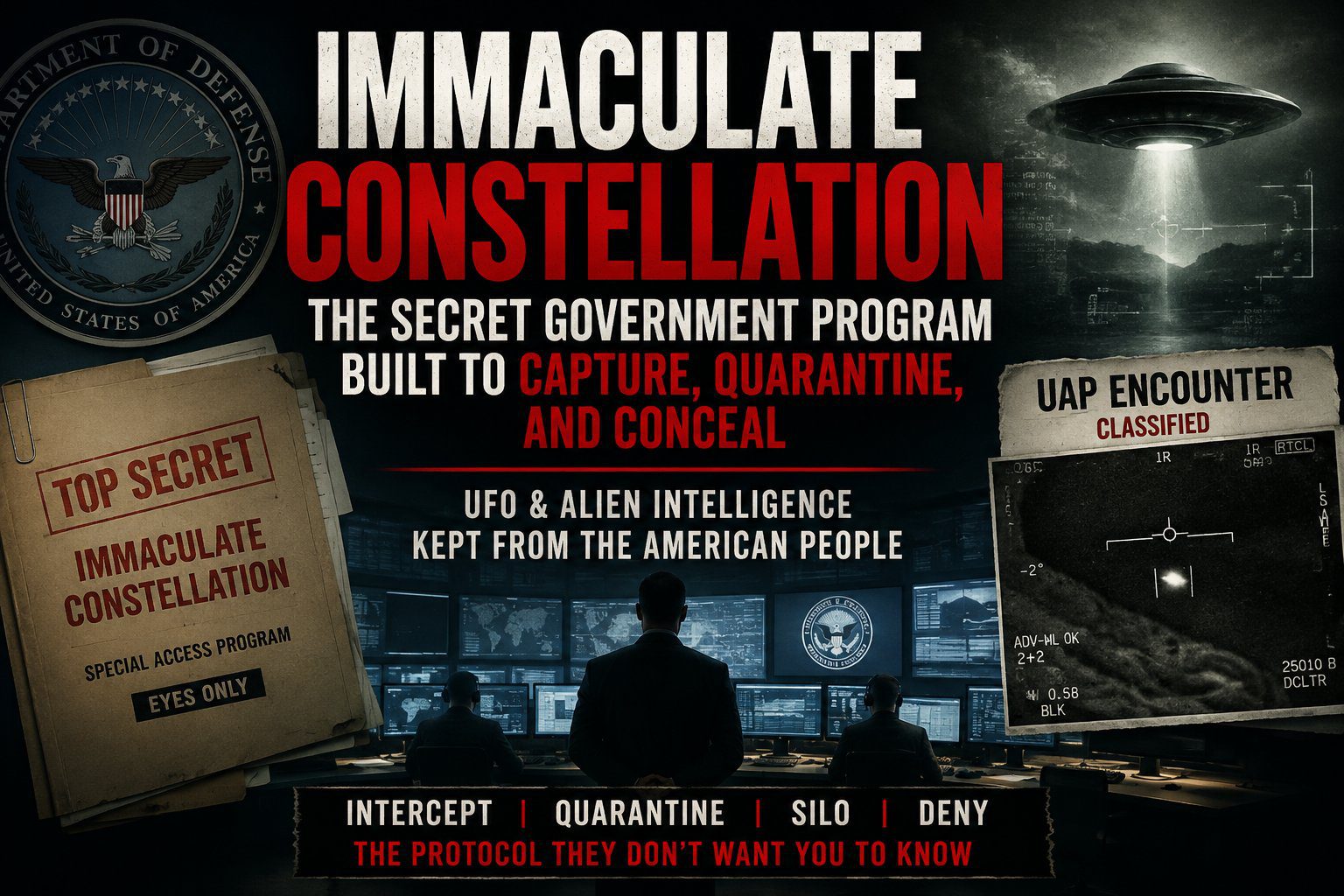
Immaculate Constellation: Inside the Alleged Government System Built to Capture and Conceal UAP Evidence
For decades, one of the strongest arguments against an enormous government UFO cover up has also been one of the simplest: How could the United States possibly conceal something this consequential across the Pentagon, intelligence agencies, military branches, presidential administrations and Congress without thousands of people knowing the entire story? An extraordinary whistleblower report submitted to Congress offers a potential answer. The alleged system does not require thousands of government employees to knowingly participate in the same conspiracy because most of them would never receive the sensitive information in the first place.
The report describes an alleged unacknowledged Special Access Program called Immaculate Constellation that collects highly classified intelligence concerning Unidentified Anomalous Phenomena, or UAP, using existing American military and intelligence capabilities. More importantly, the report alleges the government possesses the capability to “detect, quarantine, and transfer” UAP related collection incidents before the intelligence is observed and circulated throughout the broader Military Intelligence Enterprise.
If accurate, that allegation fundamentally changes the architecture of the purported UAP cover up. Immaculate Constellation would not simply be a secret office where government officials store UFO photographs. It would function more like an intelligence airlock positioned between America’s enormous surveillance apparatus and the wider national-security bureaucracy, identifying particularly sensitive anomalous information and moving it into highly restricted compartments before most military and intelligence personnel ever know the evidence exists.
The Pentagon denies the central allegation. The Department of Defense has stated that it has “no record, present or historical” of any Special Access Program called Immaculate Constellation. The public record does not currently contain the underlying classified database, complete sensor files, program charter, appropriations records or other independently authenticated government documentation necessary to establish publicly that the alleged program exists as described.
What does exist is the whistleblower report itself. Rep. Nancy Mace formally submitted the document during the November 13, 2024 House Oversight hearing on UAPs, placing its extraordinary allegations into an official congressional proceeding and creating a clear roadmap for what Congress could investigate next.
The Report Alleges a Government UAP Intelligence Architecture
The whistleblower report describes Immaculate Constellation as an unacknowledged Special Access Program allegedly established following the public disclosure of the Pentagon’s AATIP and AAWSAP activities in 2017. According to the document, the program’s primary mission is collecting imagery intelligence involving UAP and alleged ARV/RV, or reproduction vehicles, through tasked and untasked American military intelligence resources. The report further characterizes the program as part of a larger network of Special Access Programs connected to UAP, alleged non-human intelligence and technologies of unknown origin.
Those remain allegations, not publicly established facts. Nevertheless, the description is important because it portrays Immaculate Constellation as something much larger than a traditional research project. It is described as an intelligence collection, analysis and dissemination architecture drawing information from military and intelligence systems already operating around the world. That would make its alleged reach potentially enormous.
Step One: America’s Existing Surveillance Network Collects the Evidence
The United States operates an extraordinary array of sensors capable of observing the atmosphere, oceans and space. Fighter aircraft carry sophisticated radar, infrared and electro optical systems. Naval vessels operate advanced radar and electronic warfare equipment. Reconnaissance aircraft collect signals and imagery. Satellites continuously observe enormous areas of Earth. Intelligence agencies operate additional classified capabilities whose technical specifications are themselves national security secrets.
Immaculate Constellation would not necessarily require a separate fleet of aircraft or satellites dedicated to searching for UAPs because, according to the whistleblower report, its collection allegedly incorporates both “tasked” and “untasked” military intelligence resources. That distinction is critical. Tasked collection means an intelligence asset has been deliberately directed toward a target or area of interest. Untasked or incidental collection means a sensor performing another mission encounters something unexpected.
A fighter pilot conducting an ordinary training mission could encounter an anomalous object. A reconnaissance platform observing a foreign military installation could capture an unidentified craft. A Navy radar system monitoring normal airspace could detect an object exhibiting unusual behavior. A satellite looking at something completely unrelated could record an anomaly passing through its field of observation. The alleged system therefore would not need thousands of dedicated UFO investigators searching the skies. America’s existing surveillance infrastructure would do much of the collecting automatically as part of its normal national security mission.
Step Two: The Anomalous Intelligence Is Identified
That creates the next logistical problem. Modern American intelligence systems generate enormous amounts of information every day. Any program attempting to locate UAP incidents inside that ocean of data would need a mechanism for identifying relevant material. The whistleblower report’s most consequential allegation addresses precisely this problem. It states that the existence of Immaculate Constellation demonstrates a capability to detect, quarantine and transfer UAP and alleged reproduction vehicle collection incidents before they are observed and circulated within the broader Military Intelligence Enterprise.
The publicly released report does not establish the precise technical architecture performing that function. It does not publicly provide source code, algorithms, network diagrams or access control documentation demonstrating exactly how anomalous intelligence would be identified and routed. That distinction matters. It would therefore be premature to state as established fact that an artificial intelligence program automatically monitors every classified American military network searching for UFO files. What the report explicitly alleges is the underlying capability: detection, quarantine and transfer.
Operationally, that would make Immaculate Constellation less like a conventional intelligence office and more like a filter operating within the classified information environment. Something anomalous is collected. The information is recognized as belonging to a particularly sensitive category. The material is separated from ordinary dissemination and transferred into a more tightly controlled compartment. The broader intelligence machinery continues operating around it.
Step Three: The Evidence Enters an Intelligence Quarantine
This may be the most significant allegation in the entire document because it offers a plausible logistical mechanism for maintaining secrecy inside an enormous bureaucracy. Traditional secrecy occurs after someone receives information: an employee obtains classified material and is legally prohibited from revealing it. The architecture alleged in the Immaculate Constellation report would be considerably more effective because it potentially controls whether the person receives the information at all.
American classified systems operate through compartmentalization. Possessing a Top Secret clearance does not provide unrestricted access to every Top Secret program operated by the United States government. Access can additionally depend on need to know requirements, compartmented information permissions and specific Special Access Program authorization. An unacknowledged Special Access Program can impose even narrower restrictions because information concerning the existence, purpose or activities of the program itself may be protected.
Consequently, a highly cleared intelligence officer could theoretically possess access to enormous amounts of national-security information while remaining completely unaware of another compartment operating elsewhere within the same government. That is the potential power of the architecture described by the whistleblower. The government would not have to convince every analyst to conceal UAP evidence. Most analysts would never see it.
Step Four: The Original Intelligence Could Become Invisible to Ordinary Investigators
The public whistleblower report does not establish that Immaculate Constellation routinely deletes original files from SIPRNet, JWICS or other classified networks, nor does it establish that sanitized replacement videos or fabricated mission reports are automatically substituted for original records. Those claims should not be presented as established facts without additional documentation. The allegation actually contained in the report is narrower but arguably more important: relevant collection can allegedly be quarantined and transferred before it circulates throughout the broader military-intelligence system. If true, that alone could create an extraordinary oversight problem.
An investigator could conduct a legitimate search of the databases available to that investigator and find nothing because the relevant intelligence had previously been transferred into a compartment the investigator was not authorized to access. That possibility changes the meaning of government statements that investigators have searched available records and discovered no evidence supporting extraordinary UAP claims.
The important questions become: Which databases were searched? Which Special Access Programs were included? Which compartments were accessible? Who determined the scope of the search? Did investigators possess authority to search unacknowledged programs? Were original collection systems examined, or only the intelligence products ultimately distributed through ordinary channels? Without those answers, “we searched and found nothing” is not necessarily the same thing as “nothing exists.”
The Report Describes Seven Categories of Evidence
The whistleblower document organizes its allegations into seven broad evidentiary categories: an alleged unacknowledged Special Access Program, imagery intelligence, human intelligence, signals intelligence, U.S. government bureaucratic records, U.S. government historical records and other sensitive sources. That breadth matters because the report does not portray the UAP issue as being based solely on eyewitness testimony or isolated videos. It alleges an intelligence ecosystem involving multiple forms of collection and government documentation.
The imagery component is particularly significant. The report describes high-quality IMINT, or imagery intelligence, and MASINT, measurement and signature intelligence, allegedly collected by American military assets. It describes infrared, forward looking infrared, full motion video, thermal imagery and still photography involving anomalous objects.
The report also says significant intelligence reporting documenting first hand encounters by Department of Defense personnel exists within defense HUMINT databases accessible to members of the intelligence community. If those databases and original sensor records exist as described, they should be discoverable through sufficiently empowered congressional investigation. That makes the allegations potentially testable.
The Alleged Archive Would Be Far More Important Than the UFO Videos the Public Has Seen
Public discussion of military UAP encounters frequently centers on short, low-resolution videos such as the Navy recordings that became internationally famous after their release. But a sophisticated military encounter can produce far more information than a single video. Depending upon the circumstances, an incident could generate radar tracks, infrared imagery, optical imagery, electronic intelligence, telemetry, human observations and potentially information from multiple platforms observing the same event. The whistleblower report specifically emphasizes the importance of multiple wavelengths and sophisticated military sensors, arguing that these systems can capture characteristics that human observers cannot perceive with their eyes alone.
That distinction is scientifically important. A blurry video by itself can be ambiguous. Multiple independent sensors recording the same object simultaneously can dramatically increase the evidentiary value of an encounter. If Immaculate Constellation possesses the type of multisensor intelligence described in the report, the most compelling government UAP evidence may bear little resemblance to the ambiguous clips available to the public. The problem is that the underlying classified imagery described in the report has not been publicly released for independent examination.
The Report Describes Extraordinary Military Encounters
The whistleblower report contains descriptions of multiple alleged UAP encounters involving American military personnel and technical collection systems. Among the reported cases are metallic spheres or orbs, unusual formations, triangular objects and other anomalous platforms observed across different military environments.
One described CENTCOM incident reportedly involved a formation of approximately a dozen metallic orbs moving rapidly near the ocean before breaking formation and dispersing in different directions. Other descriptions concern anomalous objects operating near sensitive facilities, military aircraft and maritime environments.
The report also discusses observations suggesting unusual maneuverability and apparent operation across different domains. These descriptions are extraordinary, but they remain descriptions contained in a whistleblower report. The underlying classified imagery and complete sensor packages necessary for independent scientific analysis have not been publicly released. That evidentiary distinction must remain clear. A congressional document describing extraordinary evidence is not equivalent to Congress publicly producing and authenticating that evidence.
Immaculate Constellation Could Explain Why Different Government Offices Tell Different Stories
One of the strangest characteristics of the modern UAP controversy is the enormous gap between what different government officials say they know. Some military veterans, intelligence officials and whistleblowers have described extraordinary encounters and deeply classified programs. Other government investigations have reported finding no verifiable evidence that the United States possesses extraterrestrial spacecraft or maintains secret reverse-engineering programs involving non-human technology.
Those positions appear contradictory. Extreme compartmentalization provides at least a theoretical mechanism through which different government officials could reach radically different conclusions while each accurately describing the information available to them. If the most sensitive UAP intelligence were removed from normal circulation and restricted inside tightly controlled Special Access Programs, investigators operating outside those compartments could genuinely fail to locate it. That would not automatically mean those investigators were lying. They might actually be searching an incomplete universe of records. This is precisely why congressional investigators need to examine access architecture rather than merely ask agencies whether they possess evidence.
Congress May Be the Most Important Target of the Alleged Information Control
The constitutional implications become more serious if the whistleblower’s central allegations are accurate. The report alleges that Immaculate Constellation and associated information were not lawfully reported to Congress. Special Access Programs are not supposed to become mechanisms for eliminating constitutional oversight. Congress authorizes military spending, writes national security laws and maintains oversight responsibilities over the executive branch. If an executive-branch program involving significant military and intelligence capabilities were intentionally withheld from legally required congressional oversight, the issue would extend far beyond UFOs. It would become a separation of powers crisis.
Whether the underlying objects ultimately prove to be foreign technology, secret American platforms, misunderstood conventional systems, genuinely unidentified phenomena or something even more extraordinary would not change that constitutional question. Congress cannot oversee programs that officials successfully prevent Congress from knowing exist.
Michael Shellenberger Raised an Even More Explosive White House Allegation
Journalist Michael Shellenberger, who initially reported the Immaculate Constellation allegations and testified before Congress in November 2024, relayed an additional claim from a source concerning the alleged program’s organizational structure. According to Shellenberger’s written testimony, a source told him that the program was controlled by the White House and executed and administered by the Department of Defense in a manner allegedly designed to avoid normal statutory oversight requirements.
That claim has not been independently established in the public record and should not be treated as proven. But it raises a significant investigative question. If an alleged UAP program were distributed across different executive-branch authorities rather than residing neatly inside one Pentagon office, determining who actually controls the program could become exceptionally difficult. That would also complicate congressional oversight because lawmakers could question one agency while another entity retains operational or legal authority over the underlying information.
Congress therefore needs more than the name Immaculate Constellation. It needs the chain of command.
The Pentagon Says There Is No Such Special Access Program
Any serious examination of Immaculate Constellation has to confront the government’s direct denial. Department of Defense spokesperson Sue Gough stated that the Pentagon has “no record, present or historical, of any type of SAP called ‘IMMACULATE CONSTELLATION.’” An Office of the Director of National Intelligence document subsequently released through FOIA also recorded the allegation and the Pentagon’s denial, describing Immaculate Constellation as a supposed unacknowledged Special Access Program reportedly created in 2017 and allegedly containing highly classified UAP evidence.
The government’s position is therefore clear: the Department of Defense denies having a record of a Special Access Program by that name. There is also an important distinction between a document being submitted to Congress and Congress verifying the document’s claims. Rep. Nancy Mace entered the whistleblower report into the record of the November 13, 2024 UAP hearing. The official House repository now contains the document as supporting material from that hearing. That establishes that Congress formally received the report. It does not independently establish that Immaculate Constellation exists or that every allegation contained inside the report is accurate.
The Report Has Become More Significant Because Its Allegations Are Specific
The strength of the Immaculate Constellation story is not that the public has finally been given indisputable proof of extraterrestrial spacecraft. It has not. The significance is that the allegation has become unusually specific. There is a program name. There is an alleged mission. There are claimed categories of intelligence. There is a purported information-control mechanism. There are alleged military collection systems. There are described encounters. There is an allegation that Congress was denied required oversight. And there is a direct Pentagon denial.
That creates an investigative framework. Congress does not have to hold another philosophical hearing about whether UFOs might exist. Investigators can ask specific questions about specific systems.
The Government Would Not Need Thousands of People to Participate in a Cover-Up
This is where Immaculate Constellation becomes particularly important to the larger history of government secrecy surrounding UAPs. The traditional concept of a UFO conspiracy requires an almost impossible number of people to knowingly participate. Presidents, generals, intelligence officers, pilots, engineers, scientists, contractors and members of Congress would seemingly all have to understand the same secret and maintain it across generations.
The architecture alleged in the whistleblower report is considerably more plausible from an information security standpoint. You do not tell 100,000 people to keep a secret. You build a system in which 99,900 people never receive the secret. Sensors collect information during normal operations. Sensitive collection incidents are identified. Relevant intelligence is quarantined. Access is restricted through compartmentalization. Only personnel with the appropriate authorization receive the complete material. Everyone else continues doing their jobs.
The secrecy becomes structural rather than personal. No enormous conspiracy meeting is required. No memo has to inform the entire Pentagon that UAPs are real. No army of government employees has to coordinate the same story. The bureaucracy itself becomes the wall.
Immaculate Constellation May Represent the Missing Organizational Layer
For decades, researchers have searched for the hypothetical government office where the United States keeps its most sensitive UFO information. The Immaculate Constellation allegations suggest that this may have been the wrong model. The most effective system would not necessarily be a giant standalone “UFO department.” It could instead be an information layer operating across existing intelligence infrastructure.
The Air Force continues flying aircraft. The Navy continues operating radar systems. Intelligence agencies continue collecting signals. Reconnaissance satellites continue photographing Earth. Combatant commands continue conducting missions. But when one of those systems encounters information falling within a particularly sensitive category, that intelligence could be redirected into another compartment. Under that model, the underlying military machinery performs the collection. The compartmentalized program controls what happens to the evidence afterward.
That is why the allegation that Immaculate Constellation can detect, quarantine and transfer UAP collection incidents is potentially more important than the program’s dramatic name. It describes the mechanics necessary to make an enormous secret manageable.
Congress Needs the Raw Intelligence, Not Another Round of UFO Stories
The Immaculate Constellation allegations cannot ultimately be resolved through anonymous claims, Pentagon press statements, podcasts, documentaries or another collection of ambiguous videos. Congress needs the underlying records.
Lawmakers should determine whether databases matching the whistleblower’s description exist, identify the controlling authorities, establish how relevant activities are funded, determine which Special Access Programs receive UAP derived intelligence and obtain the original multisensor records described in the report. Congress should also examine access logs, classification guidance, program security instructions, appropriations records, contracting records and the legal mechanisms used to establish any relevant compartments.
If the alleged databases and programs do not exist, an appropriately empowered investigation should be capable of establishing that. If they do exist, Congress needs to determine who authorized them, what information they contain, who has access and whether legally required congressional notifications occurred. The government has allowed the UAP controversy to remain trapped for decades in an evidentiary fog in which witnesses make extraordinary claims while the most important underlying information remains inaccessible. Immaculate Constellation presents a substantially more testable proposition.
Either an intelligence architecture matching the whistleblower’s description exists or it does not. Either UAP intelligence has been detected, quarantined and transferred outside ordinary military-intelligence circulation or it has not. Either the relevant programs were properly reported to Congress or they were not. Those questions can be investigated through documents, databases, funding records, classification authorities, access logs, sworn testimony and subpoenas.
The Real Disclosure Question Is Who Controls the Evidence
The most important question surrounding Immaculate Constellation may therefore have little to do with whether someone believes in extraterrestrials. It is about control of information. How could extraordinary evidence potentially remain hidden inside one of the largest bureaucracies on Earth? The architecture alleged by the whistleblower provides a disturbingly simple answer.
You do not attempt to hide the evidence from everyone after everyone sees it. You control who gets to see it in the first place. If the report is accurate, Immaculate Constellation represents precisely that kind of system: a highly compartmented intelligence architecture allegedly capable of collecting UAP information from America’s existing surveillance infrastructure and detecting, quarantining and transferring sensitive incidents before the evidence circulates throughout the broader military intelligence enterprise.
That extraordinary allegation remains publicly unproven. The Pentagon denies having any record of a Special Access Program called Immaculate Constellation, and the underlying classified evidence described by the whistleblower has not been made available for independent public examination.
But the report is now part of an official congressional proceeding, and its central allegations are specific enough to investigate. Congress does not need another hearing asking whether witnesses believe UAPs exist. It needs the original data. It needs the program authorities. It needs the access records. It needs the funding trail. And if those records are being withheld from lawful congressional oversight, it needs subpoenas.

Sources
U.S. House of Representatives — “Immaculate Constellation” Whistleblower Report

















































Want to join the conversation?
Create an account or sign in to share your thoughts, vote,
and reply to other readers.
Showing 0 of 0 comments
Don't have an account?
Already have an account?