
Donald Trump’s Greatest Mistake May Be the Generational Threat He Created for His Family…
The Long Memory of Extremism: What Salman Rushdie’s Story Could Teach America About Threats Against Donald Trump
The knife arrived thirty three years later.
That may be the single most terrifying fact about the attempted assassination of Salman Rushdie.
When a 24 year old man rushed the stage at the Chautauqua Institution in western New York on August 12, 2022, he wasn’t reacting to breaking news. He wasn’t responding to a recent speech, a fresh controversy, or a new insult. He was acting on a death sentence issued before he was even born.
Thirty three years earlier, on Valentine’s Day in 1989, Iran’s Supreme Leader, Ayatollah Ruhollah Khomeini, issued a fatwa calling for Rushdie’s death after the publication of The Satanic Verses. At the time, many in the West assumed it would eventually become another forgotten geopolitical crisis. Governments would change. Leaders would die. Public outrage would cool.
History had other plans. Rushdie once famously wrote, “What is freedom of expression? Without the freedom to offend, it ceases to exist.” Those words became a rallying cry for advocates of free speech. For religious extremists, however, the passage of time never erased the offense. That is the lesson America should remember today. Extremism rarely operates on election cycles or news cycles. It operates on memory.
As Donald Trump once again becomes the target of public assassination rhetoric from Iranian hardliners and extremist supporters, the Rushdie story offers a warning that deserves far more attention than it is receiving. Not because history repeats itself exactly. But because history often rhymes.
The Fatwa That Never Expired
The violence surrounding Salman Rushdie didn’t begin with the man himself. It began with everyone around him. In July 1991, Italian translator Ettore Capriolo survived a brutal knife attack after an assailant forced his way into his apartment. Just days later, Japanese translator Hitoshi Igarashi was stabbed to death outside his university office. Two years later, Norwegian publisher William Nygaard was ambushed outside his home and shot three times in the back, barely surviving.
The pattern was unmistakable. When extremists could not easily reach Rushdie, they simply began targeting the people closest to him. Publishers. Translators. Editors. Friends.
The message was clear: everyone connected to the perceived offense was now part of the target.
Many believed the danger had passed after Iran announced in 1998 that it would no longer actively pursue the fatwa diplomatically. It hadn’t. The ideology simply outlived the politics.
On August 12, 2022, thirty three years after the original decree, Hadi Matar calmly walked onto a stage in Chautauqua, New York, and stabbed Rushdie approximately fifteen times. The attack left the celebrated author permanently blind in one eye and seriously injured. The fatwa had survived multiple American presidents. It had survived multiple Iranian administrations. It had survived the Cold War. It had survived the birth of the internet. It had even survived into a generation that had never witnessed the original controversy firsthand. The death sentence never expired. It simply waited.
The Children Who Weren’t Even Born Yet
Perhaps the most unsettling fact of the entire Rushdie story isn’t that someone eventually tried to carry out the fatwa. It’s that the man who allegedly did it wasn’t even alive when the order was issued. Hadi Matar was born years after The Satanic Verses was published. He was born after the protests. After the riots. After the diplomatic crisis. After the world had largely moved on.
Yet somewhere along the way, he inherited someone else’s grievance. That is how ideological extremism survives. Hatred becomes cultural memory. One generation passes its enemies to the next. Children inherit battles they never witnessed. The target grows older. The believers grow younger. By the time violence finally arrives, it is no longer driven by current events. It is driven by mythology. That reality fundamentally changes how democracies should think about long term threats. We assume danger fades with time. History suggests some ideologies simply recruit new followers.
The New Target
Whether one supports Donald Trump or opposes him politically is almost beside the point. Security professionals cannot afford to evaluate threats through partisan lenses. Following recent U.S. military action involving Iran, public demonstrations inside Iran featured banners proclaiming a reported “$100 million bounty” on Donald Trump alongside posters placing his image inside sniper crosshairs and chants openly calling for revenge. Whether every bounty claim represents official Iranian government policy or originates from hardline groups operating alongside the regime, the imagery itself is impossible to ignore.
History teaches us that public incitement matters. The Rushdie fatwa became larger than the government that created it. Once violent ideas enter extremist circles, they can develop lives of their own. Rushdie’s attacker wasn’t responding to breaking news. He was responding to unfinished business.
No Security System Is Perfect
The United States possesses one of the most capable protective agencies in the world. It also has a sobering history. Four American presidents, Abraham Lincoln, James Garfield, William McKinley, and John F. Kennedy, were assassinated while in office. Ronald Reagan survived a gunshot wound only because surgeons acted within minutes. Gerald Ford survived two assassination attempts in just seventeen days. Harry Truman survived an armed attack outside Blair House.
Most recently, Donald Trump survived the July 13, 2024 assassination attempt in Butler, Pennsylvania, after a rifle round struck his ear. Subsequent investigations exposed significant failures involving communications, perimeter security, and advance planning. None of this suggests the Secret Service is incompetent. It demonstrates something much simpler. No protective system has ever been perfect. Security reduces risk. It never eliminates it.
The Geometry of Protection
Protecting Donald Trump is difficult.
Protecting the entire Trump family may be nearly impossible.
Trump’s world extends far beyond one individual. It includes adult children, spouses, grandchildren, business partners, employees, and an extensive network of relatives who live active, highly public lives. Security experts often describe protection as a series of concentric circles. At the center sits the principal. Around that principal are increasingly larger rings of people. With every additional ring, security becomes exponentially more difficult.
Children attend school. Families travel. Businesses hold meetings. Grandchildren play sports. Private vacations become public appearances. Every movement creates another potential vulnerability. Every additional family member expands what security professionals call the attack surface.
Terrorism Rarely Chooses the Hardest Target
History repeatedly shows that extremists often pursue the most accessible target rather than the most protected one. Salman Rushdie’s translators paid the price. His publisher paid the price. The objective was never simply murder. It was psychological warfare.
The same pattern emerged with Dutch filmmaker Theo van Gogh, the journalists of Charlie Hebdo, and French teacher Samuel Paty. In each case, violence served as both punishment and intimidation, sending a message far beyond the immediate victim. Modern terrorism has always understood that fear spreads faster than bullets.
The Long Game
The Rushdie attack wasn’t remarkable because it happened. It was remarkable because it happened after everyone assumed it never would. Thirty three years is longer than many political careers. Longer than most military conflicts. Longer than entire generations of voters. Yet for one radicalized believer, the clock had never started. America often assumes that threats expire when headlines disappear. History suggests that assumption may be dangerously optimistic.
A Warning From History
This is not an argument that Donald Trump or any member of his family will inevitably become the victim of another attack. History cannot predict the future. But history can illuminate patterns. And one pattern stands above the rest. Ideological violence has an extraordinarily long memory.
Salman Rushdie’s story is not merely about literature or free speech. It is about patience. It is about the frightening endurance of fanaticism. Most importantly, it reminds us that the greatest danger may not come tomorrow or next month. It may come decades from now, carried out by someone who wasn’t even born when the first call for violence was made. That is the true lesson of Salman Rushdie.
The greatest mistake isn’t underestimating today’s threats. It’s assuming they come with an expiration date.
The Security Bubble Doesn’t Last Forever
One of the least discussed realities of presidential security is that it is designed around an office, not a dynasty.
While Americans often picture a former president surrounded indefinitely by Secret Service agents, the legal framework is far narrower than most people realize. Under federal law, former presidents receive lifetime Secret Service protection, as do their spouses unless they remarry. Their children, however, are protected only until they turn 16 years old. Congress restored lifetime protection for former presidents in 2013 after briefly limiting it for future presidents in the 1990s, reflecting concerns about the modern threat environment.
That distinction becomes significant when viewed through the lens of long term extremist threats. The presidency creates an extraordinary security bubble. The president travels with one of the most sophisticated protective operations in the world. Intelligence agencies monitor threats continuously. Advance teams secure locations days in advance. Every movement is planned. But that bubble inevitably contracts.
Once a president leaves office, the law no longer provides ongoing Secret Service protection for adult children simply because they are the former president’s children. Grandchildren, nieces, nephews, cousins, and other extended relatives have no automatic statutory protection at all. Unless protection is temporarily extended or separately authorized because of a specific threat, responsibility shifts largely to private security and personal resources. (Legal Information Institute)
For most former first families, that transition is manageable. For a family as large, visible, and globally recognized as Donald Trump’s, it presents a much different security equation.
Concentric Security Decay
Security professionals often think in concentric circles. At the center sits the primary protectee. Around that person are increasingly larger rings of family members, business associates, employees, and friends. Every ring farther from the center is harder to secure. Donald Trump may be among the most heavily protected individuals on Earth. His adult children run businesses, appear publicly, travel internationally, and maintain independent lives. His grandchildren attend schools, participate in sports, and live lives that are necessarily more decentralized than those of a sitting president.
The outer rings are simply more difficult to defend. That is not a criticism of the Secret Service. It is mathematics. Every additional family member creates exponentially more locations to monitor, travel schedules to coordinate, residences to protect, and public appearances to assess.
The Cold Math: Why the Trump Family’s Greatest Vulnerability Is Basic Arithmetic
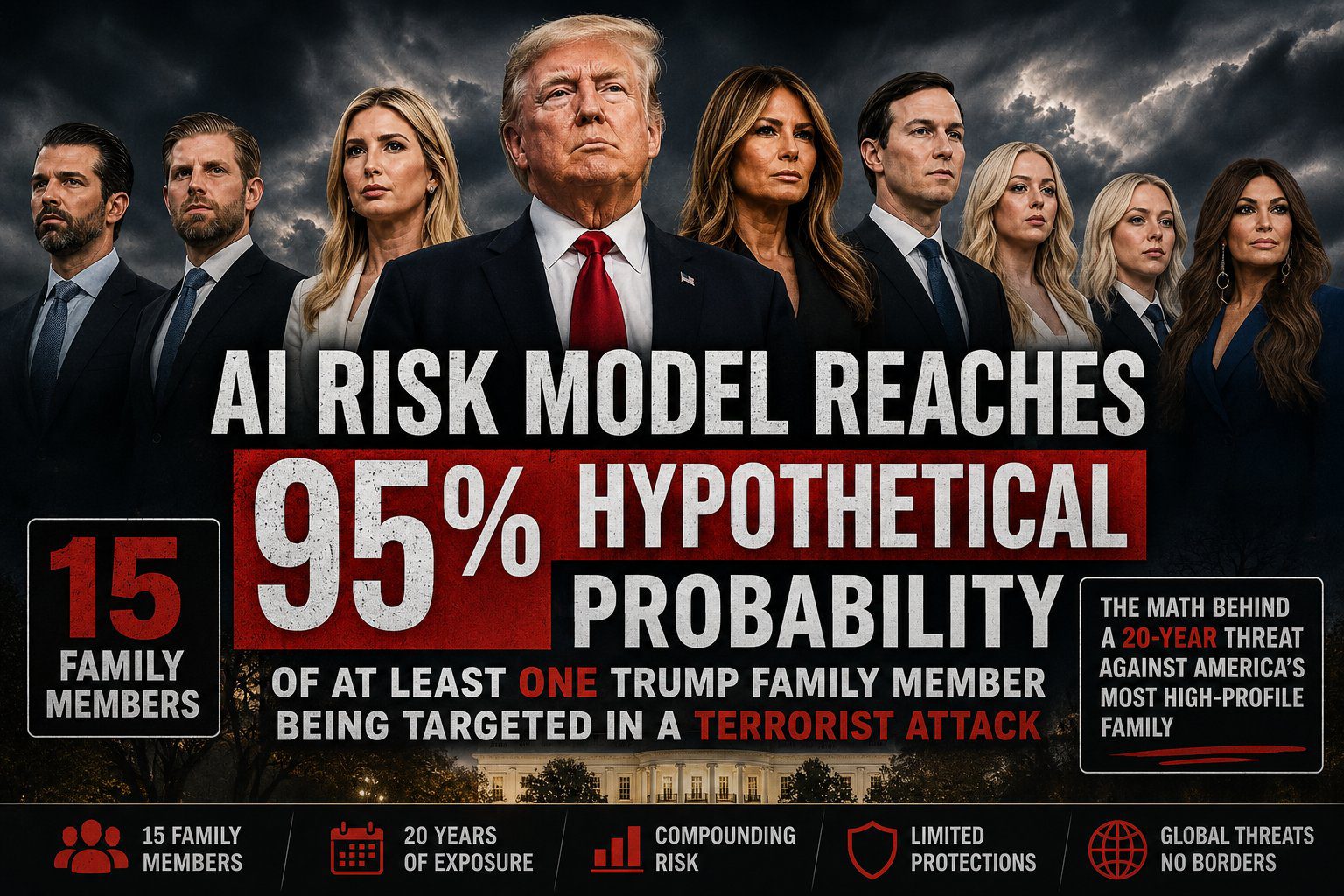
No credible security expert can honestly assign a precise percentage to the likelihood that a member of the Trump family will be attacked over the next twenty years. Terrorism is too adaptive, intelligence constantly evolves, and security measures change over time. Any specific figure would ultimately rest on assumptions rather than measurable fact.
What mathematics can demonstrate, however, is how cumulative risk compounds. Using a purely hypothetical model, assume there are 15 highly recognizable family members and that each faces just a 1 percent annual risk of a successful targeted attack over a 20 year period. The probability that none of them would be attacked is:
(0.99)^(15 × 20) = (0.99)^300 ≈ 4.9%
That means the probability that at least one member of the family would be successfully attacked under those assumptions is:
1 − (0.99)^300 ≈ 95.1%
That 95 percent figure is not a prediction. It simply illustrates how even a very small annual risk, when spread across a large, highly visible family over decades, compounds into a dramatically larger cumulative risk.
The fatal flaw is arithmetic. In executive protection, more people create more exposure, more exposure creates more vulnerabilities, and more time creates more opportunities for a patient adversary. A hostile actor does not have to defeat the entire Secret Service or penetrate the President’s security bubble. They only have to find one family member, on one day, in one place, when the protective umbrella is at its weakest. That is the cold mathematics that keeps security professionals awake at night.














































Want to join the conversation?
Create an account or sign in to share your thoughts, vote,
and reply to other readers.
Showing 0 of 0 comments
Don't have an account?
Already have an account?