
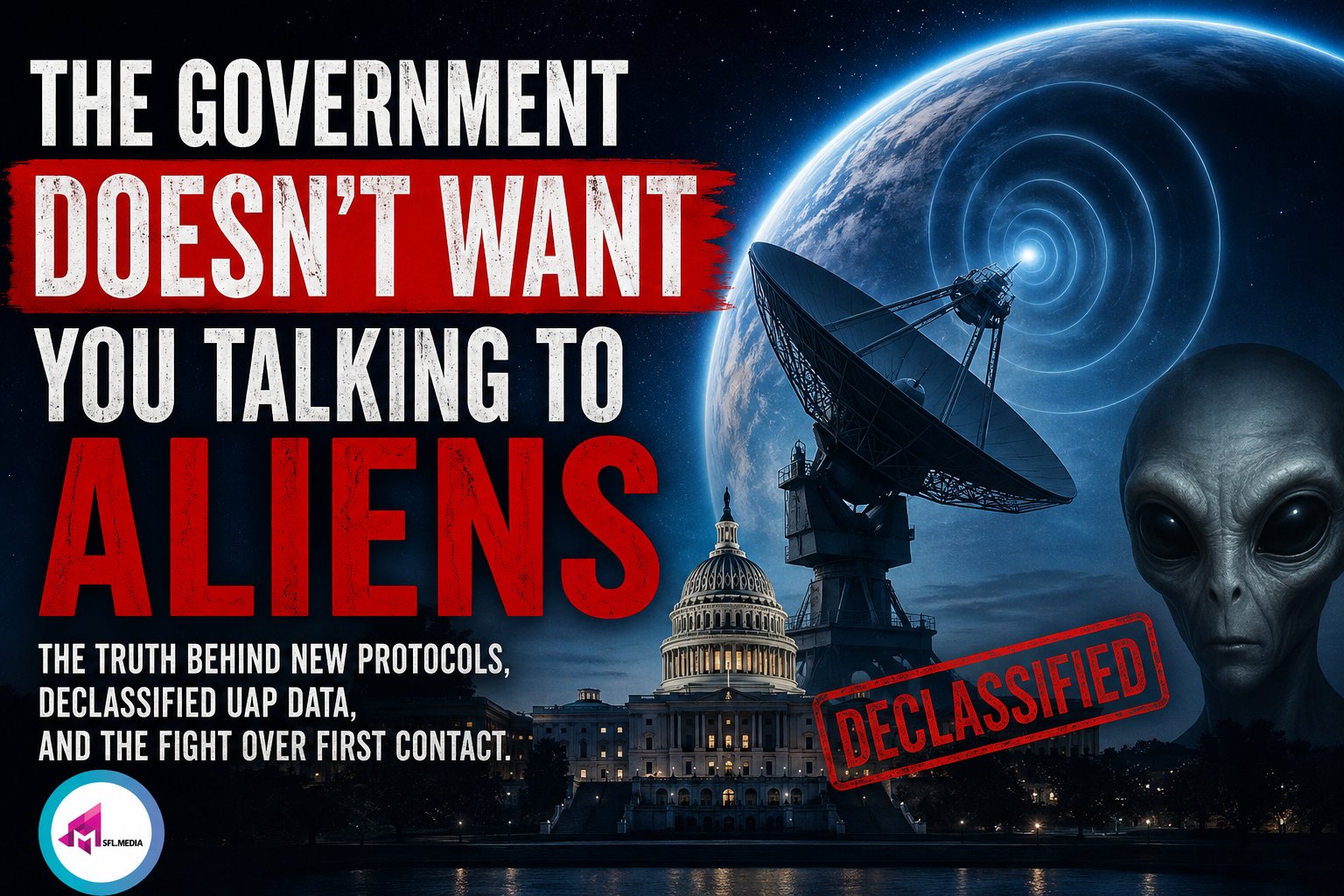
Why the Government Doesn’t Want Anyone Talking to Aliens
New Scientific Protocols, Government Secrecy, and the Battle Over First Contact
For decades, humanity has dreamed about receiving a message from another civilization somewhere among the stars. Hollywood imagined heroic scientists answering the call. Science fiction envisioned ambassadors greeting visitors from distant worlds. But if a signal ever arrives tomorrow, the people listening may be under strict instructions not to answer. That reality has surprised many observers following recent updates to international first contact protocols and a growing wave of government disclosures involving unidentified anomalous phenomena, commonly known as UAPs.
The question is simple. If humanity finally hears from another intelligence, who gets to speak for Earth?
According to leading scientific organizations, the answer is not you, not your government, and not even the scientists who discover the signal.
The New Rules of First Contact
The International Academy of Astronautics and researchers associated with the Search for Extraterrestrial Intelligence program have spent years updating protocols designed for a world where advanced artificial intelligence, social media, cyber warfare, and geopolitical competition now shape every major global event. The updated framework emphasizes verification before communication.
If a potentially artificial signal is detected, researchers are instructed to avoid transmitting a response until the discovery can be independently confirmed by multiple organizations around the world. The goal is to prevent humanity from accidentally responding to a false signal, a technical malfunction, or a naturally occurring cosmic phenomenon. That sounds reasonable on its face.
But critics argue the protocol raises a larger philosophical question. If extraterrestrial intelligence belongs to all of humanity, who has the authority to decide when and how contact occurs? Under current guidelines, the information would likely be elevated to international bodies such as the United Nations before any coordinated response is authorized. In practical terms, the first conversation with another civilization could become a political process.
Why Governments Prefer Control
Governments have always sought control over information they consider strategically important. Nuclear technology, cryptography, satellite surveillance, cyber warfare capabilities, and military intelligence have all historically been managed through layers of classification and restricted access. The possibility of extraterrestrial contact would represent a discovery potentially more significant than any of them. The implications would touch religion, science, economics, defense, philosophy, and geopolitics simultaneously.
From a government perspective, an uncontrolled response to a verified extraterrestrial signal could create uncertainty, panic, diplomatic conflict, or even national security concerns. That is one reason many officials and scientific organizations argue that any confirmed contact should be coordinated globally rather than handled by a single institution or nation. The concern is not necessarily that aliens are hostile. The concern is that humanity itself may not react predictably.
The Disclosure Era Changes Everything
What makes this debate particularly relevant today is the unprecedented shift in public discussion surrounding UAPs. Over the past several years, governments around the world have released thousands of pages of documents, military sensor recordings, pilot testimony, radar data, and investigative reports involving objects that remain unexplained.
The United States government has acknowledged that military personnel have encountered phenomena that are not easily attributed to known aircraft, drones, or natural events. Congressional hearings have featured military witnesses describing encounters with objects demonstrating unusual flight characteristics. Intelligence officials, pilots, radar operators, and defense personnel have increasingly spoken publicly about incidents that once would have remained classified. While none of these disclosures prove extraterrestrial visitation, they have dramatically changed the conversation. The possibility of non-human intelligence is no longer confined to science fiction conventions and late-night radio shows. It is now a legitimate subject of congressional hearings, intelligence reviews, and scientific inquiry.
Information Control Versus Public Knowledge
For many researchers and transparency advocates, the biggest issue is not whether extraterrestrials exist. It is whether governments would be honest if they knew. Decades of secrecy surrounding classified aerospace programs have fueled public suspicion that information about anomalous phenomena may have been withheld from both lawmakers and citizens.
Numerous whistleblowers have alleged that portions of the government possess information that has never been fully disclosed to the public. Those claims remain heavily debated and largely unverified, but they have intensified demands for transparency. As more documents become public and more officials speak openly, trust has become a central issue. Many citizens increasingly question whether governments should be the sole gatekeepers of potentially civilization changing information.
The Real Question
The updated first contact protocols are not evidence that an alien message has been received. They are not proof that extraterrestrials are visiting Earth. They are simply a recognition that humanity may eventually face a situation for which no modern government, scientific institution, or international organization is fully prepared. Yet the protocols reveal something important. The moment humanity discovers it is not alone, the first battle may not be between humans and aliens.
It may be between secrecy and transparency. The debate over who controls information, who speaks for Earth, and who decides what the public is allowed to know has already begun. If a signal ever arrives from the stars, the biggest challenge may not be understanding the message. It may be deciding who gets to answer.













































Want to join the conversation?
Create an account or sign in to share your thoughts, vote,
and reply to other readers.
Showing 1 of 1 comment
Don't have an account?
Already have an account?