
Are UFOs Hiding in the World’s Oceans? Congressional Investigations and Whistleblower Claims Raise Questions About Underwater Bases
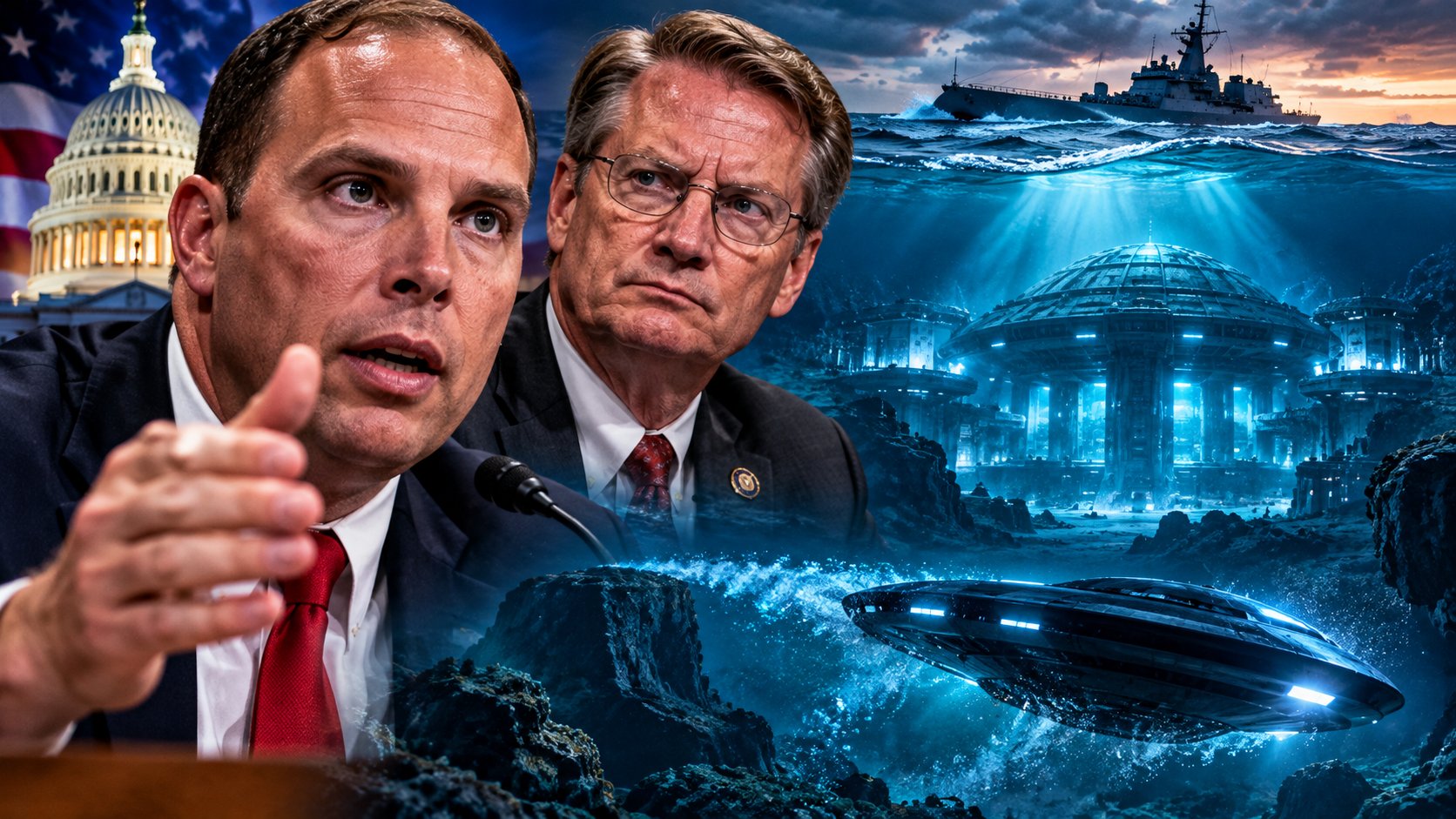
Former intelligence official David Grusch and Congressman Tim Burchett have helped bring allegations of secret UFO programs into the national spotlight. Now attention is shifting beneath the waves, where reports of unidentified submerged objects, alleged transmedium craft, and speculation about enormous underwater installations are raising questions about what the U.S. government knows and what remains unexplained.
The UFO Mystery Is Moving From the Skies to the Deep Ocean
For decades, the search for unidentified flying objects has focused primarily on the skies, with reports of mysterious lights, unexplained aircraft, unusual radar signatures, and military pilots encountering objects they could not immediately identify. But a growing part of the UFO debate has moved into an environment considerably more difficult to observe: the world’s oceans, where some former military personnel, whistleblowers, and researchers believe unexplained phenomena may be operating far beyond the reach of conventional surveillance.
The allegations range from unidentified objects entering and exiting the water to claims of enormous underwater facilities allegedly capable of concealing advanced craft. Some proponents suggest that the oceans could provide an ideal environment for technology attempting to avoid detection, while others argue that certain reported encounters point toward vehicles capable of operating in air, space, and water without the performance limitations associated with conventional aircraft or submarines. These theories have become increasingly prominent as public attention has shifted from traditional flying saucer sightings toward reports of unidentified anomalous phenomena, or UAP, involving multiple environments.
The discussion has gained national attention partly because the broader UFO issue has moved into congressional hearings and national security investigations. Republican Congressman Tim Burchett of Tennessee has repeatedly pressed federal officials for greater transparency, while former intelligence officer David Grusch has alleged that secret government programs possess recovered technology of nonhuman origin. Their public statements have helped move previously fringe claims into mainstream political and media conversations, although their involvement does not establish the accuracy of the underlying allegations.
The distinction between an unidentified observation and evidence of nonhuman technology remains essential. Military personnel have reported objects and sensor readings they could not immediately explain, and federal investigators have acknowledged that some incidents remain unresolved because of insufficient information. But the existence of unexplained observations is not proof of extraterrestrial technology, and claims about massive underwater installations have not been supported by publicly authenticated physical evidence.
David Grusch and the Allegations of Secret Government UFO Programs
David Grusch became one of the most prominent figures in the modern UFO disclosure movement in 2023 when he publicly alleged that elements of the United States government and its contractors had operated secret programs involving recovered craft of alleged nonhuman origin. A former intelligence official who worked with the National Geospatial Intelligence Agency and served as a representative to the Pentagon’s UAP Task Force, Grusch said his claims were based largely on information provided by individuals who purportedly had direct knowledge of classified activities.
During a July 2023 congressional hearing, Grusch testified under oath that he had been informed of a long-running crash-retrieval and reverse-engineering program operating outside normal congressional oversight. He also alleged that information about such programs had been improperly withheld from lawmakers. Grusch said he could provide certain names, locations, and other details in a classified setting, but he did not publicly produce recovered technology or documentation independently proving the existence of nonhuman vehicles.
His testimony attracted attention because of his intelligence background, his willingness to make allegations under oath, and the broader questions he raised about oversight of classified programs. It did not establish that extraterrestrial spacecraft had been recovered, and the Pentagon has disputed allegations that it possesses verified evidence of extraterrestrial technology. Nevertheless, Grusch’s statements contributed to a larger debate over whether highly classified programs could conceal information from elected officials and whether whistleblower protections are sufficient for individuals reporting alleged misconduct within the intelligence community.
The underwater base narrative has developed alongside Grusch’s broader claims, but the relationship between them requires careful examination. Public discussions frequently combine statements by Grusch, remarks from other UFO researchers, historical military reports, and anonymous online allegations into a single narrative about secret facilities beneath the ocean. That combination can create the impression that every detail comes from the same firsthand source, even when different claims have different origins and levels of supporting evidence.
Grusch Describes an Alleged Underwater Base Spanning Multiple City Blocks
One of the most extraordinary allegations emerged during an appearance by David Grusch on The Joe Rogan Experience, where the former intelligence official discussed what he characterized as a large underwater installation associated with unidentified anomalous phenomena. During the interview, Grusch suggested that information available to him indicated the existence of a substantial underwater base of operations. When Rogan pressed him about its size, Grusch described a structure comparable to multiple city blocks, while declining to provide a precise location and indicating that certain details could involve sensitive Navy information.
The claim attracted attention because it appeared to move beyond general speculation about unusual objects entering the ocean and toward an allegation concerning a specific type of permanent installation. An underwater facility spanning multiple city blocks would be an enormous structure by conventional engineering standards, particularly if situated at significant depth. Its construction, operation, and maintenance would ordinarily require substantial materials, energy, transportation, and logistical support, all of which would present challenges for any attempt to conceal it from scientific or military surveillance.
However, Grusch did not publicly present authenticated imagery, construction records, sonar measurements, physical materials, or independently verifiable documentation establishing that such a facility exists. His statement is therefore a significant public allegation from a former intelligence official rather than a confirmed discovery. Without a verifiable location or independently examined evidence, researchers cannot determine whether the described structure is real, whether it is a conventional installation, or whether the information Grusch received was accurate.
The distinction is especially important because claims involving enormous hidden structures can quickly become amplified through online discussions, where speculation is often repeated as established fact. A credible investigation would need to establish the facility’s location, physical dimensions, observable characteristics, and possible origin before drawing conclusions about its purpose or the technology allegedly operating within it.
Congressman Tim Burchett Pushes for Answers About Unidentified Objects
Congressman Tim Burchett has become one of the most outspoken advocates for greater government transparency concerning unidentified anomalous phenomena. He has criticized the Pentagon’s handling of UFO related information and argued that lawmakers and the public deserve clearer answers about reports involving military pilots, classified sensor systems, and possible advanced technologies. His public commentary has helped keep UAP investigations within the broader national security discussion, particularly as questions about unidentified objects have expanded beyond conventional aviation encounters.
Burchett has frequently emphasized accounts of objects allegedly displaying extraordinary performance characteristics, including rapid acceleration, unusual maneuverability, and movement between different environments. He has also discussed claims involving unidentified objects operating near or beneath the ocean’s surface, suggesting that the government may possess information about unusual activities that has not been fully disclosed to Congress. These statements reflect his interest in the allegations and his concerns about government secrecy, but they do not independently establish that hidden underwater bases or nonhuman vehicles exist.
The congressman’s involvement is significant because the subject has moved beyond informal UFO enthusiast communities into questions about national security oversight, military readiness, and government accountability. Congressional hearings have examined whether unidentified objects present aviation hazards, whether military personnel have adequate reporting protections, and whether classified programs are receiving appropriate legislative scrutiny. Those are legitimate oversight questions regardless of whether any particular UAP report ultimately involves foreign technology, a sensor error, a natural phenomenon, or something that remains unexplained.
What Are Transmedium UFOs, and Why Do They Matter?
One of the most intriguing concepts in modern UAP investigations is transmedium travel, a term describing an object reportedly moving between different environments, such as air and water. The Department of Defense’s All-domain Anomaly Resolution Office, or AARO, includes such reports within its investigative mandate because unusual activity crossing operational domains could present intelligence or national security concerns. Reports of objects entering the ocean without obvious deceleration, splashes, or conventional propulsion signatures have become particularly prominent in discussions about possible underwater UAP activity.
The technical implications are significant because aircraft and submarines operate under dramatically different physical conditions. Air is comparatively low density, while water produces much greater resistance and pressure. Conventional aircraft are designed to generate lift and minimize aerodynamic drag, whereas underwater vehicles must contend with buoyancy, hydrodynamic resistance, cavitation, and structural loads. A vehicle capable of transitioning rapidly between air and water without suffering damage or losing substantial speed would represent an extraordinary engineering achievement, particularly if it could perform the maneuver repeatedly without conventional propulsion or visible structural adaptations.
However, the existence of a reported transmedium encounter does not establish that a vehicle actually performed those maneuvers. Radar artifacts, infrared interpretation errors, viewing angles, sensor limitations, and incomplete observations can create misleading impressions of an object’s speed, distance, altitude, or trajectory. An object appearing to disappear into the water might actually have moved beyond a sensor’s field of view, while an apparent high speed maneuver could result from inaccurate assumptions about distance or movement.
AARO’s fiscal year 2024 consolidated report provides an important reality check. The office received 757 UAP reports during the reporting period, but none were classified as occurring in the maritime or transmedium domains. Most involved airborne observations, while others concerned objects reported in space. The report did not establish the existence of extraordinary underwater vehicles or nonhuman technology, although it acknowledged that some incidents remained unresolved because investigators lacked sufficient information.
That finding does not mean unusual underwater encounters are impossible or that every historical report has been adequately investigated. It means the available official evidence does not support treating transmedium craft as a demonstrated technological reality. The challenge for researchers is obtaining reliable observations that can distinguish genuinely unusual performance from errors involving instruments, environmental conditions, or interpretation.
Why the Deep Ocean Has Become Central to the UFO Debate
The world’s oceans cover approximately 71% of Earth’s surface and contain environments that remain difficult to observe directly. Vast areas lie thousands of meters below the surface, beyond the reach of ordinary diving equipment and outside the routine operations of commercial vessels. The extreme depth, darkness, pressure, and enormous geographic scale of the ocean create significant challenges for scientific exploration, even with modern satellites, sonar systems, autonomous underwater vehicles, and remotely operated submersibles.
Although scientists possess broad global models of seafloor topography, much of the ocean floor has not been surveyed using modern high resolution techniques. An area can be represented on a map without having been directly photographed or examined for smaller geological or artificial structures. This distinction has contributed to the popular perception that the deep ocean remains one of Earth’s last great unexplored frontiers, a characterization that contains an important element of truth but can also exaggerate how little scientists know about the marine environment.
For proponents of underwater UAP theories, those observational limitations make the deep ocean an attractive hypothetical location for concealed installations. A facility positioned far below commercial shipping lanes, civilian radar coverage, and routine human activity might be difficult to detect without specialized equipment. Ocean currents, complicated underwater terrain, and the limitations of acoustic surveillance could theoretically make certain locations more difficult to investigate than others.
But an environment being difficult to observe is not evidence that an extraordinary installation exists there. The ocean contains underwater mountain ranges, hydrothermal vents, trenches, geological formations, and biological ecosystems that scientists continue to discover and study. Its unexplored regions provide legitimate opportunities for scientific investigation without requiring an extraterrestrial explanation. The relevant question is whether any credible observation identifies a specific underwater anomaly that cannot be explained through known geological, biological, technological, or sensor related processes.
The Navy’s Encounters Helped Bring UAPs Into Mainstream Investigation
The modern UAP debate owes much of its prominence to reports from U.S. Navy personnel, particularly encounters involving military aviators operating near American coastlines. One of the most widely discussed incidents occurred in November 2004 when Navy pilots associated with the USS Nimitz carrier strike group reported an unusual object during training operations off Southern California. The encounter later became a central example in public discussions about unidentified aircraft and the possibility that military sensors had detected technology exhibiting performance characteristics beyond conventional expectations.
Retired Navy Commander David Fravor has described encountering a white, oblong object that appeared to maneuver in ways he could not explain. Other personnel reported radar observations associated with the incident, and infrared footage of an unidentified object later became part of the broader public discussion. Some witnesses described unusual activity near the ocean’s surface, contributing to later speculation about whether unidentified objects might operate underwater or emerge from beneath the waves.
The Nimitz encounter remains important because it involved trained military observers and raised questions about the interpretation of radar, visual, and infrared information. However, the publicly available evidence does not establish that the object originated from an underwater base or possessed extraterrestrial technology. Witness testimony can provide valuable investigative leads, but reconstructing the performance of an unidentified object requires reliable measurements, complete sensor data, and independent technical analysis.
For the Navy, unusual observations near military training areas also present practical concerns. Unidentified drones, foreign surveillance platforms, sensor interference, and unauthorized aircraft can create hazards or intelligence risks even when no extraordinary technology is involved. That national security dimension is one reason the government has continued investigating UAP reports despite the absence of verified evidence supporting extraterrestrial explanations.
The Pentagon Says It Has Found No Evidence of Alien Technology
The Department of Defense’s official position remains substantially more cautious than the claims advanced by some whistleblowers and UFO researchers. In its March 2024 historical review, AARO reported that it had found no empirical evidence that the United States government or private contractors possessed or reverse-engineered extraterrestrial technology. The office also concluded that investigations spanning decades had not confirmed that any UAP observation represented technology originating beyond Earth.
According to AARO, many incidents could be explained through ordinary objects, misidentification, incomplete information, or limitations in available sensor data. Other reports remained unresolved because investigators lacked sufficient evidence to reach a reliable conclusion. The distinction between an unresolved case and a confirmed extraordinary event is central to the office’s findings, which caution against interpreting missing information as proof of nonhuman technology.
That assessment directly conflicts with the broader allegations made by Grusch and other disclosure advocates. Grusch has argued that highly classified programs and restricted information may prevent ordinary oversight mechanisms from revealing the full picture. AARO, by contrast, has stated that its investigations have not substantiated claims of secret extraterrestrial recovery and reverse-engineering programs. The disagreement illustrates one of the central difficulties in evaluating UAP allegations: whistleblowers may describe information they believe is credible, while investigators must determine whether the underlying evidence can be authenticated and independently assessed.
NASA has reached a similarly cautious conclusion from a scientific perspective. Its independent UAP study emphasized the need for better data collection, improved scientific methodology, and more reliable observations. NASA has stated that no available data establish that UAP represent alien technology, while acknowledging that some reports remain difficult to explain because the necessary measurements are incomplete. These conclusions do not establish that every UAP has been identified or that future discoveries are impossible; they establish that extraordinary explanations have not met the evidentiary standards required for scientific confirmation.
Could Advanced Underwater Technology Be Hidden From Conventional Surveillance?
Even without invoking extraterrestrial civilizations, the possibility of unusual underwater technology deserves serious consideration. The world’s major military powers invest heavily in submarine development, underwater surveillance, autonomous vehicles, acoustic detection, and technologies designed to reduce the visibility of military assets. Modern submarines can operate covertly for extended periods, while autonomous underwater vehicles are increasingly capable of performing reconnaissance, mapping, inspection, and other missions without direct human control.
Military research also explores unconventional propulsion systems, advanced materials, and improved methods of detecting or avoiding underwater surveillance. These developments demonstrate that sophisticated underwater technology exists and continues to evolve, although they do not demonstrate the existence of vehicles capable of violating known physical constraints or moving between air and water at the extreme speeds described in some UAP accounts.
A classified military program could plausibly produce observations that civilian witnesses or even some military personnel could not immediately identify. That possibility is one reason investigators must distinguish unfamiliar technology from genuinely anomalous performance. The challenge becomes more difficult when claims involve alleged secret facilities because governments do operate classified military installations, including underwater surveillance systems and submarine infrastructure, but the existence of those programs does not provide evidence of nonhuman bases spanning multiple city blocks beneath the ocean.
A credible investigation would need to establish the alleged facility’s location, physical dimensions, observable characteristics, and possible origin. Without those details, the hypothesis remains difficult to test and impossible to independently confirm. The presence of classified underwater technology also means that some legitimate national security information may remain unavailable to the public, but secrecy alone cannot establish the existence of any particular extraordinary program.
Why Congress Continues Asking Questions
The congressional UAP debate has expanded beyond the question of whether extraterrestrial visitors exist. Lawmakers have raised concerns about the handling of classified information, protections for whistleblowers, the reporting of unusual encounters, and whether defense and intelligence agencies have adequately informed Congress about relevant programs. These issues involve the government’s responsibility to oversee classified spending, protect military personnel, and ensure that intelligence activities operate within the law.
Burchett and other lawmakers have argued that military witnesses should be able to report unusual observations without fear of professional retaliation. They have also questioned whether excessive secrecy has prevented legitimate oversight of programs involving advanced aerospace technology or unidentified phenomena. Those concerns can be examined independently of claims about extraterrestrial life, particularly if credible whistleblowers identify improperly concealed programs or potential violations of federal oversight requirements.
At the same time, congressional hearings and public interviews are not substitutes for scientific verification. The fact that a claim is discussed by a member of Congress or a former intelligence official does not establish its accuracy. The next meaningful development in the underwater UAP controversy would therefore be the release of independently verifiable evidence, including authenticated sonar recordings, original sensor data, physical materials, corroborated documentation, or information sufficient for qualified researchers to examine a specific location.
The World’s Oceans Remain a Genuine Scientific Frontier
The fascination surrounding underwater UFO bases reflects a broader truth about humanity’s relationship with the ocean. Despite major advances in satellite observation, oceanography, robotics, and underwater mapping, substantial portions of the deep sea remain poorly understood. Scientists continue to discover new species, previously undocumented geological features, unusual ecosystems, and complex environmental processes in regions that were once considered inaccessible.
Those discoveries demonstrate that the ocean remains a legitimate frontier of scientific exploration. They also illustrate why speculation can flourish in environments where direct observation is difficult. When the public knows that vast underwater regions remain incompletely explored, claims about hidden structures and mysterious vehicles can appear plausible even without supporting evidence.
The responsible approach is neither to dismiss every unusual observation automatically nor to accept extraordinary explanations because an environment is difficult to investigate. It is to demand evidence capable of distinguishing an actual anomaly from an error, an ordinary object, a natural phenomenon, or a classified human technology. That standard applies equally to the Pentagon, congressional investigators, military witnesses, and whistleblowers making claims about nonhuman intelligence.
Are We Looking for UFOs in the Wrong Place?
For generations, the public imagination has associated UFOs with distant stars, mysterious lights in the sky, and spacecraft descending from outer space. The growing discussion of underwater phenomena offers a different possibility: that some of the most intriguing reports concern environments much closer to home but far more difficult to observe. The deep ocean’s enormous scale, incomplete high-resolution mapping, and challenging surveillance conditions have made it a natural focus for speculation about where advanced technology might remain concealed.
Grusch’s comments about an alleged underwater installation spanning multiple city blocks have added a dramatic claim to that conversation. Burchett’s continued interest in ocean-related UAP allegations has helped bring the subject into political discussions, while military reports involving unusual objects near coastal waters have provided a factual foundation for examining unexplained observations. Together, these developments have intensified public interest in the possibility that some UAP mysteries might involve the world’s oceans rather than distant regions of space.
But these developments must not be confused with proof. The public record does not establish that an underwater nonhuman base exists, that unidentified craft routinely move between air and water at extraordinary speeds, or that the United States government has confirmed such technology. What it establishes is that former intelligence officials and military witnesses have made claims serious enough to attract congressional attention, while federal investigators and scientists continue to report insufficient evidence for extraterrestrial explanations.
The oceans remain vast, difficult to explore, and full of unanswered scientific questions. Whether any of those questions will ultimately involve technology beyond current human understanding is unknown. If an enormous installation of unknown origin really exists beneath the ocean, its discovery would represent one of the most consequential scientific and national security developments in modern history. But until someone produces evidence that can be independently examined, the difference between an extraordinary possibility and an extraordinary discovery remains the same: proof.





















































Want to join the conversation?
Create an account or sign in to share your thoughts, vote,
and reply to other readers.
Showing 0 of 0 comments
Don't have an account?
Already have an account?