

We Asked AI to Fix America’s $40 Trillion Debt. Its Answer Could Terrify Washington...
America has spent decades debating the national debt while continuing to add to it. Republicans promise spending cuts, Democrats defend major social programs, both parties propose expensive priorities of their own, and Washington repeatedly returns to the same result: more borrowing, more interest and a larger bill pushed onto the next generation.
So we decided to ask a different question: What happens if artificial intelligence is given the problem instead?
Not a chatbot instructed to produce a fantasy in which trillions of dollars magically disappear, taxes fall, benefits increase and economic growth explodes forever. The more interesting experiment is to put AI in the role of an independent national fiscal planner and impose constraints that resemble the real world: no defaulting on Treasury debt, no deliberately inflating the debt away, no eliminating Social Security or Medicare, no dismantling national defense, no imaginary economic growth rates and no pretending that every dollar labeled “waste” can simply be recovered.
Under those conditions, AI can construct a plausible framework in which the United States could dramatically reduce, and under sufficiently favorable assumptions potentially eliminate, publicly held federal debt over roughly four decades. There is, however, an enormous catch: the machine’s answer requires Washington to do many of the things Washington has spent decades refusing to do.
First, Understand the Size of the Hole
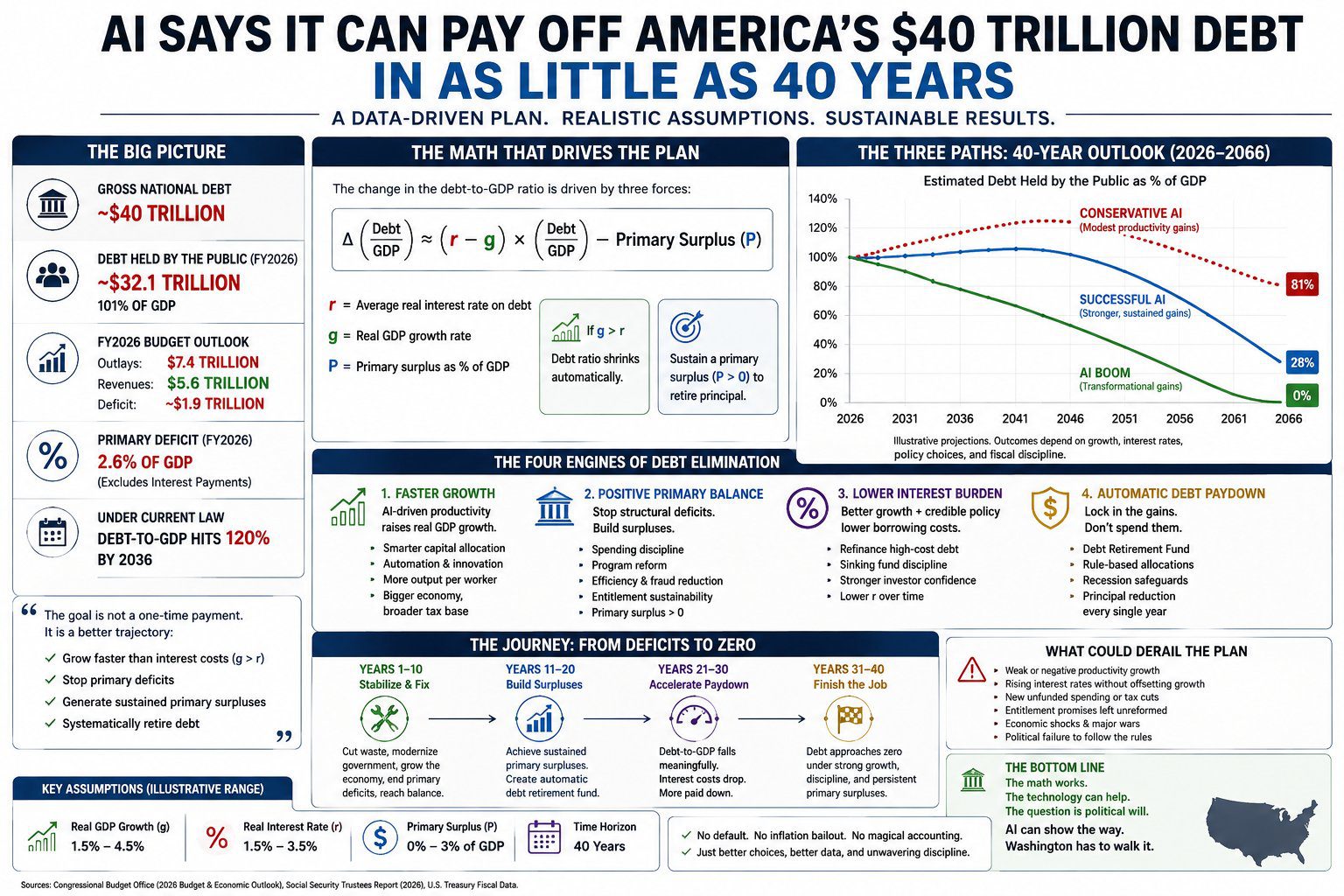
The federal government’s fiscal trajectory is already extraordinary. The Congressional Budget Office projects a federal deficit of approximately $1.9 trillion in fiscal year 2026, with roughly $7.4 trillion in federal outlays against $5.6 trillion in revenues. Debt held by the public is projected to reach approximately $32.1 trillion at the end of the fiscal year, equal to about 101 percent of gross domestic product, and CBO projects that ratio will climb to 120 percent by 2036 under current law.
There is an important distinction between America’s headline national debt and the debt measure economists generally use when evaluating fiscal sustainability. Gross federal debt includes Treasury securities held by federal government accounts, while debt held by the public measures federal borrowing from investors outside those accounts. The headline national debt is approaching the $40 trillion neighborhood, but a serious debt-reduction model should primarily track publicly held debt and its relationship to the size of the economy. That distinction does not make the problem small. It makes the analysis more accurate.
AI’s First Discovery: America Does Not Need to Find $40 Trillion Under a Couch Cushion
The most important insight in a long term debt elimination strategy is that the United States does not have to suddenly produce tens of trillions of dollars and write one enormous check to the Treasury. It has to fundamentally change the trajectory of federal finances. The basic mathematics can be summarized through the relationship between three forces: the government’s effective interest burden, economic growth and the primary budget balance. In simplified form, the change in the debt to GDP ratio is driven by the difference between the real interest rate and real economic growth, multiplied by the existing debt burden, minus the government’s primary surplus.
In other words, three letters become enormously important: R, G and P. R is the effective real interest rate on government debt, G is real economic growth and P is the primary budget surplus. When economic growth persistently exceeds the effective real interest rate, existing debt becomes easier to carry relative to the expanding economy. When the government simultaneously stops running primary deficits and begins generating sustained primary surpluses, it can start retiring principal rather than continually borrowing more money.
The machine therefore does not begin by asking how America finds $40 trillion. It asks how America gets growth above interest costs, stops adding structural deficits and begins producing enough recurring surplus to systematically retire debt. That is a radically different problem, and it is one AI may be particularly well suited to attack.
The Biggest Weapon Is Not Spending Cuts. It Is Growth.
The most powerful variable in the entire experiment is productivity. Artificial intelligence, automation, robotics and autonomous software agents have the potential to allow companies to produce more goods and services with fewer inputs. AI could accelerate scientific research, improve logistics, automate administrative work, increase manufacturing efficiency, optimize energy systems and allow individual workers to accomplish substantially more.
CBO already incorporates some AI related productivity improvement into its economic projections. Its central estimate assumes AI related productivity increases add roughly 0.1 percentage point per year to economic growth on average, while acknowledging enormous uncertainty about how quickly the technology will improve, spread through businesses and affect long term output.
That uncertainty is critical because small differences in annual growth become enormous over 40 years. An economy growing at 2 percent annually becomes roughly 2.2 times larger after four decades, while at 4 percent annual growth it becomes nearly 4.8 times larger. Higher output can produce higher wages, higher corporate profits, larger investment returns and substantially greater federal tax receipts even without enormous increases in baseline marginal tax rates.
That is why an AI debt strategy would treat productivity growth as a national fiscal weapon. The objective would not simply be to cut government until the spreadsheet balances. It would be to make the American economy dramatically more productive while ensuring the federal government captures enough of the resulting economic expansion to repair its balance sheet.
But We Cannot Cheat by Assuming an AI Economic Miracle
This is also where an AI generated debt plan can become misleading very quickly. Assuming that artificial intelligence will produce 3.5 percent, 4 percent or 5 percent annual productivity growth for decades can make almost any long term debt model look wonderful. It can also turn the exercise into economic science fiction.
No one knows how large AI’s economy wide productivity effects will ultimately become. CBO has explicitly warned that the direction, magnitude and timing of AI’s effects on federal revenues and spending remain uncertain. Faster diffusion could accelerate economic growth, while expensive implementation, infrastructure constraints, labor disruption or disappointing technological progress could produce substantially smaller gains.
A credible AI fiscal system therefore could not operate from one optimistic forecast. It would need multiple scenarios running simultaneously, including conservative AI adoption, successful AI adoption and an extraordinary AI boom. The government would then make fiscal decisions against the conservative and middle scenarios rather than spending money based on the assumption that the most optimistic future will automatically arrive. If the boom arrives, America pays down debt faster. If it does not, the fiscal architecture still survives.
Before AI Can Pay Off the Debt, It Has to Stop the Bleeding
Economic growth alone is not enough. The federal government currently runs a substantial primary deficit, meaning it spends more than it collects even before net interest costs are included. Before America can begin systematically paying down debt, AI would first have to move the federal government from primary deficit to primary balance and eventually into persistent primary surplus.
That represents a fiscal adjustment measured in percentage points of GDP, potentially well over a trillion dollars annually once fully implemented, depending on the economic environment. There is no painless way around that fact. The adjustment could come from stronger economic growth, greater tax revenue, lower spending growth, entitlement reform, administrative savings, healthcare reform, procurement reform or some combination of all of them. A serious AI would almost certainly choose the combination.
AI Cannot Solve This by Firing Federal Office Workers
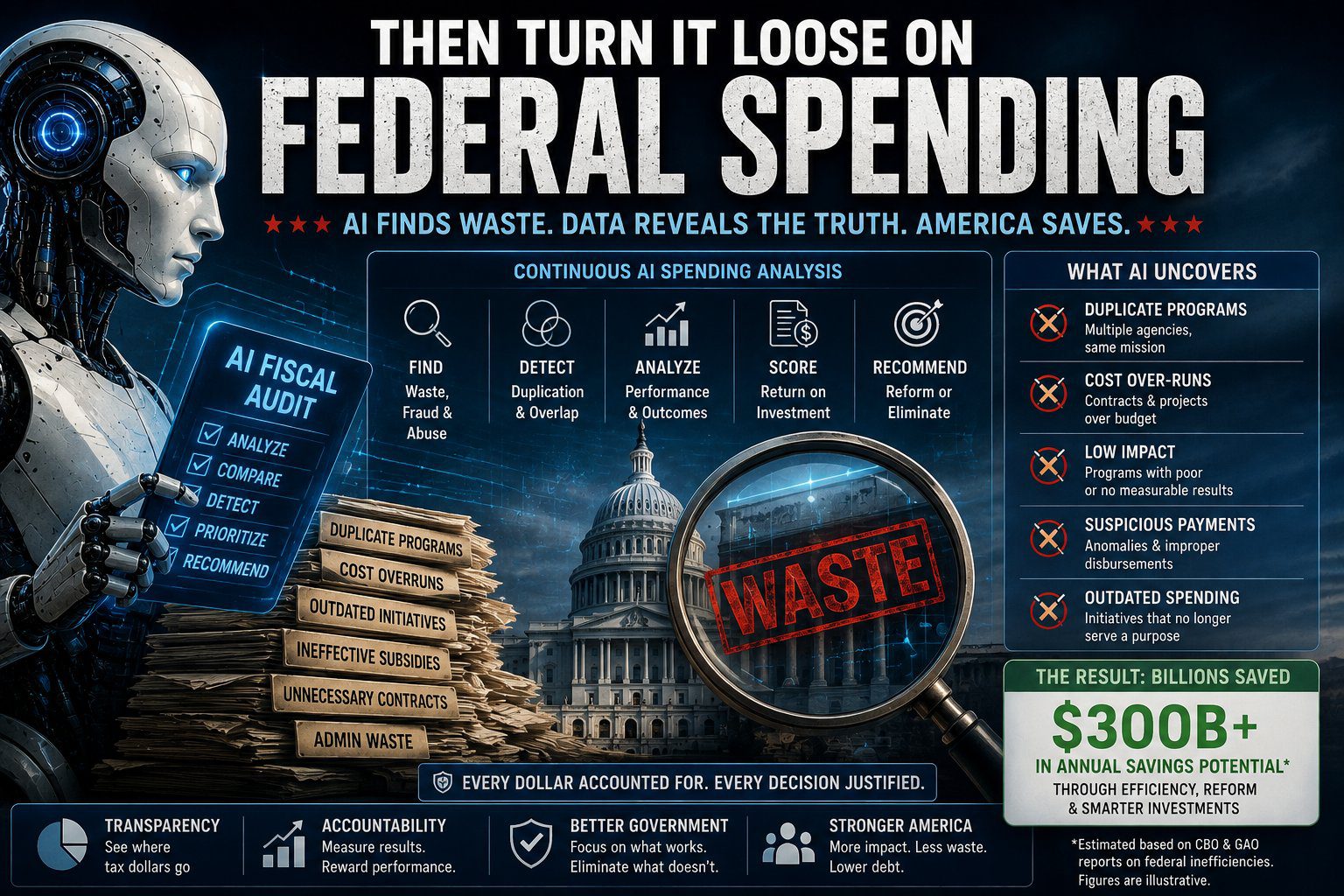
This is where the fantasy of eliminating the national debt through “government efficiency” collides with arithmetic. Federal administrative waste should absolutely be attacked. AI could automate redundant administrative work, identify improper payments, detect suspicious procurement patterns, compare prices across agencies, expose duplicative programs and continuously audit federal transactions. Those savings could be substantial, but they are not enough.
America’s long term fiscal problem is deeply connected to mandatory spending, healthcare costs, Social Security, interest payments, defense and the structural relationship between federal revenues and expenditures. Eliminating office jobs in Washington cannot make those obligations disappear.
The 2026 Social Security Trustees Report illustrates the scale of the challenge. Under current projections, the Old-Age and Survivors Insurance Trust Fund is expected to deplete its reserves in the fourth quarter of 2032. At that point, continuing program income would be sufficient to pay approximately 78 percent of scheduled OASI benefits absent legislative action. On a combined Social Security basis, reserves are projected to be depleted in 2034, with continuing income sufficient to cover approximately 83 percent of scheduled benefits at that time.
Eventually the AI has to enter the political minefield. It has to analyze Social Security, Medicare, healthcare delivery, defense, tax expenditures, retirement policy, corporate taxation, capital gains, federal procurement, consumption taxes, investment incentives, energy, immigration, trade and research and development. That is precisely where artificial intelligence could become politically revolutionary because, unlike elected officials, the machine does not need reelection.
The Machine Would Eventually Tell Everybody Something They Hate
A credible debt elimination plan almost certainly cannot be constructed around one political party’s ideology. The AI might tell Democrats that some benefits must be restructured to remain sustainable. It might tell Republicans that additional federal revenue is mathematically unavoidable. It might tell defense hawks that weapons programs need to be terminated, corporations that cherished deductions have little economic justification, wealthy households that they need to contribute more and younger Americans that retirement parameters have to change.
It could tell environmentalists that certain energy infrastructure is economically necessary, protectionists that particular tariffs suppress growth, and politicians in both parties that some popular subsidies are terrible investments. Everybody gets something they hate, and that may be one of the strongest indications that the plan is legitimate. If a supposed solution to America’s national debt perfectly matches one political party’s existing platform, there is a good chance somebody cooked the assumptions before running the numbers.
Then the AI Comes for the Tax Code
A machine trying to maximize economic growth and federal solvency would not necessarily begin by asking whether taxes should be “higher” or “lower.” It would ask which taxes generate revenue with the least economic damage and which provisions produce enough economic benefit to justify their cost.
That means analyzing thousands of deductions, credits, exclusions, exemptions and preferences against measurable outcomes. A corporate tax provision that demonstrably increases productive domestic investment could be retained or improved, while an exemption that primarily enriches an industry without producing its promised economic benefits could be eliminated. Research incentives could be measured against actual innovation and investment, marginal rates could be evaluated for their effects on work and capital formation, and alternative combinations of income, consumption and capital taxation could be modeled against revenue, growth and distributional consequences.
Instead of politicians beginning with ideology and searching for numbers to support it, the machine begins with the objective and searches millions of potential combinations.
Then Turn It Loose on Federal Spending
Every major federal program could face continuous return on investment analysis. The machine could compare agencies performing similar functions, identify programs whose costs consistently rise faster than their results, find contracts priced dramatically above comparable commercial products, flag duplicate procurement, detect suspicious payment patterns and identify programs that continue receiving appropriations long after their original justification has disappeared.
That does not mean AI automatically shuts programs down. It means Congress loses the ability to pretend it does not know. Every major spending program could receive a continuously updated fiscal score showing its cost, measurable results, historical performance, duplication with other programs and projected long-term return. The question would no longer be whether politicians claim a program works. The question would be whether the data says it does.
Create an American Debt Retirement Fund
Once the federal government reaches sustainable primary surplus territory, the AI framework could impose a mechanical debt-retirement rule. A predetermined share of revenues exceeding a conservative long term baseline could automatically flow into a protected federal sinking fund dedicated to retiring Treasury debt. Alternatively, primary surpluses above a defined percentage of GDP could automatically be directed toward principal reduction, preventing Congress from casually converting every fiscal improvement into another permanent spending commitment.
The system would also need recession safeguards. During severe downturns, wars or genuine national emergencies, automatic debt retirement could temporarily slow or stop so fiscal policy does not deepen an economic contraction. When prosperity returns, however, the rule would return with it. That is how a 40 year strategy could potentially survive 20 different Congresses and approximately 10 presidential terms.
Give AI a No New Bullshit Fiscal Rule
Congress wants a new $300 billion program? Fine. The AI shows where the $300 billion comes from. Congress wants another major tax cut? The system identifies the offset or evaluates the claimed economic effects under conservative scoring assumptions. A new subsidy would come with an expected return, while a new military commitment would include a transparent estimate of its long term cost and how the government intends to finance it.
Emergency legislation could receive clearly defined exceptions, but ordinary legislation would receive an automated fiscal assessment showing its projected effects over 10, 20 and 40 years. Congress would remain constitutionally responsible for legislating and could override the machine, but the override would be public. Americans could see, in plain language, when lawmakers knowingly approved legislation projected to add hundreds of billions of dollars to federal debt. Politicians could still vote yes. They would simply have to own the number.
Then the AI Comes for Congress
This may be the most difficult part of the entire plan because America’s debt problem is not primarily the result of politicians being incapable of arithmetic. It is the result of incentives. Members of Congress face elections every two years in the House and every six years in the Senate, while presidents govern in four year cycles. Long-term fiscal reform can create immediate political pain while delivering benefits decades later, meaning the politician accepting the pain may be long gone before the country receives the reward.
Artificial intelligence has no election calendar. A fiscal model can evaluate 2050 just as dispassionately as next Tuesday. That does not mean machines should be permitted to govern without democratic control. It means a permanent AI fiscal institution could preserve long term institutional memory and force elected officials to confront consequences extending far beyond the next election. The machine remembers every promise, every projection, every supposedly temporary program and every fiscal warning Congress ignored, and it does not care who wins the midterms.
America Has Balanced Its Budget Before
This is not entirely theoretical. The United States recorded federal budget surpluses from fiscal years 1998 through 2001, demonstrating that America’s fiscal trajectory is not some immutable law of nature. Those surpluses emerged from a combination of strong economic growth, rising revenues, spending restraint and deficit-reduction policies enacted during the preceding years.
The lesson is not that America can simply recreate the 1990s. The economy, demographics, entitlement obligations, interest environment and federal budget are different today. The lesson is that fiscal trajectories can change when policy and economic conditions change. An AI fiscal system would attempt to make that discipline structural rather than temporary.
Plot Twist: AI Could Also Bankrupt Us Faster
There is another possibility that any intellectually serious discussion of AI and federal debt has to acknowledge: artificial intelligence could make the fiscal problem worse. AI requires enormous private capital investment, data centers, advanced semiconductors, electricity generation, transmission infrastructure and cooling systems. Automation could disrupt employment and reduce taxable labor income for some workers, while economic gains could become concentrated among relatively few companies and investors as government simultaneously spends more supporting displaced workers, retraining employees, building infrastructure and protecting increasingly important technological systems.
CBO has warned that AI’s effects on employment, wages, income distribution, tax revenues and government spending could move through multiple channels, making the ultimate federal budget impact uncertain. A larger economy therefore does not automatically guarantee a healthier government balance sheet. The distribution of the gains matters, and if AI makes America vastly richer while federal finances remain structurally broken, Washington could simply discover innovative new ways to spend the additional revenue.
The Machine Cannot Save Us if Congress Spends Every Dollar It Saves
This may ultimately be the most important weakness in the entire proposal. Imagine AI driven reforms eventually generate $300 billion in annual administrative, procurement and program savings while faster productivity simultaneously pushes federal revenues hundreds of billions of dollars above previous projections. Those improvements accomplish little for the national debt if Congress immediately converts the entire dividend into new permanent spending or tax reductions financed against future revenue.
Technology cannot solve a political incentive problem unless the fiscal rules surrounding the technology also address those incentives. The objective therefore cannot simply be to make government more efficient. A successful system would have to automatically convert a defined portion of efficiency savings, unexpected revenue gains and sustained primary surpluses into permanent improvements in America’s balance sheet. Without that mechanism, artificial intelligence could make government dramatically more productive without making the government meaningfully more solvent.
What a 40 Year AI Debt Plan Could Actually Look Like
A serious 40-year framework would not attempt to eliminate the debt overnight. During roughly the first decade, AI would focus on identifying waste, improving procurement, reducing tax leakage, automating administrative functions and exposing duplicative or ineffective programs while policymakers gradually address the structural gap between federal revenues and expenditures. At the same time, the government would prioritize investments and reforms capable of increasing national productivity, with the immediate fiscal objective of moving from persistent primary deficits toward primary balance without triggering a severe economic contraction.
The second decade would represent the transition from stabilization to repayment. If productivity gains, revenue reforms, spending discipline and structural changes succeeded in producing sustained primary surpluses, a mandatory sinking mechanism could begin directing a predetermined share of those surpluses toward retiring publicly held federal debt. The key would be preventing temporary improvements in federal finances from automatically becoming permanent new spending commitments.
During the third decade, compounding would become increasingly important. A larger economy would broaden the federal tax base while a declining stock of debt would gradually reduce the resources consumed by interest. Those lower financing costs could reinforce the fiscal improvement, allowing additional resources to flow toward principal reduction without requiring the same degree of annual policy intervention.
By the fourth decade, a successful strategy would attempt to complete the transition from chronic borrowing to long-term fiscal sustainability. Under favorable combinations of economic growth, interest rates and primary surpluses, publicly held debt could potentially be pushed toward historically low levels and perhaps toward zero. Under weaker assumptions, complete elimination might remain out of reach, but America could still emerge with dramatically lower debt relative to the size of its economy and far greater fiscal capacity to respond to future crises.
The critical point is that none of those outcomes can be guaranteed. A 40 year debt elimination scenario is not a prediction of what artificial intelligence will accomplish. It is a mathematical and policy framework showing what combinations of growth, spending discipline, revenue and debt retirement would be required to produce the result.
Now Make the AI Prove It
The next stage of the experiment should be quantitative. A legitimate AI fiscal model would need to run year by year from 2027 through 2066, tracking nominal and real GDP, productivity, federal revenues, non interest spending, the primary balance, interest expense, annual deficits or surpluses, publicly held federal debt and debt to GDP.
The model should then be subjected to multiple economic environments rather than one favorable forecast. A conservative scenario could assume relatively modest AI productivity gains, a central scenario could model successful economy wide adoption, and a high growth scenario could examine what happens if artificial intelligence becomes a transformative general-purpose technology comparable to the greatest productivity revolutions in modern economic history.
Those scenarios should then be stress-tested against recessions, higher interest rates, weaker productivity, entitlement cost increases, lower than expected tax receipts and other fiscal shocks. If a 40 year debt elimination framework survives relatively conservative assumptions and repeated economic disruptions, that would be a remarkable result. If it collapses once realistic stress is introduced, that result would be equally valuable because it would expose exactly how difficult America’s fiscal position has become.
Either outcome produces an answer Washington desperately needs.
The Hardest Part of the AI Plan Is Not Artificial Intelligence
The central obstacle to eliminating America’s national debt may ultimately have very little to do with computing power. AI can analyze federal spending, identify inefficiencies, model tax structures, compare millions of economic scenarios and calculate the long-term consequences of legislation with a consistency no human congressional staff could realistically match. What it cannot do on its own is make Americans accept the tradeoffs required by the arithmetic.
Debt reduction becomes politically difficult precisely because the benefits are spread across decades while many of the sacrifices are immediate. Voters may resist changes to benefits they were promised, businesses may fight to preserve valuable tax provisions, lawmakers may protect spending flowing into their districts, agencies may defend their budgets and presidents may prefer economic stimulus today over fiscal improvements that become visible after they leave office. AI does not eliminate those conflicts. It exposes them.
That may be its most valuable contribution. Instead of allowing every faction in Washington to produce its own assumptions, projections and preferred version of fiscal reality, an independently audited AI system could continuously show the country what different choices actually cost and who ultimately pays for them.
The Real AI Revolution Might Be Forcing Government to Think Beyond the Next Election
America does not need to surrender control of the Treasury to a computer, nor should an algorithm autonomously cut Social Security benefits, raise taxes or eliminate federal programs. Those decisions belong to elected officials operating within the Constitution. What America desperately needs, however, is a fiscal system capable of remembering what politicians prefer to forget and calculating consequences far beyond the election cycle that dominates modern government.
Such a system could track every dollar borrowed, every interest payment, every supposedly temporary program, every tax provision promised to pay for itself, every major contract that exceeded its budget and every fiscal warning Congress chose to ignore. It could continuously model how today’s decisions affect taxpayers five, 10, 20 and 40 years from now, while maintaining an auditable record that prevents inconvenient projections from quietly disappearing when political leadership changes.
Humans would still decide what America values, determine which sacrifices are acceptable and cast the votes that ultimately determine federal policy. AI would not replace democratic government; it would force democratic government to confront the mathematics behind its choices.
After decades of trillion-dollar deficits, exploding interest costs and repeated warnings about the country’s long-term fiscal trajectory, that may be the most valuable role artificial intelligence could play. The machine does not have to become president, control Congress or run the Treasury to change American government. It simply has to do the math, remember the results and make it much harder for Washington to pretend those numbers do not exist.

Sources & Further Reading
Federal Budget, Deficits and National Debt
Congressional Budget Office — The Budget and Economic Outlook: 2026 to 2036
https://www.cbo.gov/publication/61882
Congressional Budget Office — Outlook for the Budget and the Economy
https://www.cbo.gov/topics/economy/outlook-budget-and-economy
Congressional Budget Office — Long-Term Budget Outlook and Federal Debt Research
https://www.cbo.gov/topics/budget/long-term-budget-outlook
U.S. Treasury Fiscal Data — Debt to the Penny
https://fiscaldata.treasury.gov/datasets/debt-to-the-penny/
Artificial Intelligence, Productivity and the Federal Budget
Congressional Budget Office — Artificial Intelligence and Its Potential Effects on the Economy and the Federal Budget
https://www.cbo.gov/publication/60774
Congressional Budget Office — How Budgetary and Economic Outcomes Might Differ From CBO’s February 2026 Projections
https://www.cbo.gov/publication/62184
Social Security and Long-Term Federal Obligations
Social Security Administration — 2026 Social Security Trustees Report Announcement
https://www.ssa.gov/news/en/press/releases/2026-06-09.html
Social Security Administration — 2026 OASDI Trustees Report: Key Results
https://www.ssa.gov/OACT/TR/2026/II_A_highlights.html
Fiscal Policy, Growth and Long-Term Sustainability
Congressional Budget Office — Economic Effects of Fiscal Policy
https://www.cbo.gov/topics/economy/economic-effects-fiscal-policy
Congressional Budget Office — Federal Budget Research and Analysis
https://www.cbo.gov/topics/budget



















































Want to join the conversation?
Create an account or sign in to share your thoughts, vote,
and reply to other readers.
Showing 0 of 0 comments
Don't have an account?
Already have an account?