
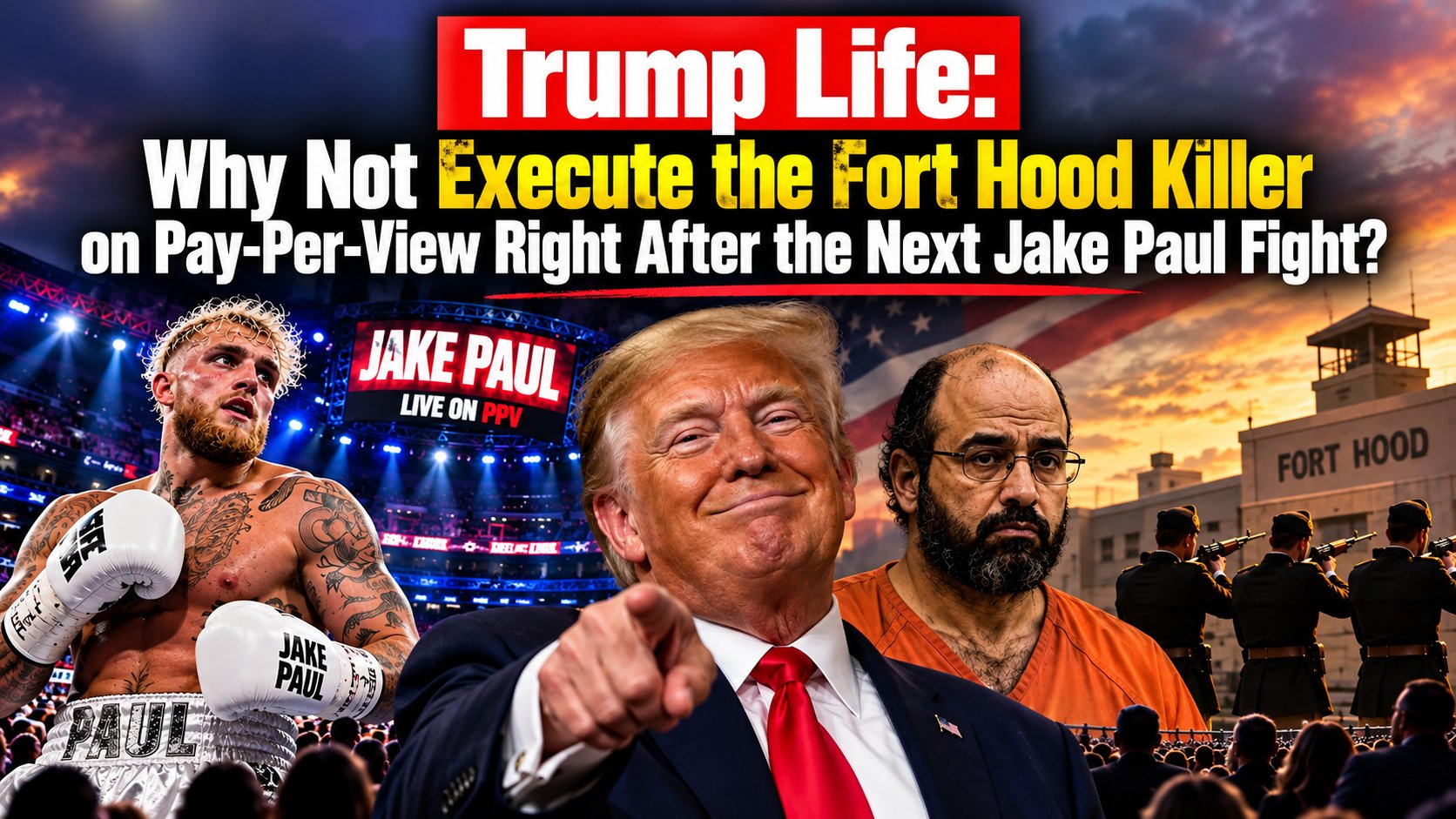
What Could Be More American Than Executing the Fort Hood Killer on Pay Per View After the Next Jake Paul Fight?
The Pentagon wants to livestream the execution of the Fort Hood mass murderer. America already turns celebrity boxing into a global entertainment spectacle. So why not combine the two, throw in a few sponsors, and charge $79.99? The ridiculous proposition exposes a serious question about American justice, capitalism, and the entertainment industry.
America’s Next Great Pay Per View Event?
Somewhere in the increasingly blurred space between American justice and American entertainment lies a business opportunity so outrageous, so morally questionable, and so perfectly suited to the modern media landscape that it almost sounds inevitable: put the execution of the Fort Hood mass murderer on pay per view immediately after the next Jake Paul fight.
Think about the programming possibilities. Twelve rounds of influencer boxing, celebrity appearances, gambling promotions, energy drink advertisements, and enough manufactured controversy to dominate social media for a week. Then, just when audiences think the evening is over, the broadcast transitions to its final attraction: the execution of one of the most notorious mass murderers in modern American military history. One night, two spectacles, and the ultimate collision of punishment and entertainment. What could possibly be more American?
The proposal is satire, not an actual commercial event being planned by Jake Paul, Netflix, or any boxing promoter. But the underlying story is considerably more serious than the joke. The United States has scheduled the execution of Nidal Malik Hasan, the former Army psychiatrist convicted of murdering 13 people at Fort Hood in 2009, and Defense Secretary Pete Hegseth has publicly supported broadcasting the execution. The Pentagon initially announced that it would be livestreamed, although President Donald Trump subsequently indicated that he would make the final decision about televising the punishment.
That development places the country at an extraordinary cultural crossroads. America has spent centuries debating the morality of capital punishment while simultaneously perfecting the business of transforming almost anything into entertainment. Now, with a government execution potentially becoming a live national broadcast, those two distinctly American institutions are moving closer together than at any point in modern history.
The uncomfortable question is no longer whether the technology exists to turn an execution into mass entertainment. It does. The question is whether a country that once abandoned public hangings as an unacceptable spectacle is preparing to resurrect the tradition for the streaming age.
The Fort Hood Massacre and the Man Sentenced to Die
On November 5, 2009, U.S. Army psychiatrist Major Nidal Malik Hasan opened fire at Fort Hood, Texas, killing 13 people and wounding 32 others. The attack unfolded at a military installation where soldiers were preparing for deployment and conducting their ordinary duties, becoming one of the deadliest shootings at an American military base. Hasan survived after being shot by a responding civilian police officer and was subsequently prosecuted through the military justice system. In August 2013, a military jury convicted him of 13 counts of premeditated murder and 32 counts of attempted premeditated murder before sentencing him to death.
The massacre devastated military families and raised profound questions about domestic terrorism, extremist ideology, military intelligence, and warning signs that preceded the attack. For the families of those killed, the case is not a theoretical discussion about entertainment or political philosophy. It is the story of loved ones who went to work on an American military installation and never returned home. Those victims deserve to be remembered as people, not reduced to supporting characters in the biography of their murderer or props in a hypothetical television event.
On October 7, 2026, the U.S. Army announced that Hasan would be executed by firing squad at Fort Hood on December 3 at 1 p.m. Central Standard Time. According to the Army, Trump approved the death sentence on October 2 following the completion of the military appellate process, and the acting secretary of the Army subsequently directed that the execution proceed. The scheduled execution would be the first carried out by the American military since 1961, although additional legal proceedings could still affect the timetable.
The administration’s interest in making the execution publicly viewable has transformed the case into something larger than the fate of a single convicted murderer. It has reopened a fundamental debate about the purpose of punishment, the responsibilities of government, and the increasingly thin boundary between public accountability and public entertainment.
Jake Paul, Celebrity Boxing, and the Business of Selling Outrage
Jake Paul did not invent spectacle driven combat sports. Professional boxing has spent generations selling rivalries, personalities, controversy, and the possibility of violence. Muhammad Ali understood promotion, Don King built an empire around it, and Mike Tyson became a global attraction whose fame frequently extended far beyond his actual fights. What Paul helped demonstrate was how effectively the influencer economy could modernize that formula for an era dominated by streaming platforms, viral clips, and social media algorithms.
His November 2024 fight against Tyson, distributed by Netflix, attracted extraordinary worldwide attention, with the company reporting an estimated average live global audience of approximately 108 million viewers. The event demonstrated that traditional sporting credibility was not necessarily the most important ingredient in a successful combat-sports broadcast. Celebrity, controversy, nostalgia, and the ability to dominate online conversation could be just as commercially powerful. A 27 year old social media personality fighting a 58 year old former heavyweight champion became one of the most widely watched boxing spectacles in history, despite intense criticism of the competitive matchup.
There is nothing inherently wrong with promoting boxing as entertainment. The fighters agree to participate, the audience understands the nature of the contest, and athletic commissions impose rules intended to protect competitors. An execution is fundamentally different. The condemned person does not enter into a voluntary sporting contest, and the government is not supposed to administer punishment for television ratings. That distinction is precisely why the comparison is so revealing.
If American audiences will gather by the millions to watch celebrity conflict packaged as a global media event, what happens when the same promotional machinery is applied to something genuinely consequential? Would broadcasters resist the temptation? Would advertisers refuse to participate? Would audiences turn away in disgust, or would the controversy itself become the most effective marketing campaign imaginable?
The answers remain hypothetical, but the underlying incentives are real. Modern media rewards attention, and few things attract attention more reliably than celebrity, violence, controversy, and moral outrage. The entertainment industry has spent decades refining the mechanisms for monetizing those impulses, while social media has made the process faster, more profitable, and more difficult to escape.
The Pentagon Is Already Moving Toward a Public Execution
The most remarkable part of this story is that the fictional pay per view concept is developing alongside a genuine government debate about broadcasting an execution. On October 8, the Pentagon confirmed to multiple news organizations that Hasan’s execution would be livestreamed after Hegseth said the public should be able to watch the punishment. The announcement immediately generated criticism from religious leaders, military veterans, legal scholars, and relatives of the victims, some of whom warned that broadcasting the execution would turn a solemn act of military justice into a national spectacle.
The situation subsequently became less certain when Trump indicated that he would personally decide whether the livestream should proceed. As of October 14, the execution remains scheduled for December 3, but the final decision about broadcasting it has not been publicly settled. The distinction is important: the government has authorized the execution, while the proposed public broadcast remains a separate and controversial question.
The proposed livestream is not a commercial pay per view event, and there is no announced partnership with a private entertainment company. Nevertheless, the government’s willingness to consider broadcasting the killing of a condemned prisoner raises questions that go well beyond the technical details of military justice. Once an execution becomes publicly accessible video content, the distinction between documenting punishment and transforming punishment into spectacle becomes considerably harder to maintain.
A government broadcast would not necessarily resemble a commercial television production, but the footage would enter a digital environment where shocking material can be clipped, reposted, sensationalized, and distributed without the original context. The government might intend the event as a demonstration of accountability or deterrence, yet it would have limited control over how millions of viewers interpreted or redistributed the images afterward.
America Used to Treat Executions Like Public Entertainment
The concept of gathering enormous crowds to witness a criminal execution is hardly foreign to American history. Throughout the 18th and 19th centuries, public hangings attracted spectators who traveled considerable distances to watch the government carry out death sentences. Some gatherings developed carnival-like atmospheres, complete with vendors, large crowds, and intense public curiosity. Executions were simultaneously acts of state authority, public warnings, community gatherings, and, for some spectators, entertainment.
One of the most infamous examples occurred on August 14, 1936, when Rainey Bethea was publicly hanged in Owensboro, Kentucky. An estimated 20,000 people attended what is widely remembered as the last major public execution in the United States. The event generated national publicity and became a symbol of the disturbing spectacle surrounding capital punishment. Although public executions had already been disappearing for decades, the attention surrounding Bethea’s hanging helped reinforce the growing belief that state-administered death should not be treated as a public attraction.
The United States also has a darker history of public violence, including lynchings that attracted crowds and were sometimes photographed and circulated as souvenirs. Those murders were acts of racial terror rather than legitimate judicial executions, and they should never be confused with lawful punishment. They do, however, illustrate how public violence can become a mechanism of intimidation, social control, and collective entertainment when institutions and communities abandon basic principles of human dignity.
Over time, executions moved behind prison walls as American society reconsidered the relationship between punishment, public exposure, and the responsibilities of the state. But the impulse to witness punishment never entirely disappeared. It migrated into sensational crime reporting, courtroom television, documentaries, true-crime programming, and eventually the algorithm driven world of online media.
Today, the same country that abandoned public hangings as a form of mass spectacle possesses the technology to transmit an execution instantly to millions of people around the world. The town square has become a smartphone screen, the crowd has become an audience, and the executioner could theoretically have a broadcast director.
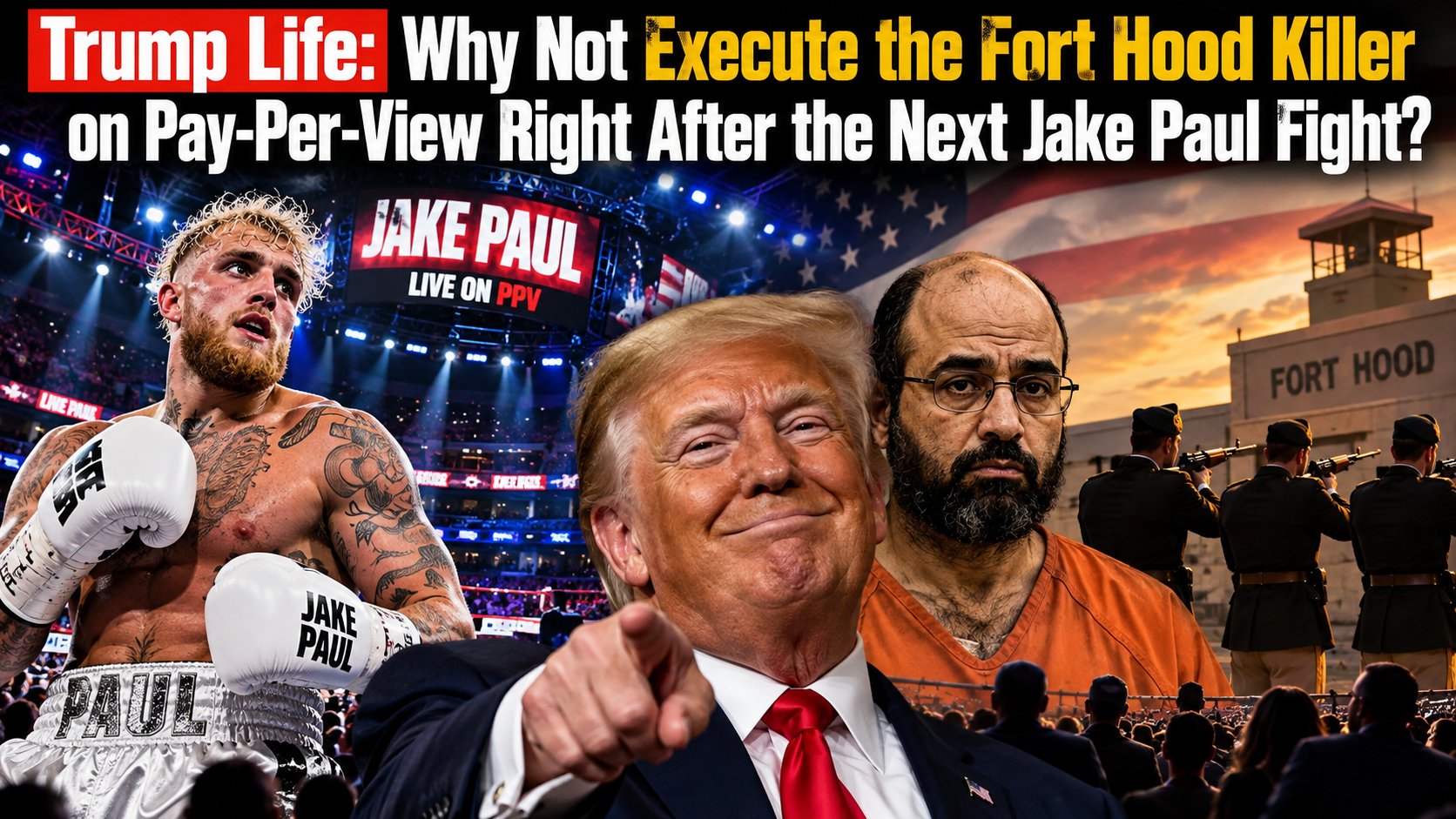
The $79.99 Question: Can Capitalism Monetize Absolutely Anything?
Imagine the hypothetical commercial possibilities: a $79.99 pay per view package, a celebrity boxing undercard, premium streaming access, advertising breaks, and an exclusive post event discussion panel. The financial projections would be irresistible to a certain kind of television executive. At one million hypothetical purchases, a $79.99 event would generate nearly $80 million in gross sales before fees, taxes, production expenses, and revenue-sharing arrangements. At five million purchases, the figure approaches $400 million.
Those numbers are illustrative, not actual forecasts or evidence of consumer demand. No such commercial event has been announced or established as legally permissible. The calculation merely demonstrates the economic logic that drives so much modern entertainment: find something capable of attracting enormous attention, control access to it, and charge the audience for admission.
That logic becomes profoundly troubling when applied to criminal justice. In a commercial broadcast, success is measured through viewership, engagement, revenue, and audience retention. In a justice system, success should be measured through fairness, legality, proportionality, and respect for constitutional protections. The two institutions operate according to fundamentally different principles, and combining them would create incentives that have no legitimate place in the administration of punishment.
If an execution becomes an entertainment product, the commercial incentive is no longer simply to document the lawful administration of a sentence. It becomes maximizing the audience for that sentence. Once audiences become customers, the next question is inevitably how to make the product more compelling, how to attract more viewers, and how to generate greater revenue from the controversy.
That is the fundamental danger exposed by the hypothetical Jake Paul doubleheader. It asks what happens when the most consequential power a government possesses, the power to deliberately take a human life, is subjected to the same commercial pressures that determine television programming, advertising campaigns, and celebrity boxing promotions.
The Victims’ Families Are Not Television Props
There is another serious problem with transforming Hasan’s execution into a national spectacle: the people who suffered most from his crimes have not necessarily asked for one. Keely Cahill Vanacker, whose father Michael Cahill was killed in the Fort Hood attack, has publicly opposed livestreaming Hasan’s execution, warning that it could sensationalize the massacre and inflict additional trauma on survivors and relatives. Her objections underscore a critical distinction between accountability and entertainment.
A death sentence may be regarded by some families as justice, but a public broadcast is a separate decision with consequences extending far beyond the condemned prisoner. For survivors living with post-traumatic stress, children who lost parents, and families who have spent nearly 17 years dealing with the aftermath, the prospect of watching their tragedy become a global media event raises serious questions about whose interests the broadcast would actually serve.
The same concerns have been raised by religious leaders and senior military veterans. Archbishop Timothy Broglio, who oversees Catholic spiritual care in the U.S. military, has urged Catholic service members not to participate in the planned firing squad. Meanwhile, dozens of retired senior military officers have publicly opposed livestreaming the execution, warning that it could undermine military honor, diminish human dignity, and provide extremist organizations with propaganda material.
None of those objections requires sympathy for Hasan or minimizes the severity of his crimes. They require recognizing that a government’s treatment of a condemned prisoner communicates something about the government itself. Justice is not merely about what happens to a convicted murderer; it is also about the principles a society chooses to preserve while imposing punishment.
The Constitution Was Not Written for a Streaming Audience
The Eighth Amendment prohibits cruel and unusual punishments, but whether broadcasting a lawful execution would independently violate that protection remains an unresolved legal question. The Constitution does not expressly prohibit television coverage of executions, and legal experts have identified significant obstacles to challenging the proposed Hasan livestream. Military executions are governed by specific regulations, including Army Regulation 190-55, while the president plays a central role in approving military death sentences.
Commercial broadcasting would introduce questions extending far beyond the traditional procedures for witnessing an execution. Who would control the footage? Could the government authorize private distribution? Would broadcasters have First Amendment arguments for carrying it? Could victims’ families object? Would the condemned prisoner’s constitutional protections extend to the circumstances of public exposure?
These questions cannot be answered simply by pointing to the existence of a death sentence. The government’s legal authority to execute a prisoner does not automatically establish an unrestricted right to commercialize that execution, and the distinction between public access, official transparency, and commercial exploitation would be central to any serious legal analysis.
The controversy also exposes an inconsistency in how Americans often discuss capital punishment. Supporters frequently defend executions as necessary acts of justice, deterrence, or retribution, while opponents question their morality, effectiveness, and compatibility with human dignity. Those disagreements are longstanding and legitimate subjects of democratic debate. But turning the administration of a death sentence into a broadcast event introduces an additional issue that cannot be resolved simply by taking a position for or against capital punishment.
A person can support the death penalty and still oppose televising executions. A person can oppose the death penalty while recognizing the public’s interest in understanding how the government exercises its authority. The relevant question is whether transparency requires broadcasting the moment of death, or whether meaningful accountability can be achieved through independent witnesses, reporting, legal oversight, and public documentation without turning the event into mass entertainment.
The Ultimate American Spectacle
Perhaps the most revealing aspect of this entire idea is how little imagination it takes to construct the hypothetical broadcast. The boxing promotion already exists. The streaming infrastructure already exists. The advertising industry already knows how to sell controversy. The audience already understands pay per view. And the government has now scheduled a military execution while openly debating whether to make it publicly viewable.
The only missing ingredient is someone deciding that these separate institutions should become one entertainment product. That does not mean such an event is likely, legally permissible, or desirable. It means the satire works because the institutions being satirized are real, and because American culture has repeatedly demonstrated its willingness to turn controversy, conflict, and human suffering into consumable content.
America has always contained a strange tension between its ideals and its appetite for spectacle. It celebrates liberty while maintaining capital punishment. It condemns violence while building enormous entertainment industries around simulated and consensual combat. It insists that justice should be solemn while consuming true-crime entertainment on an industrial scale. The hypothetical Jake Paul execution doubleheader simply compresses those contradictions into one absurd television schedule.
First, two celebrities fight for money. Then, the government kills a convicted murderer in the name of justice. Between events, viewers are encouraged to stay tuned. The proposition is grotesque precisely because it makes the distinction between civic responsibility and consumer entertainment disappear. It takes a government action that should be subject to the highest standards of legal scrutiny and imagines packaging it with the promotional machinery normally reserved for sporting events and celebrity entertainment.
And that leaves America with a question considerably more serious than whether anyone would pay $79.99 to watch an execution. If the government begins broadcasting death as a public event, are Americans watching justice being served, or watching justice become another form of entertainment? Because if the United States ever reaches the point where a military execution is promoted with the same machinery as a celebrity boxing match, the most disturbing part might not be the broadcast itself. It might be how quickly the audience learns to treat it as normal. And really, what could be more American than that?








































Want to join the conversation?
Create an account or sign in to share your thoughts, vote,
and reply to other readers.
Showing 0 of 0 comments
Don't have an account?
Already have an account?